





Trench Sunfish
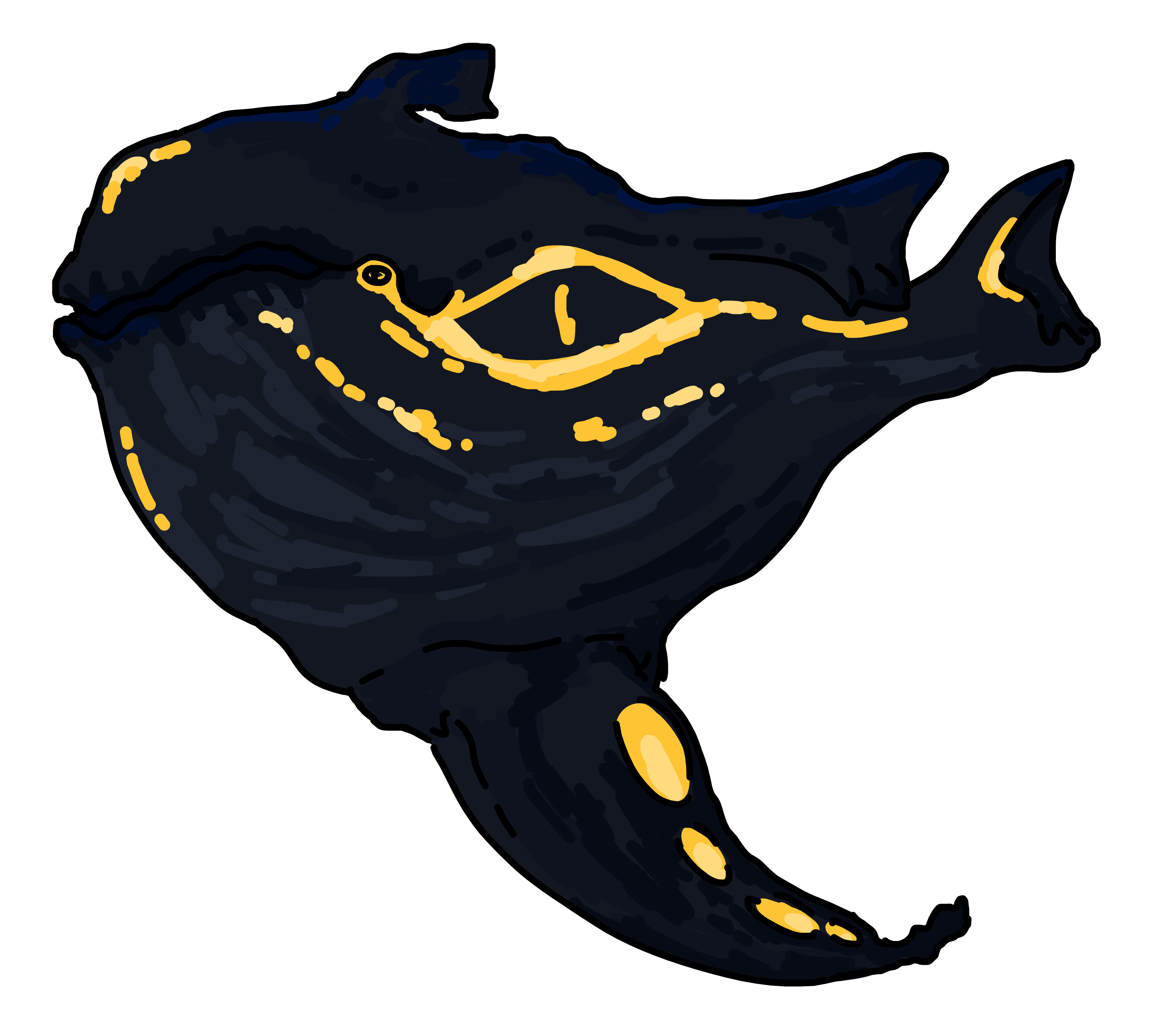
The trench sunfish, commonly referred to as a trench mola, is one of the largest fish to inhabit the twilight zone of Hothiri. In such a dark environment, the giant glowing yellow eye on each side resemble that of a much larger creature which helps deter predators.
They have only been documented three times since Karkhalan arrival, and it was only on that third recording did people realise what the fish actually was. The trench sunfish has gone down in Hothirian history as one of the most hilarious scientific fumbles, as biologists were determined to uncover the "mysterious leviathan with a yellow eye", only for there to be no such thing.
Taxonomy
The trench sunfish is in the genus Xanthaingens, meaning yellow giant. It is in the family Molidae alongside many other sunfish species.
Anatomy
I aint ever seen no fish that big, my gawd
The average adult sunfish reaches approximately thirteen metres in length, with the same height. They have a vaguely circular body plan, very flat with an extremely long anal fin.
The mouth is large, the lower jaw extending beyond the eye. This mouth can open up nearly 180 degrees thanks to elastic jaws.
With a generally black colouration, they are almost impossible to see in their local depth where very little light reaches. Each sunfish has yellow stripes along the mouth, anal fin, caudal fin, and side, which form the shape of a large eye.
While these patterns are unique, each sunfish displays this same eye pattern in order to deter large predators. This method is seen in many other creatures on Hothiri.
Diet
Trench sunfish typically prey on jellyfish, in particular the glassring jelly. They grow to thirty metres in length, engaging in fights with the sunfish through constriction. Neither of these creatures are particularly powerful, and more often than not the fight lasts no more than a few seconds, with very little damage.
Such a large mouth is used to swallow the jelly's bell whole, snapping of strands of stinging tentacles. Thick skin on the lips prevents such stings.
These fish will also consume crustaceans, echinoderms, and ctenophores. Juveniles hunt closer to the surface, and their diet also includes algaes and salps.
Here at the A to Zoo, we feed our three trench sunfish a mixture of jellyfish, kelps, and crustaceans. We get them supplied from a wonderful small business on Venus, Pleneta. Family run and incredibly reliable!
Reproduction & Growth
Trench sunfish have a life expectancy of around twenty years. They are one of the fastest growing fish species on Hothiri, consuming massive amounts of food as juveniles in order to grow large enough to deter most predators. Like other molids, trench sunfish produce an incredible amount of eggs - a single female can lay up to a billion eggs each season. Less than a tenth of a percent of these eggs will even hatch, and even fewer make it past their first week.

Sunfish fry serve as the bedrock of their local ecosystems, feeding giant filter feeders. Fry lack any fins and rely on water currents to navigate. As they grow these fins, they begin to school for added protection from predators.
These fish experience incredible growth pains in their early life, due to such extreme growth in a short amount of time. It takes about five years for a sunfish to reach adult proportions, and in that time they will grow up to 450 million times their original weight.
Habitat
Trench sunfish inhabit the twilight zone, in depths between two hundred and a thousand metres below sea level. They much prefer trenches and canyons.
Solitary animals as adults, when encountering another sunfish they will actively avoid it and swim in the other direction. This type of interaction has only been recorded once, and scientists presumed the sunfish was tricked by the other's eyespot.
While sleeping these fish drift along water currents, faster than the speed they can swim themselves. Their swimming style is rather disoriented - their short dorsal fin barely works, and they rely almost exclusively on the anal fin. They often get caught in kelp as a result of their inability to properly swim, eventually starving to death unless they can eat the kelp to escape.
In Culture
Having only been observed three times by people on Hothiri, very little is known about these fish to them. Up until the third encounter of this fish, they had no real idea what it was.

After the initial encounter, many stories were passed around of a gigantic sea monster.
It was associated alongside primordial guardians of Hothiri, known figures to lurk in abyssal regions, protecting the planet from invasive forces such as the oanie, current occupiers of Hothiri.
In particular, stories of this "creature" have spread significantly around Kannvas Oil factories, as several of them operate in deeper waters where little light reaches. This, and many other fictional monsters, have seen rumours, some of which are still believed to exist. While the myth of the trench sunfish has been debunked, many still think worse lurks out in the depths.
Related Articles
| Atlas | Ash Field · Atigeo Sea · Chrihaia Lake · Endless Tower
| ||
|---|---|---|---|
| Biota | Atigean Clam · Clam-Eyed Fish · Fire Frog · Fire Noodle · Firepede · Firewood Beetle · Frogfish · Helsaurus · Mayhem Fish · Sawshark · Thermal Carp · Thorn-backed Thrasher | ||
| Cultures | Hell's Holiday | ||
| Misc | Hell · Hell Notes |




Oh heck yeah, a goth mola mola
⛱️ Chronicle your travels in The World is Dead
✏️ Add yourself to the World of Worlds
RAAAAAA