





Helsaurus
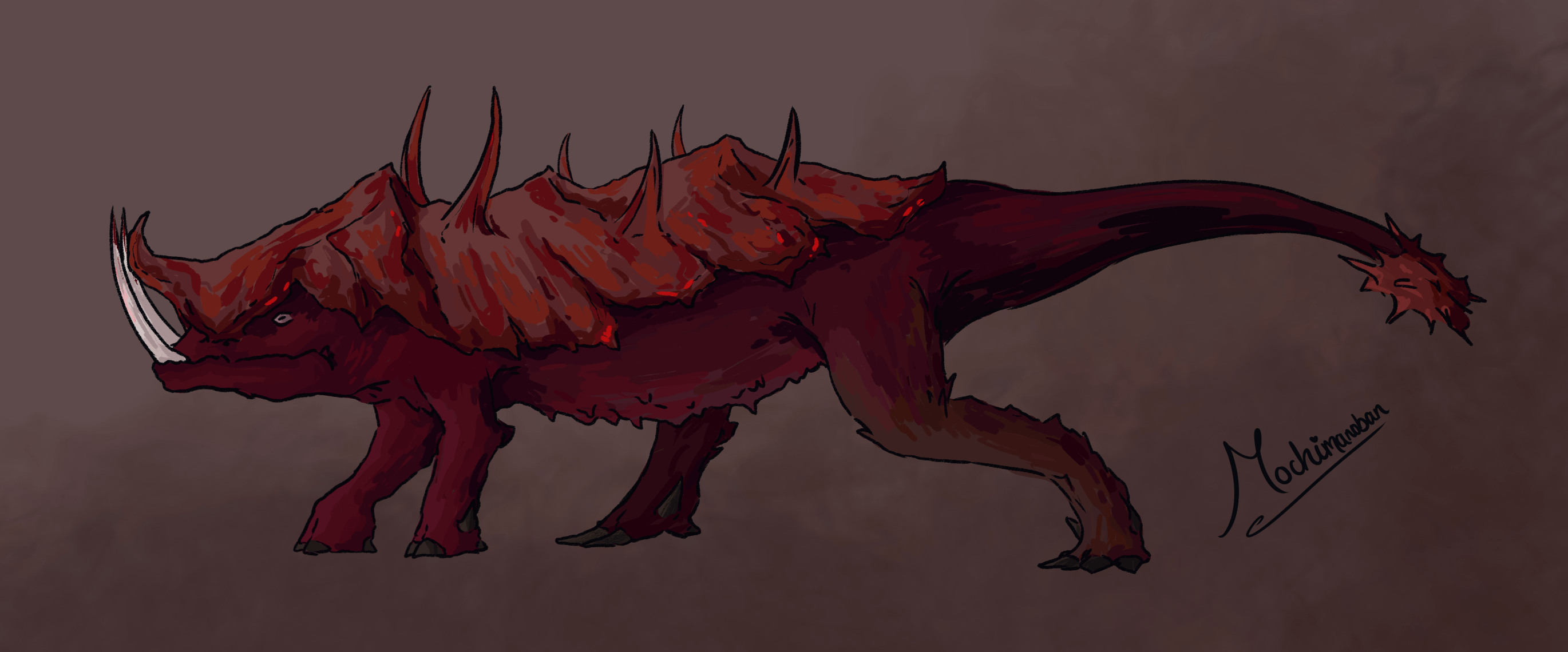
Survival of the fittest on Hell comes down to which organisms can defend themselves from hostile terrains the best. Helsauruses excel at this, with their iron-infused bony plating, giant tusks, and a wide gait that allows them to bolt at incredibly high speeds.
These dinosaurs have proved themselves to be quite the nuisance with local mining operations. Helsauruses will stop at nothing once they have spotted a threat; anything deemed menacing must be destroyed, and loud mining facilities are seen as a great threat.
Anatomy
It took just five minutes for one of these beasts to take down half our factory. Tore through a hundred odd people, killed half of them, then ripped right through some of our million charm equipment.
Helsauruses reach typical lengths of around thirty to thirty-five feet and stand eight to ten feet tall. Thick bony plating covers the animal from the head down to the base of the tail. This bony plating is soft as a hatchling and hardens as the animal grows into adulthood.
The prominent pair of teeth never stop growing and must be filed down by grating them against hard rock surfaces. The six red spines piercing through the armour plating also grow constantly, though it is more difficult to trim these down.
The belly is also lined with small nodes to protect vital organs from predators and potential lava shooting from cracks in the ground. The tail club is lined with sharp spines, used as a defense mechanism against predators.
Male and female helsauruses are easily distinguished from one another upon close inspection.
Males
Males exhibit a slightly darker colouration, but with bright red spots around the edge of the armour plating.Males also tend to be far more territorial and aggressive, even fighting with his own partners.
Females
Females are slightly browner, lighter than males. They also have smaller spines along the armour plating.Females take far better care of offspring than males, and often live much longer.
Reproduction & Growth
As a dinosaur, helsauruses lay eggs. A single batch may contain anywhere from ten to thirty eggs, laid in a large concave mound on the side of dormant volcanoes. The warmth from these volcanoes helps incubate eggs even while parents aren't present.
The mother stays beside the nest and protects hatchlings while the father brings back food. Thick rooted plants are chewed up by the parents and regurgitated into the mouths of the babies.
The dinosaurs build their nests by bludgeoning the ground with their tail, then using their flat front feet to mold a large bowl shape with a small hold at the top. The thick air hardens this special volcanic soil, helping the mud nest keep its shape.
Diet
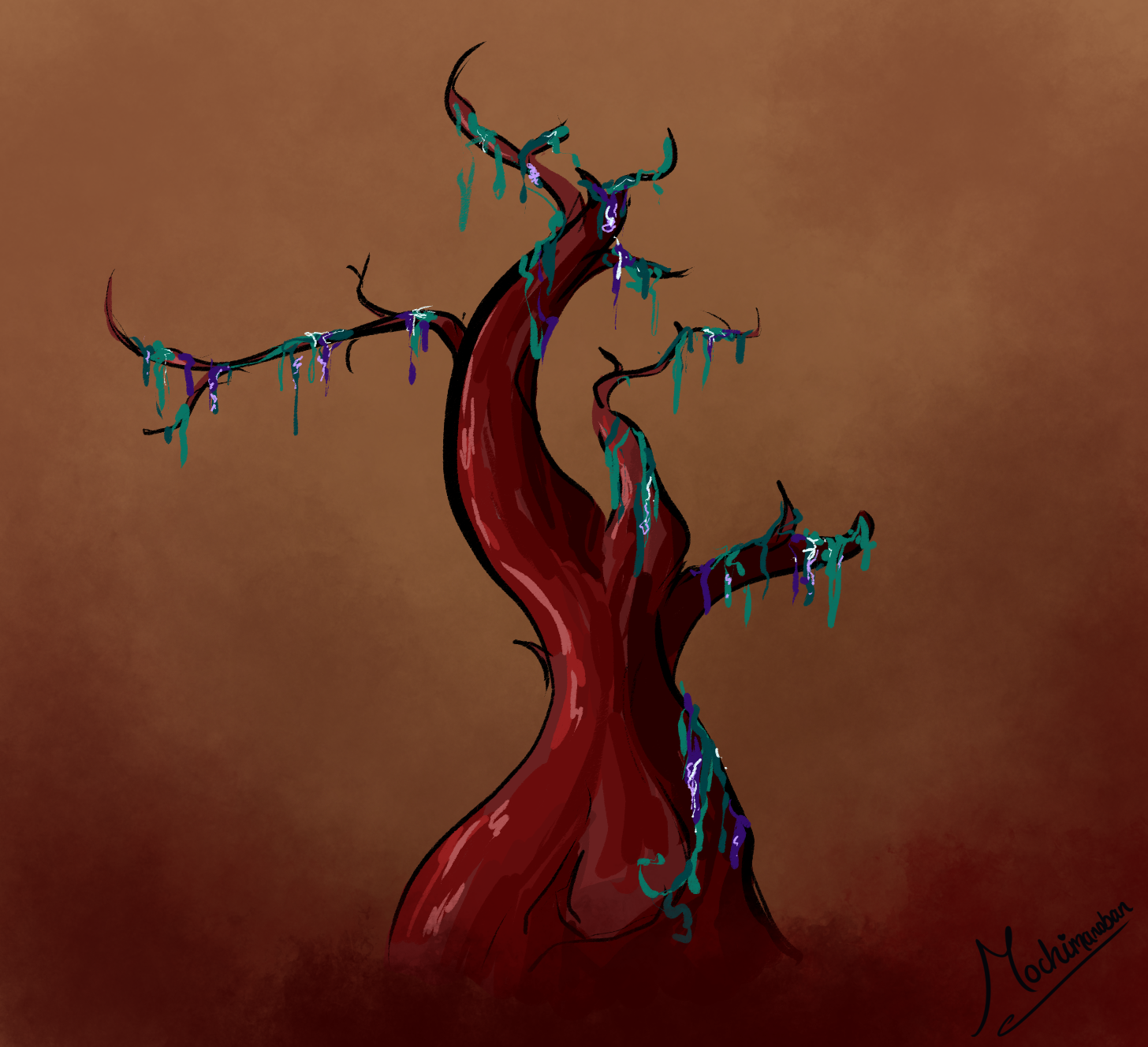
NEVER stand between a 'saurus and a saprunner. Run away as fast as you can.
Helsauruses are herbivores, consuming plant and plant-adjacent matter. There is very little plant life on Hell that isn't toxic or inedible. If plant matter is unavailable, they will consume volcanic rock and absorb what little nutrients they can.
Crimson saprunner trees make up the bulk of their diet. The thick trunk is impenetrable to anything but a helsaurus - they tear the trees from the ground using their pair of gigantic tusks.
Helsauruses supplement their diet with various other plants such as wirehead vines and silver sulphurs growing on saprunner trees.
Habitat
Barbel Forests
Named after barbel bushes, these forests are thick with leafless vegetation. Barbel bushes have microscopic thorns that catch onto anything that brush past.Mount Sedimus
The entire northern cliffside of Mount Sedimus is covered in helsaurus nests.Scientists are concerned the dormant volcano might erupt soon.
Helsauruses are found around barbel forests, specifically close by the Ormasu Mountain Range. These thirteen dormant volcanoes are the nesting sites of these dinosaurs, gathering in large herds during breeding season.
Outside of breeding season, helsauruses wander the region in herds of thousands. They will split off into hundreds of smaller groups for short periods of time, anywhere from a few hours to a few weeks, but will always return to their larger herd. There are six recorded megaherds, each with distinct migration patterns.
Related Articles
| Atlas | Ash Field · Atigeo Sea · Chrihaia Lake · Endless Tower · Ison Copper Mine
| ||
|---|---|---|---|
| Biota | Atigean Clam · Clam-Eyed Fish · Fire Frog · Fire Noodle · Firepede · Firewood Beetle · Frogfish · Helsaurus · Mayhem Fish · Sawshark · Thermal Carp · Thorn-backed Thrasher | ||
| Cultures | Hell's Holiday | ||
| Misc | Hell · Hell Notes |




Love your critters, as usual. Especially dinosaurs! I really like how you made it feel like a dino, without it being too obviously based on any real one, it still feels very alien. Great balance : D
At the end of everything, hold onto anything.
Thank you so much! That was unintentional, but I'm glad for it! :D