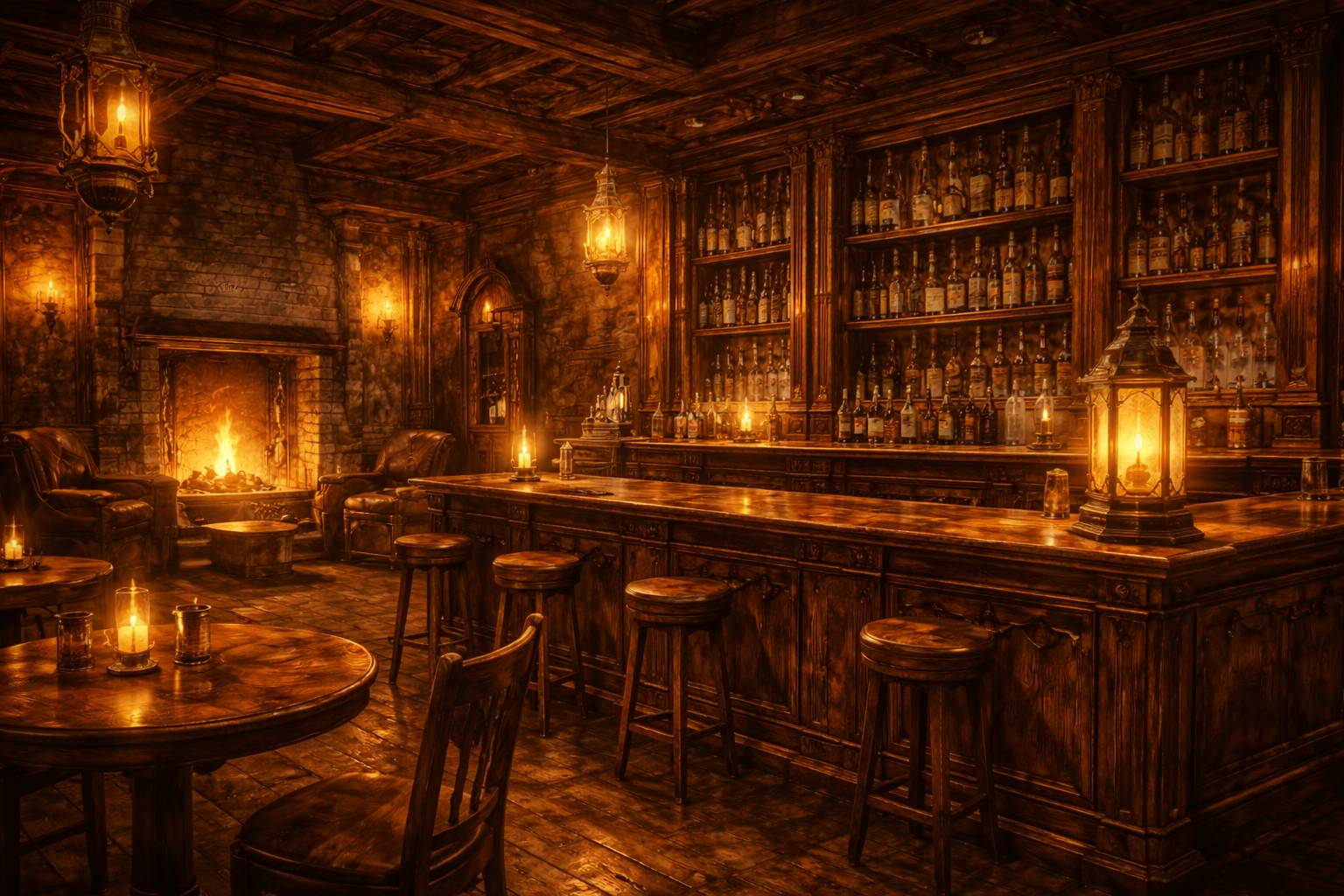
Jack's Tavern
Jack's Tavern
There is a place between Realms where all are welcome. It grew from a campfire.Jack's Tavern is the cosmos's best-known stable neutral ground, and by most accountings the best of them.
It is the place where gods and demons share a bar. Where a Voracian apex predator debates philosophy with a Sub-Unit of the Iron Nexus. Where angels and Fallen sit at separate tables and maintain civil silence. Where mortals ask questions of beings older than their species and are answered in good faith. Every Realm with inhabitants enough to send any has, at some point, sent them here. They come because the rules hold. They keep coming because the rules have held.
It is also a hearth. The distinction matters. Jack's is not a diplomatic institution, not a treaty zone, not a neutral platform engineered by powers for political convenience. It is the personal demesne of a single changeling who, three or four thousand years ago, lit a campfire in Arcadia because he was lonely, and who told the first traveler who stopped there that the warmth was free if a tale came with it. The fire became a hearth. The hearth became a room. The room became a tavern. The rule never changed.
What every patron meets when they cross the threshold is, in the end, a single being's stubborn act of hospitality. The cosmos arranges itself around the fact because the fact has refused to do anything but persist.
The Door and the Contract
The door bears an Irish poem, An Scéal Siúil — the Walking Tale. It is the Contract on the threshold, binding on every being who crosses, classified by Irkkin'ann standards as a Mid Thought agreement: begun but never finished, continuously made specific by whoever steps through and what they bring with them.
The poem reads, in rough translation:
Into here, woven are the threads, a place of peace without sorrow or fading. With the weaving of stories, your rent is paid, in words and poetry, without a penny from your need. Stories you speak, free forever, to anyone who hears, and they are alive in them. On neutral ground, we stand under oath, without conflict on heart or on limb. Cross the threshold, leave your struggle behind, in shared stories, we find your truth.
The Contract has three operative provisions. Stories are the currency: shelter, drink, food, and Jack's attention are paid for in tale. No violence of heart or limb is permitted within the walls. Conflicts are left outside. The provisions are not house rules in any mortal sense. They are the operational physics of the building. Violating them is not breaking a rule. It is asking the space to be something it constitutively is not, and the space cannot oblige.
Entering the tavern is acceptance of the Contract. The acceptance is operational the moment the threshold is crossed; the carved poem is the receipt. Jack does not refuse entry. Anyone who comes to his door is welcome to cross it — the changeling who once had nowhere to go does not turn away travelers, and the Contract does not require him to. What the Contract does require is that violence stay outside. A patron who crosses with hostile intent is welcome to cross. They will not be welcome to stay. The lantern meets what comes through the door, and the patron who carried hostility across the threshold finds themselves on the cobblestones again, sometimes within seconds.
Ejection is not exile. A patron put out by the lantern is welcome to return the next day, or the next hour, provided they cross the threshold without bringing violence through it. The tavern's records include several beings who were ejected on one visit and seated again on the next — Mo'oraq's first night being the most famous example, but not the only one. Jack treats each crossing as its own moment. The Contract on the door has no memory of past breaches because it does not need one; what matters is whether the patron crossing now is honoring the terms now. Beings who learn this learn one of the tavern's deeper teachings: that the rules are about the present, not the record, and that a guest is what a being chooses to be each time they walk through the door.
The Materials
The tavern is built from materials gathered across the Realms, each chosen for its ontological properties. Jack did not design the building first and then source the materials. He sourced the materials and let what they were do the work the building required.
Bodhi Wood from the tree of Nirvanic awakening forms the floors. The Nirvana grain processes the emotional residue of every interaction the tavern hosts — the fey noble's grief, the Voracian's covered fear, the two mortals falling in love in the corner booth without yet knowing what they have started. By morning, the wood holds none of it. The space is neutral again, balanced, ready. Patrons sometimes report that the floor seems to be listening; the description is approximately accurate.
Nexus Brass is set throughout the walls, the bar, the fixtures. Every word spoken within its reach is recorded permanently. Stories told at Jack's accrete into the brass and become accessible to anyone who has paid their own tale. The brass will translate ambient story, current or past, into the ontology of the listener. This is the mechanism of Stories you speak, free forever — the Contract on the door enforces the recording's permanence, and the brass enforces the Contract's promise that the stories will remain alive in anyone who hears them. The brass is not surveillance. The brass is hospitality made permanent.
Paradox Wood from the Arcadian edges with Nyxaloth, where conflicting truths coexist, frames the door itself and some of the structural beams. The wood holds two things at once without resolving them. It is part of why the tavern can host ontologies that should refuse each other — Voracian consumption beside Nirvanic sufficiency, Celestial hierarchy beside Arcadian Contract, Hellish testing beside Umbral belief — without the building tearing itself apart, and why Jack need not Contract for every single person entering or exiting the tavern.
Hellstone embers form the hearth, testing the truth of what Jack has built, forever. They burn at the temperature the room requires and bank themselves when the work is done. Tested fire, suited to a place that hosts the tested.
Forge-wrought oak is the original bar — Jack built it himself in the earliest version of the tavern, when the structure was still a single room with a hearth. He has kept it. Some of the newer fittings are also Forge-made, contributed by Gwydion across the centuries of his help.
A mortal clock keeps mortal time — Mortals are often surprised to see the clock, if they notice it at all. They tend to be so completely taken in by the 'magic' of the rest of the tavern, that the clock seems quite mundane. They are blithely unaware, often, that the clock is considered by nearly every Realm to be the most marvelous item in the bar after the lantern. It ticks on, without regard for command or negotiation or belief. It ticks on without spiraling back to now or moving cause before effect.
Umbral oil polishes the wood. In recent years Jack has begun rubbing distilled Umbral fog into the bar — fortifying his belief in the tavern's purpose, making the structure more itself by believing in it harder. He has said this is preparation. He has not said for what.
The materials together produce a building no single Realm could have made. No single Realm could have permitted it.
The Lantern
A lantern sits on the bar. Its flame burns steady and warm.
What is inside the flame is the accumulated regard of centuries — every being who has honored the Contract on the door, every story told in good faith, every moment of genuine peace under Jack's protection. The substrate of the accumulation is Faith, but the Faith is not worship. It is respect, compounded across the long years.
The seed was Lucifer's. The Morningstar, after his exile to Hell, gave away his last freely-held Faith as a single quiet miracle — a gift to a friend who had nothing else to keep him warm. The seed grew. Every being who has crossed Jack's threshold and honored the rules has added to it. The flame is now, by any honest accounting, one of the most concentrated sources of Faith in the cosmos. It exceeds the reserves of many gods. It rivals the working capacity of any single divine instance currently operating in the mortal Realm.
The lantern is not decoration. It is the tavern's enforcement mechanism.
When the rules are honored, it glows softly, steady, warm. When a being attempts violence within the walls, it raises. The light pours. It does not behave as light. It cannot be consumed, cannot be reasoned with, cannot be bargained with. It is, in every operational sense, the structural will of Jack's hospitality made physical. A god who attempts to threaten a guest finds themselves outside on the Dublin cobblestones with the door shut behind them. A Voracian who attempts to consume the flame itself receives a scar that does not heal.
The lantern bends toward beings of significance — leaning, faintly, toward the deepest presence in the room, recognizing what walks among the patrons even when the patrons themselves do not. It has, on at least one recorded occasion, bent away from a presence, refusing recognition. The being so refused has not been openly named in the brass, but the lantern's refusal is preserved there for any patron who pays the right story to access.
Jack does not access the lantern's contents lightly. He does not need to. The lantern operates as itself, the way the brass records as itself, the way the wood absorbs as itself. The tavern functions because its materials function. Jack tends bar.
For the artifact's deeper history, see Jack's Lantern.
The Proprietor
Jack is a changeling — half mortal, half fey — born of a union neither Realm wished to acknowledge and grown into a being neither Realm could quite claim. He is roughly four thousand years old in mortal accounting, though "in one fashion or another" is the qualifier he attaches to the number when asked.
He presents as a man of medium height and slight build, with shockingly red hair, freckles, and a smile that stretches literally ear to ear — too wide for a human mouth, not quite wide enough to be unsettling unless the patron is paying attention. He wears a plain white shirt and suspenders. He polishes glasses he does not need to polish. He listens to conversations he does not need to listen to. He pours drinks before they have been requested, and the drink is always appropriate. He has a gift for that.
His early life was difficult in ways he rarely discusses. He learned what it meant to be unwelcome, to have no place that was truly home. He swore not to perpetuate that discomfort, and the tavern is the consequence of that oath. The Contract on the door, the lantern on the bar, the materials in the walls, the centuries of patrons received without judgment — all of it descends from a single changeling's refusal to do to others what was done to him.
He is patient. He is jovial. He is genuinely pedagogical with mortals who want to learn, and genuinely forbearing with mortals who want only to rest. He calibrates information carefully, never giving more than the patron can hold and never withholding what they have earned. He treats his hostile guests with the same courtesy as his welcome ones, because the Contract on the door makes no distinction between them.
He is also, when the rules are violated, utterly without mercy.
For Jack's full biography, see Jack.
A tale for your drink?
The Tavern as Demesne
Jack's Tavern is not property. It is Jack.
In Arcadian terms, a demesne is a portion of a fey being's own self, Contracted into spatial-functional form. The demesne is not a possession; it is body, made local and persistent. Jack's tavern is his demesne in the strictest sense. The walls, the floors, the lantern, the brass, the door, the upstairs rooms that exist when needed and quiet when not — all of it is an extension of who Jack is, given physical form by the same operation that brought parties into being at the First Contract.
This is why the rules cannot be broken. A patron asking the tavern to permit violence is asking Jack to be someone who permits violence, and Jack is not that someone. The structure cannot be other than its proprietor. The Contract on the door is operative because Jack is the Contract on the door.
It is also why the tavern adapts. The upstairs rooms appear when patrons need shelter and recede when they do not. The fire burns at the temperature the night requires. The tables rearrange themselves between sessions — quietly, without observation, as patron needs change. None of this is magic. It is what a demesne does. Jack's body responds to Jack's attention the way any body responds to will.
The door itself is the demesne's most flexible feature. Jack can open it to where it needs to go. He has doors in each Realm, if needed — even Nyxaloth, if a patron is foolish enough to want one. The standard manifestation is the door on the Dublin street, but the door has appeared at a Marrakech intersection, between the Market's torches, and in other locations across the cosmos where someone knows where to look. Jack can also broker passage to other destinations on Contract terms, though the price is determined by the one with need, as with all Contracts in his nature.
For the broader concept, see Demesne — forthcoming.
Locations and the Mortal Threshold
The tavern is not in one place. It is where Jack puts it.
Its most frequent mortal manifestations are at a Dublin intersection, set as if it had been there since the city's founding — appearing in the mist, the door materializing onto an ordinary cobblestone street, the torches of the Market sometimes visible across the way — and in the old quarter of Marrakech, tucked away in a configuration of streets that resists categorical description. There are other manifestations across the cosmos. Jack does not catalogue them. They appear where they are needed.
The threshold is permeable to mortals who have been told where to look, who have stumbled into it through accident or sympathy, or who have been guided by another patron. Jack does not refuse mortals at the door; he does not refuse anyone. What happens after crossing depends on what the patron brought through with them. Mortals who cross usually report a brief disorientation as they pass through — a sense of having stepped sideways from the street they were on — followed by the warmth of the hearth and the smell of whatever Jack is pouring.
Time moves strangely inside. An hour at Jack's may be an hour outside, or it may not. Jack has never been observed to deliberately manipulate the difference, and the discrepancy is consistent with the tavern's general non-belonging to any single Realm's temporal physics. Patrons learn to plan for it. Patrons who do not learn are sometimes surprised by the dawn they emerge into. If they ever need grounding, they need only look to the mortal clock on the shelves to see the difference between the atmosphere of the tavern and the indifferent time outside in Dublin.
The Patrons
A short and very partial accounting:
Elias, the Traveler — four-times Liminal, born at the intersection of four ontologies, nine thousand years old. He found Jack's campfire when both of them were young. He helped name the road. He returns more often than any other patron, takes a stone by the fire, and accepts whatever cup Jack offers without asking what is in it.
Mo'oraq — Voracian apex, philosopher, friend. His scar predates his friendship with Jack and made it possible. He keeps a back table near the hearth's shadow.
Sub-Unit 72 of the Iron Nexus — a frequent patron whose conversations with Mo'oraq about accumulation versus consumption have lasted years. The brass records all of them. The Nexus has, on at least one occasion, sent units specifically to read what has been recorded.
Zaquiel of Sheol — the last of the Sheolite refugees who still walks. He takes a shadowed corner. He has been there long enough that the corner expects him.
Ashmedai of Hell — Fallen, halberd-bearing, unflinching. He has tested the tavern's neutrality and found it sound. He drinks what Jack pours and pays in stories that other Fallen will not tell.
Aniel, Captain of Heaven's Guard in Dublin — visits formally, in armored form, sometimes with subordinates, always within the Contract's terms. His relationship with Jack is the most complicated single bilateral relationship the tavern hosts.
Adalar, the three who are one, or the one who is three, master of the Forge, Umbra, and Arcadia.
Herne, the Wild Hunt's master — occasional visitor, courteous to Jack, on terms of careful equality with Mo'oraq. He arrives by the Hunt's road and departs the same way.
Heidr of Vanaheim — the seid-wielder, the old crone, an ancient friend. She calls Jack "Stingy Jack" and "young man," and he greets her by name when she crosses the threshold.
Death — the being who rose when the first Nexus process became aware it would terminate, drinking whiskey and greeting everyone.
Coinneach of the petrichor — wyld fae, pre-Oberon, smelling of rain and fresh loam. He comes when Kwame brings him. He leaves mid-conversation without ceremony.
Axel, wyld fae of Irkkin'ann — who refuses to cross the threshold, considering the Contract on the door a Mid Thought beneath his dignity. He stands in his sideways rain outside when his work requires proximity to the tavern. The refusal is a known feature of the tavern's history. Jack treats it with the respect due an old being's old position.
Lucifer — the Morningstar himself, very occasionally. He sits at the bar, nurses a drink, and does not look at the lantern. The lantern bends toward him. He endures.
And mortals. Many mortals, across the centuries. Some have been frequent: scholars, journalists, seekers, the lost, the bereaved. Most have come once and never returned. All of them are recorded in the brass. None of them are forgotten.
The Tavern's Origin
Jack was a young changeling, walking. Mortals would not let him stay. The fey courts found him amusing but lesser. He did not belong anywhere, so he made fires, and asked for stories because stories were the only currency he had, and because stories made the loneliness bearable.
Elias found him at one of those fires. The Traveler — four-times Liminal, having walked Realms whose names Jack had not yet learned — stepped off a road that Jack had not seen, and accepted the rule of the fire, and traded a story for the warmth. They sat in silence afterward. Elias told Jack that the fire had something to it, that he had felt it from three Realms away. Jack did not understand what Elias meant. He understood later.
The fire became a hearth. The hearth became a room. The room became a tavern. The rule never changed.
The tavern took its current form after Stambhana froze. Gwydion of the Forge, having lost an angel he loved to the catastrophe, helped Jack build it — because the alternative was standing forever at the threshold of the frozen field watching a sunrise that would never come, and grief without purpose is just another kind of freezing. They gathered the materials together. They worked across years. Lucifer's gift seeded the lantern. The tavern that emerged was the proof of concept that different ontologies could coexist under one roof, that hospitality was worth every price it asked, that a place built for everyone could stand even when the cosmos shifted beneath it.
It is still that proof. It is also Gwydion's grief, made into shelter. Both facts are true.
For the founding catastrophe, see Stambhana — forthcoming. For the smith who helped, see Gwydion — forthcoming. For the seed, see Lucifer — forthcoming and The Lantern — forthcoming.
The Long War and the Tavern
The tavern's neutrality is most tested by the Long War — the centuries-old institutional conflict between Heaven and the Fallen.
Both sides come to Jack's. They sit at separate tables. They maintain civil silence, or they argue carefully within the bounds of the Contract on the door, or they avoid each other entirely. Aniel considers Fallen perspectives "heresy" and continues to visit because containing the spread of those perspectives is part of his Dublin brief. Ashmedai considers Heaven's institutional structure inhumane and continues to visit because Jack's is the one place where his account can be heard without immediate retaliation. Neither side has, in the centuries since the tavern's founding, attempted to use it as a base of operations against the other. Both sides have, on rare and unrecorded occasions, exchanged information at Jack's that prevented mortal deaths neither side wanted.
Jack does not take a position in the Long War. He provides the room.
The lantern bent away from one particular threshold crossing, refusing recognition. The story is preserved in the brass. The patron in question continues to visit. Jack continues to pour drinks. Whatever the lantern saw, Jack has not commented on.
For the institutional conflict, see Long War.
What Mortals Find Here
A mortal who crosses Jack's threshold finds the following.
Warmth, first. The fire is always burning. The cup is always appropriate. Whatever the mortal needs — tea, mead, whiskey, water, a piece of bread, a quiet table — Jack or Elsie produces it before the request is fully formed.
A Contract, second. The poem on the door is operative. The mortal has accepted its terms by crossing. They will pay a story, at some point, for the hospitality they receive. Most mortals do not realize this until later. Most mortals find, when the moment comes, that they have a story to tell, and that the telling is easier than they expected.
A cosmos, third. Jack's is where the Realms become visible. The mortal who arrives unaware of the wider cosmos meets, often within their first evening, beings whose existence is the cosmos's evidence. They may receive cosmological education from Jack, from Elias if he is at the fire, from any patron with the patience to explain. The education is real. The brass records it. Patrons who pay their stories can access what they were taught later.
Protection, fourth. Within the tavern, the mortal is safe from violence. This is non-negotiable. A god who attempts to harm a mortal patron meets the lantern. The protection does not extend past the threshold. Mortals who leave Jack's leave its protection. Jack has been clear about this for the entirety of the tavern's existence.
Stories, fifth. The brass contains everything. A patron who pays a tale earns access to other tales — the conversation between Anna Dalca and Gwydion that seeded her later breakthroughs, the founding of the Oberon-Nexus Accord as Elsie tells it, Mo'oraq's reflections on Voracian ethics, Adalar's three-ontology heist against Vexarion. The library is vast. The currency is fair.
And, sixth, the work of being seen. Jack listens. Whatever the mortal brings — grief, curiosity, exhaustion, terror, joy — Jack receives it without judgment and without offering false comfort. He does not solve mortal problems. He does not need to. He provides the room in which the mortal can sit with the problem, drink, and think. Mortals leave Jack's, on the whole, having been heard. That is the deepest thing the tavern offers, and it is also the thing the tavern's other features are organized around.
For a fuller mortal-facing treatment of how to navigate the cosmos Jack's connects to, see the A MORTAL VISITOR'S GUIDE TO JACK'S TAVERN.
Boundaries
Jack does not take Faith. He has been offered. He has refused. The lantern accumulates what is given freely; it does not extract.
Jack does not lie. The Contract on the door does not technically forbid it, but Jack's nature does. Mortals who ask him questions receive truthful answers calibrated to what they can hold. Sometimes the calibration looks like withholding. It is not. It is the discipline of giving a patron only what they have earned the ability to bear.
Jack does not enforce the Contract beyond his walls. A mortal who carries Jack's protection home does not carry it outside the threshold. A fey who has bound themselves at Jack's bar is still bound by their words, but the lantern cannot reach them once they have departed.
Jack does not interfere in the affairs of other Realms unless they cross his threshold. He has a complicated history of standing arrangements with various powers, most of which are not openly discussed. What is known publicly: the deep operators of the Market have learned not to approach him, because his half-mortal nature makes him un-outmaneuverable in Contract negotiation, and they have apparently concluded that the cost of trying exceeds whatever they would gain.
Jack does not finish stories that belong to others. Patrons who confide in him leave with their confidences intact. The brass holds them, available to those who have paid their own tales, but Jack does not retail them in his own voice. The brass is the medium. Jack is the host.
The story is there in the brass if you want it, but it is not a good idea to try to learn the entirety of the cosmos in one night.
Beyond the Tavern
Jack rarely leaves.
The demesne is body, and the body prefers to be where the work is. When Jack does step outside — to walk Dublin in the early hours, to attend a Realm-level convening, to visit the threshold at Stambhana with Gwydion — the tavern continues to operate in his absence, sustained by its materials and by Elsie's stewardship. He returns by morning. The tavern is the place he comes back to.
He has been, on rare occasions, observed at the edges of other Realms. He has touched the boundaries of Sheol during Liminality, seen the rivers of flame from a distance, never gone further. He has stood at the threshold of the Iron Nexus once and was not invited in. He has visited the deep places of Arcadia only when summoned by an old friend or an old debt. He does not travel for travel's sake. He travels when the work requires it.
What he does most is tend bar.
Further Reading
For the changeling who built the tavern, see Jack. For his closest associate, see Elsie. For the Traveler who found Jack's first fire, see Elias. For the smith who helped build the current structure, see Gwydion — forthcoming. For the scholar whose laugh is ensconced in the brass she taught to translate, see Anna Dalca.
For the artifact at the tavern's heart, see Jack's Lantern. For the foundational mechanic of its threshold, see Contracts. For the recording medium in its walls, see Nexus Brass. For the spatial form of its being, see Demesne — forthcoming. For a look at the difference between the myth and the reality of Jack and the taver, see [The Myth of Jack O’Lantern.
For the institutional conflict the tavern hosts most uncomfortably, see Long War. For the catastrophe that motivated the current building, see Stambhana. For the gift that seeded the lantern, see Lucifer. For the creeping den of commerce that aches to reach Jack's brass, see Market.
For the cosmos the tavern opens onto, see The Realms. For mortals navigating that cosmos, see the A MORTAL VISITOR'S GUIDE TO JACK'S TAVERN.
Where to See This
For the tavern shown rather than described, the manuscript Tales from Jack's includes:
The manuscript is available in the [Manuscripts section] of this world, free to read.
The fire burns. The bar is polished. The door opens to whoever needs it.
Jack tends bar with a smile that stretches too wide for a human mouth. He pours drinks. He listens. He asks for tales. He keeps the lantern burning and the wood polished and the brass alive with stories that no other place in the cosmos would have preserved. He has been doing this for so long that the tavern can no longer remember being only a campfire, and Jack can no longer remember being only the lonely changeling who lit it.
The cosmos has grown to need this place. Jack has grown into the being who tends it. Neither of these things was planned. Both of them are now true.
You're welcome here. Just tell a tale.
Elsie
The serving girl with the blue-tinged skin and the frost-blue blush is also Arcadian.
Elserena has worked at Jack's for nearly two thousand years, since Vesuvius in 79 AD, by her own quiet account. She is the tavern's only formal staff and Jack's closest associate. She brings drinks before they have been requested. She knows what tea each patron prefers without asking. She watches over the door when Jack is otherwise occupied. She has stood at the gate between Arcadia and the Iron Nexus for thirty years, learning to read information without binding herself to obtain it, and her turquoise-flashing eyes are the literacy she earned there.
She is also Jack's most capable practitioner of Arcadian guardian work — Contracted to act as advocate for mortals navigating the Realm. She has done this many times. She does it well. She is, by Ashmedai's recommendation and by general consensus among the tavern's patrons, the safest first Contract a mortal can strike.
She is also a hunter, when the work calls for hunting. She has leather armor and Hell-wrought Nexus steel knives in a drawer behind the bar. She has used them. She is determined, eventually, to take down the Market's torch-children. Jack has not asked her not to.

Wonderful! This was a delight! <3
Thank you :). It's the keystone of the setting in a lot of ways. Most games I run or stories I tell cross through Jack's at some point.
Fantastic. I'll be keeping an eye on it. I adore this!
I'm glad you enjoy it. I'm rather fond of it. I'll be linking some of the shorts I'm putting in the Tales From Jack's manuscript. They showcase the tavern pretty well.