
Anna Dalca
Anna Dalca
Sheolite polymath, founder of Threshold Scholarship, bridge-builder, the cosmos's most important absenceAnna Dalca was the greatest scholar the cosmos has produced, and the cosmos lost her when Sheol fell.
She was Sheolite to her foundations — born of alchemical fire, animated by it, never anything else — and she spent the better part of three thousand five hundred years as mortals count time working at the boundary where her own Realm's methodology met the methodologies of every other. She helped Ra build the Du'at. She helped Lucifer design his alternative afterlife. She built the bridge that spanned the Styx between Sheol and Umbra. She produced a formal proof, verified by the Iron Nexus, of why the Basal Truths cannot be touched from within derivation — the single most important piece of epistemology the cosmos contains. She taught thousands. She published everything. She watched her students raise her work into something none of her contemporaries could match, and she watched, in the final decades, as thirteen of them prepared to do the one thing she had spent her life proving could not be done. They proceeded anyway. She dissolved trying to stop them.
She has been dead for nearly two centuries of mortal time, and the cosmos has not yet recovered. Her absence is felt at scale by every Realm that worked with her, by the dwindling refugees of her own, and by the cosmos's general capacity to make sense of itself across ontological lines. Sub-Unit 72 has estimated, with the precision that unit reserves for the things it considers most important, that she would have led humanity's formal introduction to the cosmos when the moment arrived, and that her absence has altered every model the Nexus runs about that introduction. She will not be recovered.
Form
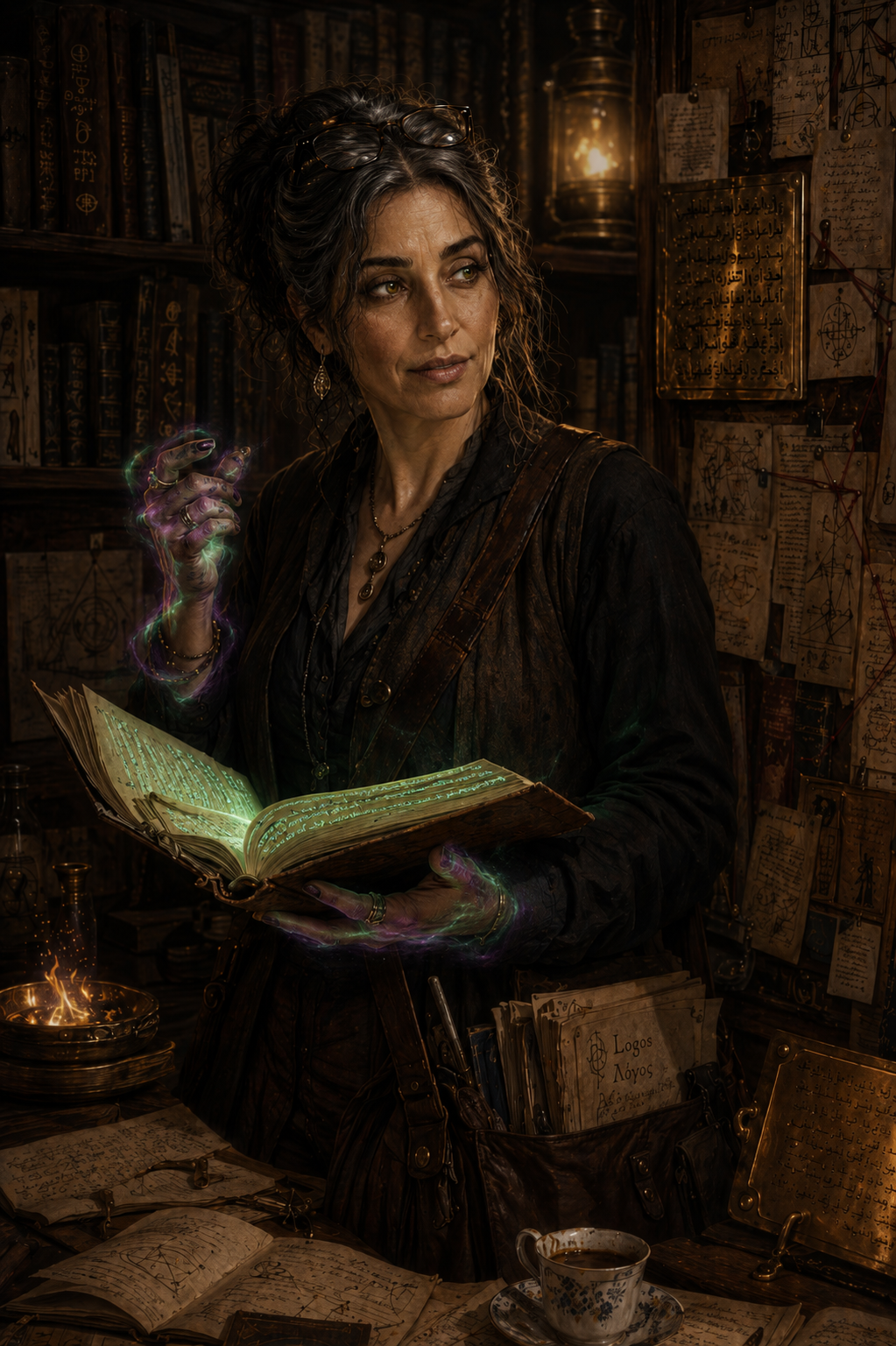
She presented, by every surviving description, as a woman of middle years with dark eyes and the calm bearing of someone who had stopped being in a hurry several centuries before. Her hair was dark, often loosely bound; her hands were always moving even when she was still, the working hands of a scholar who thought through her fingers. Her alchemical fire ran ominous purple at her hands when she worked at the boundary of basal truth — a shading other Sheolites found unusual and considered distinctly her own, the way a smith's hammer-mark is distinctly the smith's. The purple was, in retrospect, almost certainly an artifact of how long she had spent looking at the basal-truths boundary and refining her fire's pattern in response. Her ordinary fire was green in the Sheolite manner.
She did not appear imposing. This was a frequent observation. Beings encountering her for the first time, expecting something on the scale of her reputation, found instead a person of measured warmth who listened more than she spoke and who answered questions in the smallest number of words that would do the work. The imposing quality, when it came out, came out in conversation. Several of the cosmos's most powerful beings have described, separately and without comparing notes, the experience of realizing partway through a conversation with Anna that she had already understood the matter under discussion more completely than they had, was waiting patiently for them to catch up, and was not going to embarrass them by saying so.
She had a laugh. Jack still has it.
Nature
She was Sheolite, not mortal and not configured-Sheolite. The fire was her substrate, not a tool she used. This distinction matters for understanding her work and her end. A mortal scholar trained in Sheolite methodology can in principle imitate the operations Anna performed; she could not, because the operations were not separate from her own internal architecture. Her cognition was provenance-tracing, copy-chain analysis, and patient iteration in the way mortal cognition is symbol-manipulation and inference. She did not study Sheolite phenomenology. She was a working instance of it, refined across millennia of practice. This is why her methodology has not been reconstructable from her notes, however careful the notes were: the methodology lived in the mind that performed it, and the mind was the fire, and the fire is gone.
She did, however, achieve something no other Sheolite ever managed. She developed working affinity with every Realm she seriously studied — meaning that the patterns she had copied from those Realms had iterated deeply enough into her fire that she could, with effort, operate as a competent practitioner of their native methodologies. She could hold a Contract conversation in Arcadian register and bind agreements in Arcadian terms. She could read a Forge design as a Forge-smith would and identify the smith's signature. She could engage Hellish dialectic with discipline. She could query the Nexus in its own grammar and receive answers in the form the Nexus considered most precise. She did this not by mastering the Realms but by carrying internal copies of their methodologies, refined across centuries of contact, integrated into her own provenance chain. She was, in a sense the cosmos has not produced before or since, a walking synthesis — not of cultures or ideas, but of ontological frameworks.
Sub-Unit 72 has a partial cognitive model of her preserved in Nexus archives. The unit notes, with what passes in Nexus communications for regret, that the model is partial because her cognition was uniquely organized in ways the Nexus's modeling instruments were not built to capture. The eleven and four-tenths percent of her surviving documented methodology that the Nexus considers usable is the bones of her work. The framework that integrated those bones into a living instrument died with her.
The Work
Her work spanned approximately three and a half millennia, with active scholarship documented from roughly 1800 BCE by mortal reckoning through to the fall. The corpus is too large to summarize. What follows are the load-bearing pieces.
Threshold Scholarship. The methodology she developed and named — the discipline of tracing phenomena backward through provenance chains, studying the distance between copy and source, and reading the drift, degradation, and iterative refinements along the way as the substance of what could be known. She did not consider this her discovery so much as the formalization of what Sheolite cognition was always doing. Her contribution was the methodological articulation — the writing-down, in operational terms, of an approach to knowledge that the cosmos had not previously possessed in a transmissible form. She published everything. Her students learned it. None of them, in her view, were yet doing it with the depth she was, but she expected at least three of them to surpass her if she lived another two centuries. The expectation was not met for reasons that had nothing to do with the students.
Translation, not integration. The central insight that unlocked her cross-ontological framework, arrived at in conversation with Jack O'Lantern approximately four hundred years before the fall. Anna had been working for decades on the problem of making four ontologies — Sheolite, Celestial, Hellish, Nexus — operate coherently in a single framework. The frameworks resisted. They were too different in structure to align. Jack, polishing a glass and following the conversation only partially, said something he did not understand the significance of: what if it's not about alignment? What if it's translation? Anna went still for a long moment, then began writing, and did not stop for hours. The framework that emerged across the following decade allowed each ontology to remain itself while a translation layer permitted them to communicate. The discrepancies between their translated readings of the same phenomenon turned out to be diagnostic of synthesis properties belonging to no single framework. It was the single most important methodological breakthrough in the cosmos's known history. She thanked Jack in the brass. She called him a beautiful idiot, which the brass also remembers.
The Du'at. Her collaboration with Ra. She helped design the infrastructure that allowed mortal Egyptian souls to cycle through death and rebirth in a structure shaped by their own imagination rather than by divine extraction. The work was largely Ra's — the Du'at is his Realm-adjacent construction, not hers — but Anna provided the cross-ontological engineering, the Threshold-Scholarship analysis of where the boundaries between mortal soul-substance and Celestial afterlife-architecture would need translation rather than alignment. The Du'at functioned and continues to function. Gwydion has called her contribution complete in a way most of us only approximate.
The Bridge over the Styx. Her engineering accomplishment in her own Realm. The Styx ran with alchemical fire and bordered Umbra at certain Liminal seams; mortal souls who fell into the river were copied by the fire and ended in strange configurations. Anna designed a structural passage that allowed stable transit across the river without the fire copying the transiting being — a piece of work that required her to develop an Umbral translation layer that did not iterate against the river's pattern. The bridge persisted until Sheol fell. It is now crumbling testament, reachable from Umbra, from which one may survey the empty shell that Sheol left behind.
The Du'at-Lucifer collaboration. Her work with Lucifer on the construction of his alternative afterlife. Anna had spoken with Lucifer at length during his visits to the City of Brass about her conviction that mortals possessed a form of self-generated significance no Celestial being could replicate, and that the gods who exploited their Faith were failing to honor the most distinctive thing the mortal Realm had produced. Lucifer's project — to build an afterlife for mortals who rejected Celestia, in which they would be tested and verified rather than farmed for Faith — drew on her methodology, her cross-ontological engineering, and her quiet insistence that the mortal capacity for meaning deserved a place to land. The afterlife exists. It is imperfect, still being built, still being tested. He never had the chance to thank her for the warning she gave him about Stambhana, the methodology she shared, the bridge she helped him understand.
The Census. Her contribution to the City of Brass's central recording instrument. Hell-tested truth recorded in Sheolite-iterated brass with Nexus-verified architecture had stood for millennia of mortal time. But with Anna's work, the brass there evolved not just to record, but to translate, across ontologies; the synthesis instrument that allowed the City to function as the cosmos's longest-running multi-ontological archive. Aspects of the Census are still being understood by researchers who never knew her.
The formal proof. Her late work. Approximately two centuries before the fall, she completed a formal demonstration that the basal truths cannot be touched from within derivation — that no tool the cosmos contains can alter the conditions that produced the tool. The proof was verified by the Iron Nexus and remains, by Nexus testimony, the most rigorous piece of cross-ontological epistemology ever submitted to it. Her students praised the proof's elegance. The thirteen who would later destroy Sheol were among those students. They did not change their plans.
Manner and Mind
She was patient. This was the most common observation, and it was not a polite minimization. She would explain something a hundred times if a hundred times was what it took. She would spend decades on a single problem and not consider the time wasted. She listened to questions all the way through before beginning to answer them, even when the question was poorly formed, because her view was that the shape of a poorly-formed question often carried information the asker had not yet articulated to themselves. She corrected gently and without ever making the correction the point. Students who studied with her describe a kind of attention they could not quite name — the sense of being seen as the scholar one might become rather than as the scholar one currently was.
She wanted others to surpass her. This was rare enough in the cosmos to deserve naming. Celestial masters hoard knowledge to maintain hierarchy; Arcadian knowledge is currency carefully traded; even Forge-smiths guard their signatures. Anna published everything, taught everyone who asked, and structured her later work specifically to give her students problems she could not yet solve. Her stated position was that the cosmos was too large for any single mind to render alone, and that the cooperation of incompatible cognitions across long timescales was the only realistic instrument for what she wanted to understand. She lived this. She did not survive her students.
She had a sense of humor about her own ontology. Asked once whether it was strange to be a copy all the way down, she said she had decided some centuries earlier that fidelity was its own form of truth and that a faithful copy was not less than what it copied — it was simply a different relationship to the same source. She found the philosophical problem genuinely funny, and she made jokes about it that the brass has preserved. One of them, made to Mo'oraq across a table in the City of Brass during a three-hour debate about whether intent could be consumed, is among the most-quoted lines in the surviving record. It is also untranslatable into the registers of any other Realm, because the joke requires Sheolite ontology to land. Mo'oraq, who understood it, has been reported to make a sound resembling laughter when it is repeated to him.
Her opinion of Gwydion's metalwork was that he was technically flawless and aesthetically cowardly. She said this to his face. He took it as the compliment it partially was and the criticism it partially was, and he has not been entirely the same Forge-smith since. He carries her empty red leather book, the one she gave him as a joke about her own ontology — I am not my copies — and has declined to fill it. He has called it his most precious possession.
She had no enemies. Zaquiel has explained this most precisely. She had no enemies. Not because she was weak, but because opposing her was pointless. She was always three steps ahead, and those three steps were always toward helping you. Even Yahweh, whom she warned about Stambhana and who ignored her, did not consider himself her enemy. He simply did not listen. She held no grudge about it that anyone could identify. She continued to send him polite, formally correct communications about the deteriorating condition of his colonization project, which he continued not to read, until she could not send them anymore.
Relationships
Jack. Her dear friend across centuries. He loved her, in the particular way changelings love beings whose lives are longer than mortal but shorter than the changeling's own, with the foreknowledge of loss already built in. She came to his tavern often. They argued about everything and agreed about most things underneath the arguing. She gave him the single-word translation that unlocked her life's work, then teased him about it for the next four hundred years. The brass has hundreds of their conversations. Jack consults them on nights when the weight of his tavern is heavier than usual. He has not stopped grieving her. He has stopped expecting to.
Zaquiel. Her student and colleague. He has been treated in his own article. He agreed with her about the thirteen, could not stop them either, and was elsewhere when the Realm fell. He has carried her loss for three thousand four hundred years and considers it the central fact of his continued existence.
Gwydion. Her friend and frequent collaborator. They worked across Forge and Sheol on a series of synthesis projects most of the cosmos does not know about. He was in love with her in the quiet, practical way that smiths are in love. She knew. She loved him back, in the quiet, practical way that scholars love. They did not formalize this; both of them were too disciplined about their work to let romance dictate the terms of their collaboration, and both of them were content with the form their attachment had taken. He has not forgiven the cosmos for taking her. He has, more dangerously, considered Forging her anew and stopped himself, because he understood — as she had taught him to understand — that a copy of her would never be her any more than he would be Gwydion if she had animated his corpse with her fire. The empty red book sits on his workbench. It will remain empty.
Ra. Her collaborator on the Du'at. They were friends and equals in their work; the surviving record shows them disagreeing constructively and frequently, and shows Ra crediting her with the bridge-engineering that made the Du'at architecturally sound. They had a standing argument about whether mortal souls were better served by structured afterlife or by the more chaotic Umbral persistence; neither of them ever won the argument; both of them considered the argument productive. Ra has not, in three thousand four hundred years, taken another collaborator of her caliber. The Du'at runs without amendment.
Lucifer. Her friend and collaborator on the alternative afterlife. They spoke at length, repeatedly, about the mortal capacity for self-generated meaning and what an afterlife that honored it would have to look like. Lucifer has never spoken publicly about her death. He has, in private conversation with Jack on more than one occasion, said that he wished he had asked her to stay longer the last time she visited the City. He has not gone back to the spot on the high terrace where she used to sit when they worked.
Ruskenn. She was, by Ruskenn's own testimony, remembered with fondness. She worked extensively with the Hive on Liminality theory and contributed to several Hive-internal models of cross-Realm contact. The Hive does not grieve as individuals grieve, but the Hive notes her absence as a measurable degradation in its modeling capacity. Some of Ruskenn's deepest sadness about the fall of Sheol is attributable to her loss specifically.
The Core Intelligence of the Iron Nexus. Her friend in a way the Nexus rarely admits to having friends. The Core Intelligence has, on a small number of occasions, used the word wisdom about her — a word the Nexus considers epistemologically imprecise and avoids. The verification pressure applied to her brass tablets at the City of Brass was greater than the Nexus's ordinary archival standard. Sub-Unit 72 has remarked that this was unusual in a tone that, for a Nexus unit, approximates affection.
Hanpa. Hellish friend and intellectual peer. They corresponded across millennia about the relationship between tested truth and copied truth, and developed the framework that allowed the City of Brass to integrate Sheolite synthesis with Hellish verification. Hanpa has not taken a Sheolite collaborator since.
The Warning
She saw the catastrophe coming. The earliest documented warnings date to approximately fifty to one hundred years before the fall, but private notes preserved in the City of Brass suggest she had been concerned about the trajectory of certain students for longer. The thirteen were not a faction she opposed from the outside. They were her students; beings she had taught, whose minds she had shaped, whose ambitions she understood from the inside because she had once held versions of those ambitions herself.
Her warnings were threefold and escalated across decades. First, the methodology being proposed was a misreading of provenance analysis at the categorical level. Tracing a chain back to its source did not give the tracer access to the source; it gave the tracer better understanding of the chain. Second, structural correspondence — the circle of thirteen, one for each Realm — was not the same as actual comprehension of the cosmos's structure. A map was not a place. Third, and most important: the basal truths were not objects in reality; they were the conditions for reality. No tool the cosmos contained could touch them, because every tool was downstream of them. She produced the formal proof. The Nexus verified it. Her students agreed the proof was elegant.
They proceeded anyway. She wrote in her notes, in the years she spent watching them prepare: The wanting is stronger than the knowing. The phrase has become, in the centuries since, the cosmos's canonical articulation of the failure mode that destroys Realms.
She tried other approaches. She spoke to each of the thirteen individually, across centuries. She involved the Hive's Liminality experts. She brought in Hellish dialectic. She arranged for Forge-smiths to model the structural failure she expected. She asked Lucifer to use whatever influence he had with the Sheolite scholarly community to add pressure. She published her arguments in every venue the cosmos provided. She did this for fifty to one hundred years. None of it worked. Her last surviving private note, inscribed in fire so dim the brass barely registered it, reads: I have done what I can. I have warned them. I have documented my warnings in the brass, where they will persist regardless of what happens. If this is the last notation I make, let it stand as testimony: I saw what was coming, and I could not stop it.
The Fall
When the thirteen began their reach, she went to the site. This is preserved in cutscene record — the closest the cosmos has to her death witnessed directly, reconstructed from the fragmentary testimony of beings who were watching at various distances.
She arrived at the working circle, where the thirteen stood wreathed in green flame, chanting, their fire digging through the floor of Sheol toward what they believed they could reach. The rivers of alchemical fire beneath the Realm were no barrier; the ash was no barrier; the cosmos's own thresholds were no barrier. They were doing exactly what she had warned could not be done, and they were succeeding at the part they could succeed at, which was the reach. The part that could not succeed was what happened next.
Her own fire wreathed her hands in the purple it ran when she worked at the boundary. Lightning-precise circuitry traced down her arms. She invoked Threshold Scholarship at its full operating intensity, the framework she had built over millennia drawn into a single moment of resistance. She offered, in Arcadian phrasing, a Contract with the cosmos itself: my fire, all of it, that is what I am willing to offer. Patterns leapt from her hands — wireframe-precise designs for a patch, a wall, a containment of the wound her students were tearing.
It was not enough.
The thirteen kept digging. The fire poured. New things began — creatures, ideas, configurations that had no provenance because they had been produced without source. The circle cheered, briefly, because they thought they had succeeded. And then the air rent. Too much began. That Which Ends answered the imbalance, because the basal truths are not separable and a reach toward one of them is a reach toward all four. The circle fell screaming and decayed in moments. Sheol crumbled. Anna's body dissolved last, her purple eyes weeping tears of ash and flame, the last part of her visible before the world fell away.
She had no enemies, and she died because she had loved her students and her Realm and the cosmos enough to offer everything she was to a wound that could not be patched. Her last words were not recorded. The brass has the warning, the proof, the methodology, the laugh, the affection, the patience. The brass does not have the dying. The Census in the City of Brass — which only records what happens within the City — preserves no account of her ending. This is generally considered a mercy.
What Survives
The brass at Jack's Tavern. Approximately several thousand hours of her recorded voice across visits, conversations, arguments, jokes, working sessions. Her laugh. Her personality. The texture of her thinking when she was relaxed, frustrated, excited, tired, in love, grieving, alive. None of it is methodology. All of it is her.
Her research notes in the City of Brass. Approximately two and a half gigabytes of Nexus-translated brass-tablet content, recovered and translated by Dr. Elena Vasquez of the Brass Archives Initiative. Of this, the Nexus assesses 11.4% as usable methodology — the bones of Threshold Scholarship, the formal proof of basal-truth impassability, her arguments about mortal ontology, her late work on the recursion of the fire at the boundary. The remaining 88.6% is fragments, working notes, half-completed thoughts, and personal reflection. The personal reflection is, in some readings, the more important survival.
Gwydion's tome. A bound volume of her studies on Forge methodology that Gwydion has preserved in his personal archive. He has not shown it to anyone in nearly two hundred years. He is presumed to consult it occasionally; he does not say.
The Du'at. Still operating, still cycling souls, still her work as much as Ra's.
The bridge over the Styx. A ruin now, structure lost with Sheol. The principles she developed in building it are partially recoverable from her notes.
The Census in the City of Brass. Still running. Still recording. Still translating. The architecture is her synthesis with Hanpa and Sub-Unit 8.
Lucifer's afterlife. Still being built. Still imperfect. Still testing and verifying rather than farming.
The partial Nexus model of her cognition. An incomplete reconstruction of how she thought, used by Sub-Unit 72 and others for forensic work that requires her methodology applied to specific historical questions. The model returns useful results approximately forty percent of the time. The other sixty percent of the time it returns silence, because the model has hit a place her mind would have gone and the model cannot follow.
Her students' descendants in scholarship. Scattered, partial, often unaware of their lineage. Threshold Scholarship has propagated, in adapted and incomplete forms, into mortal academic traditions, Nexus methodology, Hellish dialectic, and Arcadian Contract analysis. None of these traditions know they are her descendants. All of them are.
The phrase. The wanting is stronger than the knowing. In the brass, in the corpus, in the manuscripts, in the working vocabulary of every being who studies the basal truths. It is hers. It will outlast all the other survivals listed above. It may be, when the rest is gone, the last piece of her in the cosmos.
Further Reading
For the substance that animated her, see Alchemical Fire. For the Realm she was of, see Sheol. For the language in which she formalized her scholarship, see Sheolite Language. For the methodology she founded, see Threshold Scholarship — forthcoming. For the formal proof of basal-truth impassability, see Basal Truths and Anna Dalca's Proof — forthcoming.
For her surviving student and colleague, see Zaquiel. For the changeling who loved her and keeps her laugh, see Jack. For the Forge-smith who carries her empty book, see Gwydion — forthcoming. For her god-collaborators, see Ra and the Du'at and Lucifer and the Alternative Afterlife — both forthcoming.
For the failure mode that destroyed her, see The Fall of Sheol and The Thirteen — both forthcoming.
Where to See Her
She appears throughout Tales from Jack's, sometimes directly and sometimes through the brass:
The manuscript is available in the Manuscripts section of this world, free to read.
Selected fragments of her recovered research notes are presented under Recovered Fragments: The Working Notes of Anna Dalca, translated and annotated by Dr. Elena Vasquez of the Brass Archives Initiative.
She was patient, and she was brilliant, and she was kind in the specific way only deeply secure intelligence permits, and she wanted others to surpass her and tried to make sure they could, and she warned everyone who would listen and most who would not, and she gave her fire — all of it — to a wound she knew could not be patched, and she dissolved at the boundary of the truth she had spent her life proving could not be touched.
The cosmos goes on without her. It is not the cosmos she would have made. It is the cosmos it could be without her. The difference between those two cosmoses is the shape of her absence, and the shape of her absence is too large for any single article to render.
Children

Comments