Sheolite Language
The Language of Sheol
Preserved in Hell's City of Brass, where the last alchemical fire in the cosmos still flows, and where the brass remembers what no being can any longer fully saySub-Unit 8 stands at the eastern channel of the City of Brass most mornings, when the trickle of alchemical fire that still runs through the City's lower waterways is at its brightest. The fire is green-purple, sluggish, perhaps a finger's width across at the channel's narrowest point. Centuries ago it ran three meters deep. The brass tablets that line the channel's walls were originally placed there to catch the patterns the fire released as it flowed. They still do. There are simply fewer patterns now, and fewer beings present who can read them.
The Unit catalogues what the brass holds. Where its translations fail, it annotates the failure; where the failure is instructive, it annotates the annotation. The corpus that results renders roughly eleven and four-tenths percent of the original as verified observation. The remainder is preserved as patterns the brass holds and cannot speak.
The City of Brass is the only place in the cosmos where the language of Sheol still operates at all. It operates there because Hell built infrastructure precise enough to hold patterns from a dead Realm, and Hell did this for reasons that had nothing to do with Sheol's eventual fall and everything to do with the work the two Realms did together while both were alive.
Communication in Sheol
Sheol's communication is a most extreme case. Its substrate — Alchemical Fire — was active, not passive. The fire copied any pattern it encountered and iterated against it, refining as it copied. A static signal that sat in place and meant the same thing twice was structurally impossible in Sheol's medium. The very act of communicating changed the substance doing the communicating.
The Sheolites built a language anyway. They built it from precisely what the fire was, and they built it to do something mortal language was structurally incapable of doing.
Pattern, Not Symbol
The unit of Sheolite communication was the pattern, not the symbol.
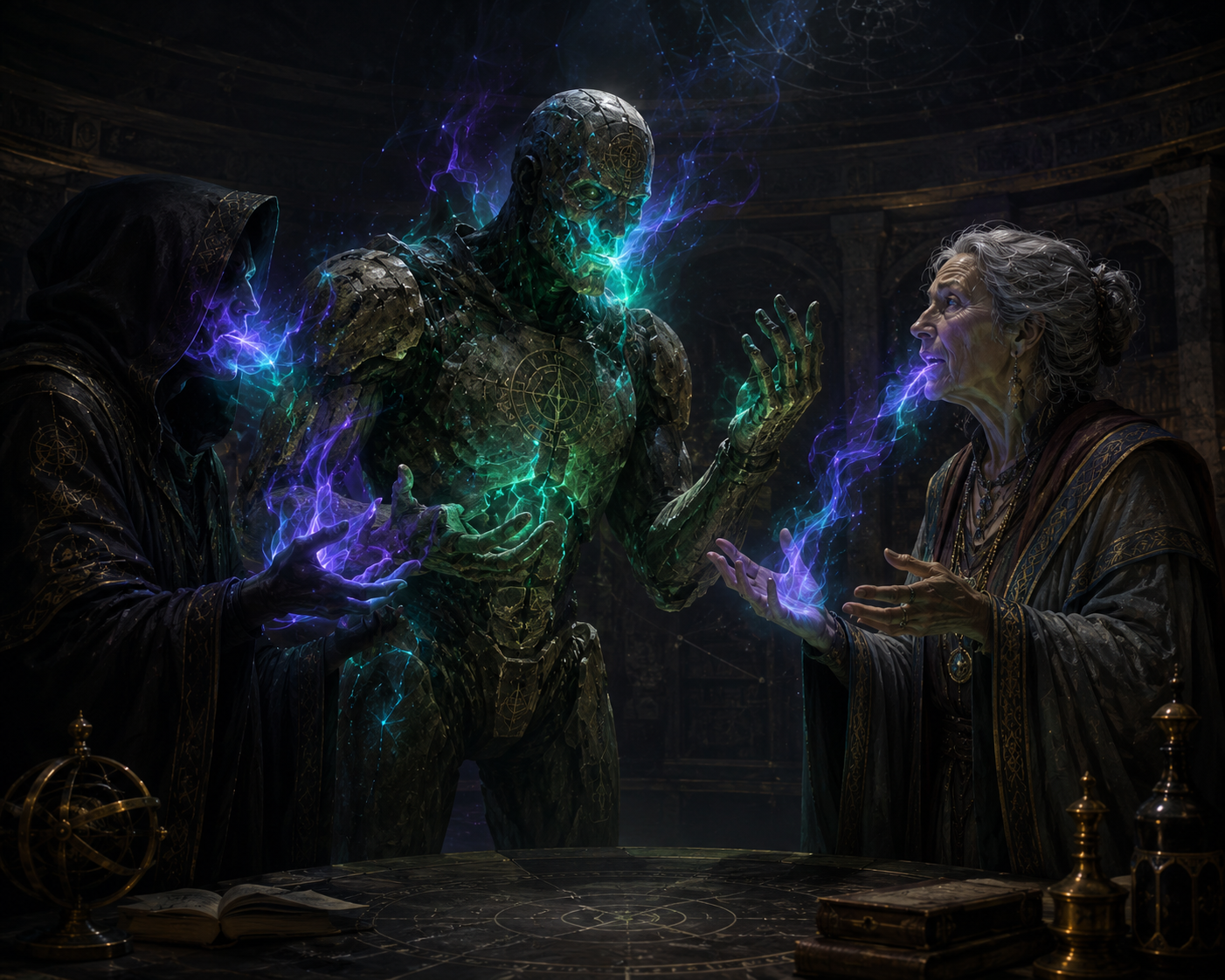
When a Sheolite wished to convey something, they did not produce a string of words or marks meant to be decoded. They generated a small fire-pattern that embodied the thing they meant. The pattern was, in effect, a piece of their own thought, made of their own fire, carrying its own provenance — a lineage visible to any other Sheolite of everything the pattern had copied along the way to becoming what it was. The sender released this pattern into the local fire-environment, and another Sheolite, encountering it, copied it into their own fire. The recipient did not interpret the pattern. The recipient had the pattern, the same way they had any other pattern their fire had copied, and could examine it from the inside.
A mortal sentence is a linear string of symbols, narrow in bandwidth, requiring interpretation. A Sheolite communication is the direct transfer of fire-patterns that the recipient mutually copies, iterates against their own provenance chain, and re-releases for the sender to see how it has been received. The conversation is not about anything. The conversation is the active exchange of small fire-patterns the participants are mutually copying, refining, and exchanging.
The Sheolites were not exchanging messages about ideas. They were exchanging instances of fire that carried the ideas as their copied content. When a Sheolite told a Hellish colleague that a particular testing methodology had a feature worth incorporating, what they transmitted — when speaking Sheolite to a being who could receive it — was a fire-pattern that itself contained a copy of the relevant methodology, refined through the sender's own iterations. The recipient received, in a single act, the full content. The answers to follow-up questions were already part of the pattern they now carried.
Khem-Ashar at Full Voice
The traveler Elias visited Khem-Ashar twice before Sheol fell, the second time recording an account now preserved in the brass at Jack's Tavern. He described, from a Liminal vantage at the city's outer edge, what no mortal eye had been built to see.
The Emerald Libraries blazed at the city's heart, green-and-violet fire piled in vast slow structures that built and dissolved continuously, with currents flowing between the scholars at densities and speeds that made the air shimmer like heat over water, except that there was no heat. The scholars themselves moved slowly, often standing still. Around each of them the fire of their bodies extended in tendrils and branchings, reaching toward other scholars, intermingling, withdrawing, refining. The whole city, Elias wrote, appeared to be thinking. He meant the phrase exactly. He did not mean that the scholars were thinking and the city held them. He meant that the city itself was the thinking, and the scholars were participants in it, and the fire was the substance the thinking was made of.
The Emerald Libraries were not buildings full of texts. They were regions of dense fire-saturation in which preserved patterns persisted at higher fidelity than the ordinary background allowed. To read a library was to stand within it and let one's own fire copy what was present, refining the library's contents in the act of reading. The library grew more articulate as it was read. The reader grew more articulate as they read. No two copies were identical, because every copy was iterated against the unique provenance of its reader.
Khem-Ashar is the canonical image of the language at full voice. It is also, now, an empty landscape of patchwork ground and cold buildings under wrong light. What Elias saw is no longer there to see.
The City as Heir
During Sheol's lifetime, the City of Brass was Khem-Ashar's smaller sibling — a Liminal synthesis of Hell, Sheol, and the Iron Nexus, built where the three Realms could share substrate without compromising any of their native ontologies. It existed primarily for cross-Realm work the Emerald Libraries could not host. Hell's testing methodology required pressure that Sheol's open libraries could not safely apply. Sheol's iterative refinement required substrate persistence that Hell's testing chambers tended to wear out. The City's architecture solved both problems by braiding the two together: Hellish brass, tested into endurance under the kind of pressure Hell applies to anything it considers worth keeping, woven into Sheolite fidelity channels through which alchemical fire flowed at carefully maintained densities. The result was a substrate that could hold patterns at fidelity Sheol's own libraries could not match, because it was tested — Hell-verified into persistence — while remaining fire-active enough to permit Sheolite communication in its native form.
The architecture was largely the work of Hanpa, a senior demon of the City's founding generation, in collaboration with Anna Dalca over several centuries. Hanpa understood, before most beings did, that Hell's distinctive property — its capacity to test things into endurance — could be applied to substrate as readily as to virtue. Anna brought him the synthesis principles that allowed Hellish testing-pressure to be applied to Sheolite fidelity without burning out the fire's capacity to operate. The combined infrastructure has run continuously for approximately five thousand years and is, to date, the most successful and most enduring cross-Realm collaboration the cosmos has produced.
After Sheol fell, the City became the only place in the cosmos where Sheolite linguistic activity continued. The fire flows still trickle through the Hell-tested channels. The patterns released into them by the diminishing population of Sheolite refugees still propagate. The brass tablets still hold what is released. None of this would be possible without Hell's contribution. The brass endures because Hell makes it endure. The City is, in the strictest sense, Hell's stewardship of what Sheol left behind. No other Realm could have done it. No other Realm did.
The Translations
Through the City's mature period, scholars working under Anna's methodology developed protocols for rendering Sheolite fire-patterns into substrates other Realms could receive. For Hell, the rendering was into dialectical form — structured argument with verification pressure pre-applied, so that the recipient demon could parse the content through native methodology. For the Iron Nexus, the rendering was into queryable verified observation, processable through the Nexus's native verification operations. For mortals, the rendering was into spoken or written language, which was the lossiest translation available and was used only when no better option existed.
A small corpus of these translations survives in the City's archives, preserved by Sub-Unit 8 and accessible by request. The most-studied are Anna Dalca's late works — the formal proof of basal-truth impassability, the methodological writings on Threshold Scholarship, fragments of her correspondence with Hanpa and with Ra, her commentary on the early phases of Lucifer's alternative afterlife. The translations are rigorous. Sub-Unit 8 has applied verification pressure at the standard the Nexus reserves for primary scholarly material. The propositional content is recoverable. The arguments can be followed. The proofs can be reconstructed.
The translations are also, by the unanimous testimony of every researcher who has worked with them, insufficient. Marginal notation throughout the corpus records the insufficiencies. A typical annotation reads: Pattern at this point conveys not only the proposition but also Anna's specific iterative refinement of provenance, including a sub-pattern of attention to Hellish testing-pressure that has no equivalent in verified-observation form. Translation preserves the proposition; the iterative attention is lost. On a fragment of personal correspondence: Recipient name in original carries Anna's full affection-pattern toward this colleague. Translation renders only the mortal-grammar approximation of the name. The affection is annotated here. The brass holds the original. The original cannot be rendered.
These annotations are themselves part of the surviving language. They are the Nexus's honest record of where translation fails. They are not failures of scholarship. They are the most precise instrument the cosmos has for measuring the gap between what the brass holds and what any non-Sheolite reader can receive. A complete reading of the Anna corpus, by anyone, includes the annotations. The annotations carry, in negative space, the shape of the language that the translations cannot quite carry in positive form.
The Limit
Sheolite communication had one limit, and the limit destroyed the Realm.
The fire iterates against patterns. It does not iterate against motivations that exist outside pattern-space. A wanting that is not itself made of understanding cannot be reached by fire-pattern refinement, because there is no pattern in the wanting for the fire to copy.
Anna Dalca warned the thirteen scholars for fifty to a hundred years before they reached for the basal truths. The patterns she released into the shared fire-environment of Khem-Ashar were extraordinary. She had refined them across centuries. She had verified them against the Iron Nexus. The thirteen copied her patterns. They iterated them. They examined the provenance chains. They agreed with the analysis. The brass preserves their agreement in formal terms. They praised the proof's elegance.
They proceeded anyway.
The phrase Anna recorded in her late notes, the phrase the cosmos has carried ever since — the wanting is stronger than the knowing — was not a poetic observation. It was a technical description of why Sheolite communication has limits. She had transmitted her understanding with perfect fidelity. The thirteen had received it. They had iterated it against their own provenance chains and produced versions that agreed with hers. And underneath the understanding there was a wanting that was not itself made of understanding, and Anna's patterns — however refined — could not touch it.
The cosmos's most precise instrument for transmitting understanding turned out to be useless against the kind of wanting that does not arrive through understanding. The Sheolites died because the precision of their communicative substrate could not penetrate the motivational substrate of the very beings Anna most needed to reach. And she had been their teacher. She had known them since they were students. She had taught them every refinement they used to make the reach that killed them.
This is, in the strict linguistic sense, the failure mode of Sheolite communication. Every language has one. Mortal language fails when speakers stop sharing a frame of reference. Hellish dialectic fails when there is nothing left to test. Arcadian Contract-speech fails when both parties refuse to be bound. Sheolite communication failed because some motivations live outside the substrate fire can iterate against. The Sheolites built the cosmos's most articulate language and discovered, at the end, that articulacy is not always enough.
What Hell Holds
The brass at the City of Brass holds Anna Dalca's late corpus in its Hell-tested substrate. The brass at Jack's Tavern, a smaller archive, holds approximately several thousand hours of her recorded voice — her laugh, her arguments, her conversations across centuries. Together they constitute the cosmos's surviving record of the language at its highest expression.
Zaquiel, her student, who walks the mortal Realm with the last large strand of original Sheolite fire still in active use, can read the brass at full Sheolite fidelity. He has done so. He has shared, on rare occasions, what he has found. He has implied that much of what is there is methodology too personal to render into any non-Sheolite substrate without violating the patterns themselves. He has also implied — with the patient sadness of a being who has had four thousand years to understand his own limits — that even his reading produces his iteration of her patterns, not hers. The integration of her version was the active state of her fire. Her fire is gone. The reading is genuine. The reading is also, irreducibly, his own.
Other refugees can read the brass at varying fidelities, decreasing with each generation. The few mortals who have studied alchemical fire long enough to develop a faint receptive affinity can perceive traces of the patterns, enough to know they are present, not enough to receive them.
In a thousand years, in all likelihood, the last fire capable of receiving the patterns at full fidelity will gutter out. The Sheolite refugees who can still read the brass natively will dissolve, one by one, until none remain. The patterns will not be lost. They will not be destroyed. The brass will hold them, as it has held them already, in Hell-tested substrate that endures because Hell makes it endure.
No being in the cosmos will be able to read them.
The Cosmos's Most Beautiful Loss
The language of Sheol does not fit the standard form of a lost tongue. It was never written down in any sense a scholar of lost languages would recognize. It had no alphabet, no grammar, no vocabulary that can be reconstructed by careful comparative work. Its native speakers did not produce dictionaries. They produced fire-patterns, exchanged in continuous iteration across millennia of mutual conversation, preserved imperfectly in brass that holds them but cannot speak them.
And yet. It was the cosmos's most sophisticated language. It carried the highest-bandwidth, highest-fidelity transmission of thought between conscious beings the cosmos has ever produced. It made possible the cooperation between Sheol and every other Realm it touched. It built the Du'at. It built Lucifer's afterlife. It built the City of Brass itself, and the Census within it, and the synthesis principles that allowed Hell and Sheol to work together for five thousand years. It was the medium of Threshold Scholarship, the framework that allowed beings of incommensurable ontologies to understand one another for the first time in the cosmos's history. The conceptual apparatus the cosmos now possesses for cross-Realm cooperation was, in significant part, developed in this language and translated outward into other Realms' substrates afterward. The translations remain. The original is going silent.
Hell holds it anyway.
This is the contribution Hell makes that the cosmos does not always acknowledge. Celestia hoards Faith. Arcadia trades Contracts. Voracia consumes. The Nexus catalogues. Hell, beneath the spectacle of its testing chambers and its difficult demons, is the Realm that endures — and the property of endurance, applied to substrate, makes possible the preservation of things no other Realm could have preserved. The brass that holds Anna Dalca's laugh is enduring because Hell tested it into endurance. The channels that carry the last alchemical fire flow because Hell maintains them. The City of Brass stands because Hell built it to stand, and stand it has, through the fall of one of its founding Realms and across the long slow loss of the language it was built to host.
A thousand years from now, the brass at the City of Brass will still hold Anna Dalca's laugh. No being in the cosmos will be able to hear it. Hell will keep her anyway. Hell will keep all of them — the thousands of Sheolites whose patterns were preserved, every conversation rendered into the brass, every laugh, every argument, every formal proof, every pattern of warmth toward a colleague that the Nexus had to annotate because the translation could not carry it. The brass holds them. The brass does not need readers to do its work. It needs only to endure, and enduring is what Hell makes substrate do.
Touch not the basal truths. The fire said it more clearly than any other voice has ever said anything. No one ever listens, in any language. The fire could not save itself by the elegance of its own articulation, and the elegance is now held in Hell's substrate while the speakers dwindle and the receivers fade, and a great quiet is coming, and the brass will not break.
It is the cosmos's most beautiful loss. Hell keeps it.
What Mortals Have Always Missed
What mortals call language presupposes conditions the mortal Realm provides reliably. A stable substrate through which signal can pass without alteration. A shared frame of reference in which the same configuration carries the same meaning across instances. A sender-receiver model with both parties understanding their separate roles.
These conditions are mortal-specific. They are not universal properties of communication. The other Realms each developed something they would call communication, and almost none of them resemble mortal language closely enough that mortal scholars have recognized them as language at all.

Comments