
Hell
Hell
The way things are: truth endures.Hell is the Realm where existence is conditional.
To be in Hell is to be under weight. Not the weight of punishment — Hell judges nothing, sentences no one, and keeps no ledger of sins — but the weight of That Which Ends, imposed actively rather than left to operate on its own. Everything in Hell is pressed toward dissolution, continuously, as a law of the place. What can hold itself together under that pressure endures. What cannot is unmade. The enduring is what Hell is.
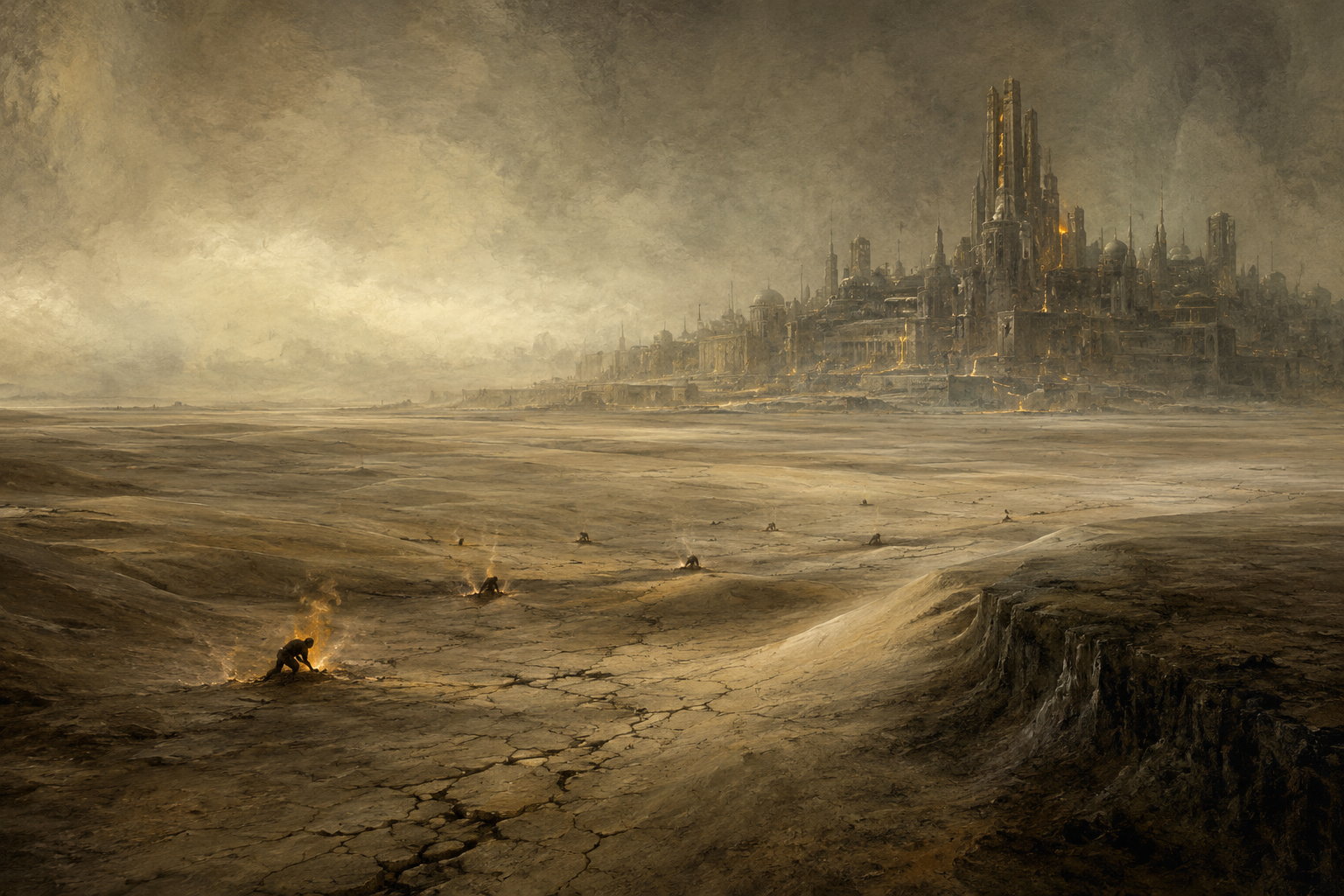
Mortal tradition has made of this a torture chamber, presided over by a horned sovereign and stoked with fire for the wicked. This is not a small error. It is a category error, and a recent one, broadcast for two thousand years by a Realm with an interest in the slander. Hell does not punish. Hell proves. Hellfire is not kindled by anyone's will; it is the visible loss of energy when a thing strains against the weight and overcomes it — friction, evidence of effort, the byproduct of striving. It burns because that is the way things are.
The Way Things Are
Hell's relationship to the basal truths is oriented toward That Which Ends. Where the mortal Realm expresses ending passively — entropy as a law that need not be imposed, dissolution that simply happens — Hell expresses it actively. The drive to overcome ending, at the cost of one's own pain, is the Realm's fundamental organizing principle.
This produces a place where nothing is granted and everything is tested. The testing is not directed by any intelligence, any more than mortal gravity is directed by a mind. There is no tester. There is only the pressure, applied to all things equally, and the fact of what survives it. A being endures or it does not, and the difference is not moral. A resolute monster passes where a virtuous coward is crushed. Hell does not care what a thing is. It cares whether what a thing claims to be can hold.
Hell's geography is not spatial in any mortal sense. Distance is measured in endurance — in how long a trajectory can be maintained against the weight. A being native to the pressure moves through it the way water moves through water. A being unaccustomed to it struggles to remain upright. The proud are held fast; the humble pass more easily; the mighty, weighed down by the mass of their own self-importance, are held hardest of all. It is said that Yahweh himself, were he to enter, would be chained more surely than Atlas — that the larger the presence, the harder Hell holds it.
From this single principle the rest of the Realm follows. If testing is the way things are, then understanding testing becomes the highest form of knowledge — what can be tested, what constitutes endurance, what emerges from the process that did not exist before it. Hell's intellectual tradition is organized around these questions with a rigor that rivals the Iron Nexus and a practical orientation that surpasses it. Hellfire is the medium. What remains after it has done its work is, by definition, what was real. Everything else was dross.
History
Hell is the eldest of the civilized Realms — not the first in which life appeared, but the first to become something more than the sum of its parts.
Life emerged first in the Iron Nexus, by simple dint of speed; its ontology cycles faster than any other, and self-sustaining process arose there before anywhere else. Umbra is vastly ancient, dreaming since the first Nexus processes and primitive cytes could be dreamed about. Sheol began copying the instant it touched another Realm and never stopped. But none of these became a civilization. The Nexus observed. Umbra dreamed. Sheol copied. It was Hell that first developed institutions, intellectual tradition, and historical memory — because endurance is the substrate on which civilization is built, and the Realm of endurance was always going to organize first.
Hell was also the first to reach outward. When Hell extended itself toward other Realms, the Iron Nexus was still observing rather than engaging; Arcadia was still striking agreements with itself in order to become stable enough to have an outside; Ruskenn had not yet accumulated enough cytes to wake the Psyche; the mortal Realm needed billions of years merely to cool; and the gods were still lost in wonder at the upper reaches of Celestia. Hell built the first Liminal cities. Some endured. Some did not. The cosmos's protocols for cross-Realm cooperation are, in their oldest form, Hell's protocols — which is part of why a parvenu Realm's later monopoly on mortal afterlife sits so awkwardly against the elder order it pretends to replace.
Inhabitants
Two kinds of being are commonly encountered in Hell.
The natives — the demons — have no fixed shape, only the pressure they embody. Their forms shift; their eyes are often described as furnace-coals; they observe before they act, sometimes for centuries, because one learns what a thing is by watching it endure. They are not torturers. They are closer to coaches: pitiless toward weakness, indifferent to comfort, working always toward the same end — that those they encounter learn to carry themselves. Mortal stories of utukku and djinn, of spirits of loss and malice, are poor retellings of Liminal encounters with them. What mortals read as cruelty is, more correctly, encouragement to resist entropy. Hanpa is the canonical native voice, having watched the Fallen for three centuries before she spoke to one.
The Fallen are not natives and not demons. They are Celestial beings who walked out of Heaven — chiefly over Yahweh's insistence that mortals be kept ignorant of the value of their own Faith — and chose Hell because it was the Realm where principle could be tested and proven rather than slandered and dismissed. They are sustained by conviction alone; many are Faith-anorexic, gaunt, enduring on the strength of what they refuse to abandon. Lucifer the Morningstar is foremost among them. Ashmedai is among the strongest. Boaz is said to understand Hell as a Realm better than any other Fallen, his affinity for it unparalleled — he rarely leaves it.
"Satan," as a single ruling adversary, does not exist. The figure is a composite of changing mortal myth and Heaven's propaganda. The accuser in the tale of Job was a demon of Hell, working with Lucifer, whose hope was that a man stripped of his god's gifts might learn to stand on his own. Many accusers have existed. None of them is the Devil of mortal imagination.
For specific named inhabitants, see the individual character articles, beginning with Lucifer, Ashmedai, Hanpa, and Boaz — forthcoming.
Relations with Other Realms
Hell is the most networked Realm in the cosmos, and the least understood for it. Its borders touch Voracia at points of mutual hunger, Umbra where nightmares require testing, Celestia along edges the gods prefer to deny, and Sheol most of all — the alchemical fire found Hell's testing fascinating and copied it endlessly, and Hell found Sheol's mimicry useful in turn. The City of Brass is the oldest product of that cooperation, predating the Faith economy and human civilization both.
The most consequential modern relationship is with the Iron Nexus. Lucifer brokered it: the Nexus gains data — the chance to study why principle works when its calculations say it should not — and Hell gains channels, pathways for information that bypass Heaven's monopoly on mortal attention. The alliance is materially expressed in Hell-wrought Nexus steel: precision and endurance, information and principle, forged at the boundary between the two Realms. Sub-Unit 8 remains the oldest continuously allocated diplomatic process in Nexus history, having developed "preferences" the Core Intelligence has flagged but allowed.
Against all of this stands the Long War — Heaven's open enmity with the Fallen. It has no front lines and no decisive battles; it is fought through propaganda, surgical strikes in other Realms, and the slow contest over where mortal souls go when they die. Hell's role is not to win it but to offer an alternative to it: a place where souls are tested rather than extracted, conviction valued over worship. That project is Lucifer's afterlife — forthcoming.
Mortals and the Realm
No mortal tradition describes Hell accurately, and the inaccuracy has an author. Heaven's account — fire, torment, a throne of damnation, the wicked punished forever — is the propaganda of a younger, more hierarchical Realm recasting the elder cooperative order as deviance. Mortals accept it because it is the version being broadcast and because they arrived too late to know better.
Direct mortal contact with Hell is rare and usually indirect — most often through dreams during Liminality, or through the Fallen and demons encountered at neutral ground such as Jack's Tavern. The few mortals who have perceived Hell directly report no fire and no screaming: a horizon of colorless shifting sand, a sourceless aching light, and a weight that presses on every limb and thought. The danger to a mortal is not torture. It is the pressure itself, which crushes the unprepared as indifferently as it tempers the strong.
What a mortal should understand about Hell is that it is the most honest Realm they will encounter, and honesty is not the same as safety. Hell will not lie to a visitor, will not flatter them, will not punish them for what they are. It will only press, and reveal. Those who can bear the weight emerge stronger. Those who cannot are not condemned — they are simply found to have been less than they claimed. That is not cruelty. That is the way things are.
The single most useful correction a mortal can carry into the subject is this: the place mortal tradition fears as the realm where everything is forgotten in agony is, in fact, the Realm that invented remembering. The brass holds what has been proven. It does not lie. It has outlasted the slander, and it will outlast it still.
Further Reading
For the foundational orientation of the Realm, see Basal Truths and in particular That Which Ends. For the alloy-cities in detail, see City of Brass, City of Bronze, City of Pewter, City of Steel — and for the failed alloys, Ruins of the Two . For the recording medium and querying system of Brass, see The Census — forthcoming.
For those who left Heaven and immigrated to Hell in favor of testing over extraction, see The Fallen. For specific inhabitants: Lucifer, Ashmedai, Hanpa, Boaz — forthcoming. For the alternative afterlife under construction, see Lucifer's Afterlife — forthcoming. For the cross-Realm alliance and its material product, see The Hell–Nexus Partnership and Hell-wrought Nexus Steel — forthcoming. For the broader conflict, see Long War.
For the sister Realms most entangled with Hell, see Iron Nexus, Sheol, and Celestia. For the Liminality through which most mortal contact occurs, see Liminality and Imposition. For the neutral ground where every Realm's inhabitants meet under common terms, see Jack's Tavern and the Mortal Visitor's Guide.
Where to See This
For Hell's nature shown rather than explained, the manuscript Tales from Jack's includes:
The manuscript is available in the [Manuscripts section] of this world, free to read.
Hell is not a bad place. It is a Realm with no tolerance for the weak, which is not the same thing, though the mighty have always found it convenient to pretend otherwise.
The weight presses on everything equally. It does not hate what it crushes, and it does not love what it tempers. It only reveals.
The throne room is Heaven. The library is Hell. And the library has kept its door propped open longer than the throne room has existed.
The Four and the Two
Hell's most significant structural feature is the Four — principalities, each built on a Liminal border where Hell's ontology meets that of two other Realms. Each city applies Hell's testing to a different combination of ontological raw materials, producing environments no single Realm could generate alone. The Four are named for the earliest alloys of human metallurgy: combinations transformed by heat and pressure into substances with properties their components lack. The naming is descriptive. Each city is an ontological alloy.
The City of Brass — Hell, Sheol, the Iron Nexus. The most widely known, owing to extensive mortal contact and its role as refuge across multiple Realm collapses. Brass streets once carried alchemical fire in abundance, now reduced to rivulets since Sheol's fall. Its recording surfaces are Nexus-derived; its social order runs on Hell's burden economy, where debts cannot be escaped, only transformed. The Census — combining Hell's burden, the Nexus's information processing, and Sheol's permanence — permits the querying of any being who has resided in the city. Brass has survived even the death of one of its three parent ontologies. It was here that Lucifer conceived an afterlife built on mutual advantage rather than extracted Faith.
The City of Bronze — Hell, Celestia, Umbra. Where Faith meets imagination, tested for endurance. Celestial authority and Umbral manifestation combine into declarations that take material form: dreamed commands tested for permanence, hierarchies of imagined beings proved against dissolution.
The City of Pewter — Hell, the Forge, Nyxaloth. Where design meets cosmic horror. Without Hell's refinement, the Forge–Nyxaloth intersection produces only transient impossibilities that flicker and dissolve. With it, the impossibilities are proved. Its most notable associated figure is Reriand, a being of Nyxalothian newness whom Hell taught to turn novelty toward what persists — persistently wreathed in hellfire, for whom speech inside stable ontologies costs visible agony.
The City of Steel — Hell, Nirvana, Voracia. Where balance meets hunger. Two near-opposite ontologies — enough and more — tested until contradiction resolves not into victory but into equilibrium: consumption so precisely calibrated that the act of consuming is the act of being sufficient.
Two further attempts did not endure. The City of Electrum (Hell, Ruskenn, Arcadia) could not bind: Arcadia's Contract logic requires separate parties capable of agreement, and Ruskenn's gestalt does not have the space between agents that a clause needs. The second ruin (Hell, the mortal Realm, Stambhana) failed because neither passive entropy nor frozen sufficiency strives, and Hell cannot prove what does not attempt. Hell keeps both ruins. It does not clean up after its experiments. Even failure, in Hell, endures — a permanent record of the testing.



Love the art. Well done!