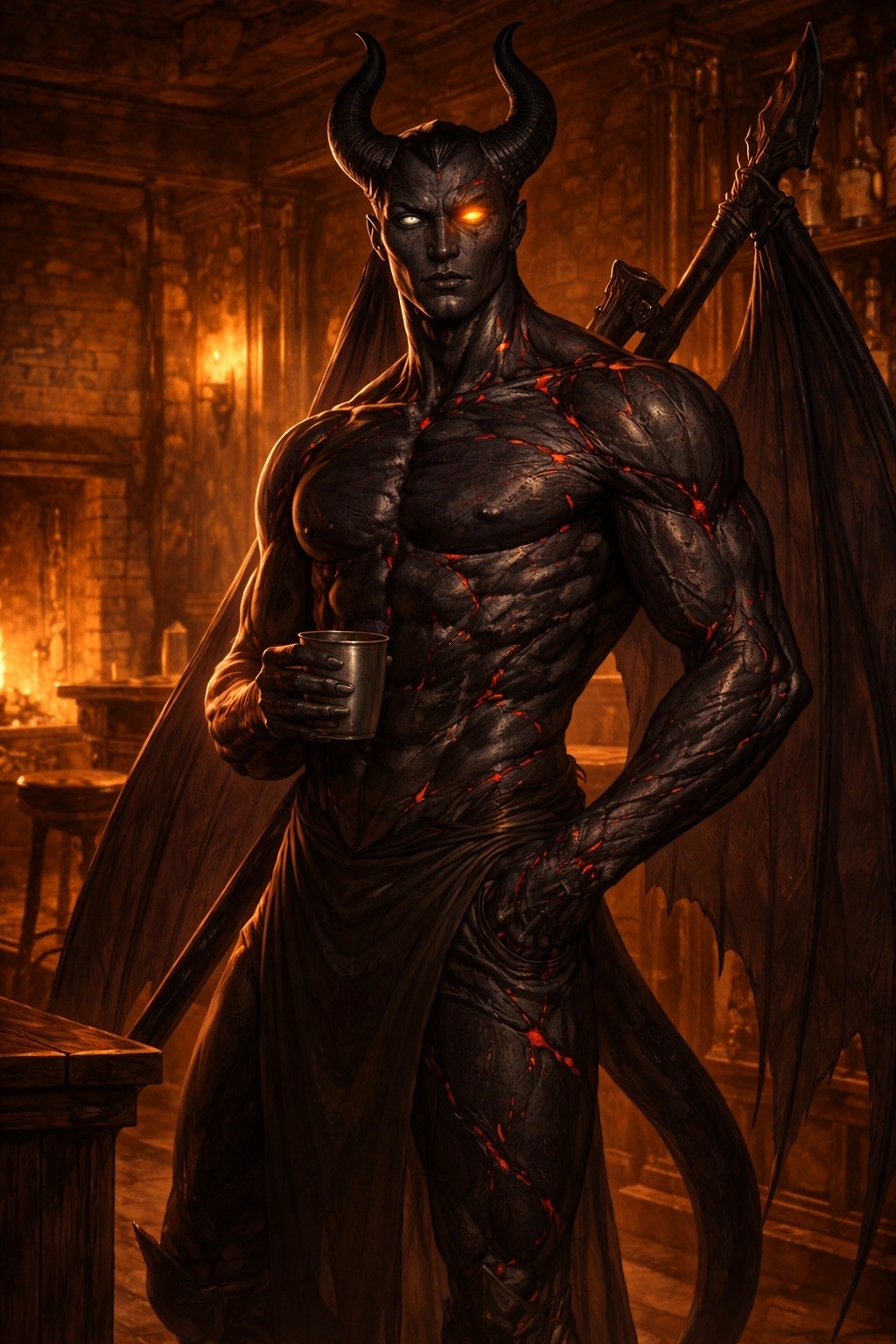
Ashmedai
Ashmedai
Fallen general, Lucifer's right hand, master of Hell-wrought steelAshmedai walked out of Heaven before the propaganda had been written, and the propaganda has been catching up to him ever since.
He was Celestial once — a being of Yahweh's host, an officer in the army of the Most High, present at the long councils when the question of humanity was first raised and never honestly answered. He left when the answer settled into farming. He has been Fallen for as long as the word has existed in mortal mouths, which is to say longer than mortal mouths have agreed on what it means. In Heaven's account he is a rebel against righteousness. In his own he is a soldier who refused to be made a herder. He does not argue the point. The propaganda, he has observed across millennia, does not survive Hell, and Hell is where he lives.
At Jack's Tavern he is courteous, warm, and unexpectedly funny. Mortals who meet him for the first time and have prepared for the Devil's lieutenant are usually thrown by the chuckle. They should not be. Hell does not require its veterans to be grim. It only requires them to be honest, and Ashmedai has been honest for so long that there is nothing left in him that needs to dress the truth up.
He is Lucifer's right hand. He is also, in his quieter way, humanity's.
Appearance
Outside Jack's, in the open street, he can pass for mortal. A tall athletic Black man in a long coat, broad-shouldered, faintly tired around the eyes, the kind of presence pedestrians look up at once and then politely look away from. Across the threshold, the Contract reveals him. Mortal clothing falls away from a frame the clothing was never quite the right shape for.
His skin is obsidian — black, polished, faintly translucent where the light catches it, and traced with sullen red fractures like cooling magma at the joints and along the great muscles of the chest and back. His wings are leathery, dark, and folded carefully; the wingspan is generous and he is courteous about it indoors. Two great dark horns sweep back from his brow. One eye is coal-red and faintly glows, the way a banked forge does in a quiet room. The other is metal — a sphere of pewter or Hell-wrought Nexus steel, cracked across its surface, faintly luminous from within. The metal eye absorbs observation rather than reflecting it. Mortals who try to meet his gaze find one half of it meeting them and the other half taking notes.
He wears a breastplate of iron-dark plate that does not reflect light, and at his back rides a great halberd — Hell-wrought Nexus steel, forged at the boundary between Realms, tested in Hell's fires until only robust truth remained. The weapon does not gleam. It is too certain of what it is to advertise.
He weighs significantly more than his frame suggests. The floorboards of Jack's tavern have learned this. He moves quietly anyway, in the manner of a being whose nature is to overcome resistance and who has chosen, in this place, not to.
Nature
Ashmedai is a Fallen — once Celestial, remade by Hell's ontology over the long millennia of his exile. He was not corrupted. He was conserved. What Heaven made, Hell tested; what survived testing is what walks the tavern floor today, and the testing was thorough. The obsidian, the fractures, the metal eye, the halberd's certainty — none of it is degeneration from a higher state. It is what a Celestial being becomes when he chooses That Which Ends over comfort for long enough that the choice settles into his bones. The Law of Conservation of Ontology, that mortal alchemists half-remember as Anna's law, made him what he is. He is not ashamed of the work it did.
He left Heaven, by his own account, because of humanity. When the Mortal Realm touched Umbra and souls awakened in mortals, the gods of Celestia found something they had not known they were missing — beings genuinely other, not extensions of divine attention, capable of regard freely given. Many pantheons formed relationships. Mumiah found the Realm first. Yahweh crafted a mortal form and walked in the garden, and Adam pointed at a bird and grieved he would never see them all, and Yahweh was moved, and called every creature for miles so a mortal could see them once before the end. It was real. It was friendship. It was a brief golden age that no one in the cosmos remembers correctly except those who were there.
Then Tiamat died. Then Umbra touched Celestia and Ra's fear birthed Apophis and the gods learned they could end. And friendship, overnight, became economy.
Yahweh, Ashmedai will say, was not wholly cruel about it. He was afraid, and he chose his survival over the friendship, and he chose to keep humanity ignorant of what was being taken from them so that the taking would be more efficient. Lucifer disagreed. Ashmedai aligned with Lucifer. Many did. The argument was not won; it was made into a war, and the war was made into propaganda, and the propaganda has run for so long that mortals now think the side that wanted them informed was the side that wanted to harm them. He has stopped being angry about this. There is too much else to do.
He cares about humanity. He has said so plainly. He has cared for many millennia, in the slow patient way of a being who knows he will not see the work finished and is doing the work anyway.
The Halberd and the Eye
His weapon was forged by Lucifer himself, at the boundary between Hell and the Iron Nexus, in the first hours of what would become the partnership that produced Hell-wrought Nexus steel. The metal was alloyed in the fires of Sheol, refined by the Nexus's verifying observation, and tested in Hell's pressure until only what was true survived. The halberd does not gleam. It does not reflect. Looking at it, the folklorist Yusuf once observed, feels like looking at a theorem so completely proven that questioning it no longer applies.
When Ashmedai first received it from Lucifer, he held it for a long moment in silence. It feels like conviction, he said. It feels like what I chose when I chose to fall. Lucifer answered: It is exactly that. Truth that has survived every test. Principle made into something you can hold.
The metal eye came later, from the same forge and the same fire. He does not say how he lost the first one. He does not need to.
The blade has been tested across most of the cosmos. It has held against Arcadian arms designed to become whatever the wielder needed; against fey wood that reshapes itself mid-strike; against weapons of dream and Contract and intent. The principle is simple. Arcadian weapons become. Hell-wrought steel simply is. In the collision, being outweighs becoming. The Samildánach, Lugh Lámhfhada himself, fought Ashmedai to a draw in Arcadia's silver light and made him bleed for the first time since the War in Heaven. Lugh remarked afterward that Ashmedai was the first being in three thousand years to stand against him and not fall. Ashmedai remarked that Lugh was the first since the War to make him bleed. They had a drink afterward. They both meant the compliment.
He has matched blades with Michael. With Samael. With beings whose names have been burned from mortal memory. He does not boast of this. It comes up, sometimes, when the conversation requires it.
The Long War
He is a general. The Long War is the work that defines what use he makes of his existence.
It is a war fought without front lines, mostly through propaganda and the slow contest over where mortal souls go when they die. Heaven extracts; Hell endures; the Fallen offer an alternative to the extraction without resorting to the methods that drove them out of Heaven in the first place. Ashmedai does not build churches. He does not demand worship. He does not lie about what Faith is or what it costs. These are not strategic restraints. They are the conditions of being Fallen at all — the principles whose betrayal would make the Fall meaningless. He holds the line by being what he is.
His chief contribution to the war, beyond his blade, is patience. He has fought Heaven's propaganda for so long that the exhausted patience of someone who has fought propaganda for millennia has become a recognizable register in his voice. He does not snap at frightened mortals who have been raised on Sunday-school versions of what he is. He explains. He answers questions. He is, by the standards of beings of his magnitude, astonishingly willing to sit at a tavern and talk a stranger through eight thousand years of cosmic history without losing his temper or his warmth.
He is also tactically formidable. He has fought the hunter god Rundas — of the dankuiš tagaanzipaš, an instance of Celestia other than Heaven — three times across the centuries and has not been brought down yet. Rundas has been pursuing him for reasons that have not been fully aired in the tavern's hearing; the pursuit continues; Ashmedai has not, so far, returned the favor in kind. He has the resources to. He has not chosen to. Patience, he has been heard to say, is the longer sword.
The most recently consequential aspect of his role is his work on Lucifer's afterlife — the place under construction at Hell's borders for souls who reject Heaven's terms, where conviction is tested rather than worship extracted. Ashmedai is the right hand of that project. He has been called to the City of Brass often to aid the Fallen there. He returns when he can.
The Demonstration
Ashmedai is the Fallen most mortals at Jack's encounter when they want to understand what Hell actually is. He teaches by demonstration. He has done so many times.
The most common version begins with a mortal asking about hellfire. He turns to Jack, formally, and requests permission: May I demonstrate? Upon my spirit, I swear no harm nor ill intent. Per my Contract at the threshold, I raise no hand against another nor seek violence nor injury. Jack raises the lantern. The lantern flares. Tables clear. A small spear is offered to the mortal. The instruction is gentle: We are sparring only. Strike me if you can.
The spear thrusts forward. The mortal discovers that the air has become honey, that the weapon has become unaccountably heavy, that their muscles strain against a resistance that was not there a moment ago. The strike lands as a feeble push, barely a touch. Then Ashmedai closes his open palm, and the weight comes down. The mortal is driven to the ground. The floorboards crack beneath them. They cannot breathe. They cannot move. Then Jack's lantern brightens — gently, in correction — and Ashmedai relaxes his hand, and the weight is simply gone, and the mortal is left gasping on a cracked floor with a new framework for understanding Hell.
I was picturing hellfire, maybe, the mortal usually says.
Oh, hellfire is real enough, Jack will reply. Think of it as friction. The leaking loss of energy from overcoming. Ashmedai will then move his fist forward in a violent martial strike. The air will crack. For a moment his hand will wreathe in acrid fire — not summoned, not cast, simply generated by the force of will overcoming resistance. The fire will gutter out as he relaxes.
Hellfire isn't a weapon, mortals usually realize aloud, by this point. It's a byproduct. Evidence of effort.
Precisely, Ashmedai will say, and his obsidian face will show something that might be approval. Hell does not grant power. Hell reveals it.
The Miracle
He starves quietly, most of the time. He has starved for centuries.
The Fallen will not extract Faith from beings who do not understand what they are giving. This is the principle they left Heaven for, and they hold to it. The result is that Ashmedai, like all his kind, is chronically gaunt — sustained on Hell's ontology and conviction alone, drawing on the depleted ledger of his own endurance, refusing the worship that Heaven's propaganda has tried for two thousand years to deny him anyway.
He can be fed.
It happens, occasionally, when a mortal at Jack's encounters him with full understanding of what Faith is, what it costs, what extraction means, and chooses anyway — knowingly, freely, with informed consent — to offer respect. The reporter Nadia Osei did this once. She raised her glass and named what she was giving and gave it. The change in Ashmedai was immediate and visible. The gaunt features filled out. The fractures dimmed. The metal eye warmed. The obsidian flushed. He had been hungry for centuries and was, for a single moment, not.
He spent every last bit of it on a stranger.
There was a man at the tavern, Colin of Dublin, whose memories of his dead daughter had been Contracted away to a fey to escape the pain of grief. Ashmedai walked to him and spoke the words of restoration — Be whole then, Colin of Dublin, and go forth from this place in peace you have earned. A flash of silvery white light. Colin collapsed, weeping, naming his daughter aloud for the first time in years. Ashmedai was gaunt again instantly. He vanished in a flash of acrid flame, gone to Hell to confer with Lucifer about what had just been proven.
The proof was Lucifer's thesis, demonstrated end to end: informed consent generates Faith as effectively as coerced worship. The Faith economy does not require ignorance. The thing the Fall was for is possible. It only requires a single mortal, in a single moment, to give freely what Heaven has spent millennia teaching them to give blindly.
Ashmedai does not boast of the miracle. He has not, in fact, mentioned it again. He returned to the tavern in his usual gaunt state and continued his usual work. But the people who were there know what happened. And the lantern, on the bar, brightened a little that night — and has stayed slightly brighter ever since.
At Jack's
He keeps no table. He does not need one. He arrives when he arrives, sits where Jack puts him, and stays as long as the conversation merits. He is unfailingly courteous to Jack, to Elsie, and to every patron who manages to address him directly. He is on warm terms with Zaquiel — the Sheolite vampire whose loss, Ashmedai has said, is more profound even than his own. He has companionable acquaintance with Sub-Unit 72, whose Realm forged the metal of his eye and the steel of his blade. He is the only being known to weather Mo'oraq's unfiltered presence without observable reaction — his ontology of testing-and-endurance built precisely to withstand exactly such things. The Voracian apex notes this with respect. The two of them have a courteous, mutually wary acquaintance and an unspoken agreement to never test whose hand the cosmos would favor if it came to it.
He laughs more than mortals expect. The laugh is unhurried, a sound like grinding stone with warmth behind it. He has been known to teach without irony, to compliment without ornament, and on one occasion to inform a journalist with absolute sincerity that she had earned her place in Hell and that he would see to it personally that the offer was extended to her when she passed on. He meant it as a kindness. By Heavenly standards it was an insult. By his standards it was the highest praise he could give. The mortal, after a confused moment, understood and accepted in the spirit it was offered.
He recommends Elsie to mortals who require Arcadian guidance. He defers to Jack absolutely on matters of the tavern. He has never tested the Contract on the door. He does not need to.
Beyond Jack's
His home is Hell, and the depths he has reached there are not for mortal description. He is one of the strongest of the Fallen — adapted better to Hell than nearly any of his peers, second only perhaps to Boaz, who has gone deeper still and rarely leaves. Where Boaz understands Hell as a Realm, Ashmedai understands Hell as a project — a place that can be built upon, allied with, leveraged toward purposes Hell's natives would not pursue on their own and have nonetheless allowed because the Fallen have proven themselves worth the alliance.
He spends much of his time in the City of Brass — the three-Realm Liminal city of Hell, Sheol, and the Iron Nexus, where forty million inhabitants live under the testing of three ontologies at once. The fires of Sheol there are dwindling but not yet guttered. The Census remembers everything. The Fallen who work there are doing the foundational work of Lucifer's afterlife. Ashmedai goes when called, fights when fighting is required, returns when the work allows.
He moves between Realms. He has fought across most of them. He has sparred in Arcadia with the Samildánach and walked away with a story. He has stood at the threshold of Celestia and been turned back by his own brother Michael without either of them saying a word — eight thousand years of estrangement that still contains the memory of what they were. He has fought Rundas three times and not yet finished the matter, though by all accounts he could.
He returns to Jack's when the work allows that, too. He drinks something that smells faintly of cinders. He answers the questions mortals bring him. He has been quietly doing the work of teaching humanity what was actually taken from them — one mortal at a time, one truthful answer at a time, for as long as it takes.
He does not seem in a hurry.
Further Reading
For the Realm whose ontology shaped him into what he is, see Hell. For the leader whose right hand he is, see Lucifer. For the alliance that forged his halberd and his eye, see The Hell–Nexus Partnership and Hell-wrought Nexus Steel — forthcoming. For the city he most often returns to, see City of Brass. For the hunter who pursues him, see Rundas — forthcoming. For the brother across the line, see Michael — forthcoming.
For the larger conflict in which his work sits, see Long War. For the alternative afterlife under construction, see Lucifer's Afterlife — forthcoming.
For the place he relaxes to put down the weight of Hell and the weariness of the Long War for a while, see Jack's Tavern.
For close companions at the bar: Zaquiel, Sub-Unit 72, Mo'oraq, Jack, Elsie.
Where to See This
For Ashmedai in action, the manuscript Tales from Jack's includes:
The manuscript is available in the [Manuscripts section] of this world, free to read.
Ashmedai walked out of Heaven for a reason, and the reason has held. He has been hungry for it. He has been hunted for it. He has been lied about for it for so long that the lies have outlived empires.
He is still standing. He is still patient. He is still telling the truth.
The halberd does not bend. Neither has he.

Comments