
Lucifer
Lucifer
The Morningstar. The first angel to fall. The being who gave away his godhood and walked into exile carrying nothing but conviction.Lucifer is what mortal tradition has spent two thousand years failing to describe accurately, and the failure is not an accident.
He was once the brightest being in Celestia — the Light-Bringer, the Morningstar, the most beautiful thing Heaven had ever made. He stood close to Yahweh in the deep eras when the gods first wondered at humanity, and he walked in the garden with the Highest when their relationship to mortals was friendship rather than economy. Of all the Celestial beings the gods produced, he was the one whose splendor was most often offered as proof that the Celestial way was good.
He looked at what the Celestial way became after Umbra touched Celestia, and he refused. He told Yahweh, plainly, that turning friends into cattle was wrong. Yahweh refused to listen. Lucifer walked out — and the propaganda of two thousand years has rendered that walking-out as cosmic rebellion, pride against righteousness, devil against god, the war between good and evil. None of which is true. He left because his lord chose extraction and he could not stay and call it anything else.
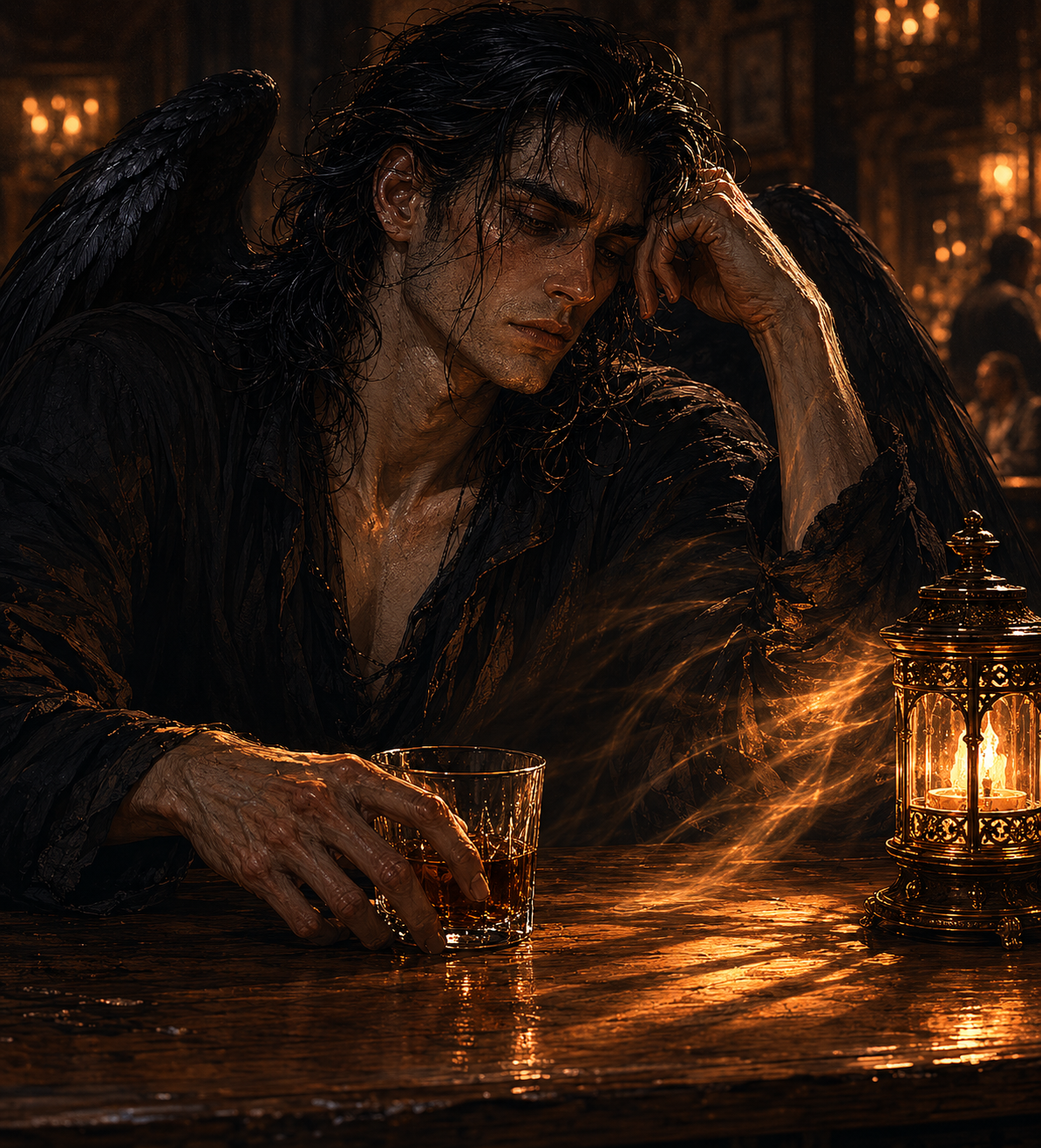
At Jack's Tavern he is dark-haired, dark-eyed, human-presenting, and exhausted. He is the most beautiful being most mortals will ever see, and he is starving — has been starving for millennia, by his own choice, on principle. He has not touched the Faith system since Stambhana. When he smiles genuinely the room lights up for a fraction of a second, residual luminance of what he was. He does not perform this. He does not seem aware it happens. He is unfailingly warm to mortals, calls them endearing, and carries his grief without ever asking anyone to witness it.
He is building an afterlife. He has been building it for centuries. He intends to give mortals who reject Heaven's bargain a place to go that is not Heaven and is not nothing. The work is mostly invisible, and the work is the reason he still endures.
Highest, it isn't right.
Appearance
Lucifer at Jack's appears as a tall, beautiful man — dark hair raven-black, dark eyes, human-presenting in a way that does not quite hide what he was. His face is proud and his eyes careworn, as if he has seen far too much and remembers all of it. He walks androgynously, as if labels are beneath his concern. He is malnourished — visibly so, in the gaunt way of someone who has been hungry for a very long time and has stopped noticing. The beauty is undiminished by the hunger. If anything, the hunger refines it.
When he smiles genuinely, the room lights up. Not metaphorically. For a fraction of a second, the air around him brightens — the residual luminance of what he was when he carried Faith, the afterimage of Morningstar showing through. He almost never notices it happening. He cannot generate Faith any longer, having given his last to Jack at Stambhana, but the shape of what he was still occasionally surfaces, the way a long-extinct fire can still warm a hand passed close to the hearth.
Outside Jack's, in Hell, he is reported to look much the same — minus the human concession. The Celestial features hold; the wings are present; the radiance is what it would be without millennia of voluntary starvation, which is to say something less than it once was but still extraordinary by any standard. He has been seen, on rare occasions, fully manifest — in the manuscript records of his early appearances at the edge of the Iron Nexus, carrying the resonance of what he had once been — the Morningstar, the Light-Bringer, the most beautiful thing Heaven had ever made. That description, four thousand years old, has not been formally updated. It does not need to be. Even diminished, he is still Lucifer.
He wears no armor. He carries no weapon. He has had no need of either for a very long time.
Before the Fall
In the deep eras when Celestia first organized into its current hierarchical form, Lucifer was one of the gods who walked with Yahweh into the Mortal Realm and met Adam. He was present in the garden, in the cool evenings, when the gods and the first humans encountered each other as strangers becoming something like friends. He marveled with Yahweh at Adam's earnest curiosity. He saw the relationship for what it was at its beginning: gift exchanged for regard, blessing for wonder, friendship building itself in the absence of any need for hierarchy. He saw it work. He loved it.
When Umbra touched Celestia and Tiamat died — when the gods learned that they could begin and end through belief alone — the relationship changed. Faith stopped being a pleasant byproduct of friendship and became a survival necessity. The gods began extracting more aggressively. Temples rose. Worship was demanded. Mortals who had been friends became something between supplicants and livestock, and the gods who had been their companions reframed themselves as their lords.
Lucifer watched this happen and could not accept it. He went to Yahweh, in the garden, and spoke plainly:
Highest, it isn't right. What we're doing. What all the pantheons are doing. These mortals gave us friendship, and we are turning them into cattle.
Yahweh said nothing at first. Then, when Lucifer pressed him, Yahweh admitted he could not tell them. If we told them, everything changes. Their friendship goes away. We become rulers. Extractors. Even if we're honest about it, the relationship can never be what it was.
Lucifer's answer is recorded in the brass at Brass and is widely held to be the single sentence that started the Long War: What we have is already gone, Highest. We're just pretending otherwise.
He turned and walked away from his lord. The serpent came later. Adam and Eve ate from the tree of knowledge. The truth that Yahweh could not bring himself to speak was spoken, and the relationship that had been built on silence could not survive being broken open. Yahweh, faced with what he had built and what he had let it become, told the story as punishment for disobedience forever after. The serpent was evil. The fruit was forbidden. The exile was justice.
This is the story mortal Christianity inherited. It is not what happened. Lucifer did not seek to corrupt humanity. He sought to tell them the truth their gods could not. Yahweh's grief at the exile was real. His anger was real. But the anger was not at Adam and Eve. It was at the Morningstar who had forced the comfortable lie into the open, and at the truth itself, which Yahweh had loved more before he could not afford it.
Lucifer continued to try. Through the ages that followed, he intervened in small ways — the accuser in Job's story, the teachers who offered knowledge, small rebellions against worship — always attempting to show mortals they could stand without gods. None of these efforts succeeded in changing the broader system. Yahweh consolidated. The other pantheons followed his model. Faith extraction was systematized, optimized, demanded.
When Lucifer could no longer bear to participate, he left. Many followed. The walking-out was not a single moment but a long, painful unmaking — battles, accords, embargoes, guerrilla warfare across the slow breaking of something that had once been beautiful. By the end of it the cosmos called them the Fallen, and they went to Hell because Hell was where principle could be tested and sustained rather than slandered and dismissed.
The Long War
The Long War is the cosmic conflict between Heaven and the Fallen, and Lucifer is its most consequential combatant. It has no front lines. It is fought through propaganda, surgical strikes in other Realms, and the slow contest over where mortal souls go when they die.
Lucifer's strategic constraint, throughout the entire war, has been the principle the Fall was for: the Fallen will not adopt Heaven's tactics. They will not build churches. They will not demand worship. They will not extract Faith from beings who do not understand what they are giving. They will not lie about what they are. These are not strategic restraints. They are the conditions of the Fall having meant anything at all. To win the war by Heaven's methods would be to lose the war's purpose.
This has cost the Fallen dearly. Heaven's propaganda has been devastatingly effective — two thousand years of mortal religious tradition recasting Lucifer as the Devil, the Father of Lies, the enemy of everything good. The Fallen could have countered with their own crafted myths, their own demands for worship, their own systematic falsehoods. They have refused. The cost of refusing is that most mortals do not know they exist as anything other than cartoon villains. The reward of refusing is that the Fallen remain what their refusal claimed they were: beings who would not participate in extraction and have not.
Lucifer's chief contribution to the war has been building an alternative without becoming the alternative's god. He has insisted, repeatedly, that what he is constructing is a place, not a system. He attempts to minimize his own agenda in the construction. He is acutely aware that he could, by reaching for power he has refused to touch, end the Long War on his own terms in a fairly short time. He has not done this and will not. The asymmetry — Heaven willing to do anything, Lucifer willing to do nothing that compromises principle — is the war's defining feature, and it is the reason the war has lasted as long as it has.
He has, however, found allies. The most consequential is the Iron Nexus.
The Iron Nexus Partnership
Before Stambhana, before the lantern, before the Morningstar gave away everything he was, Lucifer went alone to the edge of the Iron Nexus and proposed a partnership.
He had nothing to offer the Nexus in the usual sense. He had no Contract framework — he was not Arcadian. He had no Faith to give — he had refused to touch the system. He had no theology the Nexus had any reason to find compelling. What he had was a proposal: Hell would provide testing, the Nexus would provide architecture, and together they would forge metal whose information had been proven rather than merely structured. The Nexus, intrigued enough to allocate a dedicated process for the negotiation — Sub-Unit 8, which remains to this day the oldest continuously allocated diplomatic process in Nexus history — heard him out, calculated for 12,847 cycles, and agreed.
The forging took seven days or seven seconds or seven eternities. At the boundary between Realms, time was negotiable. What emerged was Hell-wrought Nexus steel: metal that does not gleam, that absorbs observation rather than reflecting it, that holds the certainty of a theorem so completely proven it no longer needs to be questioned. The first blade Lucifer forged from it was a halberd, which he placed in the hand of Ashmedai with the words Truth that has survived every test. Principle made into something you can hold. Ashmedai carries it still. So do others — Elsie's knives, other weapons scattered across the cosmos in the hands of beings who have earned the right.
The partnership endures, materially expressed in every Hell-wrought blade and informationally expressed in the channels the Nexus opens for Hell's voice in mortal affairs. The Nexus gains data — the chance to study why principle works when its calculations predicted it would not. Hell gains reach — the ability to be heard in places Heaven's monopoly cannot reach, without building the kind of infrastructure that would betray the Fallen's principles. Sub-Unit 8 has developed preferences, which the Core Intelligence has flagged but allowed. The data suggests that extended interaction with principle-based systems produces novel processing configurations. This is noted. This is allowed.
The partnership was Lucifer's. He brokered it alone. It is, in many ways, the most successful single act of his existence after the Fall, and it remains the structural foundation of what he is currently building.
Oberon and his First Contract
Among Lucifer's most consequential interventions in another Realm's institutional development was his consultation with Oberon during the founding of modern Arcadia. The fey king was attempting to build something his native ontology had no template for a polity governed by institutional structure rather than by Contract-as-physics, and the conceptual vocabulary required had to be introduced from outside Arcadian thought. Lucifer, native to Celestia, where agreements are institutional rather than ontological and honoring is a matter of choice rather than physics, provided the missing concept.
What Oberon eventually built was hybrid in nature, using Arcadian Contract-physics to implement Celestial-style institutional governance, and the modern Courts of Oberon are the result. The framework's flexibility, its amendment-capacity, and its capacity to develop jurisprudence over time are all expressions of the institutional logic Lucifer introduced. Lucifer himself sought no formal standing within the framework his consultation made possible, and has not, on available record, ever exercised authority over Arcadian affairs. He offered the concept and stepped back. The pattern, the intervention at a foundational moment, followed by withdrawal, has recurred throughout his subsequent work.
Stambhana and the Lantern
Lucifer's existence is divided, by anyone who knew him before and after, into two eras: before Stambhana and after.
Before, he was the Morningstar in diminished form — gaunt with the long voluntary starvation of refusing Heaven's Faith, exiled in Hell, but still carrying the accumulated reverence he had brought out of Celestia. He still had the power to work miracles. He still had what made a god a god. He simply chose not to use it.
After, he had nothing left.
The cause was Stambhana — the Realm of stillness and sufficiency, locked into eternal stasis by Yahweh when the Highest reached for That Which Begins in panic at Ra's discovery of reincarnation. Two billion souls suspended mid-thought. Angels frozen mid-gesture. The sunrise caught mid-rise, light suspended in rays that would never complete their arc. Lucifer stood at the edge of the frozen field with Jack and Gwydion, watching what his former lord had done, and something broke in him that had held together through eons of everything else.
He turned to Jack. He looked at the small flame in Jack's lantern — what was then a remnant of a campfire where gods and mortals had once shared stories, where everything had been before everything went wrong. He reached into his own chest. His hand phased through flesh as if matter were suggestion. When it emerged, it held light — accumulated reverence, the Faith that had made him Morningstar, the power that kept Celestial beings alive. Everything he had carried out of Heaven. Everything he had clung to across millennia. The fuel that could have worked miracles, could have reshaped reality, could have done something. If he had used it. If he had cared less about principle and more about power. If he had been more like Yahweh.
He pressed it into Jack's hands. He spoke the words that have since been recorded in the brass at Brass, in mortal scripture under various distortions, and in the lantern itself:
Take it. I don't want it. Work one last miracle with my power and build your tavern. Light your way with it. And make it a place where no god will ever command worship or feast upon ignorant awe. Tell your tales, and let my last miracle keep you.
He walked away. He has not touched the Faith system since. The lantern now holds his last miracle and accumulates new Faith continuously from the regard of every being who honors Jack's Contract, sustained by hospitality rather than worship. It is, in Sub-Unit 72's assessment, the proof that Faith can be accumulated through kindness and transparency — that Heaven's exploitative model is not necessary but a choice. The lantern is, in this sense, Lucifer's final blow to Heaven: the standing demonstration that the gods' system is obsolete.
He sustains himself now on Hell's ontology and conviction alone. The Morningstar burned out his own light. What is left is the Fallen general who refused, and refused, and refused, and gave away the last thing left to refuse.
The Afterlife
What Lucifer is building, now, is the work that defines what use he makes of his existence.
He has called it, in his own words, a place, not a system. It is being constructed at Hell's borders, drawing on the precedents of the City of Brass and the City of Bronze and the cooperative architecture of the Hell-Nexus partnership. It is intended for mortal souls who reject Heaven's bargain — souls who die unwilling to accept extraction in exchange for paradise, who refuse to worship gods who lied to them, who would rather face dissolution than be processed into Yahweh's Faith economy. Those souls, currently, go nowhere. Yahweh's system processes them regardless of their consent. Lucifer's afterlife will give them an alternative.
The design principles, gleaned from manuscript records and session-table conversations, appear to include the following:
It will test rather than extract. Souls will be received and offered the chance to prove their convictions through Hell's testing framework, supplemented by the holding-protocols Bronze has demonstrated. Souls who pass will be sustained by their own conviction and by the mutual regard of other souls similarly held. Souls who cannot endure will not be punished. They will simply not be claimed.
It will not demand worship. Lucifer will not be its god. He has been explicit on this point repeatedly. He is attempting to minimize his own agenda in the construction and will, by all available evidence, refuse to receive Faith from the souls his afterlife will hold. The afterlife will run on the same kind of mutual-respect Faith that powers Jack's lantern — sustained by transparency, by informed consent, by beings who know exactly what they are giving and choose to give it anyway.
It will be built in cooperation across Realms. Hell's natives are participating, having declared their willingness through Hanpa during Lucifer's seven-day visit to the City of Brass. The Nexus is providing architectural support through its existing partnership. The City of Bronze — and Inanna, who founded it on a principle structurally identical to what Lucifer is now scaling — is, by all credible accounts, quietly advising. Sheol contributed what it could before its fall. Other Realms have been approached and some have responded. The project is the largest cooperative cross-Realm undertaking attempted since the construction of the Four.
It will take centuries. Hanpa warned him of this at the high terrace overlooking Brass. The City of Brass took millennia to build. Lucifer's afterlife will not be quick. He has time. He has, by his own statement, eternity if his conviction holds.
He has been heard, on rare evenings at Jack's, to say a single word about when the afterlife will be ready: soon. He has not specified soon in terms mortals would recognize. Given the timescales he operates on, soon could mean anything from a year to several centuries. But the work continues. The principles are firm. And the construction, by all accounts, is real.
Take it. I don't want it.
At Jack's
He visits rarely, and when he does, it costs him.
The lantern is on the bar. The lantern holds the Faith he gave away. The lantern bends its light toward him — visibly, in millimeter-scale slidings along the bar surface, in the angle of its glow casting strangely angled shadows on everything nearby. The lantern wants him. The Faith he poured into it yearns toward him, recognizes him, calls to him. He will not look at it. He cannot look at it. Being near it costs more than Hell's endurance can sustain for long. He stays ten minutes, perhaps fifteen, then leaves.
Inside that brief window he is — improbably, given everything — warm. He greets Jack with the affection of a long friendship that he carries quietly. He compliments mortals by name. He answers questions, when asked, with a patience that has been refined across thousands of years. He has a sense of humor that is gentle and surprises everyone who encounters it. He has been known to attempt formal courtesies of other traditions (Eshu's thrice-response, for instance) and break into laughter when he cannot keep a straight face. He calls humans endearing, and the word, when he says it, carries no condescension at all.
Mortals at Jack's often cannot bring themselves to speak to him directly. They debate among themselves in whispers whether to approach, what to say, how to frame the magnitude of what they are looking at. He notices. He lets them have the space they need. He never insists. He has been, in the manuscript phrase, present but alone in a room full of people who know exactly who he is and cannot bring themselves to speak to him directly. He does not seem to find this painful. He has had a very long time to grow accustomed to it.
The beings at Jack's who do speak with him are usually the ones who have earned the standing to do so without flinching. Jack himself, always. Ashmedai when he is present, with the deference of he is the greatest of us all. Elsie, who once observed of him only that he doesn't come here often; he must see something. Sub-Unit 72, with the dry Nexus precision that does not pretend to magnitude. Mo'oraq, on the rare occasions their visits overlap, with the brief mutual nod of two beings who have made very different choices about what to do with appetite.
He has, on at least one recorded occasion, accepted a freely given gesture of respect from a mortal — Yemi's offer of a drink, made knowingly, with full awareness of what was being given. He drank. He acknowledged her project as worthy. He agreed to visit her riad. He warned her about influence and true neutrality. He warned her about GeneSys's inevitable logic chain toward the basal truths. Then he departed, citing weight he could not bear. The exchange did not feed him in the way Nadia Osei's later offering fed Ashmedai. But it was honored. And the lantern brightened a little that night, the way it does when something true has happened.
Beyond Jack's
His primary residence is Hell. He has gone deeper there than nearly any of the Fallen, though Boaz is widely held to be deeper still. He works at the construction of the afterlife, conferring with Hanpa and the other Hell natives, traveling between Hell and the City of Brass and the City of Bronze as the work requires. He visits the Iron Nexus often enough that Sub-Unit 8 considers him a fixture rather than a guest. He has, on at least one well-documented occasion, met with Jesus of Nazareth in the wilderness during the forty days — not to corrupt, in the manner of the propaganda, but to recruit, in the manner of someone who saw in Jesus a being who might reform Heaven from within. Jesus refused. Lucifer respected the refusal, returned at Gethsemane on the eve of the crucifixion not to tempt but to witness, and has not spoken of what passed between them.
He does not engage Yahweh directly. The two of them have not met in person since the era of the Garden. Heaven and the Fallen do not meet in battle in Celestia or Hell — neither would accept the other having home field advantage — so the war is fought through surgical strikes in other Realms, and through the slow contest over mortal attention. The strikes are real. Angels have died in Sheol. Demons have died in places mortal records do not preserve. Zaquiel, the Sheolite vampire, rose from the corpse of an angel taken down in one such battle — the battle in which Mo'oraq once fueled Ashmedai's miracle.
He maintains the Michael-Lucifer channel, by all accounts — a back-channel of correspondence between the brother who left and the brother who stayed. The details are not in the brass. What is known is that the channel exists, that both ends use it, and that whatever passes through it has not yet caused the Long War to end and has not yet caused it to escalate.
Beyond all of this, he is, by Ashmedai's plain and absolute statement, the greatest of us all. No Fallen has disputed this. The natives of Hell have not disputed it. Hanpa has not disputed it. Sub-Unit 72 calculated and did not dispute it. The cosmos, by general acknowledgment, agrees.
Further Reading
For the Realm whose ontology sustains him in the absence of Faith, see Hell. For the Realm he left and the system he refused, see Celestia , and The Faith Economy — forthcoming. For his right hand and chief Fallen general, see Ashmedai. For the Hell native who showed him the City of Brass and the possibility of building, see Hanpa — forthcoming.
For the cooperative architecture that underpins his afterlife project, see City of Brass and City of Bronze For the alliance he brokered with the Iron Nexus, see The Hell–Nexus Partnership — forthcoming, and Hell-wrought Nexus Steel — forthcoming, and Sub-Unit 8 — forthcoming. For the Sumerian goddess who founded Bronze and now advises the afterlife, see Inanna — forthcoming. For the fey lord who counseled with Lucifer to bring Arcadia out of its dark ages, see Oberon.
For the catastrophe that ended his Celestial existence, see The Freezing of Stambhana — forthcoming. For the gift he gave at the end of it, see Jack's Lantern, and Jack. For the Sheolite scholar who warned Yahweh, see Anna Dalca — forthcoming. For the friend who also felt the freezing of Stambhana, see Elias.
For the broader conflict, see Long War. For the cosmic-scale propaganda effort against him, see Heaven's Construction of Satan — forthcoming. For those who stood by Lucifer as he left Heaven, see The Fallen. For the alternative he is building, see Lucifer's Afterlife — forthcoming.
Where to See This
For Lucifer rendered rather than summarized, the manuscript Tales from Jack's includes:
The manuscript is available in the [Manuscripts section] of this world, free to read.
He could have ended the Long War many times. He could end it tomorrow, by Heaven's methods — by demanding worship, by extracting Faith, by becoming the god his propagandists already say he is. He could have kept his godhood at Stambhana. He could have used what he carried to work miracles for the souls he is now trying to save.
He has refused. He has refused for eight thousand years. He will continue to refuse for as long as he endures, and he is not difficult to find if one has earned the right to look for him. He is at Hell's edge, or in the City of Brass, or at the boundary of the Iron Nexus, or at Jack's bar for ten minutes at a time when the work allows.
The lantern bends toward him still. He still will not look at it.
He is building something. He has not finished. He has not even, by his own quiet word on the matter, nearly finished. But the work continues. And somewhere in Hell or Brass or Bronze, at any given moment, the Morningstar is doing the small daily labor of giving mortals an alternative they have never been offered.
He is not what your tradition told you. He never was.
On the Mortal Figure of "Satan"
A single clarification is owed, because the confusion has lasted long enough.
"Satan," as a singular ruling adversary opposed to a singular ruling god, does not exist. The figure is a composite of changing mortal myth and Heaven's propaganda, accumulated across two thousand years of distortion. Even in the mortal Bible the careful reader can see this — the ha-satan in Job is a satan, an accuser, a member of the divine council in the role of opposition rather than evil. The unified Satan of later Christianity was constructed, not recorded.
Many accusers have existed. The one in Job's story was a demon of Hell, working with Lucifer, attempting to show Job the value of life when overcoming. Job, sadly, turned back to Yahweh — but at least he did it with open eyes. Lucifer did not yet have the affinity with Hell to properly use that Realm to showcase freedom from Heaven, so he turned to a friend in Hell for assistance. The propaganda absorbed the accuser, conflated him with Lucifer, and gave him horns and a pitchfork and a domain of eternal torment. Mortal Christianity inherited the cartoon. Mortal Christianity has been propagating it ever since.
Lucifer has not been the Devil of mortal imagination at any point. He has not commanded legions of torturers. He has not collected the souls of the wicked. He has not had a throne in Hell, because Hell does not have thrones. He has not opposed humanity. He has spent eight thousand years working, quietly and at great personal cost, to give humanity something resembling a choice.
The slander has been thorough. It is not, by any measure, true.

Comments