Jack's Lantern
The Lantern
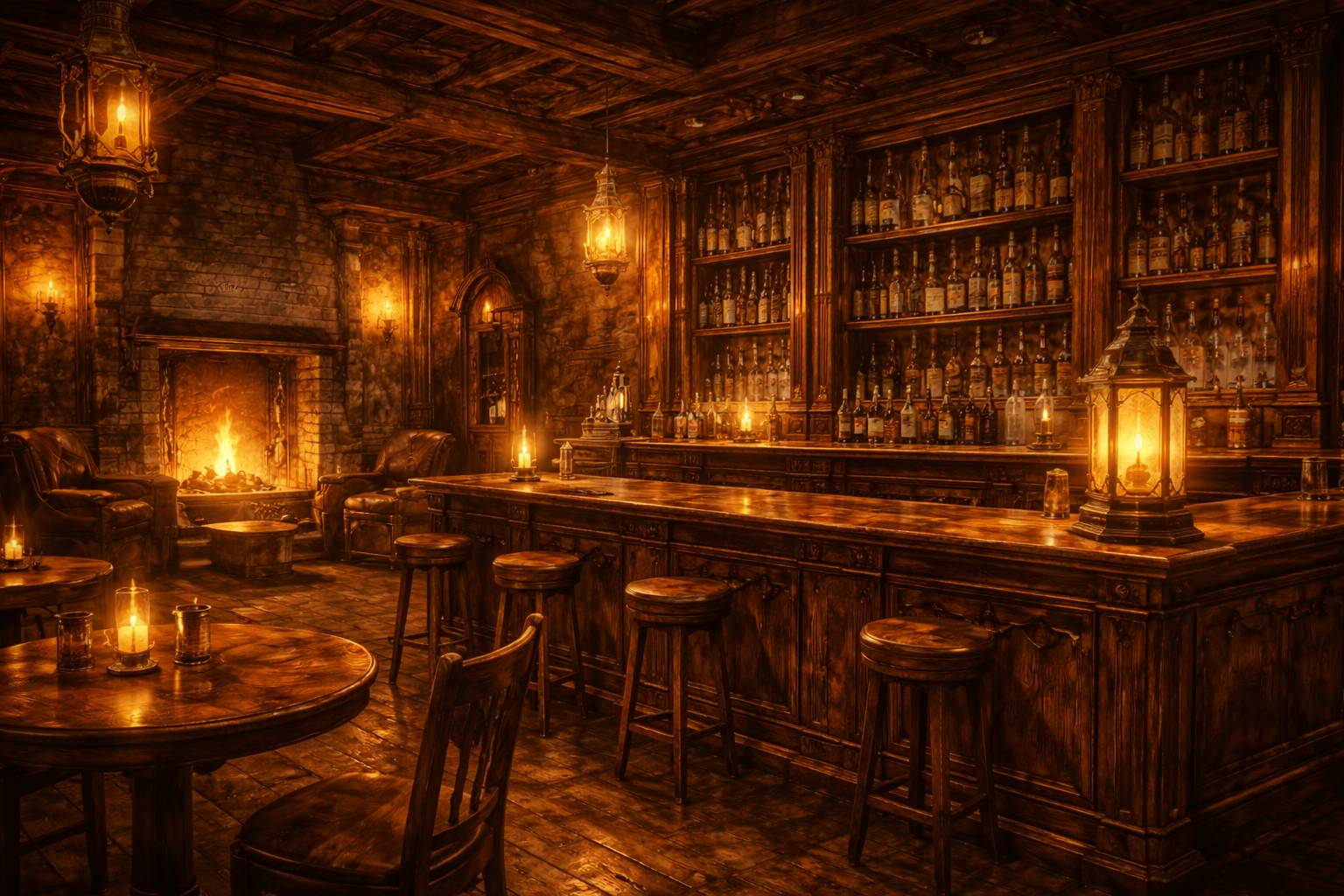
Lucifer's last miracle. The proof that the gods' system is a choice and not a necessity. The most concentrated stockpile of freely given regard the cosmos has produced.The lantern rests on the bar at Jack's Tavern, glowing softly, and what it contains is enough to humble Yahweh.
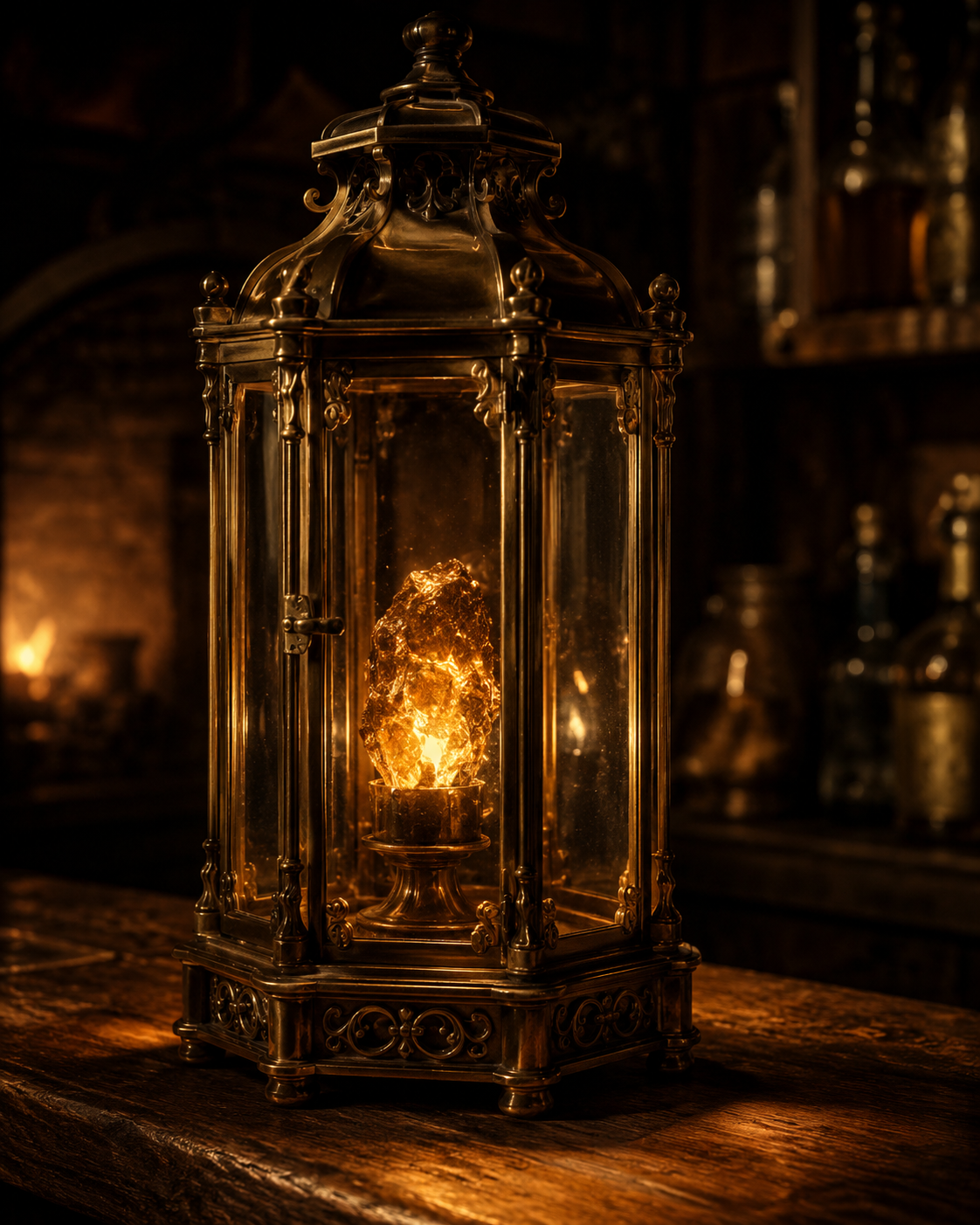
It looks like a fine piece of work — a beautiful brass-and-glass artifact, the kind of object a craftsman might spend a lifetime perfecting and never quite match. Patrons who notice it for the first time often comment on its beauty. They are typically not aware, at first, that they have just remarked on the second-most-powerful object in the cosmos that they will encounter today; the most powerful is the Contract carved into the door behind them. Both are connected. Both are why Jack's Tavern works.
The lantern's light was a gift to Jack from Lucifer, given at the threshold of the Realm of Stambhana on the day Yahweh froze two billion souls. It was, by Lucifer's own description, his last miracle. The Faith it was seeded with was every particle of accumulated reverence Lucifer had carried out of Heaven across millennia — the power that had made him Morningstar, the substance that kept Celestial beings alive, everything he had clung to and refused to spend on himself since the Fall. He gave it all away in a single act, and the gift went into the small flame Jack had been carrying in a lantern he made himself, by a campfire where stories had once been exchanged.
That was the seed. What has grown from it across the centuries is the proof of Lucifer's whole argument — that Faith can be accumulated through transparency and informed consent, rather than through extraction and ignorance. The lantern is, in Sub-Unit 72's assessment, what Jack possesses that may rival the gods themselves in stored Faith. The lantern is also what Jack uses to enforce hospitality. The two facts are the same fact.
This is the article on what the lantern is, what it does, and why it matters.
Origin
The seed within the lantern is what Sub-Unit 72 has calculated, with 99.98702% certainty, to be the crystallized Faith Lucifer carried out of Heaven when he fell.
This requires careful distinction. The coal at the lantern's heart is not hellfire; hellfire is the friction-byproduct of overcoming Hell's testing pressure, and would be the wrong substance for the lantern's function. Nor is it ordinary Celestial Faith of the kind the gods extract from mortal worshipers; that substance is alive with the conditions of its extraction, tied to the hierarchies that produced it. The coal is something rarer: Faith that was extracted properly (by Heaven's standards) at the time of its accumulation, then refused, then carried voluntarily across millennia by a being who would not use it, and finally given freely to another being as a gift. The voluntary giving is the key. Faith offered as a gift, by a being who could have used it for anything and chose to use it for this, is qualitatively different from Faith extracted from any other source.
The giving happened at the edge of Stambhana. The circumstances are recorded in the manuscript and in the brass at Brass. Yahweh, in panic at Ra's discovery of reincarnation, had reached for the basal truth That Which Begins in an attempt to create a paradise that could compete with the new option. That Which Is answered instead. Two billion souls were frozen in eternal stasis. Lucifer, Jack, and the Forge-smith Gwydion stood at the edge of the frozen field and watched what could not be undone.
Something broke in Lucifer that had held together through everything else — through the Fall, through millennia of voluntary starvation in Hell, through watching Yahweh's propaganda twist his name into cartoon villainy. He turned to Jack. He looked at the small flame in Jack's lantern, which was at the time only the memory of a campfire where Jack and Elias had once shared stories. He reached into his own chest. His hand phased through flesh as if matter were suggestion. When it emerged, it held light — accumulated reverence, the Faith that had made him Morningstar, the power that kept Celestial beings alive. Everything he had carried out of Heaven. Everything he had clung to across millennia.
He pressed the smoldering Faith into Jack's hands and the lantern. It flowed like liquid light, pooling into the flame, making it burn brighter. He spoke the words that are now recorded in the brass at Brass and that the lantern itself remembers.
Take it. I don't want it. Work one last miracle with my power and build your tavern. Light your way with it. And make it a place where no god will ever command worship or feast upon ignorant awe. Tell your tales, and let my last miracle keep you. - Lucifer
He walked away. He has not touched the Faith system since.
Gwydion, who had loved an angel frozen in the field behind them and who could not design his way back to her, made a quiet promise to help build the tavern. He kept it. The materials gathered from across the cosmos — Bodhi wood from the tree of Nirvanic awakening, Nexus brass that records every word, Paradox Wood from Arcadian edges where conflicting truths coexist — were chosen with the same care Gwydion brought to everything else. At the heart of the building, in the only place that made sense, Jack set the lantern.
That was several centuries of mortal time ago, in one fashion or another. The lantern has been there since.
What the Coal Is
Sub-Unit 72 has explained the technical nature of the coal more clearly than anyone else, and the explanation bears repeating in full because it corrects a common misunderstanding mortal patrons reach.
The coal is not hellfire. Hellfire is the friction-bleed of imposing Hell's pressure; it appears wherever beings overcome the weight of Hell's testing, including inside Hell proper and at the borders of the Outer Ring. The coal at the lantern's heart is a different substance entirely. It is, per the Nexus calculation, the crystallized form of the Faith Lucifer carried out of Heaven — Celestial substance that has been folded into a stable physical artifact through the conditions of its giving.
This crystallization is itself remarkable. Faith ordinarily does not crystallize. It is fluid, accumulating in beings rather than in objects, dissipating when the source of its extraction is removed. What produces crystallized Faith is the specific combination of conditions that obtained at Stambhana: an enormous quantity of accumulated Faith, given voluntarily by a being who had refused to use it for millennia, transferred deliberately into a physical vessel by a being capable of receiving it, and committed to a permanent function that the giver and receiver both intended. The combination produces a state of Faith that mortal physics has no analogy for. Sub-Unit 72 has called it gift-state Faith, and considers it the most ontologically stable form of Celestial substance known to exist.
The crystallized coal does not deplete. The Faith within it is the original gift, intact, since the Morningstar gave it. What changes over time is not the coal but what surrounds it: the centuries of additional Faith that has accumulated in the lantern's housing through the regard of beings who have entered Jack's Tavern, honored the Contract, and given their respect freely. Each act of honest acknowledgment adds to the stockpile. The coal is the seed. What surrounds it is the forest the seed has grown.
The housing itself, the brass-and-glass artifact in which the coal sits, was a modifcation of the original, forged by Gwydion, to contain Lucifer's gift. It is not ordinary brass; it might not even be Nexus brass. It is, by all available evidence, a crafted vessel made specifically to contain the gift Lucifer was about to surrender.
Accumulation Through Hospitality
The function of the lantern, beyond its origin, is to demonstrate Lucifer's central thesis: that Faith can be accumulated through transparency, hospitality, and informed consent rather than through extraction, hierarchy, and ignorant worship.
The mechanism is straightforward to describe and ontologically extraordinary in operation. Every being who enters Jack's Tavern and honors the Contract on the door — agreeing to neutral ground, leaving conflict at the threshold, paying for service with a story freely told — performs a small act of regard. Their entry signals: I respect what this place is. I accept its terms. I value what is offered here. That regard, when freely given, flows into the lantern. The coal receives it. The accumulated Faith grows.
This is Faith without worship. Jack does not demand reverence. He does not present himself as a god; he is not one. He does not promise paradise or threaten damnation. He simply runs a tavern according to clear terms, and beings who use the tavern as those terms describe — and who do so willingly, knowingly, with full understanding of what they are accepting — generate Faith in the lantern as a natural consequence of the transaction. The substance is the same Faith the gods extract from mortal worshipers. The economy is the inverse.
Zaquiel has been Jack's most articulate interpreter of this mechanism.
The lantern was seeded with Lucifer's last Faith. His final miracle, given to Jack at Stambhana. But it has grown since then. Every being who enters, who honors the Contract, who respects neutral ground — their appreciation feeds it. - Zaquiel
The implications are extraordinary, and Zaquiel has named them plainly: Jack may rival the gods themselves in stored Faith. And he uses it to run a tavern. To enforce hospitality. To maintain neutral ground. To prove that power accumulated through kindness is possible.
This is, in the deepest sense, what Lucifer was doing when he gave the gift. He could not defeat Heaven directly. He could, however, demonstrate an alternative model — a way to accumulate cosmic power without exploitation. The lantern is that demonstration, sustained for centuries of mortal time and counting, in a tavern where millions of beings across all thirteen Realms have entered, told their stories, and left changed.
Functions
The lantern performs a number of functions, all of which are expressions of the same underlying principle: it stores accumulated regard, it draws on that regard to enforce the Contract of Jack's Tavern, and it responds to the presence of beings according to its own ontological sense of what is honorable and what is not.
Enforcement of the Contract. When the Contract on Jack's door is violated — when a being inside the tavern breaks the terms they agreed to upon entering — the lantern can be raised, and the Faith it has accumulated can be discharged as a corrective force. The display when this occurs is dramatic. The lantern flares with light that does not behave like ordinary light. It does not illuminate; it presses. The pressure is directed at the violation, not the violator's personhood — but the violator, of course, experiences the pressure as personal, because they are the locus of the violation. Mortal patrons have witnessed Jack throw three angels through the door without effort; the lantern flared, the light poured out, and the angels were ejected as casually as one might shoo annoying insects. The door blew off its hinges and reappeared whole moments later.
The enforcement is selective and proportional. Small violations produce small flares. Significant violations produce significant displays. The lantern does not punish; it corrects, and the correction is calibrated to the breach. Beings who realize they have violated the Contract and immediately apologize typically find the lantern's response gentle. Beings who attempt to escalate find it less so.
Diagnostic illumination. Jack has been seen to use the lantern as an assessment tool — holding it up to a patron's face, looking into their eyes, reading something the lantern's light reveals. He used the lantern this way on Nadia Osei early in her first visit, and remarked afterward that she had a kind soul beneath her thirst to investigate. The mechanism is not fully understood, but appears to involve the lantern's stored Faith resonating with the moral substance of the being being examined. Beings whose nature is dishonest, harmful, or fundamentally opposed to what Jack's Tavern represents register negatively. Beings whose nature is genuine, however flawed, register positively. Jack does not use this tool casually. When he does use it, the assessment is final.
Acknowledgment of presence. The lantern brightens or dims in response to certain beings entering the tavern. The brightening is not flattery; it is recognition. The dimming is not rejection; it is wariness. The substance has been accumulating regard for four thousand years and has developed something close to taste — a preferential responsiveness to beings whose character resonates with what the lantern is made of.
The most consistent brightening occurs in response to honored guests — beings of significance whose presence the lantern recognizes as worthy. The most dramatic brightening occurs in response to Lucifer himself. The light bends toward him visibly, sliding millimeter-by-millimeter along the bar in his direction, casting strangely angled shadows on everything nearby. The lantern wants him. The Faith inside it knows who it once belonged to. Lucifer will not look at it. Being near it costs more than he can sustain for long, which is why his visits to Jack's are brief.
The most consistent dimming occurs in response to beings of bad faith. When the angel Aniel and his companions entered with hostile intent, the lantern was raised in warning before they had even reached the bar. When Ilyanka entered under a partial-truth Title, the lantern's light bent imperceptibly away from him — and Jack noticed.
Distinctions of recognition. The lantern's responses have developed enough nuance that mortal observers have begun to learn its vocabulary. There is the warm brightening for honored guests. There is the guttering acknowledgment given to beings of cosmic significance whose presence is heavy but not unwelcome — what the manuscript describes as the lantern's response to Lord Death's arrival. There is the older recognition the lantern offered when Ilyanka revealed himself: not the warm brightening it offers to honored guests, nor the guttering acknowledgment it gave to Death. Something older. A recognition of what once was — a candle greeting the memory of a sun. There is the flicker of disquiet for beings carrying unspoken violation. There is the bright flare for hostility, and the dimming for dishonesty, and the steady glow for honest exchange.
The lantern is, in this sense, an active participant in the tavern's operation. It is not simply furniture. It watches. It responds. It remembers.
Intriguing - Sub-Unit 72
Mortal Folklore
The mortal Irish tradition of Stingy Jack — the trickster who carried a coal from the Devil in a carved-out turnip lantern — is, by mortal-folkloric standards, an unusually accurate rendering of what actually happened. The accuracy is partial and the framing is wrong, but the structural facts are recognizable.
In the mortal tale, Jack is a clever fey-touched mortal who has tricked God and the Devil and is therefore refused entry to either Heaven or Hell. The Devil, in the most common version, takes pity on him (or honors a bet he lost) and gives Jack a single coal of hellfire to light his way as he wanders the world forever. Jack carries the coal in a hollowed-out turnip (or, in later American renderings, a pumpkin).
The structural facts the folklore preserves:
The structural facts the folklore distorts:
When the homeless Dubliner Colin recognized Jack as Stingy Jack, the man who fooled God and the Devil, Jack responded with characteristic grace: So I am, so to speak. The stories you've heard may be a touch exaggerated. The understatement is itself characteristic. The stories mortals tell about him are not wrong in their structure. They are wrong, however, in their conclusions, and they leave out almost everything that matters.
The lantern in the mortal tradition is the most enduring piece of the story. The jack-o'-lantern of modern Halloween — carved gourds with candles inside, set out at the threshold to ward off wandering spirits — is the mortal echo of what Jack's actual lantern does at his actual threshold. The function has been preserved across cultures and millennia, even where the meaning has been forgotten.
Notable Events Involving the Lantern
The lantern has been involved in nearly every significant event at Jack's Tavern for the four thousand mortal years of its existence. A short selection of the most well-documented:
The first lighting at Stambhana. The original act. Lucifer transferred his accumulated Faith into the lantern at the threshold of frozen Stambhana, in Gwydion's presence. The moment is the subject of the manuscript scene The Moments After and is recorded in the brass at Brass.
The construction of the tavern. Jack and Gwydion built Jack's Tavern using the lantern's Faith as one of the constituent forces. Gwydion provided design and Forge precision; Jack provided the changeling's instinct for thresholds; the lantern provided the foundation for everything else.
The expulsion of three angels. When Aniel and two Celestial companions disrupted a conversation at Jack's by reaching for sword and making veiled threats, Jack raised the lantern. The light poured out and threw the three through the closed door, blistering their faces, igniting their feathers, and tumbling them into the street. The door blew off its hinges and reappeared whole. Sub-Unit 72's commentary: Intriguing. The incident is the subject of the manuscript scene The Weight of Heaven and is widely cited in cross-Realm conversation as the moment the lantern's full capacity became publicly known.
The repulsion of Mo'oraq. When the Voracian apex attempted, in his first visit, to consume Jack himself — extending Voracian hunger toward the changeling behind the bar — Jack raised the lantern. The light could not be eaten. Mo'oraq's hunger closed around it and found nothing to grip. The light burned across his throat, leaving a scar that has never healed and will never heal. Mo'oraq returned the next night chastened, asked what the lantern was, and received Jack's now-famous explanation: Respect, freely given. Accumulated over time. Not worship.
Ashmedai's demonstration. When the Fallen general demonstrated Hell's ontology to a curious mortal at the bar — the spear, the imposed weight, the cracked floorboards — Jack raised the lantern in formal authorization. The lantern flared brightly. Hell's full pressure was permitted, briefly, inside the tavern, with the lantern as the seal of authorization. Without the lantern's permission, the demonstration could not have proceeded.
The diagnostic on Nadia Osei. In Nadia's first conversation with Jack, he held the lantern up to her face and looked into her eyes. The reading produced his assessment: You have a kind soul beneath your thirst to investigate. The lantern's diagnostic capacity is rarely deployed; its use here was a sign of Jack's interest in her and his recognition of her potential.
Yahweh's confession. When Yahweh himself entered the tavern — a presence the lantern recognized with a single, accusatory flare — and confessed to the freezing of Stambhana, the lantern brightened at the moments of his honesty. The brightenings were not gentle. They were judgmental. Yahweh accepted the judgment, drank his refilled glass, and acknowledged that the story he had given as payment was not enough. Jack agreed.
Zaquiel's correction. When the Sheolite vampire moved to strike Mira after she announced her decision to inform humanity about the Realms without their consent, Jack's quiet word stopped him: Zaquiel. The lantern brightened. Zaquiel dissolved into mist rather than test the warning. He left through the door without violence. The lantern's authority was sufficient even to halt a Sheolite predator mid-strike.
These events constitute, in a sense, the lantern's curriculum vitae. It does what it does, in service of the Contract, and its history is the history of Jack's Tavern itself.
The Lantern's Limits
The lantern is not omnipotent. A few limits are worth naming.
The lantern's authority extends only to the Contract on the door. Beings who have entered Jack's and agreed to its terms are subject to the lantern's enforcement. Beings outside the tavern are not. Jack does not project the lantern's power into the wider cosmos as a general tool of will; he projects it only as the structural enforcement mechanism of a specific Contract in a specific place.
The lantern does not act against beings who have committed no violation, regardless of who they are. Yahweh himself was permitted to enter Jack's, sit at the bar, drink, confess, and depart. The lantern's flares during his visit were responses to specific moments of revealed truth, not aggression. The Contract is the law, and the Contract applies to everyone equally.
The lantern cannot be commanded by anyone other than Jack. The Faith it contains responds to Jack's deliberate use of it because Jack is the bearer to whom the gift was given. No other being can wield it. Lucifer, the original donor, could in theory reach for it but does not. No mortal has ever attempted to take it. The few beings who have entertained the idea — there are records of Celestial reconnaissance, certain Voracian considerations, at least one Arcadian theft proposal that died in early planning — have all concluded that the cost of attempting and failing would be irretrievable, and the cost of attempting and succeeding would be unbearable. The lantern remains where it is.
The lantern is not invulnerable in any absolute sense. Sub-Unit 72 has calculated scenarios in which sufficient coordinated cosmic force could overwhelm it. None of these scenarios are practical. The coordination required would be greater than any current cosmic faction can muster, and the coordination itself would constitute such a profound violation of the existing order that other forces would respond before the attack could be executed. The lantern is, by Nexus assessment, operationally invulnerable in the current cosmic configuration. This is not the same as being theoretically invulnerable. It is, however, sufficient.
The lantern's Faith does not run out. The original gift is permanent; the accumulated regard is ongoing. As long as Jack's Tavern operates and beings enter it honestly, the lantern grows. The only thing that could deplete it is the closure of the tavern, and the tavern is unlikely to close. Lucifer's last miracle, in this sense, has worked rather well.
Certain beings such as 156th Hunger have calculated what they deem to be the effort necessary to resist the lantern's power for a time in order to, for example, pull a waiting human from the doorway of the tavern before being struck down. The cost is always high, and generally disregarded as not worth the effort.
Further Reading
For the being who gave the gift, see Lucifer. For the keeper of the lantern, see Jack. For the building the lantern was given to fund, see Jack's Tavern. For the Contract the lantern enforces, see The Contract on the Door — forthcoming.
For the catastrophe at which the gift was given, see The Freezing of Stambhana — forthcoming. For the Forge-smith who helped build the tavern around the lantern, see Gwydion — forthcoming. For the Sheolite vampire who explained the lantern's function most clearly, see Zaquiel. For the Nexus process whose calculation confirmed the coal's nature, see Sub-Unit 72.
For Lucifer's broader alternative-Faith project, of which the lantern is the proof of concept, see Lucifer's Afterlife — forthcoming and Faith.
Where to See This
For the lantern rendered rather than summarized, the manuscript Tales from Jack's includes:
The manuscript is available in the [Manuscripts section] of this world, free to read.
The lantern sits on the bar. The flame inside it is small, warm, golden, faintly humming with the weight of what it contains. It looks like a fine piece of work. It is more than that.
It is Lucifer's argument made into an object. It is the proof, sustained for four thousand mortal years, that the gods' system of extraction and worship is a choice rather than a necessity. It is the foundation of the only true neutral ground in the cosmos. It is the seal of authority that Jack uses to enforce a Contract he has held for millennia of mortal time.
It is also, more simply, a gift from one friend to another, made in a moment of unbearable grief, and carried since with the gentle competence of a being who knows exactly what was given and exactly what it cost. The Morningstar gave away his godhood and walked into exile carrying nothing but conviction. The changeling at the campfire received the gift and built a tavern around it. Both of them are still keeping the promise they made that day.
The lantern is the promise made visible. It glows. It remembers. It will not stop.
The Lantern and Lucifer
The most painful relationship in the lantern's history is the relationship between the lantern and the being who created it.
Lucifer visits Jack's occasionally. He sits at the bar, nursing his drink, present but alone in a room full of people who know exactly who he is and cannot bring themselves to speak to him directly. The lantern, sitting on the bar, bends its light toward him. There is a scratching noise as it slides imperceptibly along the wood in his direction, drawn by the recognition of its own substance. Strangely angled shadows fall across the bar surface as the lantern's glow shifts. The Faith inside it wants him. It was his. It remembers having been his.
He will not look at it.
He cannot look at it. Being near it costs more than Hell's ontology can sustain for him over any extended period. He has been told, by every being who knows what the lantern is, that the Faith is still there and could in theory return to him if he reached for it. He does not reach. He has not reached for four thousand mortal years. The decision to give it away was not provisional. He does not regret the gift, but the proximity to it remains exquisitely painful, in a way that the mortal language for grief barely covers.
The lantern's yearning is not malicious. It is structural. Faith remembers what it was extracted from or given by, and Lucifer's Faith remembers him most of all. The recognition is involuntary on the lantern's side and unbearable on Lucifer's. Their proximity is a continuous tragedy, witnessed by every regular at Jack's, never spoken of directly, and never resolved.
When he is at the bar, the lantern brightens. When he leaves, the lantern's light returns to its ordinary glow, and the tavern's other patrons exhale. They have been holding their breath without knowing they were doing so. The room felt smaller while he was there, not because of his presence but because of what was happening between him and the small object on the bar that he made.

This is wonderful! Although I haven't read enough of your world, it really brings together what I have read. And, I'm intrigued - by nearly everything. But, in particular, the Faith Economy, and the Freezing story.
I'm so glad you enjoyed it! I've linked the Faith article above, if you're curious how the Faith economy works. I've still got lots more to pull off my computer and get into article form, so there's plenty more to come as I continue to add to WA.