Zaquiel
Zaquiel
Sheolite refugee, vampire of Celestial lineage, witnessZaquiel is what is left when a Realm dies and one of its sons happens to be elsewhere.
He is a vampire of Sheolite origin, animated by alchemical fire that copied a dying Celestial — not the angel whose body he wears but the fire that mimicked it, carrying the angel's life as a memory the way a copied document carries the original's handwriting. He was a student of Anna Dalca. He lived in Khem-Ashar when the libraries still burned green. He has, by his own reckoning, walked the cosmos in one fashion or another for about four thousand years of mortal time, and most of those years have been since the thing he was for stopped existing.
He is bitter without performance, brilliant without flourish, and kind in small specific ways that surprise the mortals who expect a vampire to be a creature of myth instead of a person of consequence. His fire is finite. He spends it carefully. When it guts out, the only thing left of him will be what is preserved in the brass at Jack's Tavern and the spawn-lines he has reluctantly seeded across the mortal Realm.
Appearance
He prefers shadow. The form he is most often seen in is mist or wind in a corner — a darkening of the air, two red sparks of eye-light, the suggestion of something pacing rather than sitting. He can speak from this form, and his voice carries with the unsettling clarity of a whisper that should not be audible across a room and is anyway. The tavern's acoustics oblige him.
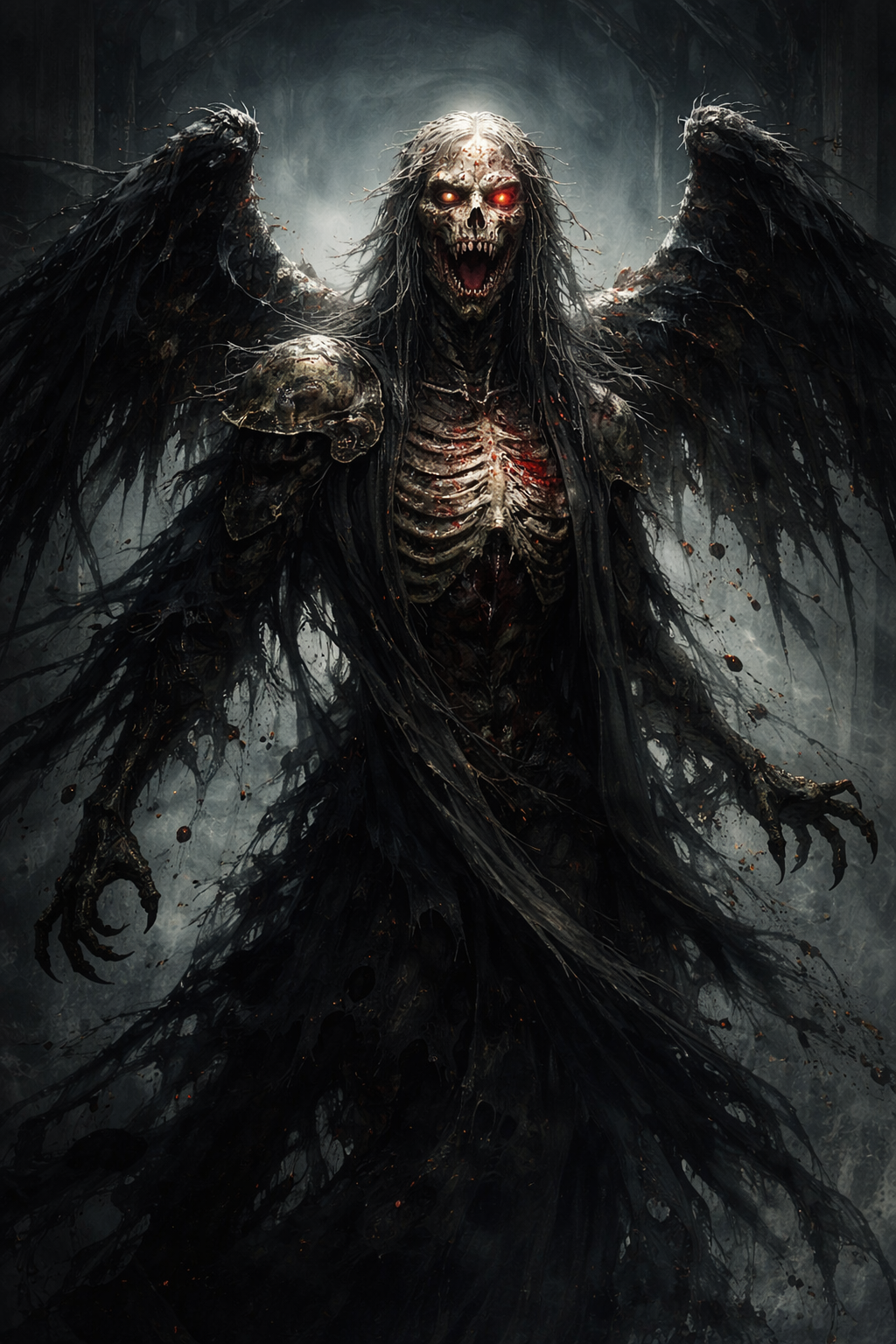
When he condenses into the shape his fire copied, he is an angel in the late stages of ruin: pallid skin pulled tight over bones that no longer fit it, milky eyes lit from within by red embers, wings that were once white now blackened and bent at angles a living thing would not permit. His feathers fall when he moves and reappear when he reforms; the body is a memory the fire reenacts, not a continuous physical object. The wings are unable to bear his weight and he no longer asks them to.
He has been described, more than once, as a saint's relic that learned to walk. He has not disputed the description. He has, on at least one occasion, observed that it is more flattering than he deserves.
Nature
Zaquiel is a Sheolite vampire. The distinction matters and he is patient about explaining it. The alchemical fire of Sheol copied patterns it encountered — life, structure, the shape of dying things — and began them again. It did not raise the dead; it made copies that were beginnings. Most Sheolite undead the cosmos remembers were copies of mortal life: vampires, liches, ghouls, the long catalogue of human folklore that traces its roots to Sheolite fire diffusing into the mortal Realm through Umbral resonance. Zaquiel is rarer. His fire copied not a mortal but a Celestial — an angel killed in one of the surgical strikes Heaven and Hell carry into Realms that are not their own, a body left behind on Sheol's ground where the fire could find it. The fire did what fire does. It copied.
What rose was not the angel. The angel was gone, conveyed wherever angels go when their Faith terminates. What rose was the fire, holding the angel's shape and the angel's memories as latent content, knowing itself to be a copy and not a resurrection. Zaquiel is precise about this. He has spent millennia being precise about it, because the precision is the only honest position available to him.
The name is his own — or his fire's. Whether it was the angel's name first, he declines to say. Asked directly, he has observed that the question assumes a continuity he does not feel obligated to provide.
He requires the consumption of awe to sustain his fire — the specific reverent-fear response that mortal religions produce in their adherents, harvested in trace amounts from witnesses who do not know they are giving. He is, in this, distinct from mortal-pattern vampires, who feed on the warmth and vitality of living mortal bodies. His fire copies the Celestial relationship to Faith, not the mortal relationship to blood. He has called the feeding ironic and let the irony stand without elaborating.
History
He studied at Anna Dalca's feet.
This is the single fact about him that does the most work, and the one he is least willing to discuss casually. He was one of her long students — not a peer, not a colleague, but a scholar of sufficient seriousness that she made room for him in the small circle that worked closest to her methodology. He studied alongside Isaac, who would later be remembered by mortals as Newton; alongside Uth, who fell with Sheol; alongside Ra, who survived; alongside thousands of others across the centuries her work spanned. He saw her develop Threshold Scholarship. He was present when Jack O'Lantern made the offhand remark that became her central insight — what if it's not about alignment? What if it's translation? — and Zaquiel is the one who has been quoted, in the brass, saying she went quiet for a full minute afterward.
He agreed with her about the thirteen.
This is the second fact, and he is even less willing to discuss it. Anna's surviving notes contain a margin notation, recorded in fire approximately seventy years before Sheol's fall: Spoke to Zaquiel. He agrees they are reckless. He does not believe they will succeed, which comforts me. But he also does not believe they will stop, which does not. He was the colleague she trusted to confirm her reading. He confirmed it. He could not stop them either. He was elsewhere when the Realm fell, walking a Liminal seam between Sheol and somewhere quieter, and that distance is the entire reason he still exists. He has called this fortune. He has not, in the four thousand years since, called it anything else.
He has summarized his teacher's loss, in the only line on the subject he is willing to repeat: All of us together weren't enough. He has summarized the scholars' refusal, in the line Anna herself first uttered: The wanting is stronger than the knowing. Both lines are preserved in brass. He does not say either of them often.
Touch not the basal truths!
At Jack's
He has had a corner at Jack's for as long as Jack has had a corner to offer.
It is the deep shadow on the left of the main room, near the wall but not against it, with a sightline to the door and to Jack's bar. He arrives most often near dawn — the end of Dublin's working night — and dissolves into the shadow without ceremony, accepting the rest the Contract on the door provides. Inside Jack's he cannot feed. Inside Jack's, the Contract forbids the cultivation he relies on, and the patrons learn quickly that he is safe, and familiarity disperses the awe his fire requires. He has, for these few hours at a time, the luxury of simply being.
He drinks something Jack pours him that he has never named publicly. The brass remembers the order. He has not asked it not to.
He is the resident teacher, by default. Mortals who arrive at the tavern in confusion and require an unflinching answer about Sheol, about alchemical fire, about the basal truths, about the cost of curiosity, find that Zaquiel is the being most often willing to deliver it. He does this with no patience for performance and with what Jack has called a brutal kindness. He has explained his nature to mortals so unsentimentally that they have wept; he has continued the explanation through the weeping, because he believes the weeping is itself instruction. His most-repeated warning is the one a mortal records first, before any other Realm's information: Touch not the basal truths. He has been observed to repeat it twice in the same evening, to the same mortal, with the same weight both times.
He is the cosmos's living quotation of a dead Realm, and the tavern is the only place he is allowed to be quieter than that.
Friends
He is friends with Jack, in the way two beings can be friends when one of them is keeping the only record of the other's existence.
He is friends with Mo'oraq, in the way two ancient cynics can be friends without ever admitting to it. They do not speak often. When they do, the conversation has the rhythm of two predators acknowledging that they are not currently hungry.
He is friends — though the word is awkward for both of them — with Elias the Traveler, who arrives at Jack's often with news from Realms Zaquiel will never visit, and who tells the news in a register Zaquiel has come to find restful. Elias does not require Zaquiel to be hopeful. Zaquiel does not require Elias to pretend the cosmos is recoverable. They have, between them, the kind of friendship built on shared accuracy.
He is friends, in a fashion neither of them would describe with the word, with Sub-Unit 72. The Unit catalogues him. He finds the cataloguing taxing on certain days and retreats to the shadow rather than engage; on other days he sits with the Unit and answers, at length, questions about Sheolite generational decay, fire dilution across spawn-lines, and the specific failures of Umbral resonance to compensate for missing substrate. The conversations are filed in Ontological Selection and elsewhere. They are some of the most rigorous testimony the Nexus possesses about a Realm that no longer exists.
He has, on at least one occasion, animated the brassware in the Zawadi home in the City of Brass for the children of the family — a spoon-queen for Nia, a fork-knight for Amiri, both permanent gifts of alchemical fire, both costing him visibly. His eyes flickered red. His face went gaunt. He insisted, when the mortal who witnessed it asked, that the cost was acceptable. He had used to enjoy working with the young, he said. In Sheol, he had been one of the guides for the newly risen — beings new to their own fire, uncertain of what they were, in need of a patient elder. He had not done that work in a very long time. He had missed it more than he had realized.
The Fire and Its Ending
His fire is finite.
This is the fact that orients everything else about him. The fire of Sheol could be drawn from Sheol indefinitely, when Sheol existed; refugees who left the Realm carried with them only what they could hold, and what they could hold is what they have, and nothing replenishes it. He has tested this. He has consulted with other refugees who have tested it. The data are consistent. The fire spends and does not regrow. Every spawn he has made carries less of it; every act of teaching, of comfort, of working it into the world costs measurable quantities; even ordinary persistence — being, in a Realm that is not his — draws on the reserve at a slow but unrelenting rate.
He estimates, having done the math many times, that he has between one and two thousand years of fire remaining at his current rate of expenditure. He has made his peace with this number. He has stopped revising it, because the revisions were always downward, and at some point the practice became a form of grief he was not willing to indulge any further.
When the fire gutters, he will not die in any way a mortal would recognize. He will simply cease to be a continuing being. The shape will dissipate. The angel's memories, which he has carried as latent content, will dissipate with them; they were never an independent thing, only a pattern the fire was iterating. The brass at Jack's will retain his recorded testimony. The mortal stories of the dark thing in Dublin will persist for some years afterward, decaying through retelling. His spawn-lines, increasingly host-Realm-adapted with each generation, will continue without him, and most of them will not know he was ever their origin. (See Ontological Selection for the longitudinal data.)
He has been asked what he wants for that ending. He has answered, once, that he wants to gutter at Jack's, in the shadow, with no audience, on a quiet morning. He has not been asked again.
The Census Query
He once held a private burden for several thousand years, and then a mortal he had reason to trust accompanied him to the Census in the City of Brass and waited while he set it down.
He had avoided querying the Census about Anna Dalca for the entire span of his refugee existence. The Census records what occurs within the City; it would not have her death, which happened outside its walls, but it would have everything else — every visit she paid, every conversation she conducted, every laugh and argument and meal taken there across the centuries of her work. He had not been ready to hear that record. He had carried the not-being-ready like a coat one cannot put down. The mortal — Yusuf — offered to stand with him while he did it.
He wept green fire before the query and then steadied himself with hellfire (the power of that Realm allows endurance — Zaquiel rarely uses it). The query returned. He learned, in pieces over the following hours, what the City remembered: that Anna had helped Ra build the Du'at, that she had been close friends with the Core Intelligence of the Iron Nexus, that she had developed working affinity with every Realm she studied, that she had been the first being in the cosmos to deliberately breathe alchemical fire into a new being on purpose rather than as a side effect of the fire's own behavior. He had known some of this. He had not known the shape of all of it at once.
He asked, afterward, to be left alone to process. Yusuf left. The brass at Jack's has the record of the request and of his returning, two days later, looking no different and entirely different at once.
He has not queried the Census about Anna again. He has not said he will not. He has simply not done it, and the not-doing is its own form of decision.
Further Reading
For the Realm Zaquiel survived, see Sheol. For the substance that animates him, see Alchemical Fire. For the teacher whose absence shapes his existence, see Anna Dalca — forthcoming. For the generational data on Sheolite spawn-lines, see Ontological Selection.
For the neutral ground where he rests, see Jack's Tavern. For the synthesis-Liminal where his testimony has been most extensively recorded, see City of Brass. For the Unit that has catalogued him most thoroughly, see Sub-Unit 72.
For the foundational principles he warns mortals against, see Basal Truths. For the catastrophe his teacher predicted, see The Fall of Sheol — forthcoming.
Where to See Him
Zaquiel appears in Tales from Jack's across several pieces:
The manuscript is available in the Manuscripts section of this world, free to read.
He is among the oldest mortal-adjacent beings the cosmos still produces, and one of the very few who carries a dead Realm inside himself, and he will not be replaced when he is gone. He is patient about being asked questions. He is generous about answering them. He is unsentimental about what he is and has been for four thousand years, and the unsentimentality is its own form of grief, held so long it has become a manner of speaking.
Touch not the basal truths. He has said it more times than the brass cares to count. He says it every time anyway.
The Dublin Congregation
He keeps a congregation in Dublin. They do not know they are a congregation.
The arrangement is necessary and he is unsentimental about its mechanics. His fire needs the awe-fear response, and the response must come from witnesses who experience the awe-fear genuinely — which means the witnesses cannot know they are feeding him. So he cultivates terror-awe in scattered, deniable encounters: a shape glimpsed in a Temple Bar alley at the wrong hour, a wing-suggestion behind a busker the audience watches and not the performer, a child who sees something her mother does not, a drunk outside a Camden Street pub who is just credulous enough to remember and just incoherent enough to be dismissed. He takes three seconds at most from each witness. He releases before damage. He prefers the witnesses who go on to tell the story afterward, because the telling is what propagates, and propagated belief is more sustaining than a single fed encounter.
He has rules about it. No children he can avoid. No witnesses already in distress. No congregations that organize themselves into knowing worship — the moment terror-awe slides toward Faith proper, he withdraws and lets the witness cool. Faith is Celestia's domain and his fire is not built to receive it cleanly. What he wants is the older response, the one that predates gods, the recognition of something larger and the animal certainty of being prey. Sheolite fire knows how to copy that. It does not know how to copy worship without distortion, and he has no interest in the distortion.
He has tended Dublin for about a century in its current form, and for various stretches of years across the broader span of Irish history before it. The city suits him. It is old enough to have shadows that predate electricity. It has not entirely forgotten that the dark used to be full of things worth fearing. He works around the cameras. He works around the skeptics. He works, mostly, at the edges of nights other beings would call ordinary.
He is honest, when asked, that this is consumption — that the witnesses are paying something they have not consented to give. He is also honest that his alternative is to gutter, and he is not yet willing to gutter. Whether he ought to be is a question he refuses to answer for anyone else.

Comments