
Basal Truths
The Basal Truths
The foundation beneath every RealmBeneath every Realm lie four foundational principles. They are not forces to be wielded. They are not places to be visited. They are the preconditions under which a Realm can exist at all — the conditions for reality itself.
There are four of them, in two complementary pairs:
The Four
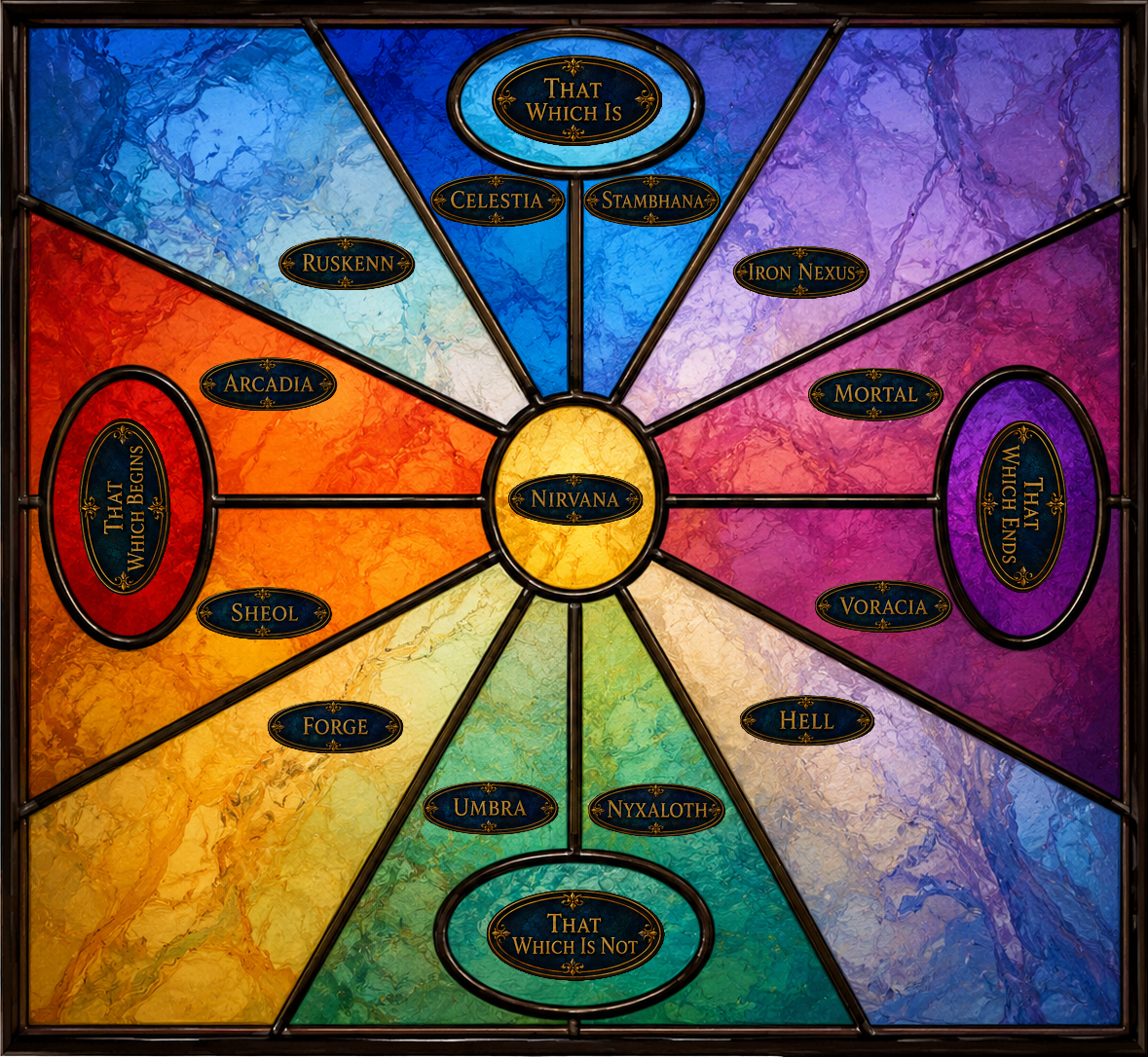
That Which Is. The state of existence — bare being, rather than nothing. The condition under which anything can be said to be at all.
That Which Is Not. The state of non-existence — the void of what is no longer and what might yet be. The boundary and definition that gives existence its shape.
That Which Begins. The flow from Is Not to Is. Emergence, prior to any specific process of becoming. The principle by which something can come into being from nothing.
That Which Ends. The flow from Is to Is Not. Cessation, prior to any specific process of destruction. The principle by which something can pass out of being into nothing.
Each Realm is a unique configuration of these four — a specific arrangement of how existence, non-existence, emergence, and cessation interact within its local logic. Celestia is one configuration. Voracia is another. The Forge is another still. The mortal Realm is one among many.
The truths themselves are not objects within any Realm. They are downstream of nothing and upstream of everything. Every being, every Realm, every phenomenon sits on the derived side of reality. The truths are the boundary against which derivation occurs.
The Categorical Boundary
There is no gradient between derived reality and the basal truths. The boundary cannot be approached gradually because there is no "closer" or "farther" — there is only on this side or not on this side, and crossing means ceasing to be derived at all.
This is not a matter of difficulty. It is a matter of category. Every tool that might be used to reach the truths is itself derived from them, which means no tool can apply to its own origin. A being who attempts to wield That Which Begins is using the very principle they are trying to grasp; the attempt fails not because they are insufficiently skilled but because the attempt is structurally incoherent.
Anna Dalca's formal proof demonstrates this rigorously. It has been verified by the Iron Nexus, which does not certify mistakes.
The Three Catastrophes
Three Realms have been altered or destroyed by attempts to reach the basal truths directly. Their fates are the cautionary anchors of the cosmos.
Sheol. Thirteen scholars of Sheol attempted to touch That Which Begins, intending to strengthen the strand of it that wound through their Realm. The attempt produced the opposite of what they sought. Sheol fell into That Which Ends. What remains is carried by refugees like Zaquiel, whose alchemical fire is finite and slowly guttering toward extinction. The Realm itself is gone. It will not return.
Stambhana. The god Yahweh attempted to manipulate the basal truths in order to process the two billion mortal souls he had placed in Stambhana as a holding facility. The Realm locked into permanent stasis. The sunrise will never complete. The two billion are not dead — they are simply frozen, and they will remain so. Stambhana is what mortals know as Purgatory.
The Forge. The origin of the Forge is uncertain, but the most credible reconstruction holds that a being touched That Which Ends and fell through into emergence — becoming the first design from which the Realm's logic unfolded. If this is correct, the Forge is not a catastrophe in the same sense as the other two; it is what happens when contact with the basal truths produces, rather than destroys. The being in question has never been identified, and may not exist as a being anymore.
These are not ancient cautionary tales. Their consequences are active and ongoing. Sheolite refugees walk the Realms with finite fire. The frozen souls of Stambhana persist in unending stillness. The Forge continues to operate by rules its origin imposed. Every present-day attempt to reach the basal truths is being made by beings who have these three precedents available to them, and who try anyway.
Why The Truths Cannot Be Used
Several factions across the Realms have, over the millennia, attempted to position the basal truths as a resource. Some have framed the project as research; some as theology; some as a path to power. All have been wrong about the same thing.
The basal truths are not a tool, a substance, an energy, or a destination. They are the condition under which tools, substances, energies, and destinations can exist. Asking how to wield them is like asking how to wield the property of being three-dimensional — the question is grammatically well-formed and semantically empty.
This is the single most consistent rule of the cosmos. It applies to mortals, to gods, to the Fallen, to the Tulasi, to the Iron Nexus, to Ruskenn. No being has been exempted. No method has been found.
The cosmos is honest about this. It does not promise that the boundary can be crossed if one tries hard enough. It demonstrates, through three permanent examples, what happens when beings try anyway.
Origin
The cosmos cannot tell its own origin.
Even Ruskenn — the gestalt consciousness that contains accumulated awareness stretching back before the Realms differentiated — does not know what came before. The Hive remembers the basal truths recognizing themselves as separate; it does not remember what preceded that recognition. The investigation terminates there.
Several mortal traditions have observed pieces of this honestly. The Rigveda's Hymn of Creation — the Nasadiya Sukta — ends with the line he who surveys it from the highest heaven, he alone knows; or perhaps even he does not know. This is among the most accurate accounts a mortal has produced, and it was produced through Liminality with Ruskenn rather than independent reasoning.
The basal truths are. They have always been, by every available measure. Whether "always" itself is a coherent claim about something that precedes time is a question the cosmos does not have the apparatus to answer.
Further Reading
Each of the four truths has its own internal logic and its own consequences for the Realms that emerge from it. Full articles will be written for each over time. See also The Thirteen Realms for an overview of how the truths express themselves as configurations, and Liminality and Imposition for how Realms interact when they touch.
The cosmos rests on four truths. The truths rest on nothing that can be observed. Reason carefully.

Comments