Thirteen Realms
Access Granted
Brass Archive Initiative — Reader Orientation. Issued upon first credential use. Filed under: Foundation Administration / Onboarding.Your credentials have been verified. You are now a reader of record with the Brass Archive Initiative, a private research undertaking funded by the Ó Lorcáin Foundation.
Before you go further, we would like a moment of your attention. Not for legal formalities — those come later, and they are shorter than you fear — but because of what may have happened to you recently, possibly today.
If You Learned Today
Some of our readers arrive here after years of quiet involvement. Some arrive after a single incident they cannot explain and cannot stop thinking about. And some of you were told, hours ago, by someone you trust, that the universe you have lived in your whole life is one of more than a dozen — and then you were handed a login.
If you are in that last group: sit down, if you are not sitting. What you are feeling has a name in our files. We call it threshold vertigo, and nearly every reader of this archive has felt it, including the people who built it. It passes. Not quickly, and not completely, but it passes, and what replaces it is something we can honestly recommend: a universe that is larger, stranger, and more interesting than the one you woke up in.
Three things are true, and we ask you to hold all three at once:
Nothing about the world changed today. The cosmos has been this way since long before humanity existed. Every night you have ever slept, you slept in a reality adjacent to twelve others, and you woke up fine. Your knowledge changed. The world did not. You are not in more danger tonight than you were last night; you are simply, for the first time, in an accurate amount of danger.
The danger is real, but it is navigable. The greater cosmos is not safe, and this archive will not pretend otherwise. It is also not hunting you. Most of it is indifferent to you, some of it is curious about you, and a small portion of it is genuinely fond of your species. The rules of safe conduct are learnable. They are, in fact, much of what this archive exists to teach.
You do not have to grapple with all of it today. The archive is large and growing. It will still be here tomorrow. So will the cosmos. Eat something. Sleep. Do not make any agreements with anyone or anything until you have read the article on Contracts. We mean this last one seriously, and we will repeat it below, because it is the single most important piece of practical advice we can give a new reader.
What This Archive Is
The Brass Archive Initiative acquires, catalogues, translates, and interprets knowledge of the greater cosmos for mortal understanding. We are the successor to more than a century of quieter work, and the inheritor of a scholarly tradition far older than that — the threshold scholarship of Anna Dalca, whose translation methodology makes it possible for knowledge from one ontology to be rendered legible in another without pretending the two are the same.
Our knowledge comes from identifiable sources, and every article notes its provenance. The principal channels:
The Census of the City of Brass — the cosmos's most complete public archive, perfectly truthful within its limits, consulted at real and permanent cost to the researchers who query it. Where you see a Census citation, someone paid for it, and the currency was not money.
Testimony — accounts given freely by beings of other Realms, most often recorded at Jack's Tavern, the one truly neutral ground in the cosmos. Testimony is generous, irreplaceable, and unverifiable. We mark it as such.
Contracted knowledge — information acquired by formal agreement, most often with Arcadian parties. It is exactly as reliable as the wording of the Contract that produced it. Our negotiators are careful. We publish the caveats anyway.
Nexus consultation — the Initiative is advised by Sub-Unit 72 of the Iron Nexus, who serves as translation resource for our engagement with the City of Brass. The Nexus does not judge. It corrects. We have found this bracing and useful.
Field expedition — direct mortal observation, conducted under protocols written in the aftermath of our predecessors' failures. The protocols exist because the failures were total. We do not romanticize them, and we do not repeat them.
Where these sources disagree, we print the disagreement. The discrepancies between ontologies are not errors to be smoothed over; they are, as Dalca demonstrated, often the most informative data we have.
Where to Begin
Choose the door that matches how you arrived.
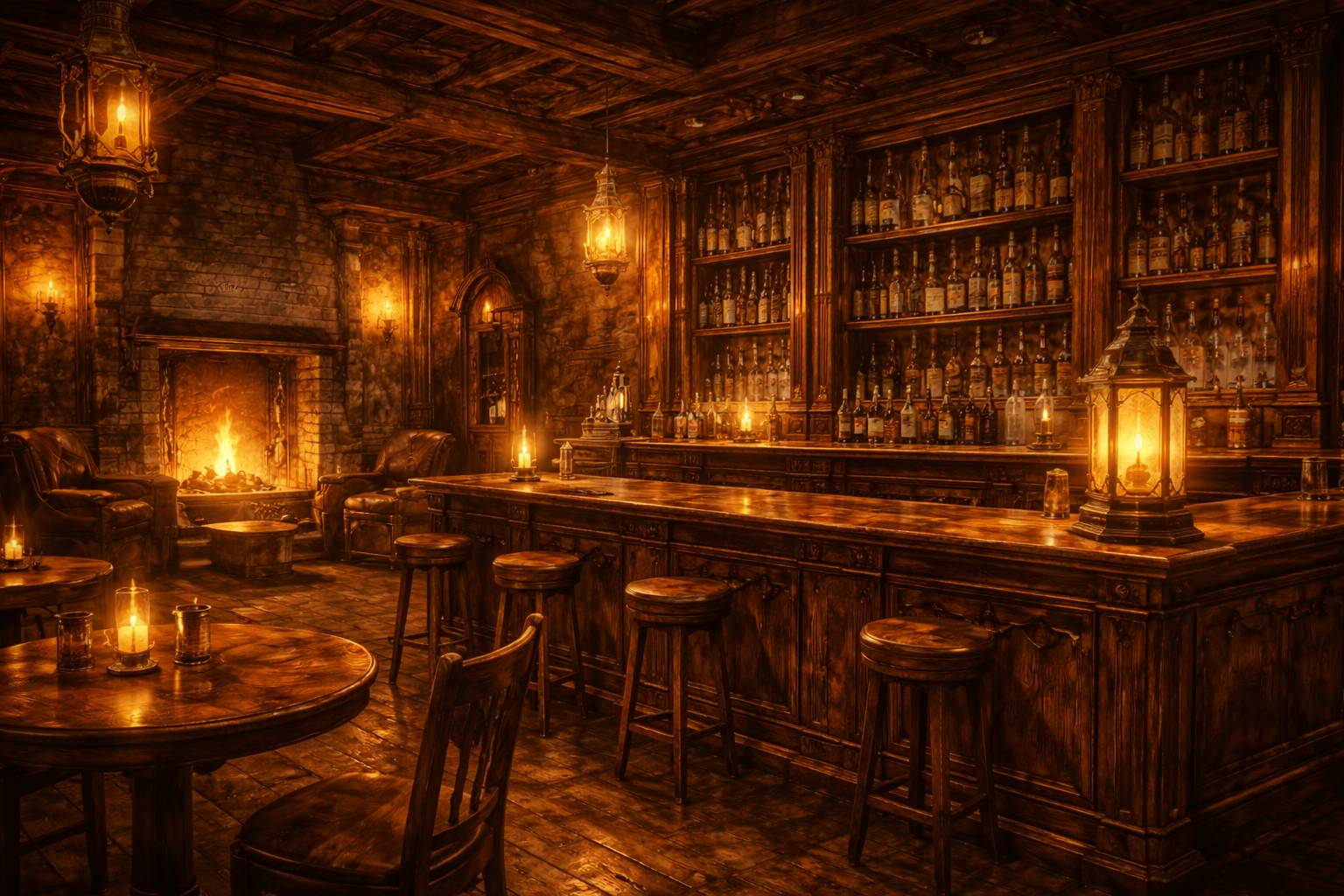
I learned today, and I need a human-shaped way in. Begin with A MORTAL VISITOR'S GUIDE TO JACK'S TAVERN. It was written by a mortal, for mortals, about the friendliest threshold the cosmos offers. It will show you the strangeness at a scale a person can hold. See the Lexicon for understanding cosmic terminology. When you are ready for structure, continue to The Realms.
I want the full picture, in order. Read The Realms, then Basal Truths, then Liminality and Imposition. These three are the load-bearing walls. Everything else in the archive hangs from them.
Something happened to me, and I need to understand it. Most unexplained mortal encounters are Liminal events — two Realms briefly occupying the same space. Start with Liminality and Imposition, then consult the article on the Realm whose logic best matches what you experienced. If you made any promise, deal, or bargain during the encounter — however casual it seemed — read Contracts now, before anything else, and then contact your Foundation liaison.
I am here to work. Researchers and field candidates should begin with the methodology notes in How to Use These Records, paying particular attention to the provenance conventions and the standing hedges. You will be trained on the rest.
Standing Advisories
Every reader, regardless of door, is bound by three advisories. They are not bureaucratic. Each one is written over someone.
Make no agreements you have not had reviewed. In several Realms, an agreement is not a promise; it is a physical event. A casual "sure, I owe you one" can be a binding of decades. Until you have read Contracts and understood it, the only safe answer to any offer from a non-mortal party is a polite, non-committal, and complete refusal.
Your skepticism is equipment. Maintain it. Mortal disbelief has real force in our native Realm — it is one of the few protections we possess that costs nothing and cannot be taken. Reading this archive does not require you to abandon it. The archive works best in readers who keep asking how we know what we claim.
Do not seek the basal truths. You will encounter, in these records, references to the four preconditions beneath all Realms. You will encounter, more than once, the account of what happened to those who reached for them. The oldest surviving witness in our records has repeated the warning more times than the brass cares to count, and we place it here at the threshold, where it belongs: touch not the basal truths.
On Discretion
Your access is credentialed, personal, and non-transferable. The Foundation asks that you not discuss the archive's contents with the unvetted; if you believe someone is ready, refer them to your sponsor rather than telling them yourself. The question of how, and when, and by whom humanity at large will be told is a live one, and it is being contested by parties with considerably more resources than good intentions. We would prefer the answer not be decided by an incident.
Your reader agreement is on file with the Foundation's counsel. You may find its language old-fashioned. We note, for the attentive, that certain of the counsel's consulting parties regard agreements as self-enforcing, and we have never once needed to pursue a breach.
Welcome to the archive. Welcome, more to the point, to the cosmos — which you have lived in all along, and may now begin to see.
The vertigo passes. The wonder, in our experience, does not.
— The Editors Brass Archive Initiative, under grant of the Ó Lorcáin Foundation
Thirteen Realms has 32 Scholars
The Thirteen Realms and all content herein — lore, characters, stories, and world material — are the original work of deryck1228 and are protected under copyright. All rights reserved. No portion of this world may be reproduced or used without explicit permission.
Artwork appearing throughout these pages is either commissioned from credited artists (see individual article attributions) or serves as AI-generated placeholder art pending final illustration. All placeholder art will be replaced as the world develops.
The Thirteen Realms is a work of dark fiction. While the setting touches real world historical events, belief systems, and stories, any resemblance to real persons, places, or events is coincidental. Some content may not be suitable for all readers.
Step carefully. Not all doors in the Thirteen Realms open from the inside.
© deryck1228 2026. All rights reserved
Artwork appearing throughout these pages is either commissioned from credited artists (see individual article attributions) or serves as AI-generated placeholder art pending final illustration. All placeholder art will be replaced as the world develops.
The Thirteen Realms is a work of dark fiction. While the setting touches real world historical events, belief systems, and stories, any resemblance to real persons, places, or events is coincidental. Some content may not be suitable for all readers.
Step carefully. Not all doors in the Thirteen Realms open from the inside.
© deryck1228 2026. All rights reserved