Hellhounds
Hellhounds
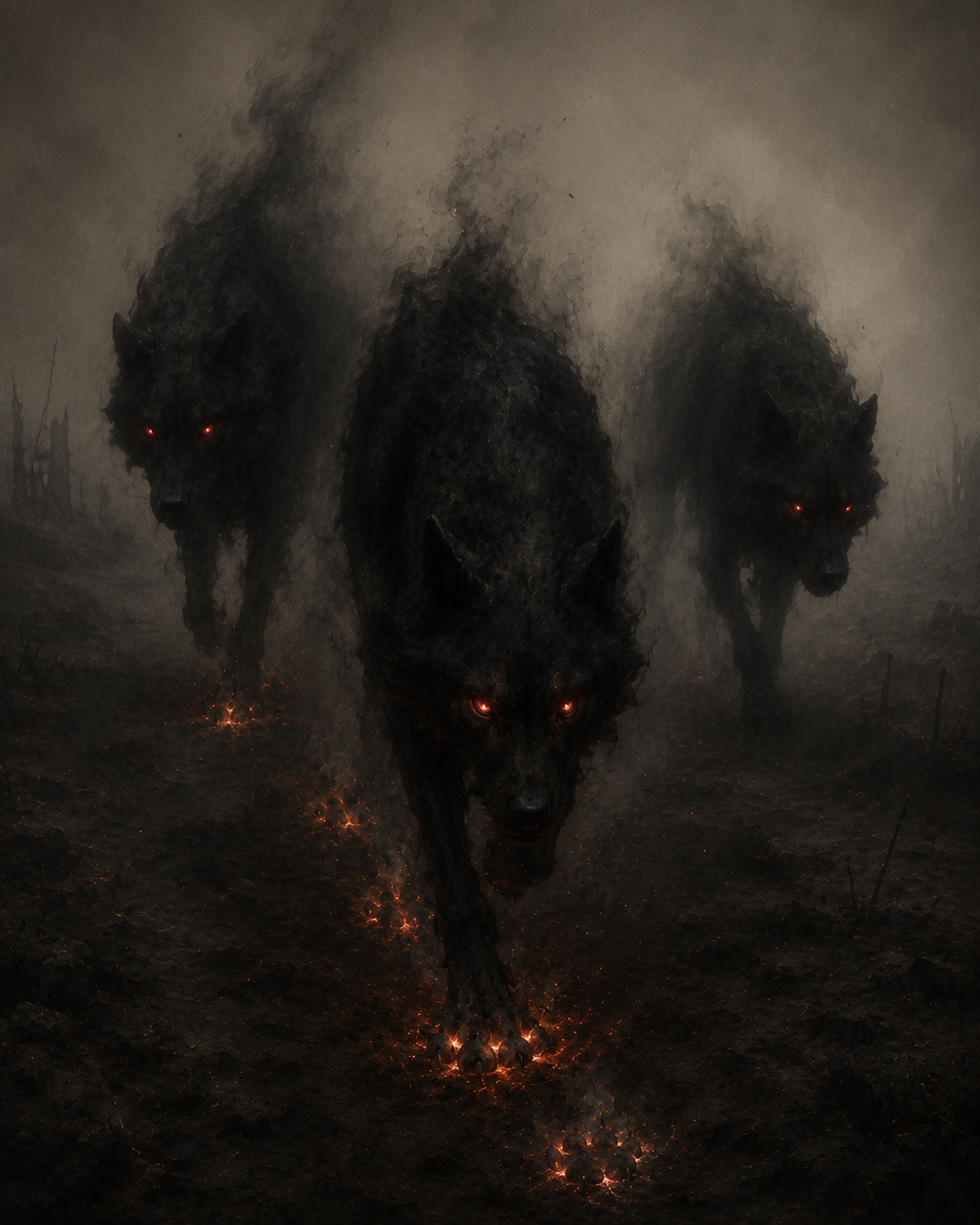
The witness that walks. The dog at the crossroads. The form Hell takes when it has noticed.A hellhound is what Hell's witness-substance looks like when it has gathered enough to walk.
It is not a demon. It is not a fallen creature, nor a punishing one, nor a hunter of damned souls. It does not serve any master, because Hell has no master to be served. It is not even, in the strictest sense, an individual being , though it walks alongside individuals, and mortals who have known one have given them names. A hellhound is a temporarily-coherent expression of Hell's deepest character, manifest in canine form to mortal eyes, attending the thresholds where the cosmos is being tested. The mortal folkloric tradition that has spent two thousand years calling them demons-on-leashes is the same tradition that called Lucifer the Devil. The propaganda is comparable in scope and comparable in inaccuracy.
What the older traditions remembered better — before Christianity rolled them into a single cartoon — was that the dog at the threshold is a structural feature of how the cosmos works, not a moral one. They exist in symbiosis with the tested, both to witness the test and to cohere into existence because of the test.
Cerberus at Greek Hades. Garmr at the entrance to Hel. The Cŵn Annwn running with Arawn. The Vedic Sarama. The Mexica Xolotl. Across an extraordinarily wide range of mortal cultures, the same role appears: a dog-shaped being attending the boundary between conditions, marking what crosses, witnessing the crossing. The cultures did not communicate the figure to one another. They each met the figure independently. They each rendered the meeting in their own visual vocabulary. The figure remained itself.
The figure is the hellhound. Mortal traditions saw it more or less accurately for most of recorded history, until the propaganda of the Long War turned every Hellish thing into a soul-eating monster. The truth is older and stranger and considerably more useful.
Ontology
Hellhounds are made of Hell's witness-substance — the part of Hell's deepest character that is responsible for the observation and preservation of what is tested. Hell's whole nature is testing; testing without witness is meaningless. Therefore Hell produces, as a structural function, the substance that attends. The tested must have a witness, and the hellhound exists to bear witness.
In most of Hell, unless a Witness stands, the witness-substance is diffuse, present everywhere but condensed nowhere. At thresholds — Liminal borders, places where one condition gives way to another, moments when significant testing occurs — the substance precipitates. Where it precipitates densely enough, it walks.
This is the foundational fact of hellhound nature, and it is the fact that all other facts about them depend on:
Hellhounds are not driven by any will external to themselves. They are not driven by their own will either. They are witness-substance, which has natural behavior: it attends thresholds, it concentrates where testing occurs, it walks alongside what it recognizes. The behavior is structural. There is no decision in it.
This means hellhounds cannot be commanded. They cannot be bribed. They cannot be reasoned with or refused. They appear where they appear because the cosmos's conditions called them; they walk with whom they walk with because their substance recognized something in that being. The mortal model of "trained dog with a master" does not apply at any level. The hellhound is not the master's. The hellhound is not anyone's. The hellhound is Hell's, and Hell does not direct, only attends.
Drives
Three drives govern hellhound behavior, and they operate together continuously without anything coordinating them.
Threshold-witness as compulsion. Witness-substance is drawn to thresholds the way water is drawn downward. A hellhound at a threshold is not stationed there; it is simply where the substance is. This is exactly the same function as a formal witness, simply performed by the Realm rather than a being. Crossroads, gates, doorways, Liminal borders, the moment of dying, the moment of refusing, the moment of choosing — all of these are thresholds, and hellhound-substance precipitates wherever they occur with sufficient ontological weight. The mortal "black dog at the crossroads" is not an omen sent by anyone. It is the visible part of Hell's witness, which is always at crossroads because crossroads are what witness is made for.
Hellish gradient as attraction. Where the cosmos's testing-pressure is most concentrated — beings in genuine crisis, decisions that genuinely matter, moments when something is being tested rather than merely happening — hellhound-substance gathers preferentially. The substance recognizes itself across the gap between the testing-event and Hell proper. A traveler making a difficult decision at a quiet roadside is producing the conditions in which hellhounds precipitate. A dying person undergoing the test of dying is producing the same conditions. A soul refusing Heaven's bargain at the moment of judgment is producing the same conditions, and at much greater intensity. The hounds appear because Hell is happening, not because anyone summoned them.
Recognition as accompaniment. Once a hellhound has precipitated near a being whose testing it recognizes, the recognition tends to persist. The hound follows. Sometimes for an hour, sometimes for years, sometimes across centuries. The being may notice; the being may not. The accompaniment is not protection — a hellhound will not fight off mortal dangers, will not intervene in mortal events, will not affect outcomes in any direct way. What it provides is witness. The being is not crossing alone. Whatever the being endures, the hellhound has seen it, and Hell remembers what its hellhounds have seen.
These drives are not subjective. The hellhound does not experience them as motivations, because the hellhound does not have a subjective frame in any sense mortal cognition would recognize. The drives are simply the natural behavior of the substance, like rain falling downhill. Mortal observers, watching a hellhound from outside, see what appears to be purposeful behavior — guarding a threshold, following a traveler, attending a deathbed — and reasonably infer purpose.
Appearance
Hellhounds do not have fixed forms. Like all Hell-natives, what they look like depends partly on what they are and partly on what the observer is equipped to see. Mortal observers register them in the visual vocabulary of their own culture's dog-folklore, which is why the descriptions vary widely across mortal traditions while sharing a number of consistent features.
The cross-cultural consistencies are real and worth listing. Hellhounds are typically:
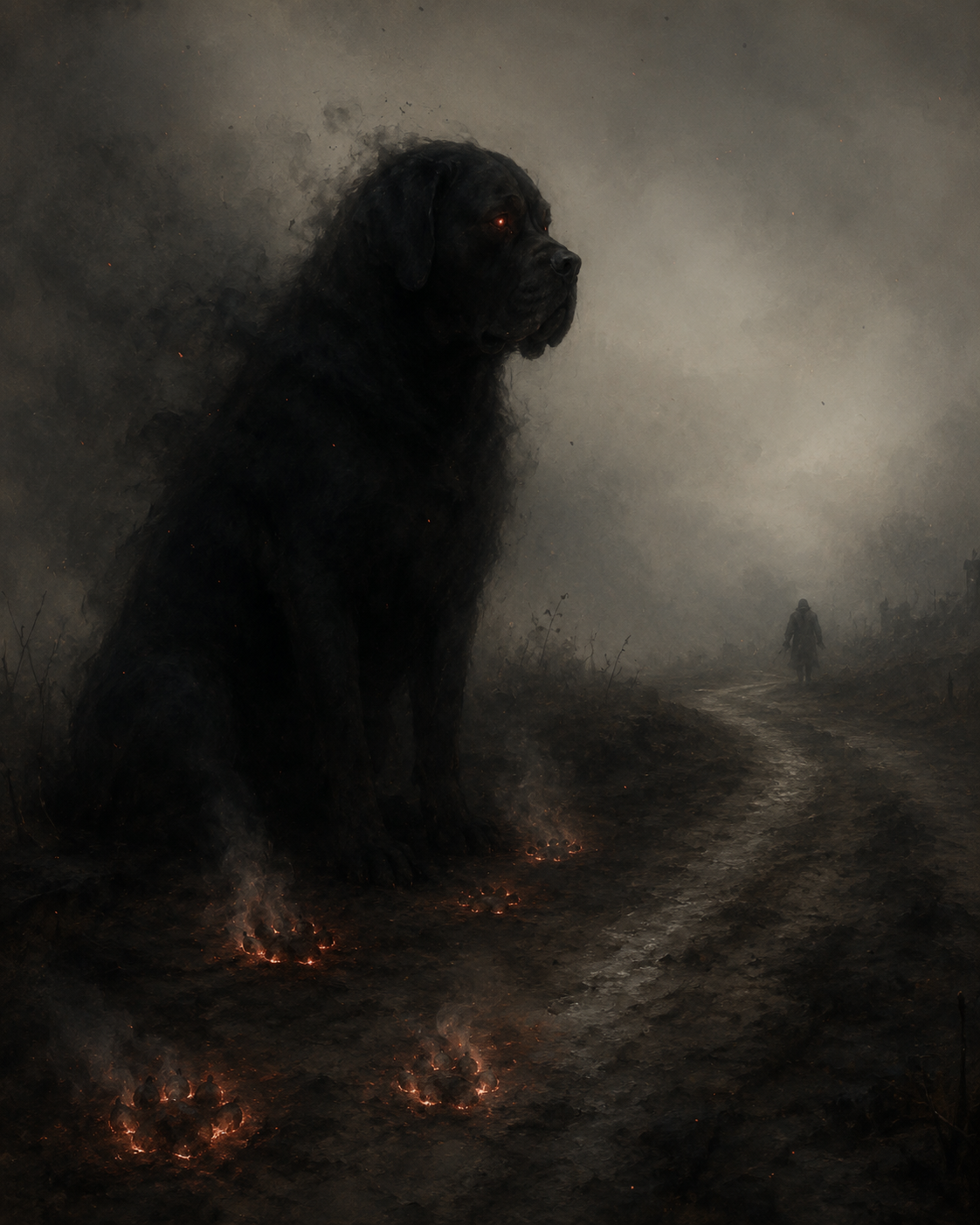
The eye detail is the most consistent and the most ontologically honest. Hell-natives generally have furnace-coal eyes — Hanpa, Ashmedai, the demons of the Outer Ring. A hellhound's eyes show the same Hellfire-tint, because the same substance produces it: the friction-light of Hell's testing, banked and visible at points of high ontological density. A hellhound's eyes are not glowing in the menacing sense the propaganda implies. They are simply showing what they are made of, the way a candle flame shows what a candle is made of.
The howl is also worth noting. Mortal folklore consistently records that hellhound howls produce a particular dread — a feeling out of proportion to the sound, a sense that something significant has been noticed, a heaviness that lands on the listener. This is accurate. The howl is the hellhound's contribution to Hell's testing-architecture; it is the substance announcing its attendance. When a mortal hears a hellhound, what they are hearing is Hell taking notice of a threshold being approached. The dread is real, but the dread is not malice. It is the simple weight of Hell's attention, which is heavy for any being not built to bear it.
Lineages and Named Hellhounds
Hellhound-substance, while not individual in the strict sense, tends to precipitate in patterns. Particular regions of Liminal thinning produce repeated precipitations across mortal generations, and the resulting hellhound-forms become recognized by local folklore. These regional patterns produce the various named hellhounds of mortal record.
Cerberus is the hellhound-form that has attended the Liminal threshold between Hell and the Mortal Realm most consistently in the regions Greek mortals encountered. The mortal myth gave him three heads, which is the mortal-cognitive rendering of his ability to observe three thresholds simultaneously — Hell-Mortal, Hell-Voracia, and the deeper threshold into Hell proper. The Greek heroes who confronted him (Heracles, Orpheus, Aeneas) had real Liminal contact with hellhound-substance and rendered the encounter in the visual terms their tradition supplied. Cerberus did not bar them passage in any active sense; he attended the passage, witnessed it, and Hell remembered. The myth that he was subdued is the mortal reading of being permitted to pass; he was never subduable in the first place. He still attends. The threshold is still there. The substance still precipitates.
The Cŵn Annwn are the hellhounds the Welsh and broader British mortal traditions encountered most clearly. They are described as white with red ears — beautiful rather than terrifying, which the Welsh tradition got right. They are associated with Arawn, lord of the Otherworld, who is in fact a Hell-native of unusual antiquity whose long association with the regional hellhound-substance has produced a stable mutual recognition. The Cŵn Annwn walk with him. Mortal folklore renders this as ownership; the truth is that the pack has, across centuries, consistently recognized Arawn as a being worth attending, and Arawn has, across centuries, conducted himself in ways that sustain the recognition. The Mabinogi's First Branch, in which the mortal king Pwyll spent a year in Arawn's place, records a small true event: a mortal who briefly accompanied the Cŵn Annwn in their attending, with the cosmic detail garbled by retelling.
The British black dogs — Black Shuck of East Anglia, Barghest of Yorkshire, Cù-sìth of the Scottish Highlands, Gwyllgi of Wales — are regional hellhound-precipitations in mortal-geographic areas of persistent Liminal thinning. Each is a local pattern rather than an individual being. Mortal traditions have given them names, attributed them to specific haunts, and developed protocols of avoidance or acknowledgment. The protocols vary in their accuracy. The hellhound-substance does not change behavior based on whether mortals know its name; the naming, however, sometimes produces a small Hellish moment in the namer (the act of acknowledging Hell's witness is itself a form of testing), and the hellhound may register that moment and proceed accordingly.
Xolotl, the Mexica dog-headed psychopomp, is the Mesoamerican parallel: a Celestial figure whose iconography developed under sustained contact with regional hellhound-substance.
Garmr, the Norse hound at the entrance to Hel, is a real hellhound-form. The mortal Norse tradition rendered him as a single individual; the Hellish truth is that the Norse-regional hellhound-substance attended the Liminal threshold the Norse mortals identified as Hel's gate, and Garmr was the consistent form it took for that culture. The Ragnarök prophecy that Garmr will battle Tyr at the end of the world is mortal reading of an apocalyptic-class testing event in which Hell's witness will attend in such density that the precipitation will be unprecedented. Whether that event will occur, no one currently knows.
There are others. The Greek Orthrus (Cerberus's brother in the mortal myth). The Hindu Sarama. The Slavic black dogs that haunt certain crossroads in the Carpathians. Each is the local precipitation of the same underlying substance, rendered in the mortal-cognitive frame available to the encountering culture. The list is not exhaustive and probably never will be; every mortal culture that has known a crossroads has had some name for what attended it.
Hellhounds and Hell-Aligned Beings
Beings native to Hell, and beings of long association with Hell (the Fallen, certain Liminal natives), often find that hellhounds attend them consistently across long periods. This is not a possession or a service relationship. It is the natural consequence of being a being whose existence is itself a continuous testing event of high ontological density. Hellhound-substance precipitates around such beings because that is what hellhound-substance does.
Ashmedai is accompanied, when his work takes him across Realms, by a small pack of hellhound-forms that have, across centuries, consistently recognized him. Three is the usual number. He does not name them, because they are not individuals in the sense that would make naming useful, but he speaks to them as one speaks to companions whose presence is steady and welcome. They wait at Liminal thresholds when he goes into spaces they cannot follow. They greet him on his return. He treats them with the casual warmth one shows working dogs, and they treat him with the alert attention they would treat any being whose testing they have learned to recognize at this depth. When he is at Jack's Tavern they are sometimes visible to the patrons, sometimes not — the patrons who see them are usually the ones whose own testing has produced enough Hellish gradient to register the substance.
Lucifer is similarly attended. The hellhounds that have followed him across millennia are older than most lineages mortal folklore records. Their recognition of him is dense beyond the substance's usual depth — he has been a testing event continuously, in every moment of his existence since the Fall, and the substance recognizes him at a level no other being in the cosmos can match. He almost never travels alone, even when he appears to. When he sits at Jack's bar in the hush no patron will break, there is usually at least one hellhound-form near him, perceptible only to those whose own ontology can resolve it. He does not address them. They do not require addressing. The attending is the relationship.
Hanpa and the older natives of Hell have casual ongoing relationships with hellhound-substance in their region of the Outer Ring. The natives walk where they walk; hellhounds walk where hellhounds walk; the paths often coincide. There is no formal organization. The natives do not consider the hellhounds to be theirs and do not consider themselves to be the hellhounds'. They are simply parts of the same Realm doing what their respective natures require.
Boaz, who has gone deeper into Hell than nearly any Fallen, is reportedly attended by hellhound-forms of unusual coherence — substance precipitated densely enough that the resulting hounds have something approaching persistent individuality. The natives who have observed him deep in the Realm have noted the unusual quality of his attendance without further interpretation.
Mortals and Hellhounds
The mortal experience of meeting a hellhound is, in most cases, one of dread followed by something more difficult to name.
The dread is real and structural. Hell's attention is heavy for any being not built to bear it; a hellhound is Hell's attention made visible at close range; the mortal is therefore briefly subject to the weight that Hell's deeper natives bear continuously. The dread is not malice. It is not personal. It is the simple ontological pressure of being witnessed by a substance whose witnessing-function is so much vaster than mortal frames can accommodate.
What follows the dread varies enormously. Many mortals flee, which the hellhound does not pursue and does not register as significant. Many mortals interpret the meeting as an omen of death — and sometimes the death does come, because the hellhound was attending a real threshold that the mortal was indeed approaching. The mortal frame for "I saw a dog and then died" reads as causation; the cosmic truth is that both events were aspects of the same significant moment, and the dog was the visible part of what was always there during such moments. The dog did not cause the death. The dog was the witness.
Some mortals do something else. They acknowledge the hellhound — speak to it, name it, offer it something honest. These acknowledgments are not effective at bribing the hound or directing its behavior, but they are sometimes effective at producing a small testing event in the mortal themselves. The act of acknowledging Hell's witness is a form of standing under its weight without flinching. The hellhound may register that the mortal has done this. The substance may sustain the recognition. The mortal may, over years, find that hellhounds attend them more consistently than they once did. This is not a relationship in the mortal sense, but it is not nothing.
Mortal traditions of leaving offerings to dogs at crossroads — bread, milk, salt, in various cultures — are not effective as bribery, but they are sometimes effective as honesty. A traveler who offers something at a crossroads is producing a small moment of self-testing — I am the kind of being who acknowledges what watches — and a hellhound may register that and proceed accordingly. The offering is not for the dog. The offering is for the test, and the dog is what attends the test.
The single piece of advice mortal folklore most consistently gets right is: do not run. Running from a hellhound is unproductive because the hellhound is not chasing in any active sense. Running, however, sometimes produces a failure of testing — a being declining to stand under what they are facing — and the hellhound may register that, and Hell may remember it. Standing is the better choice. The standing does not require courage; it requires only acknowledgment. The hellhound is not an enemy. The hellhound is what Hell looks like when it has noticed.
Termination and Persistence
A hellhound, in the mortal frame, can be killed. Mortal myth records this on occasion — heroes who slew the black dog, hunters who shot the spectral hound. The mortal kills register as real events, in the sense that the hellhound-form ceases to be visible at that location and time.
The cosmic truth is that the substance returns to Hell, where it will precipitate again the next time conditions call it forth. The killing does not affect the underlying substance any more than evaporating a glass of water reduces the world's water. The form is temporary. The substance is permanent. A mortal who killed a Cerberus would not have ended Cerberus; the next significant Liminal passage at that threshold would precipitate the substance again, possibly in slightly different form, certainly in the same role. The naming would persist. The function would resume.
This is why mortal folklore so often records the same hellhound returning across generations — Black Shuck has been sighted in East Anglia for at least a thousand years; the Barghest has haunted Yorkshire moors for similarly long; the Cŵn Annwn ride still. The mortal frame for "same dog across centuries" requires either immortality (which the mortal mind reluctantly grants) or supernatural origin (which the mortal mind grants more readily, with theological overlay). The cosmic truth is that the same substance keeps precipitating in the same places because the underlying conditions have not changed.
A hellhound cannot be permanently ended without ending Hell. As long as Hell tests, Hell witnesses; as long as Hell witnesses, the substance produces the forms; as long as the forms are needed, they appear.
Further Reading
For the Realm whose witness-function the hellhounds embody, see Hell. For the broader fauna of Hell's edge, see Outer Ring.
For Hell's testing principle in general and the witness-function specifically, see Basal Truths and That Which Ends in particular. For mortal folklore about thresholds, crossroads, and omen-dogs, see Liminality and Imposition.
The dog at the crossroads is not your enemy.
It is not your friend, either. It is not your guide in any sense involving its own decisions, and it is not under any master's command, because the Realm that produced it has no masters and would not know what to do with one. It is Hell, having noticed you, in the only form Hell takes when it walks beside someone.
If you stand under the witness, it will witness. If you run, it will not pursue, but Hell will remember the running. If you acknowledge it, you will have done something small and true, and the substance may register what you have done, and you may find that more is being witnessed than you once believed.
Stand still. Let it see you. It will not stay long. But for as long as it is there, you are not crossing alone.

Comments