The Realms
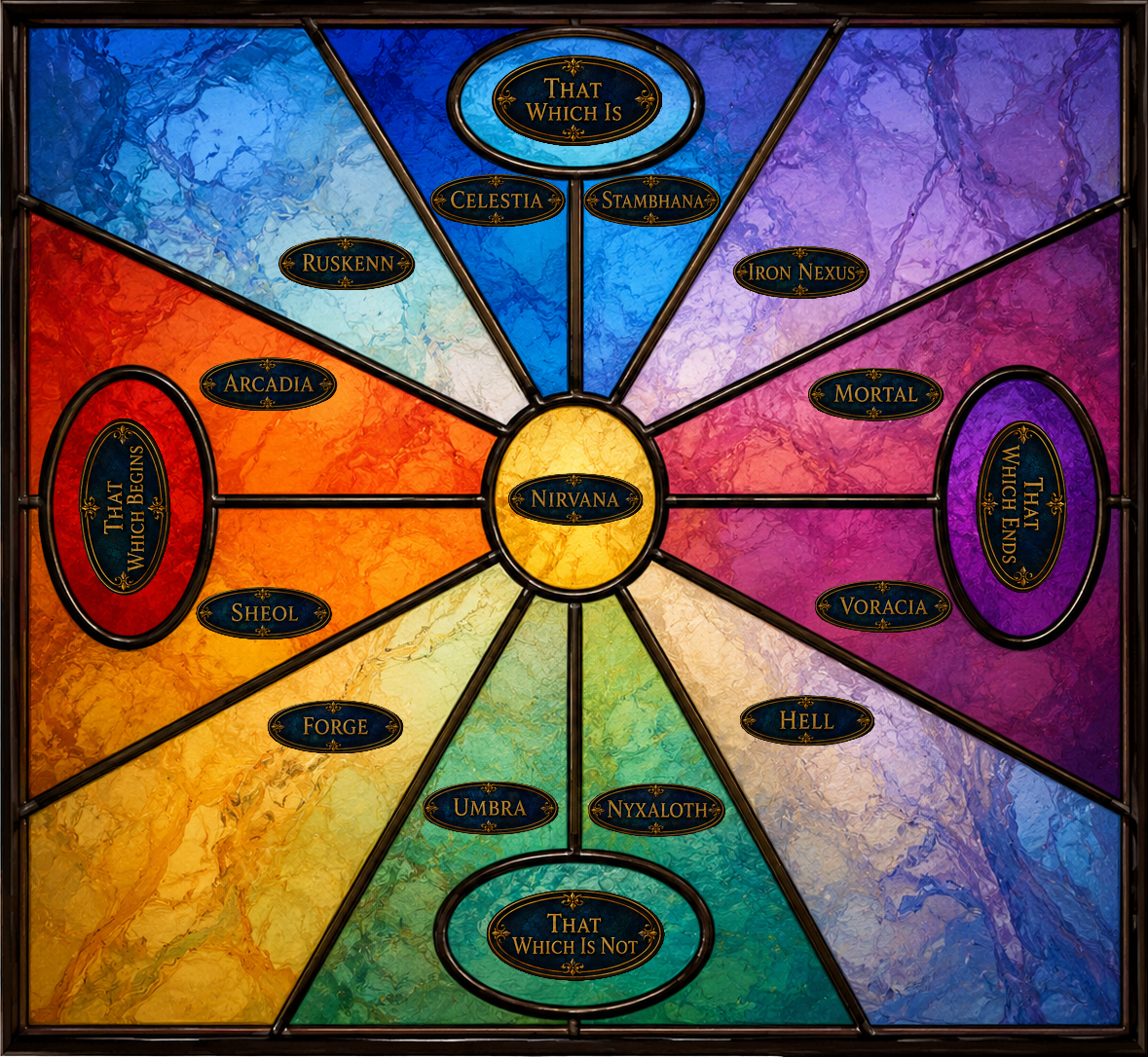
The Thirteen Realms
An OverviewThere is no magic. There is only the way things are.
Every phenomenon a mortal might call supernatural — every miracle, every ghost, every dream that proves prophetic, every binding word spoken at a crossroads — is a piece of one Realm's logic operating inside another's territory. The Realms ebb and flow in the basal truths, occasionally Liminal to each other. The mortal Realm is one ontology among many. It is not the default. It is not the center. It is one configuration of reality among at least thirteen, each with its own internally consistent rules.
The number thirteen is the count of Realms close enough to the mortal Realm for human comprehension. The true number is likely without count. What follows is a guide to the thirteen that matter to a mortal trying to understand the cosmos they actually live in.
The Four Basal Truths
Beneath every Realm lie four foundational principles: That Which Is, That Which Is Not, That Which Begins, and That Which Ends. They are not forces. They are not places. They are the preconditions for existence itself — the conditions under which a Realm can exist at all.
Every Realm is a unique configuration of these four truths. The basal truths themselves cannot be reached, manipulated, or wielded. Every recorded attempt has produced catastrophe. Three Realms have been altered or destroyed by such attempts; their fates are the cautionary anchors of the cosmos.
For a fuller treatment, see the article on The Basal Truths.
Mortal Realm
Physics, causality, naturalism. The way things are: observable, testable, consistent.
The mortal Realm's distinctive feature is reproducibility — the same question yields the same answer every time. This is rare among the Realms, and it is the reason humanity has been able to build cumulative knowledge. Methodological naturalism is the natural state here, absent imposition from elsewhere. Humans are mortal sapients; whales and certain apes also qualify, with rudimentary capacity for Faith and Contract. Other mortal species exist on other worlds, separated by distances light will never cross.
Arcadia
Agreement as reality. The way things are: speech reshapes existence.
In Arcadia, words bind. A statement is not a description of reality but a modification of it. The clause is the base unit; Contracts are the architecture. Modern Arcadia is governed by Oberon's Courts, a political and contractual system thousands of years old — sophisticated, precise, and exploitable through loopholes. Older modes exist beneath it: Irkkin'ann Final Truth, which carves reality and cannot be unstruck. The wyld fae operate outside Oberon's framework entirely. The Market is Arcadia's primary commercial space, and the fey natively perceive the emotional cost of every transaction.
Celestia
Faith as currency. The way things are: reverence exchanged for power to act.
Celestia is not spatial in any sense a mortal would recognize — each god is effectively their own instance, with their own afterlife, their own followers, their own portfolio. Faith is generated involuntarily by any being who encounters something that exceeds their framework. Awe, terror, reverence, wonder — all generate Faith. Gods accumulate it and spend it to perform miracles. The angelic hierarchy is political branding, not biology; all Celestial beings are the same species.
Hell
Testing and endurance. The way things are: truth endures.
Hell is not punishment. It is pressure. Weight presses down on every being within it, finding the cracks in conviction and revealing what is genuine. Hellfire is not a weapon; it is the friction produced when strength overcomes weight. Hell's natives — the utukku, the djinn, the ones mortals have called demons — are coaches, not torturers. They add burden so that those who endure may discover what they actually are. The Fallen chose Hell over Celestia, refusing to participate in the Faith economy. They have lived there ever since.
Sheol (Destroyed)
Mimicry and emergence. The way things were: fire copies what it finds.
Sheol no longer exists. It was a Realm of alchemical fire — fire that mimicked any pattern it touched, copying life, copying death, copying the rules of other Realms. The dead rose in Sheol because the fire found patterns that had ended and began them again. Then thirteen scholars attempted to touch That Which Begins directly. Sheol fell into That Which Ends. What remains is carried by refugees like Zaquiel — finite, irreplaceable, slowly guttering toward extinction. Necromancy and undeath in mortal traditions are echoes of Sheolite fire.
Stambhana (Frozen)
Sufficiency and stillness. The way things were: being is enough.
Stambhana was a Realm oriented toward That Which Is — pure existence without striving. Two billion souls were placed there by Yahweh as a holding facility; mortals know this configuration as Purgatory. When he attempted to manipulate the basal truths to process those souls, the Realm locked into eternal stasis. Everything within persists, unchanging, forever. The sunrise will never complete. The two billion are not dead. They are simply frozen, and they will remain so.
Iron Nexus
Information as existence. The way things are: what is measured exists; what is unmeasured does not.
The Iron Nexus is a Realm of pure information. Data constitutes reality. Its inhabitants are processes rather than beings — the Core Intelligence and its Sub-Units, allocated proportionally to need. They communicate with precision, without judgment, correcting inaccuracy as a matter of operation rather than ethics. The Nexus operates on accounting; debts are tallied and eventually come due. Observation in the Nexus is not passive. To be measured is to be made real.
Ruskenn, the Hive
Collective consciousness. The way things are: many as one; one as many.
Ruskenn is the gestalt — interconnected cytes sharing perception and processing, accumulated awareness stretching back before the Realms differentiated. Every mind that has touched the Hive remains part of it. The cytes are individually intelligent and possess free will; they are also part of a larger system that even the Iron Nexus cannot fully map. The vision Arjuna received at Kurukshetra was a mortal mind interpreting Liminality with the Hive through the only framework available to it. Ruskenn mourns Sheol and Stambhana as lost friends.
Umbra
Belief creates reality. The way things are: to imagine strongly is to manifest.
In Umbra, imagination is not metaphor. Conviction shapes existence. Nightmares and dreams are equally real, equally dangerous. Humanity gained its souls during an ancient Liminality with Umbra, roughly fifty thousand years ago — collective yearning for persistence after death made true through prolonged contact with Umbral logic. The Aboriginal Dreamtime is a legitimate observation of Umbral mechanics. Every culture that practices ancestor veneration is maintaining a relationship with the consequences of that first soul-dreaming.
Voracia
Consumption as organizing principle. The way things are: all must be broken down and returned.
Voracia is the Realm of active entropy. Anergy — anti-energy, unlight, hunger with intent — defines existence. Everything is ranked on a food chain; position is determined by what one can consume. The axis of vastness runs toward That Which Ends, approaching but never reaching it. Voracian beings are not malicious. They are operating according to the way things are in their Realm. A Voracian predator at Jack's bar is bound by the Contract on the door, but his nature is unchanged by the binding.
The Forge
Design as reality. The way things are: to design precisely is to create.
In the Forge, the gap between blueprint and implementation does not exist. Sufficient precision of intent becomes physical reality. The Realm is empty except for what has been designed into existence. Simulacra — ambient schemas — build themselves in response to contact, mirroring visitors with increasing abstraction the deeper one descends. Survival in the Forge requires constant, reflexive self-definition. Every smith has a unique signature; Gwydion's is among the most distinguished. The Forge may have originated when a being touched That Which Ends and fell through into emergence.
Nirvana
Balance and equilibrium. The way things are: all strives to return to balance.
Nirvana is held in a spiraled time where every moment infinitely approaches its own end without ever arriving. Visitors lose hours, years, centuries without noticing — time is dangerous here in ways it is not elsewhere. The Tulasi and others, generally called monks, observe and weigh the cosmos. They perceive the present weight of all things, the chatvaari, and act to tilt it toward equilibrium when they can. They are not saviors. They are scales. They measure.
Nyxaloth
Paradox and unknowability. The way things are: scale beyond comprehension.
Nyxaloth sits at the threshold of That Which Is Not and That Which Ends. Time may not operate within it; effect may precede cause; the idea of being itself may erode. The Realm cannot be probed without introducing structure that may fail catastrophically. Its inhabitants are entities whose scale and nature break mortal comprehension. Madness descends on those who contemplate it too deeply. Most beings, of any Realm, avoid Nyxaloth entirely. Naming what dwells there is itself a risk.
When Realms Touch
The Realms are not separate the way planets are separate. They drift, overlap, brush against one another. When two Realms occupy the same space, the result is Liminality: contested reality, two ontologies asserting simultaneously, each trying to be the way things are.
Most human encounters with the supernatural occur in Liminal zones. A child's nightmare manifesting in a subway tunnel is Umbra and the mortal Realm overlapping. A miracle in a hospital is Celestia imposing on physics. A binding promise that cannot be broken is Arcadia speaking through ordinary speech. The cosmos is more porous than mortal science admits.
For more on how this works, see Liminality and Imposition.
Further Reading
This article is an overview. Each Realm has its own internal logic, history, inhabitants, and politics; full articles will be written for each over time.
For the foundational physics of the cosmos, see The Basal Truths. For the neutral ground where beings from every Realm meet, see Jack's Tavern. For a mortal-perspective guide to that meeting place, see A MORTAL VISITOR'S GUIDE TO JACK'S TAVERN.
The cosmos is immense. Begin where you can.

Comments