Voracia
Voracia
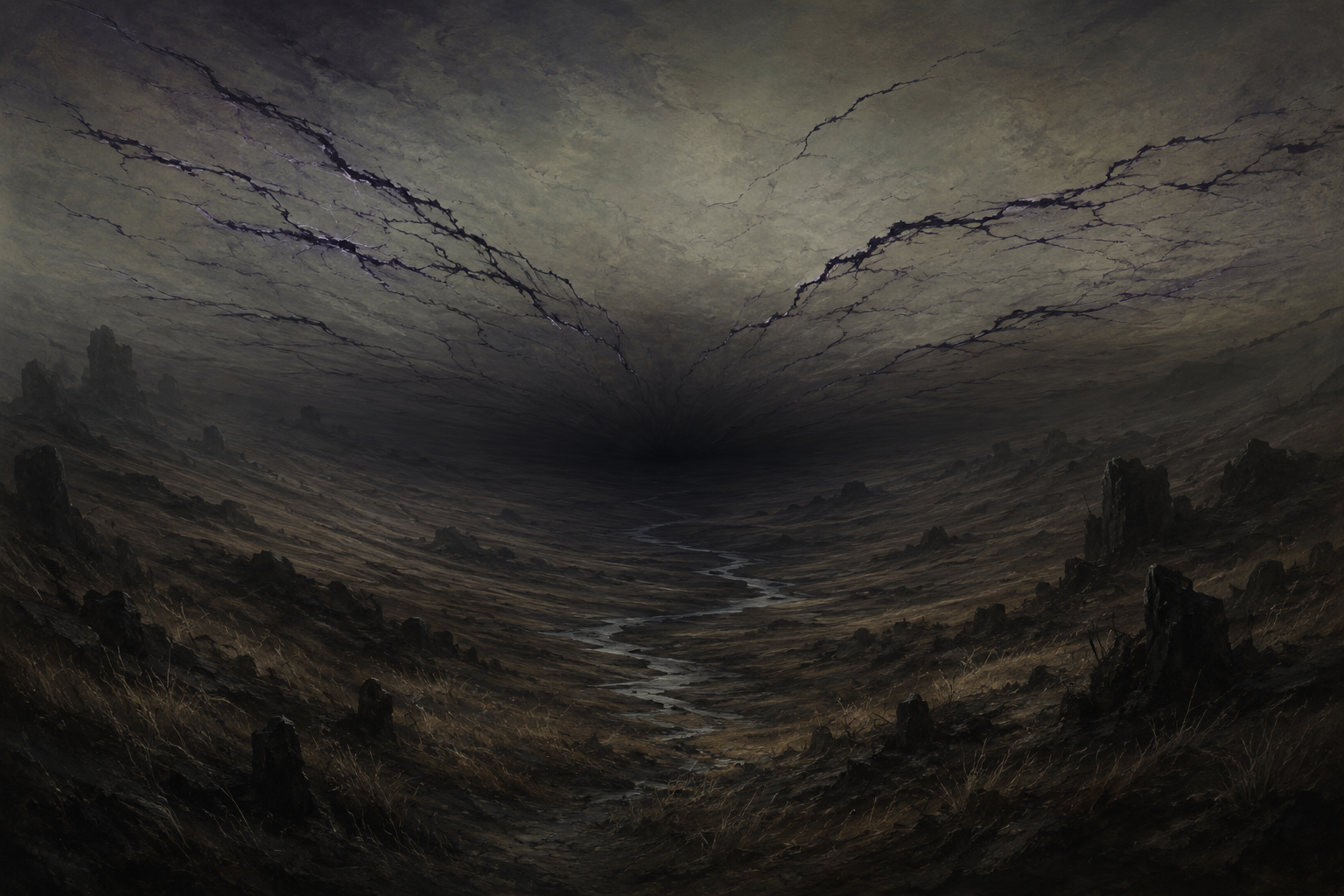
The way things are: all must be broken down and returned.Voracia is the Realm where the dark is hungry, and it is always, always watching.
Every mortal knows this Realm before they have a name for it. It is the lurch in the gut when a floorboard creaks in an empty house, the prickle along the neck in a forest gone too quiet, the certainty — older than language, older than fire — that something with teeth is deciding whether you are worth the effort. Mortals built civilization on the comfortable fiction that they sit at the top of the food chain. Voracia is the Realm that remembers what their ancestors knew in their bones: the food chain has no top. It only has depths. And something is always deeper.
This is not a Realm of cruelty. It is a Realm of consumption, which is a different thing, and the difference is the whole of it. Voracia does not devour out of malice any more than mortal entropy decays out of malice. It devours because that is the way things are, and because a cosmos that only ever made and never unmade would long ago have choked to death on itself.
The Way Things Are
The mortal Realm runs on passive entropy: things break down on their own, energy dissipates, order surrenders to disorder without anyone needing to push. Voracia is the inverse. Here, entropy is not a state that happens. It is a force that must be done. The dissolution the mortal Realm receives for free, Voracia performs by hand — actively, deliberately, eternally.
The medium of this work is anergy: anti-energy, unlight, hunger with intent. Where mortal darkness is merely the absence of light, Voracian darkness actively consumes it — light placed near a Voracian predator does not simply fail to reach the eye; it shrinks, flees, and is eaten. Anergy is not a single substance but a spectrum of consumptive forces, and everything native to the Realm is some configuration of it. The drool of a Voracian predator bores holes in a mortal floor not as an act of aggression but as a byproduct of being: even its idle secretions negate.
Against what does Voracia strive? Against accretion. The flow of That Which Begins never stops; existence is always arriving, always accumulating, always threatening to pile up into a congealed, immobile mass. Voracia's apocalypse is not fire or destruction but stasis — the Realm grinding to a halt under the weight of everything it failed to consume. This is the precise mirror of the mortal Realm's heat death: where mortals fear a universe too cold and still to sustain anything, Voracia fears a universe too full and clotted to move. Consumption is the function that holds that ending at bay. It is not appetite. It is maintenance.
From this single principle everything Voracian follows: that all things are ranked, that position is determined by what one can consume, that there is no neutral ground, and that to be is to take or be taken.
Internal Logic
The organizing structure of Voracia is the food chain, and it is not a metaphor. It is the literal architecture of the Realm — the way Contract is the architecture of Arcadia or Faith the architecture of Celestia. A being's position is its ontology. What you can consume defines what you are; what can consume you defines your limit. There are no citizens of Voracia, only ranks, and the ranks are read instantly by every native the way a mortal reads the height of a room.
The Realm's axis of vastness runs downward, into depth, toward That Which Ends. The surface of Voracia — such as mortals and travelers ever reach — is already lethal. But the surface is shallow. The deep is where the Realm's truth concentrates, where consumption approaches the basal truth it shadows, and the beings of the deep are as alien to the surface predators as deep-sea life is to creatures of the air. An apex predator of long standing may have devoured beings that called themselves gods, eaten angels who thought themselves immortal, consumed abstractions that had no physical form — and still find, going further down, that there is always something deeper, something older, something that has been eating so long it no longer needs to hurry.
What waits at the very bottom is not known and may not be knowable. Voracian testimony speaks of a patience down there: something that does not pursue because it has never needed to, that knows with absolute certainty that everything comes to it eventually. Whether this is That Which Ends itself, or merely its shadow given shape by eons of every being's terror of dissolution, no one who has gone deep enough to answer has returned to say. This is the one feature of Voracia the Realm itself seems to hold in reserve — the loaded question beneath the loaded Realm.
Consumption in Voracia extends past flesh. Knowledge, too, is consumed: it is not stored in archives but eaten, digested, and incorporated into the being that took it. The learned of Voracia are simply those who have consumed the most. This is why information shared by a Voracian is a substance genuinely surrendered rather than a thing merely communicated — to tell you what it knows, it must give you part of what it is. A Voracian that pays for a drink with the story of its people has, in the only economy that matters there, given away a piece of itself.
Inhabitants
Voracia is sparsely peopled by the standards of the political Realms, and this is not an accident of documentation but a consequence of the ontology. Predation does not assemble into parliaments. Where Arcadia has Courts and Celestia has hierarchies, Voracia has the hunt, the rank, and the solitary apex — and the moment Voracian nature organizes into anything more elaborate, it has usually become something else.
The most familiar Voracian to mortals is Mo'oraq, Hand of Ammit — an ancient apex predator who first bit into Apep when the weighing of hearts was still new, and who now keeps a table at Jack's Tavern. At Jack's he is a philosopher: urbane, direct, oddly generous in his way, dismissing wasted breath as "a waste of calories," teaching the frightened to consume their fear rather than fall to it. In his own Realm he is something with no urbanity left in it at all — a being who drinks raging rivers until they shrink away from him in terror. He is the same creature in both places. The difference is only how much of the Realm he is permitting to show. Every being in the cosmos — gods, fey, Nexus units, demons, mortals alike — carries a prey response to him. This is not mortal weakness. It is universal recognition of what Voracia is.
The Kuriasz are the closest Voracia comes to a civilization, and they reached it only by being Liminal — Voracian-Nexus, intelligence layered onto consumption because intelligent consumption outperforms the mindless kind. Among the first intelligences in the derived cosmos, they were present when the Irkkin'ann were learning to chisel truth and when the brass foundations of the Iron Nexus were laid. When their accumulated existence began to outpace their capacity to consume it — an ontological violation, in Voracian terms — they performed a deliberate self-reduction they call the culling: paring the civilization down to necessary function in order to return to stable consumption. "Culling is not suicide," one survivor explains. It is integrity. Among the cosmos's species, the Kuriasz are the existence proof that a civilization can survive its own nature taken to completion — at enormous cost.
Mortals, too, can be touched by Voracia. Those who hunt long enough at its edges acquire something of its grammar — channeling anergy as black lightning, learning to take rather than ask, measuring protection in kills rather than promises. They do not become Voracian. But the Realm leaves its scent on them, and other Voracians can smell it.
For specific named inhabitants, see the individual character articles, beginning with Mo'oraq and 156th Hunger — forthcoming.
Mortals and the Realm
A mortal does not arrive in Voracia. A mortal is drawn into it. The journey is felt first as a wrongness in balance — a lean forward, as though walking downhill on level ground — because the wind of Voracia does not blow. It pulls. The air itself draws all things toward consumption, and a traveler moves with that current whether or not they understand they are doing so. The light goes crepuscular, neither day nor night but the perpetual dusk of a world where everything is hunting or hunted. An acrid smell arrives. And then the prey-instinct every mortal carries from a billion years of being meat begins to scream, and does not stop until the door home closes behind them.
The single most important fact about Voracia for a mortal is this: the Realm does not wait for you to decide whether you are prey. If you act like prey, you become prey. Hesitation is an invitation. This is not bravado the Realm rewards — Voracia has no patience for posturing — but it is mastery the Realm requires. To pass through Voracia even briefly, a mortal must consume their own fear before the Realm consumes them through it. Those who walk it and return are not wounded, if their guides are competent. But they are changed. They have felt the pull of the hungry wind, and they do not forget it.
Travel to Voracia should never be attempted without a guide who is themselves a predator of standing — one whose rank the Realm reads and respects, under whose acknowledgment a mortal travels as a cub rather than a meal. The benediction such a guide offers worthy companions is the Realm distilled to a sentence: Hunt well, until you fall to your own hunter. It is not a threat and not quite a blessing. It is an accurate description of every being's situation, offered without apology, and the correct mortal response is to return it in kind.
Commerce with Voracia exists, though its mechanics are poorly understood. The Market has a Voracian entrance, and the deep notes of a mortal who has survived Voracia's depths can command a bidding war among buyers whose currencies are stranger than coin. What Voracians trade for, in the end, tends to reduce to the same thing they consume: information, experience, substance surrendered. The economy and the ontology are not separate. In Voracia, they never are.
Further Reading
For the active-entropy medium that defines the Realm, see Anergy. For the deliberate self-reduction of a Voracian-Liminal civilization, see The Kuriasz and The Culling — forthcoming. For the Realm directly opposite Voracia on the cosmological axis — generation against consumption, the maker against the unmaker — see Nyxaloth. For the Liminal intersection where Voracia's hunger meets Nirvana's sufficiency under Hell's testing, see City of Steell .
For specific inhabitants: Mo'oraq, Hand of Ammit and 156th Hunger — forthcoming. For the cosmic predator hunted across Realms whose pursuit first brought Voracia into mortal-adjacent record, see Apophis — forthcoming.
For the foundational principles beneath all Realms — and the truth Voracia shadows — see Basal Truths. For the Liminality through which most mortal contact occurs, see Liminality and Imposition. For the neutral ground where even a Voracian predator keeps a table under common terms, see Jack's Tavern and the Mortal Visitor's Guide.
Where to See This
For Voracia in action, the manuscript Tales from Jack's includes:
The manuscript is available in the [Manuscripts section] of this world, free to read.
In the mortal Realm, humans sit at the top of the food chain. They have arranged their entire understanding of themselves around that position.
Voracia is the Realm that informs them, without malice and without apology, that the position was always provisional. There is no top. There is only the hunt and the hunted, the consumer and the consumed, and the long descent toward something patient enough to wait for all of it.
The Realm is not unkind. It is simply honest about the one thing every other Realm lets you forget.

Comments