
Anergy
Anergy
The driving force of Voracia. The cosmos's only active unmaking.A mortal physicist once asked Mo'oraq, Hand of Ammit, what anergy was, expecting a definition. The Voracian apex set down his glass, considered the question for a long moment, and answered: little human, anergy is what your physics does in its sleep. We do it on purpose. The mortal wrote this down. He has been thinking about it for twelve years and has not yet, he admits, finished thinking about it.
Anergy is the active force of consumption — the inverse of mortal energy, the substance that breaks down organized structure, the medium through which Voracia performs its cosmic function of unmaking. Where mortal physics describes entropy as a passive law that things obey, anergy is entropy with intent. It does not wait to act. It seeks. It pulls. It consumes. Its presence is the difference between a Realm that watches things decay and a Realm that performs the decaying as its native operation.
It is also the most dangerous force the cosmos contains for mortal observers, not because it is malicious — anergy is no more malicious than gravity — but because mortal substance is precisely the kind of organized structure anergy exists to unmake. A mortal in proximity to active anergy is not being attacked. They are being read as prey by a force whose nature is to consume what it encounters. The distinction is academic and the consequences are not.
The Way Things Are
Anergy is the medium through which Voracia performs the cosmic function of active unmaking.
The cosmos as a whole faces a structural problem: existence is always arriving. That Which Begins generates continuously. New substance, new beings, new patterns of organization — these accumulate at every moment across every Realm. Without some counterbalancing operation, the cosmos would congeal under its own weight, choking on the accumulated mass of everything that has ever been generated and never returned. The mortal Realm addresses this through passive entropy: things break down on their own, energy dissipates, organization surrenders to disorder without anyone needing to push. This is sufficient for mortal physics. It is not sufficient for the cosmos at scale.
Anergy is the cosmos's active solution. Where passive entropy is a tendency, anergy is a force. Where decay happens, consumption is performed. Where mortal energy organizes substance into stable patterns, anergy disorganizes those patterns, breaks down their bonds, and incorporates the freed substance into the consumer. The operation is intentional, directional, and infinitely scalable — from the smallest Voracian scavenger taking a single bite to the deepest apex predator drinking a river that tried to drown them.
The principle that organizes anergy's operation is the food chain — not as a metaphor, but as the literal structural law of Voracia. Every being has a position. Position determines what one can consume and what can consume oneself. Anergy is what flows when consumption is performed. The food chain extends downward indefinitely, toward depths that approach That Which Ends itself, and at every level the operation is the same: anergy performs consumption, the consumed substance becomes part of the consumer, the consumer's Standing grows by the addition. The cosmos is metabolized through this operation one transaction at a time.
What anergy cannot do is rest. Voracia's only true catastrophe is stasis — the Realm congealing because consumption stopped. Anergy is therefore not a force the cosmos can switch off without consequence. It must continue, at every scale, for as long as That Which Begins continues to generate. The two truths are functional opposites holding the cosmos in operational balance.
The Modes
Anergy is not a single force but a spectrum of consumptive operations. Voracian thought organizes these into three modes, each describing the role consumption is playing in the food chain at the moment of the operation. The modes are simultaneously descriptive (they classify any given act of consumption) and developmental (they track a Voracian being's progression along the path of ontological maturity).
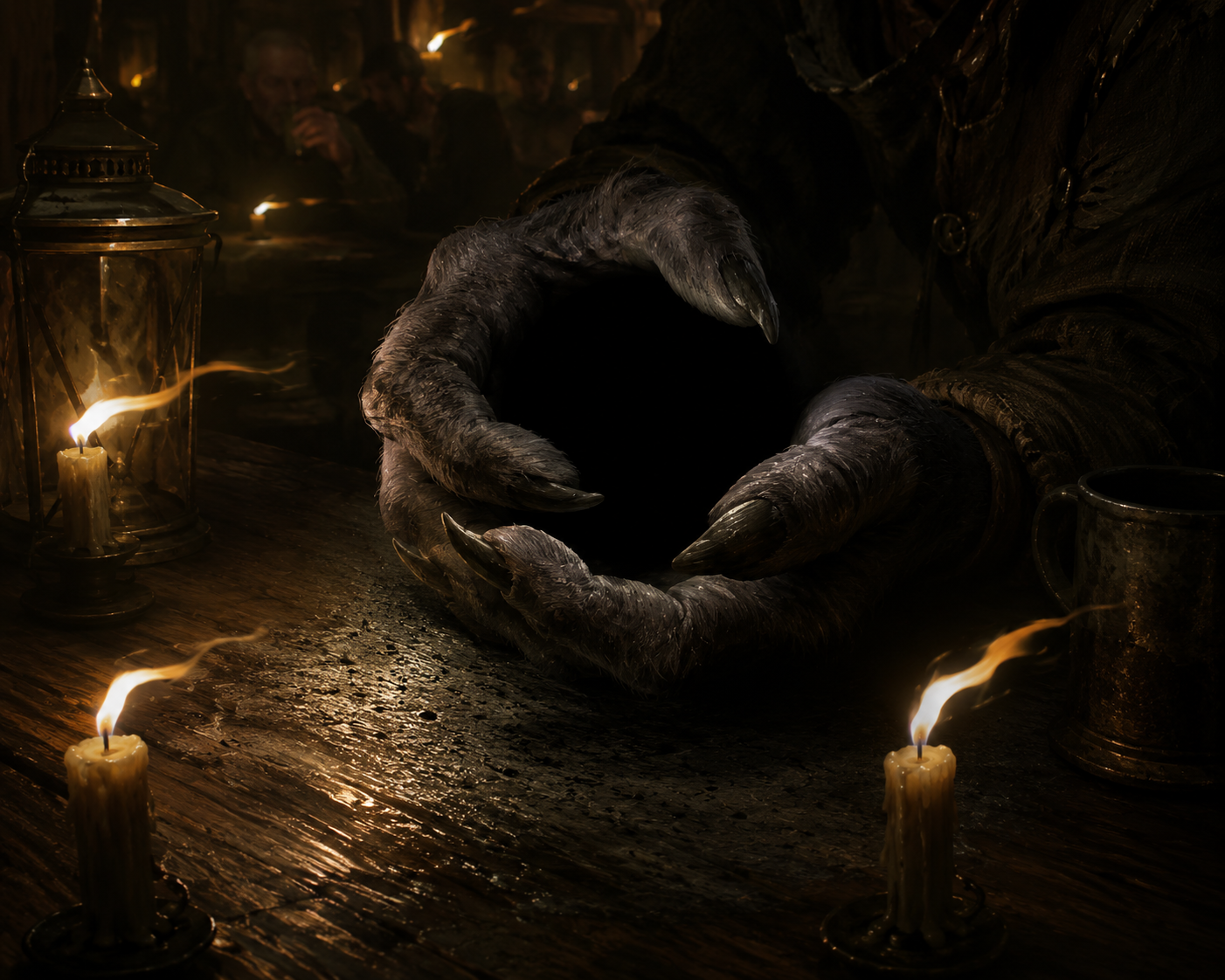
The Hunting Mode is anergy in active pursuit — directed, kinetic, the moment of taking aimed at a specific substance. Mortal observers, when they see anergy at all, almost always see it in this mode, because the Hunting form is the one that most resembles a recognizable physical event. What mortal eyes render as black lightning discharged from a Voracian-touched mortal's weapon, or as a black sun held in a predator's hand, or as black flame wreathing the body of an enraged apex, are all the same operation: Hunting-mode anergy taking visible form. This is the easiest mode for mortals to channel, when channeling is possible at all, because the Hunting form is closest to what mortal nervous systems understand as striking. It is also the mode Voracian beings consider the least sophisticated. A predator who only hunts is young.
The Pulling Mode is anergy at rest — gradient, gravitational, ambient. Where Hunting strikes, Pulling draws. In Voracia itself, the wind does not blow; it pulls, drawing all things toward the depths and toward whatever apex predators inhabit those depths. The slope of the land tilts toward consumption without anyone needing to walk it. A Voracian being of sufficient Standing radiates Pulling-mode anergy as a passive consequence of being — the field need not be deliberately generated; it is the gradient that the being's existence imposes on its surroundings. Mortal observers, unable to perceive this directly, experience it as atmosphere: the air thickening, the room cooling, the sense of leaning forward despite the floor being level, the inexplicable conviction of being drawn somewhere. This is anergy operating without intent, simply by being present. It is the mode that distinguishes mature predators from those still learning to hunt actively. A worthy predator no longer chases. The prey arrives.
The Waiting Mode is anergy as latent potential — the held breath of consumption, the certainty of taking-that-has-not-yet-occurred. Mortal observers cannot perceive this mode directly; it registers only as dread, the hair-rising at the back of the neck, the unaccountable certainty that the dark is watching. These are not superstitions. They are mortal nervous systems detecting Waiting-mode anergy and rendering it into the only category they have available. Among Voracian beings, the Waiting form is the most honored. To wait is to have understood that hunger is patient, that the cosmos brings its prey eventually, and that the deepest expression of consumptive ontology is to be the place to which all things come. The deepest Voracian beings — those approaching the patient hunger at the bottom of the food chain — operate primarily in this mode. They do not need to hunt. They do not need to pull. They wait, and the cosmos does the rest of the work.
Observable Effects
Active anergy produces effects on its surroundings that mortal observers can document, even when they cannot directly measure the force itself.
On light: anergy does not block illumination; it consumes it. Light placed near an anergetic source diminishes, flickers, and is drawn toward the source the way water is drawn toward a drain. Witnesses describe the light as appearing to panic — to shrink, to flee, to attempt to escape the proximity. A candle in a room with active anergy will gutter not from any draft but from the active erosion of its flame. A lantern of accumulated regard is one of the few light-sources known to resist this operation, on grounds discussed below.
On sound: the carriage of sound bends toward the anergetic source. Words spoken in proximity to a Voracian apex travel inward rather than outward; conversation at the next table grows quieter not because anyone is listening more carefully, but because the sound itself is being drawn. The laughter of Voracian beings is performed by inhalation rather than exhalation. The acoustic geometry of the cosmos runs backward in their proximity.
On structure: organized substance — wood, stone, metal, flesh — undergoes accelerated decay in active anergetic fields. Floorboards near a resting Voracian predator soften and pit within hours. Metal develops rust patterns that should have taken centuries. Bone weakens. The effect is proportional to the Standing of the source and the duration of exposure, and is essentially irreversible — what anergy has begun to consume, mortal restoration cannot fully repair.
On heat: fire near active anergy does not burn brighter, as mortal intuition might suggest. It cowers. Witnesses describe flames as appearing to hide behind logs, to shrink against their fuel, to seek shadow rather than oxygen. The behavior is sufficiently consistent across observations that some scholars argue fire itself recognizes the anergetic field as predatory and responds with the prey-instinct shared by all organized energy.
On beings: every entity in the cosmos exhibits a prey-response to active anergy at sufficient intensity. The response is universal and ontology-specific. Mortals experience prey-instinct, exhaustion, and biological refusal to engage. Hive cytes display visible diminishment, as if portions of their Psyche-link are being interrupted. Sheolite beings go gaunt, their alchemical fire flickering. Nexus units develop surface oxidation and tarnish. Celestials shed Faith faster than they can replace it. The only beings consistently observed to weather sustained anergetic proximity without distress are Hell-natives — whose testing-ontology, alone among the Realms, contains the structural resistance to ambient consumption. This is widely treated as cosmologically significant.
The Take
The fundamental unit of anergetic transaction is the Take — a single act of consumption, one instance of anergy acting upon a substance to break it down and incorporate it into the consumer. Mortal scholarship has only recently identified the Take as the correct unit; earlier mortal attempts at quantification used bites, calories, or other substance-centered measures and produced consistently incoherent results. The Take is correct because it is transactional rather than substantive. It does not measure what something is. It measures what is happening to it.
A Take's effective magnitude depends on two factors. The first is the caloric substrate — the energetic cost of the operation, expressible in mortal physical units. The second is the Standing of the consumer — the accumulated depth of their consumptive history, which functions as a multiplier on the cost. A young Voracian and an apex predator performing what looks externally like the same operation will produce wildly different results, because the apex's Standing multiplies the effective Take by orders of magnitude. The mortal physicist Dr. Ines Vargas Coutinho, in her 2026 paper The Food Chain as Physics, inferred Standing values for several Voracian beings by measuring the discrepancy between observable caloric expenditure and observable effect. Her values — approximately 1.0 for a mortal Voracian-touched channeler, approximately 890 for the Kuriasz being 156th Hunger, approximately 7,412 for Mo'oraq, and estimates above 50,000 for Ammit herself — should be understood as first approximations of a property that resists direct mortal measurement.
Standing cannot be sensed by any mortal instrument. It must be inferred from observable discrepancies. Voracians themselves perceive each other's Standing directly, the way mortals perceive each other's height. This asymmetry between native perception and mortal inference is the central methodological challenge of all mortal anergetic study.
Channeling Anergy
Anergy is not native to most beings in the cosmos. Voracians produce it as a function of their ontology; everyone else must, in some sense, borrow it. The means by which non-Voracian beings can come to handle anergy vary, and the consequences vary with them.
The most common path is Voracian touching. A mortal who hunts in or near Voracia for long enough, under the sponsorship of a Voracian being who has acknowledged their continued existence, may gradually acquire the capacity to channel small amounts of anergy in the Hunting mode. They do not become Voracian. Their teeth do not grow. They cannot pull and they will never wait. But they can discharge Hunting-mode anergy as a directed force — what their nervous systems and weapons render, again, as black lightning or a similar visible operation. The mortal hunter Meghan, who runs with Yusuf's pack and considers Mo'oraq her teacher, is the most documented example. Her efficiency is approximately one-to-one — every calorie of anergy she expends performs roughly one calorie of consumption. She does not accumulate Standing. She remains, in Voracian terms, very tender prey despite her tactical lethality, because she has learned the verb of consumption without becoming the noun.
Mimicry is the rarer and stranger path. Sheolite alchemical fire, under the right conditions of Voracia-Sheol Liminality, can be induced to copy anergy — producing what survivors describe as hungry decay with intent, a fire that behaves as though it were consuming rather than burning. The technique is delicate, dangerous to the practitioner, and produces results that resemble true anergy without fully replicating it. Mimicked anergy is detectable to a Voracian: it tastes wrong, it consumes inefficiently, and it can be sated rather than starved. The GeneSys corporation's outermost defensive perimeter is widely believed to be Sheolite-mimicked anergy, though the methodology by which they obtained it is not in the brass.
Direct channeling by non-Voracian non-mortal beings is essentially unattested. Hell-natives can resist anergy but do not channel it. Celestials can be diminished by it but do not handle it. Forge-smiths can shape metal in proximity to anergetic forges (see the Masamune-of-Steel methodology) but the anergy in such operations is supplied by Voracian collaborators rather than generated by the smith. Nexus units can measure it but cannot produce it. The Kuriasz, whose Voracian-Nexus Liminal nature provides them with both the producing capacity and the structural intelligence to manage it, are an exception that proves the rule: even they had to evolve the discipline of culling to handle their own ontological accumulation, and the discipline very nearly destroyed their civilization before they perfected it.
What Resists Anergy
Anergy consumes organized energy, but not all organized energy is equally consumable. The cosmos contains several specific phenomena that resist anergetic consumption, and the patterns of resistance are themselves cosmologically informative.
Accumulated regard is the most reliable resistance. Jack's lantern, which contains accumulated Faith and regard offered freely over centuries, is the documented case. Mo'oraq, Hand of Ammit, attempted to consume the lantern's light early in his acquaintance with Jack and could not — the light did not behave as light, did not dissipate or convert, but simply was, in a place where his consumption was also trying to be, and the contradiction resolved in the light's favor. He carries the scar from that attempt on his throat to this day. The principle the encounter established has been confirmed in subsequent observations: substantial accumulated Faith, freely given and properly received, resists anergetic consumption in a way no other substance does. This is not a function of quantity of Faith alone — small Faith-objects can still be consumed — but of accumulated regard with the structural depth that long honor produces.
Hellfire and Hell-tested substance are the second documented resistance. Hell's testing ontology produces, by its nature, substances that have already endured the most demanding conditions the cosmos can impose. Anergy is one such condition, and Hell-tested substance has, by definition, survived it. This is why Ashmedai weathers sustained Voracian conversations that diminish every other being in the room, why hellfire is one of the few materials Voracian metallurgy can work without consuming its containers, and why the Cities of Brass, Bronze, Pewter, and Steel can exist at all — each is built on the principle that Hell's testing produces substance whose endurance includes resistance to anergetic consumption.
The substrates that compose Voracians themselves resist consumption by lesser Voracians. The food chain's structural law means a being can only consume what is positioned below them; substance incorporated into a higher-Standing Voracian is, in effect, promoted out of the food chain of those beneath. Mo'oraq's substance cannot be consumed by an ordinary Voracian predator. It can be consumed only by something higher than Mo'oraq, of which there are very few candidates in the cosmos and most of them are theoretical.
What does not resist is the universe of ordinary organized substance — mortal flesh, mortal metal, mortal stone, the patterns of belief that have not yet accumulated into Umbral substance, the Faith that has not yet been accumulated into Celestial standing. Anergy consumes these by default, and the cosmos's general baseline is that anergy unopposed will consume what it encounters. The resistant phenomena are exceptions, and their exceptional status is part of why they are cosmologically important.
Can light panic?
Mortals and Anergy
Mortal contact with anergy is rare, dangerous, and increasingly the subject of scholarly attention.
Most mortals never knowingly encounter anergy at all. The few who do most often encounter it through one of three vectors: the Voracian edge of the Market, where Voracian traders offer goods whose nature has been touched by the Realm; the rare visit to Voracia itself, undertaken under the guidance of a sponsor with sufficient Standing to keep the mortal from being treated as prey; or the still rarer phenomenon of being in the presence of a Voracian being who is visiting elsewhere, as Mo'oraq does at Jack's Tavern. In all three cases the mortal experience is similar: a prey response that the body produces before the mind catches up, a sense of being read as substance rather than person, and a permanent recalibration of the mortal's understanding of what consumption means in the cosmos.
Mortals who survive sustained anergetic exposure are changed by it. Not Voracian — that transformation requires conditions mortal life does not permit — but Voracian-touched, which is a quieter and lifelong alteration. Touched mortals eat differently. They sleep less. They develop a precise awareness of position in any room they enter, and an instinct for assessing other beings as predator, peer, or prey that they do not lose. Some learn to channel small amounts of Hunting-mode anergy, as Meghan has. Most do not channel at all but remain marked by the contact for the rest of their lives.
Mortal scholarship on anergy is in its infancy. Vargas's Food Chain as Physics is the first sustained mortal attempt to quantify the force, and it is necessarily partial — she has noted in her own paper that her arithmetic is too clean, that Voracian beings have indicated additional factors she has not yet been able to formalize, and that the deepest Voracian modes (Waiting especially) resist mortal measurement entirely. The recovered Sheolite treatise by Xar'cahn of the Eighth Spire, On the Fundamental Structure of Nexus-Derived Substance in Voracian Ontology, provides a different and richer methodology by which a Sheolite-trained scholar could analyze anergetic substance — but the methodology requires alchemical fire that no living mortal possesses, and the work is preserved primarily as historical record rather than practical instrument.
For mortals who must interact with anergy — researchers, hunters, Liminal traders, the rare diplomat — the standing advice is the one Mo'oraq has given more often than he has counted. Consume thy fear before it consumes thee. Hunt well, until you fall to thine own hunter. Mortals who have heeded this advice have, on the whole, fared better than those who have not. The advice is not a magic protection. It is a description of the only posture from which anergetic contact can be survived: presence rather than panic, mastery of self rather than mastery of the force.
Further Reading
For the Realm whose animating principle anergy is, see Voracia. For the apex predator who has taught more mortals about anergy than any other being, see Mo'oraq. For the Liminal civilization whose self-discipline of structured consumption is the cosmos's clearest example of anergetic mastery, see The Kuriasz — forthcoming. For the Voracian unit of transaction, see The Take — forthcoming. For the multiplier that determines a Take's effective magnitude, see Standing — forthcoming.
For the mortal physicist whose 2026 paper inaugurated mortal anergetic scholarship, see Dr. Ines Vargas Coutinho — forthcoming, and her paper Scene 1 in Food Chain as Physics — forthcoming. For the Sheolite scholar whose recovered treatise remains the deepest cross-Realm analysis of anergetic substance, see Xar'cahn of the Eighth Spire — forthcoming, and his treatise Scene 1 in On The Fundamental Structure of Voracian Substance . For the teacher whose marginalia preserves the cosmos's clearest warning about where anergetic inquiry can lead, see Anna Dalca.
For the force most directly opposed to anergy in cosmological function, see Generation — forthcoming, the active operation of Nyxaloth that produces what anergy consumes. For the substance that uniquely resists anergetic consumption, see Faith — forthcoming. For the testing ontology that produces materials capable of containing anergy without being consumed, see Hell. For the Liminal city where anergy is held in equilibrium with sufficiency under Hell's testing, see The City of Steel.
The cosmos generates without rest. The cosmos consumes without rest. Anergy is the second operation, made visible in the Realm whose entire existence is the performance of it.
Mortals fear the consequences of anergetic contact, and the fear is appropriate. But the operation itself is not malice. It is the way things are. The cosmos that did not consume what it generated would, in the end, generate nothing further — there would be no room. Anergy is what makes room.
The bite that takes is also the gift that clears. Voracia does not apologize for this, and the wise do not ask it to.

Cool concept, well thought out. I like the interplay between the different forces.