
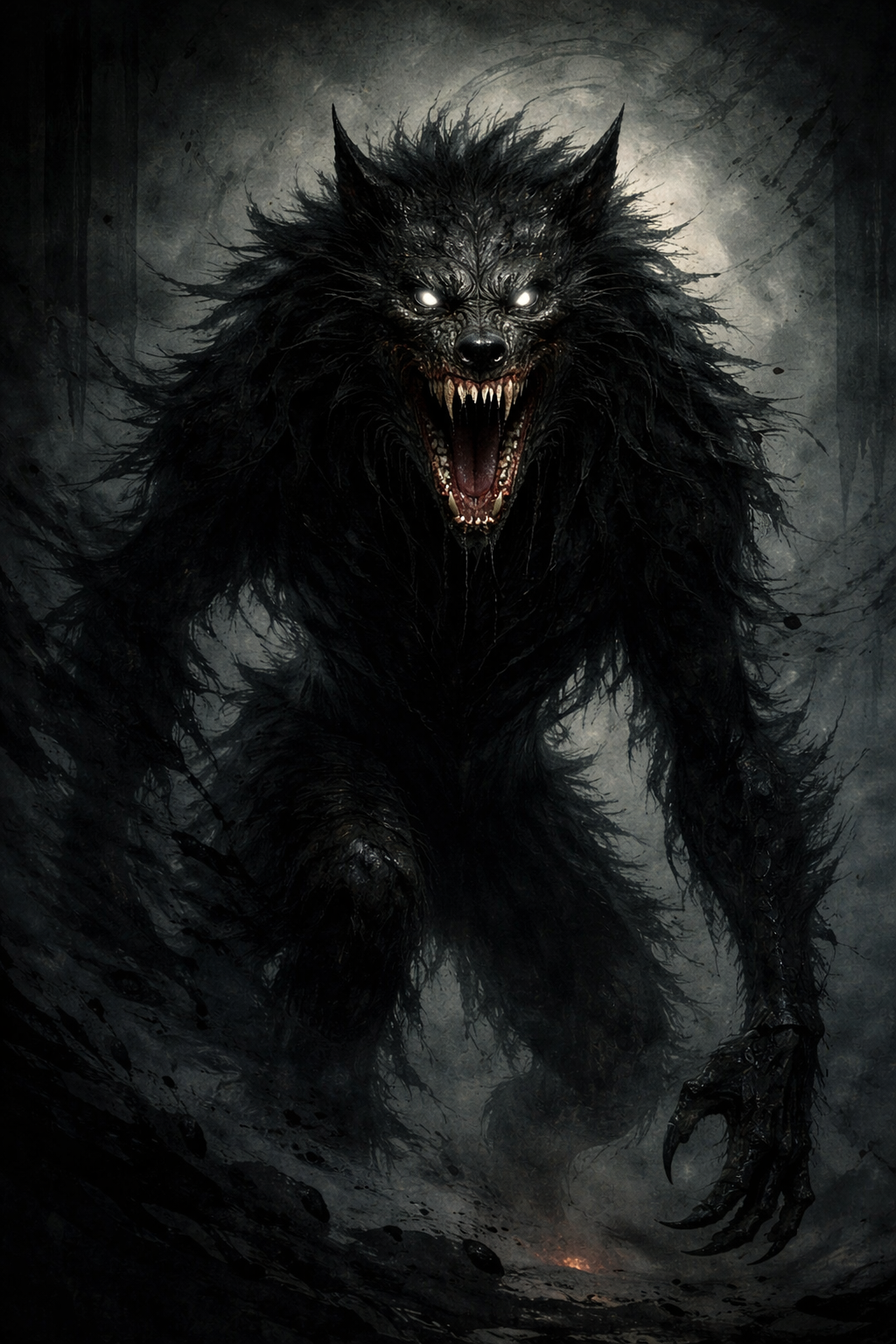
Mo'oraq
Mo'oraq, Hand of Ammit
Voracian apex predator, philosopher, regular at Jack's TavernMo'oraq is older than most gods, and he has eaten enough of them to know.
The Voracian who keeps a table at the back of Jack's Tavern is one of the deepest predators the cosmos can produce — a being whose maw first bit into Apep when the weighing of hearts was new, who has consumed angels who thought themselves immortal and abstractions that had no physical form. At Jack's he is a philosopher: direct, oddly generous, dismissive of wasted breath. In his own Realm he is something with no urbanity left in it at all. He is the same creature in both places. The difference is only how much of Voracia he is permitting to show.
He is also, by his own admission, well-mannered enough to honor a Contract he could not break — and patient enough to have learned why he should not have tried.
Appearance
He is titanic. Seated at his table he is eight feet tall, and his height standing is the kind of number mortals stop calculating once they have understood the shape of the problem. He is lupine in outline but only in outline; whether what covers him is fur, cloak, or shadow has not been agreed upon by any two mortals who have tried to describe him afterward. His mouth holds far too many teeth, in too many rows, and the geometry of them does not quite resolve under direct attention.
He moves with the lazy alpha grace of something that has not needed to hurry for a very long time. When he does need to move quickly, the speed is blinding and difficult to remember in detail. His drool falls to the floor with quiet finality and bores small holes in whatever it lands on. The wood of Jack's tavern, which has weathered far stranger guests, treats this as a fact rather than an emergency. The holes are not repaired. They are simply part of the floor now.
He laughs by inhaling. His voice arrives inside the chest more than the ear. Sound near him moves the wrong way, drawn rather than driven. None of this is performance. It is the consequence of being a creature whose ontology runs in the opposite direction from mortal physics, taking the same trip every other being takes and going through it backwards. He is not deliberately uncanny. He is what uncanny looks like when it is comfortable.
Nature
Mo'oraq is the Hand of Ammit — the one who reaches where she does not. Ammit waits beside the scales of Ma'at; he ranges. She consumes the unworthy souls justice delivers to her; he disposes of what she cannot consume herself, and hunts what she does not deign to chase. The relationship is not employment and not allegiance in any mortal sense. It is the bond between a great consuming and the agent of its longer reach, and it has held since before mortals could write its terms down.
Beyond that role he is, simply, a Voracian apex. What he can consume defines what he is; what he has consumed is the better part of the cosmos's strangest list. Gods. Angels. Cytes. Demons. Stars. The dreams of dying civilizations. He has tested himself against mortal nuclear weapons and reported, with the same mild interest he might give a vintage, that he enjoyed the small ones. He is curious about the larger ones, in the way a connoisseur is curious about a label he has not yet opened.
He is not unkind. He is not cruel. He is honest about consumption in a way no other Realm permits itself to be, and he extends that honesty as a gift to beings he considers worth the breath. Most of the mortals who have shared his table have learned more in an hour with him than in a year of less direct teachers. Some of them have thanked him for it. He has accepted the thanks gravely, as though aware that the gesture is itself a kind of meal.
Hunt well, 'til you fall to your own hunter
At Jack's
He has kept a table at Jack's Tavern for centuries.
It is the back table, near the hearth's shadow but not in it, with a sightline to the door. He arrives quietly. He pays his tales — most of them about ancient hunts, some of them about the philosophy of consumption, occasionally one about a meal so old that the words for the prey have changed three times since. He drinks something that smells of cold iron and never says what it is. He is unfailingly courteous to Jack, to Elsie, and to the patrons who manage to address him directly.
He is, to a small and surprising number of beings, a friend. Sub-Unit 72 is one — the unit's cataloging mind and Mo'oraq's hunger have found long, slow conversations to share about the nature of accumulation versus consumption, and what each calls the other across their separate ontologies. Zaquiel is another, in the way two ancient cynics can be friends without ever admitting to it. Herne is a third, and the most equal — two apex predators who hunted together when the cosmos was younger, and who still meet at Jack's occasionally to compare what each has eaten since.
To a mortal who arrives prepared to face him, he is something rare in the tavern: a being who will answer questions directly, without ornament, without the comforting fiction that the answers are kinder than they are. He has corrected a frightened mortal's instinct to hide with, If you would know me, take the answers from me. Hunt for the knowledge you seek. That is the way of things. He has dismissed the temptation to mortal cowardice with, Thy kind shrinks often from work to be conquered simply from fear of the attempt. Do not number yourself among them. He has granted, more gently than mortals expect, the permission to build impermanent things: Build your things, strive against your entropy. Teach the cubs who come after. These are worthy goals. And they are not less worthy simply because someday your Realm will swallow them anyway.
He finds criticism a waste of calories. He has said so. The phrase has entered the working vocabulary of every mortal who has heard it, and many who have only heard it secondhand.
The Scar
There is a scar on Mo'oraq's throat. It does not heal.
Early in his acquaintance with Jack — before Mo'oraq had taken the tavern's measure, before respect had become familiarity — he made the calculation that the changeling barkeep was prey, that the lantern on the bar was a curiosity, and that the rules of Jack's were rules made for lesser beings. He opened himself to consumption and reached.
The lantern raised. Light poured. Mo'oraq tried to eat it and could not. The light did not behave like light. It did not dissipate or convert; it simply was, in a place where he was also trying to be consuming, and the contradiction resolved in the light's favor. He felt it sear across his throat — the killing place, the place where predators end prey — and he staggered back, and he found himself outside on the Dublin cobblestones with the door shut behind him and a wound that would not close.
He sat there for a long time.
He went back the next night.
Jack greeted him as though nothing had happened, poured a drink, and answered his question. What was in the lantern? Respect, freely given, accumulated over time. Not worship. Not Faith in the Celestial sense. Just regard, compounded across centuries of beings who had honored the Contract on the door. Mo'oraq, who had consumed gods, had been turned back by accumulated regard.
The scar has not healed. It will not. Mo'oraq has not asked it to. He carries it as a reminder of the one thing in the cosmos he has tried to consume and could not, and the one being he has cause to honor not because he must but because he chose to. The friendship that began that night has held since.
Mistake my my peaceable intention under Jack's roof for weakness. I do not fear thee, little god.
Hunts
He hunts for joy more than necessity, and the greater the prey, the greater the joy. Mortal weapons interest him in the way fine wines interest a sommelier — for the variety, the craft, the small differences between vintages. Mortal beings interest him as cubs interest a teacher: he has consumed his fair share, but he has also stayed his hand more often than mortals would believe, because the world has plenty of unworthy prey and very few worthy students.
His longest-running hunt is for Apophis. Together with Ammit, with Herne's Wild Hunt, and occasionally with Ra himself, he has been driving the chaos serpent back into the dark between Realms for as long as Ra has had a sun to defend. They have never been able to kill it; it cannot be killed, by the nature of what it is. Mo'oraq considers this a feature rather than a failure. Asked once whether he regretted not finishing the serpent, he laughed his inhaling laugh and answered: Kill it? Little barkeep, that serpent has fed me more than any other prey in existence. Apophis is not a failure. Apophis is the meal that never ends. I hope it lives forever.
He has also, in his long career, hunted himself. Not in any mortal sense — Voracians do not commit suicide; that would be a wasted calorie. But Mo'oraq has gone deeper into Voracia than nearly any other being. He has sought the bottom of the food chain in the way a scholar seeks an unread library. He has not reached it. What he has found, the further he goes, is patience: something old, something that has been eating long enough that it no longer needs to hurry, something he cannot name and is not certain has a name. Whether he hopes to reach it or hopes never to, he has not said. He has admitted, to Herne and only to Herne, that there is a part of him that has always wanted to know what it feels like to be on the other side. It would be a worthy ending. To fall to one's own hunter at last.
Boundaries
He does not break the Contract on Jack's door. He has not tried since the scar.
He does not threaten guests in Jack's, even when teasing them, and the mortals who have mistaken his teaching for menace have always been corrected gently. He does not hunt within the tavern, will not hunt in its immediate vicinity, and has been known to relocate hunts that drifted too close to Dublin in deference to Jack's preferences.
He does not consume what cannot be used. This is a Voracian principle, not a personal one, but Mo'oraq holds it as a matter of dignity. To kill what cannot feed something is to waste calories, and to waste calories is the only obscenity Voracia recognizes.
He does not lie. Not because the Realm forbids it but because lying is inefficient, and the truth is faster.
He does not interfere in Contracts struck between others. He has watched the fey work and found them fascinating; he has watched Celestials posture and found them tedious; he has watched mortals stumble through both and refrained from comment unless asked. He is generous with his observations when asked. He is silent when not.
Beyond Jack's
He returns home often. Voracia is where he is fullest, and the river there still flees when he goes to drink. In his own Realm he is something with no philosophy left in it — only hunger and the promise of violence, only the certainty of position on the food chain and the long descent toward what lies beneath. A mortal who has met him only at Jack's would not recognize him as he stands at the water's edge in Voracia. A mortal who has met him in both places understands that the gentleness of Jack's is not a mask. It is a choice — an active restraint by a being who could choose otherwise, and who does not, because Jack's tavern is a place he honors.
He keeps acquaintances elsewhere — Ammit in the deep ranges of Voracia where her scales catch what little light reaches; Ra at certain Celestial functions where their old battle is remembered with formal courtesy; Herne wherever the Wide Road runs; Meghan, the mortal-Voracian who hunts with Yusuf's pack and calls Mo'oraq her teacher. He maintains no demesne, no court, no political position. He does not need them. He is what he is, ranked where he is, and the cosmos arranges itself around the fact without his having to ask.
He goes where the hunt calls. He returns to Jack's when the calling quiets. He does not seem to find the tavern small.
Further Reading
For the Realm whose ontology he expresses most purely, see Voracia. For the goddess he serves as Hand, see Ammit — forthcoming. For the longest-running hunt of his existence, see Apophis — forthcoming. For the lantern that gave him his only scar and his only friend, see The Lantern — forthcoming. For the changeling who owns it, see Jack. For the place he sits to debate the philosophy of consumption, see Jack's Tavern. For the Wild Hunt's master and Mo'oraq's closest equal, see Herne — forthcoming.
Where to See This
For Mo'oraq in action, the manuscript Tales from Jack's includes:
The manuscript is available in the [Manuscripts section] of this world, free to read.
He sits at the back table. He drinks something dark. He listens more than he speaks, and when he speaks the room arranges itself around him whether he wishes it or not.
He has eaten gods, and he honors a barkeep's house rules. He has scarred himself reaching for what he could not consume, and he has never tried to consume it again. He has taught more mortals than he has eaten, by some accounting, and he is not entirely sure when that became true.
Mo'oraq is Voracia's gift to anyone willing to look directly at it. He is also, by no stretch of the word, kind.
He is, however, honest. And in a cosmos full of comforting stories, honesty is the rarest meat there is.
The Universal Fear Response
Every being in the cosmos has a prey reaction to Mo'oraq.
Gods offer Faith in awe of him. Fey scribe hasty agreements. Nexus units catalogue weaknesses they cannot use. Demons endure, which is what demons do. Mortals shake, and sweat, and sometimes hold their ground, and sometimes do not. The reaction is not a function of weakness, nor of mortal fragility, nor of any failing in the being who feels it. It is universal recognition of what Voracia is, encountering one of its purest expressions. The body knows before the mind does. The mind is given time to catch up, if Mo'oraq is in a teaching mood.
He does not enjoy this effect, exactly. He does not perform it either. It is the byproduct of being present, the way heat is the byproduct of a fire. He has, on more than one occasion, encouraged mortals to consume the fear rather than be consumed by it — to take it as fuel, to master themselves through it, to refuse to be made prey by their own bodies. This is offered as instruction, not consolation. He has no patience for cowardice and no contempt for fear; he distinguishes between them the way a smith distinguishes between heat and a burn.
The only being known to weather his unfiltered presence with no observable reaction is Ashmedai, whose ontology is testing-and-endurance and whose nature is to weather precisely such things. Mo'oraq notes this with respect. The two of them have a courteous, mutually wary acquaintance and an unspoken agreement to never test whose hand the cosmos would favor if it came to it.

Comments