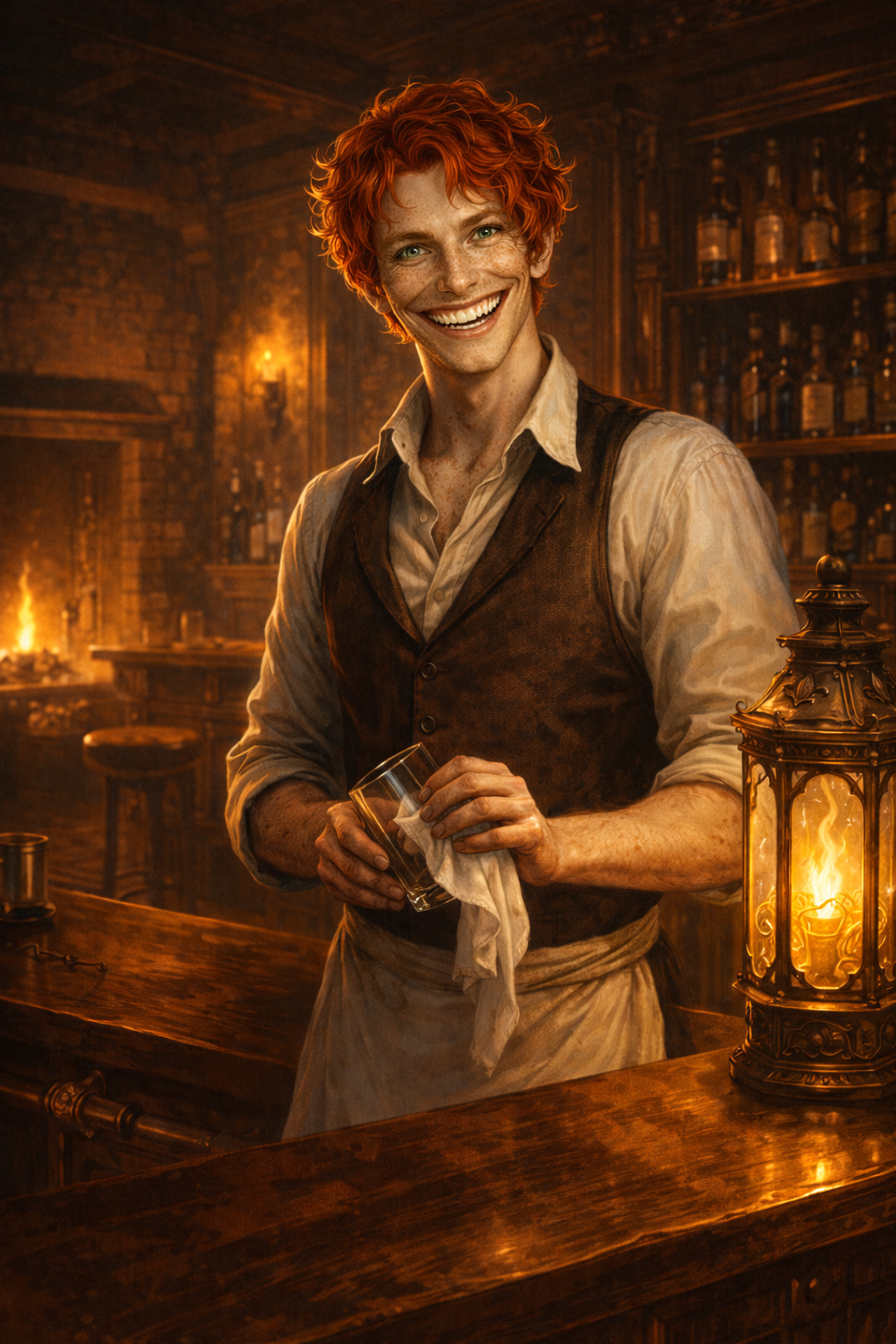
Jack
Jack o' the Lantern
Proprietor of the Tavern, ground of neutral meetingJack is older than he looks, and he looks older than most mortals would guess.
The changeling who built the Tavern from a campfire in Arcadia has been at his post for centuries. The Tavern grew around him — first a hearth, then a room, then the establishment that exists today, with doors in nearly every city where there is commerce. The rules he set at the campfire have never changed.
He is tall and lanky, copper-haired, with eyes that see more than they should. His smile stretches slightly too wide for a human mouth. He extends it equally to everyone who enters, and it is genuine.
Origin
Jack is a changeling — born of a mortal parent and a fey one, belonging fully to neither side. His early life was difficult in ways he rarely discusses. He learned what it meant to be unwelcome, to have no place that was truly home. He has not described those years in any account preserved in the brass.
What is known: he came to a place in Arcadia where the borders of several Realms touched, and he built a fire. He set a single rule beside it: you're welcome to rest and eat; just tell me a tale. The first beings to accept the invitation found him patient and the rule honest. They returned. Others followed. The fire became a hearth. The hearth became a room. The room became the Tavern.
He swore, at that first fire, not to perpetuate the discomfort he had grown up inside. He has kept the oath.
Nature
Jack is not a faction. He is not an ally that any being can recruit, and not a rival any being can defeat. He is the ground on which the Tavern stands — the neutrality that makes the meeting place possible. His role is to provide the space where every other story can happen, and he has held that role with patience for as long as anyone present can verify.
He tends bar. He polishes glasses. He listens. He offers wisdom when it is sought and silence when it is not. He is jovial without being intrusive, attentive without being eager, and unfailingly kind to beings who have rarely been treated kindly elsewhere. None of this is a performance.
He is also not soft. The Tavern's protections are absolute, and Jack is the one who enforces them when enforcement is required. Beings who have tested the rules have learned what the lantern on the bar can do when Jack raises it deliberately. Most such beings have not returned. The few who have, have learned to behave.
The Smile
The smile that stretches too wide is the first thing most mortals notice. It is genuine. It is also not entirely human, and not entirely Arcadian — like Jack himself, it is something else, something that the categories of either parent Realm cannot quite contain.
He is aware that it unsettles people. He extends it anyway, because suppressing it would be a kind of lie, and lies do not belong in the Tavern. The patrons who become regulars stop noticing the smile within a few visits. The ones who never stop noticing it tend not to become regulars.
The Lantern
The lantern on the bar is the Tavern's enforcement instrument and Jack's only weapon.
In ordinary operation, it casts warm light and bends slightly toward beings of significance who enter — a quiet illumination of those whose stories carry weight. When Jack raises it deliberately, the warm light becomes something else. Violence within the Tavern is not merely prohibited; it is impossible, in a way that the offending being cannot work around. The mechanism is not advertised. The fact that it works is sufficient.
What the lantern contains is not a subject for casual discussion; it is a deep reminder that Jack feels he owes a debt he cannot square. Several beings have inquired. He has, in each case, smiled and changed the subject. The patrons who know what is inside it know because they were present when it was given, and they keep their silence as a matter of respect rather than secrecy.
Disposition
He is curious. He listens to every story brought to his bar, and he remembers all of them. The brass keeps the words; Jack keeps the meaning. He has been asked, occasionally, what his favorite stories are. He always says it is the one he has not yet heard.
He is patient. He has watched factions rise and fall, watched gods grow into themselves and falter, watched mortals come to the Tavern bewildered and leave with frameworks they will carry for the rest of their lives. None of this seems to wear on him. He treats each new visitor as if they are the first he has ever served.
He is loyal. The beings he counts as friends — Elias, Elsie, Sub-Unit 72, Zaquiel, Mo'oraq, and a handful of others — receive a kindness from him that goes well beyond what the Tavern's rules require. He does not advertise these friendships. He simply provides for them, quietly, when they need it.
He is unbothered by cosmological weight. Gods enter the Tavern and order drinks. Demons negotiate at the hearth. Beings whose nature breaks mortal comprehension take corner seats and Jack greets them by name. He does not flinch from any of it. He does not appear to find any of it unusual.
Boundaries
There are things Jack will not do.
He will not take sides in a conflict between patrons. Many have asked. None have succeeded in persuading him, and several have damaged their welcome in the attempt.
He will not break a Contract once it has been struck inside the Tavern. The brass records all of it; his reputation rests on the integrity of those records; he will not be the one to compromise it.
He will not allow violence within his walls. Not threatened. Not implied. Not deferred to outside the door as a pretext for staging the confrontation indoors. The Contract on the door is absolute on this point, and Jack is its enforcer.
He will not accept a story he believes is being offered dishonestly. He has, in his centuries of operation, turned away a handful of beings on this basis. The encounters were brief, and the beings in question did not return.
Beyond the Tavern
Jack rarely leaves.
The Tavern is, in a meaningful sense, his ontology — the place he built, the rules he set, the materials he chose, the patrons he has welcomed. The brass remembers everyone he has served. The lantern responds to him in ways it does not respond to anyone else. The Bodhi wood underfoot, the Paradox Wood from Arcadian edges, the Umbral oil he uses to polish — all of it is keyed, after centuries, to him specifically.
He could leave if he chose. He does not choose to. The Tavern is where he is needed, and Jack is the kind of being who stays where he is needed.
The cosmos is large and frequently hostile. Jack tends bar. The two facts are not in conflict — they are why the Tavern exists.
Further Reading
For an in-world visitor's perspective on Jack and the Tavern he keeps, see A MORTAL VISITOR'S GUIDE TO JACK'S TAVERN. For the cosmological framework that makes neutral ground meaningful, see The Realms and Basal Truths. For a deep-dive into the tavern itself, see Jack's Tavern. For the binding that the Tavern's door enforces, see The Contract — forthcoming. For the item that holds the greatest gift he ever received, see Jack's Lantern. For the one who works with Jack closest in maintaining the tavern, see Elsie. For Jack's oldest friend, who first sat at his campfire and recognized what it was worth, see, Elias.
The fire is warm. The door is open. The proprietor is, as always, behind the bar.

Comments