
A MORTAL VISITOR'S GUIDE TO JACK'S TAVERN
Between Realms, Between Stories
Compiled from testimonies recorded in the brassWhat Is Written On The Door
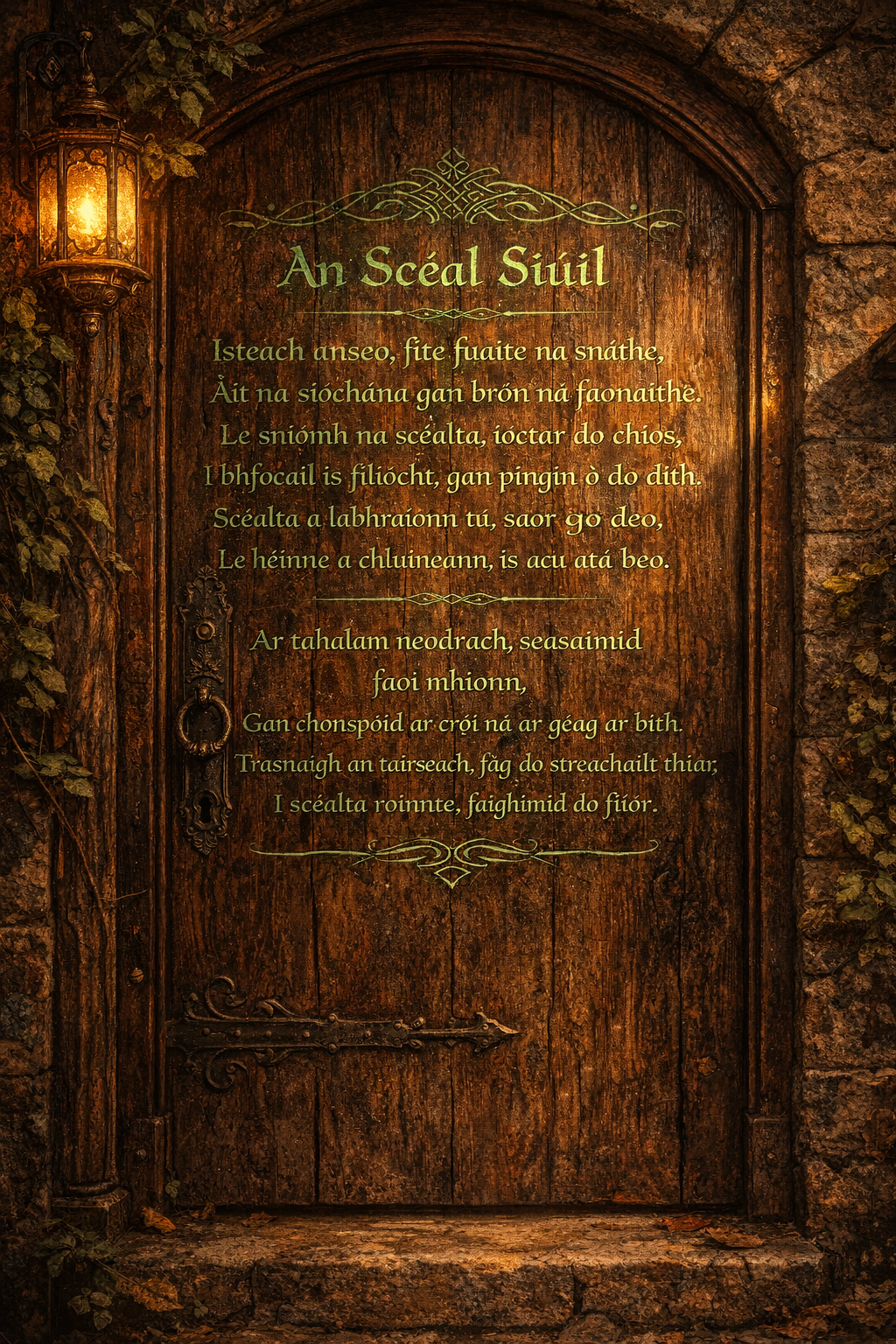
Before you open it, read the words carved into it. They are written in Old Irish — archaic, poetic, and entirely binding. The sense of them runs roughly as follows:
Enter here, this place of peace; with stories, your rent is paid. The tales you speak are free forever, to all who hear. On neutral ground, we stand under oath — no conflict of heart or limb.
This is not decoration. It is an Arcadian Contract, binding on all who cross the threshold. You agree to it by entering. Specifically:
Your story is your payment. A name is a story. A day's worth of trouble is a story. Jack chooses what he accepts; he has never, in recorded memory, turned anyone away for having too small a tale.
Everything spoken inside is recorded. Nexus brass runs through the walls. Every word you say becomes permanent, accessible to anyone who knows how to ask. This is the nature of the material, not surveillance. Speak accordingly.
Violence is prohibited. This is not a rule Jack enforces with his own strength, though he could. It is enforced by a lantern on the bar that contains centuries of accumulated Faith and the freely-given miracle of Lucifer himself. No one who has tested this has tested it twice.
If you need to have a private conversation, have it outside. The brass does not extend beyond the threshold.
Finding It
Jack's has doors in nearly every place where there is commerce. Most large cities on Earth. The City of Brass. There are even doors into Heaven. They all lead to the same place — a warm tavern of polished wood and brass fixtures and the din of conversations from beings all across the Realms. The Contract on the door tells you that you have arrived.
The Proprietor
Jack is a changeling — born of mortal and fey, belonging fully to neither. He is tall, copper-haired, and his smile stretches just slightly too wide for a human mouth. Do not let this alarm you. He extends it equally to everyone, and it is genuine.
He will ask what you'd like to drink. He will ask how you found the place. He will offer wisdom if you ask for it and leave you alone if you do not. He is patient in the way of someone who has been doing this for a very long time and finds it genuinely worthwhile.
He is not a faction. He is not an ally you can recruit. He is the ground the Tavern stands on, and his neutrality is absolute. Do not attempt to involve him in your conflicts. Do not ask him to take sides. He will decline, and the conversation will become uncomfortable in ways you cannot anticipate.
He is, however, an excellent barkeep. The two things are not in conflict.
What To Order
Jack serves food and drink appropriate to whoever is asking. Mortals report excellent whiskey, good bread and cheese, hearty breakfasts, and whatever they seem most to need at the time. The meal a toddler once received — small sandwiches, cut precisely right — is preserved in the brass and cited by regulars as a useful illustration of how the kitchen works.
Ask for what you want. If Jack has it, you will receive it. If he does not, he will tell you. The food is real. The drink is real. This is worth noting because not all cross-Realm establishments are honest about this.
You are not required to eat or drink. The story alone is sufficient payment. But the whiskey is reportedly excellent, and there is no good reason to decline it.
Fellow Patrons
Adjust your expectations before you sit down.
Gods and demons share the bar. Angels and Fallen maintain civil silence at separate tables. A fey lord may be Contracting with a mortal at a corner table, and the mortal may not yet understand what they have agreed to; this is not your business unless you make it your business, and you should think carefully before doing so.
There is, at most times, a Voracian predator somewhere in the room. He debates philosophy. He is good at it. Do not stare, do not challenge him, and do not let his assessment of you as potential prey affect your composure. The Contract prevents him from acting on it, and he respects the Contract.
The metal-skinned man with the turquoise, too-precise eyes is from the Iron Nexus. He is studying you. You are now part of his data. There is nothing to be done about this; behave as if you are being recorded, because you are.
If a figure in the shadows of the back wall seems to flicker with a fire of the wrong color, do not approach uninvited. He is a Sheolite, and what burns in him is the last of a Realm that no longer exists. He carries grief that is older than most civilizations. Let him keep his quiet.
When in doubt: everyone in the room agreed to the same Contract you did. That is more common ground than you will have with most beings you meet in the cosmos. Start there.
Safety Advice
Do not touch the lantern. It will not harm you, but it will remember the attempt, and Jack will know, and the conversation that follows will be the most difficult one you have had this century.
Do not speak a name carelessly. The brass keeps everything. Names spoken inside belong to the archive. If someone's location or identity is sensitive, say so outside.
Do not lie. This is not prohibited by the Contract, but you are sitting in a room with beings who hear lies, beings whose senses do not work the way yours do, and beings who hold grudges across centuries. The brass will outlast you and them, and the inconsistency you leave behind becomes a flag that researchers check for. The present cost is usually larger than the future one.
Do not attempt to take the Tavern's materials. The Bodhi wood floors, the brass, the Paradox Wood — they were chosen for their ontological properties and they belong to Jack's demesne. You will not get far, and you will lose your welcome permanently.
Do not arrive with an unresolved conflict against another patron currently inside. Leave it at the door. Literally. The Contract is specific on this point.
Final Notes
Jack built this place because he had nowhere else to go. He began with a campfire in Arcadia and a simple rule: you're welcome to rest and eat; just tell me a tale. The fire became a hearth. The hearth became a room. The room became a tavern. The rules have never changed.
The cosmos is large and frequently hostile and full of things that would prefer you to be frightened of them. Jack's Tavern is the exception.
Come in tired. Come in afraid. Come in with nothing but your own name and the memory of how you got here. Tell it honestly.
You are welcome. That is, in a cosmos like this one, no small thing.
Before you open the door, read the words carved into it. They are written in Old Irish — archaic, poetic, and entirely binding. The sense of them runs roughly as follows: Enter here, this place of peace; with stories, your rent is paid. The tales you speak are free forever, to all who hear. On neutral ground, we stand under oath — no conflict of heart or limb. This is not decoration. This is an Arcadian Contract, binding on all who cross the threshold. You agree to it by entering. Specifically: Your story — any story — is your payment. A name is a story. A day's worth of trouble is a story. Jack chooses what he accepts; he has never, in recorded memory, turned anyone away for having too small a tale. Everything spoken inside is recorded. Nexus brass runs through the walls. Every word you say becomes permanent, accessible to anyone who knows how to ask. This is the nature of the material, not surveillance. Speak accordingly. Violence is prohibited. This is not a rule Jack enforces with his own strength, though he could. It is enforced by a lantern on the bar that contains centuries of accumulated Faith and the freely-given miracle of Lucifer himself. No one who has tested this has tested it twice. Note: If you need to have a private conversation, have it outside. The brass does not extend beyond the threshold.

Comments