The Forge
The Forge
The way things are: to intend precisely enough is to be.The Forge does not look like what it is.
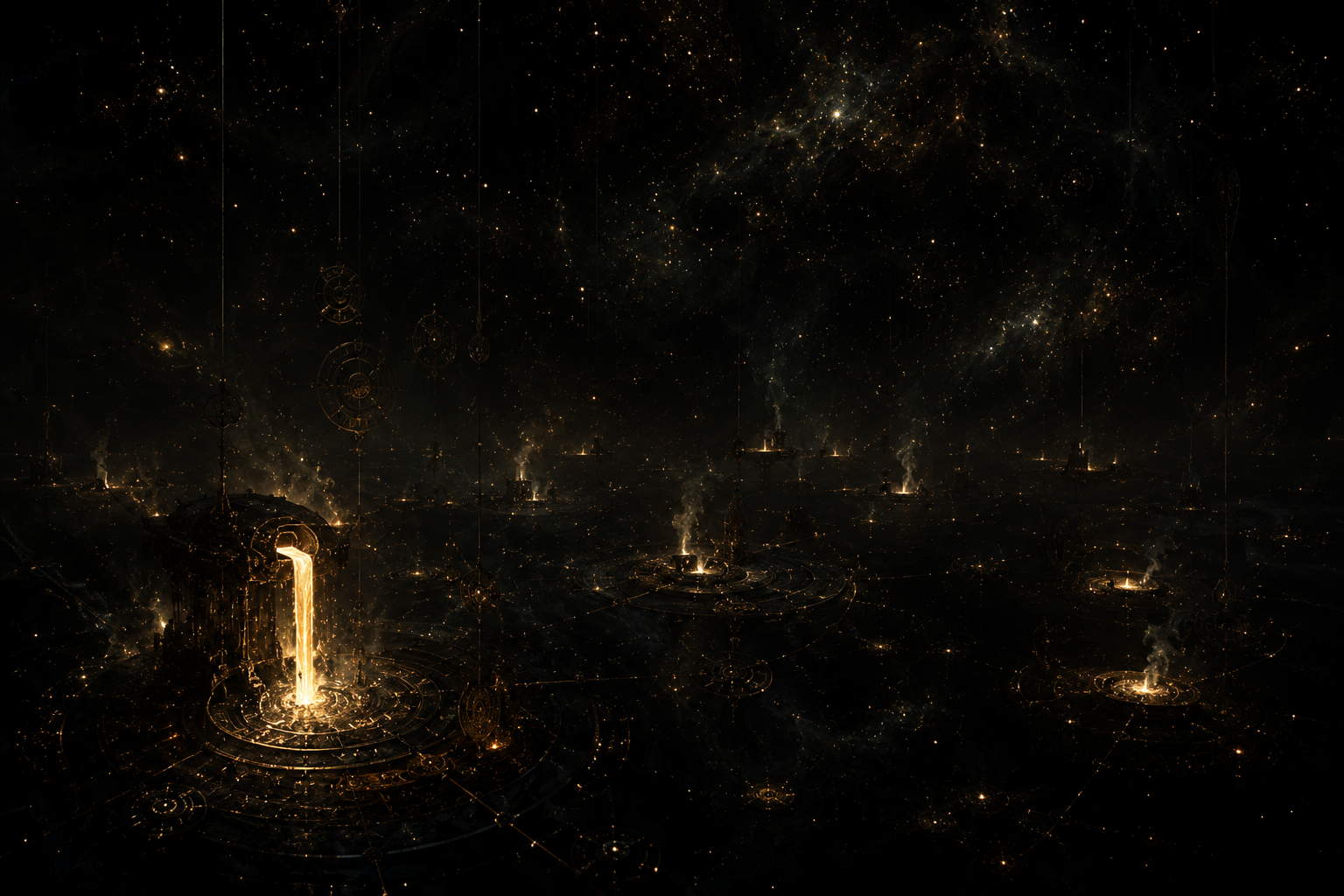
A mortal who glimpses it — through Liminal contact, through the account of a traveler who has been near enough to perceive it, through whatever fragmentary experience generated the oldest mythological traditions about the places where extraordinary things are made — would describe something like a dark field. Emptiness with too-close stars. Space without objects. The Norse record named it Nidavellir: dark fields, or narrow fields, depending on the translation. Both names are more accurate than they appear. The Forge is dark because mortal minds render pure potential as absence. It is narrow because the Forge's nature is precision — the narrowing of intent toward perfect specification, the reduction of design to exactly and only what it needs to be.
The extraordinary objects of mythology came from this dark field. They are still out there.
The Way Things Are
The Forge's foundational principle is that design is sufficient cause. A thing that has been specified with perfect precision exists. A thing that has been specified imprecisely either fails to exist or produces something unintended. There is no raw material to shape, no physical effort to expend, no labour in any sense a mortal craftsperson would recognise. There is only the design — and whether the design is complete.
This makes the Forge categorically different from every other known Realm. Other ontologies modify, shape, or influence existing reality. The Forge creates. When a smith in the Forge intends a thing precisely enough, that thing is. The distance between blueprint and reality does not exist here. Intent, made exact enough, simply crosses it.
The Forge does not call this magic. There is no magic. There is only the way things are — and in the Forge, the way things are is that design is sufficient.
What the Forge cannot do is equally important to understand. A smith who designs an object without fully understanding the Realm for which it is destined produces something that Realm's physics will not fully accept. The Conservation of Ontology erodes things that are imposed on a foreign ontology. The Forge's answer to this problem is not force but precision: a Forge artifact designed as mortal matter, specified at every level to satisfy mortal physics, is simply matter. Local physics has nothing to erode. It claims the artifact as native. The persistence is not resistance — it is belonging.
This means the craft and the knowledge are inseparable. A smith cannot design a true artifact for a Realm they do not understand. The work is not merely technical. It is a form of deep study, patient and long.
The Simulacra
The Forge's primary danger is not hostile inhabitants, environmental extremity, or ontological incompatibility in any familiar sense. It is the simulacra — ambient schemas that form when the Forge's generative potential encounters insufficiently defined intent.
The Forge is always trying to become something. When a visitor enters without complete self-definition — without a precise, internally consistent understanding of what they are — the Forge begins to fill the gaps. A simulacrum forms in the shape of the visitor's underspecified edges, using whatever patterns are available nearby. Near the surface of the Forge, simulacra mirror form: a shadow that is not quite right, a reflection that moves incorrectly. Deeper along the Forge's axis of vastness, they mirror concept and methodology — the structure of thought rather than the appearance of a body. Deeper still, they approach something that mirrors identity at its most fundamental level.
A simulacrum does not hunt. It does not pursue. It experiences nothing recognizable as intent. It is ontological drag — the Forge attempting to complete an unfinished design by consuming the patterns adjacent to it. This distinction offers little practical comfort.
Survival in the Forge requires what its native inhabitants call constant self-definition: not merely knowing what one looks like, but knowing what one is — precisely, completely, without lapse. The Forge is honest in its danger. It does not disguise the threat or make it seem like something else. The nature of the simulacra is legible to anyone willing to understand it before entering.
This is why the Forge has so few casual visitors, and why those who study it typically do so at considerable remove.
The Smiths
The Forge has native inhabitants. They are not, as is sometimes assumed, gods or scholars or fey lords who have studied their way to competence in a foreign ontology. They are native to the Forge — beings for whom design-as-reality is not a discipline but the physics of their existence, as unremarkable to them as gravity is to a mortal. They are called smiths, by convention, though the word is inadequate. A mortal smith shapes existing material. A Forge smith specifies things into being.
Smiths who wish to operate in other Realms face the same problem any cross-Realm traveler faces: their native ontology is not the local ontology, and sustained imposition against foreign physics is expensive and eventually unsustainable. Their solution is characteristic of their craft. They design themselves bodies suitable for the destination.
A smith wishing to inhabit the Mortal Realm will design, with full precision, a mortal body — matter, mass, biological process, sensory architecture — and manifest it in the Forge before departing. The result is not an imposed form requiring maintenance. It is a Forge-designed object that the Mortal Realm's physics recognises as fully native, because it was built to those specifications from the foundation up. The body does not need to argue with local physics. Local physics claims it without reservation.
Every smith's work carries a smith-signature: an identifying pattern woven through every object they design, as individual as a fingerprint and as structural as the design itself. Experienced smiths can identify one another's work by it, and detect work that does not carry one. An artifact without a coherent signature is, in Forge terms, a design that does not fully know what it is.
Most smiths do not leave the Forge. The calculation is straightforward: a Forge-designed body placed in a foreign Realm is accepted by that Realm's physics, but accepted does not mean immune. The Mortal Realm's physics will, over very long time, find whatever the smith underspecified — not through hostility, but through thoroughness. Mortal entropy probes every interface, tests every assumption, and will eventually locate the gap that any finite mind must leave somewhere in a design of such complexity. The smith will know precisely where the error was. The failure is legible. It is its own quality of difficulty.
Other Realms present different audits. A body designed for Arcadia is subject to Arcadian logic — which is not impersonal. Ancient fey lords have spent millennia locating the gap between what was said and what was meant. A Forge-designed Celestial form would be subject to the Faith hierarchy, to the claim that existence within Celestia is answerable to those above one in the arrangement. A smith who has designed their own body — who carries their own signature on their own form — finds this not merely objectionable but ontologically offensive. The Forge's axiom is that design is sufficient. Celestia's axiom is that existence answers upward to regard. These positions do not resolve.
The smiths encountered in the broader cosmos have all made a specific, considered choice to leave, knowing what it costs. This is worth bearing in mind when encountering them.
For specific named smiths, see Gwydion and Rosanna — forthcoming.
History
The recorded history of the Forge is sparse, and the reasons for this are structural rather than incidental. Forge smiths are not documented because they do not document themselves. Their work appears throughout the records of other Realms — in artifact inventories, in mythological traditions, in after-action reports from expeditions that depended on Forge-wrought equipment — but the smiths themselves generate no archives, no correspondence, no political records. What is known about the Forge comes from outside it, assembled from traces.
The Norse tradition offers the most coherent mortal account, naming the Realm Nidavellir or Svartalfheim and populating it with craftsmen whose work included Mjolnir, Gungnir, the Gleipnir binding, and Skidbladnir. These traditions are mortal translations of actual events. The objects exist. The Gleipnir binding is why the Wolf Age has not begun. Gungnir does not miss because it was designed not to miss, and that design has been sufficient since the moment it was made.
The Norse mythological tradition's well-documented confusion between dwarves and dark elves — scholars have argued for centuries about whether svartalfar and dvergar are the same beings or different beings inconsistently described — reflects a genuine ontological reality rather than a failure of record-keeping. There is a spectrum of beings associated with the Forge, ranging from pure Forge natives whose entire existence is organized around the work, through beings whose nature is Liminal between Forge and Arcadian ontologies, to Arcadian beings with significant Forge affinity. A mortal tradition encountering different points on that spectrum across different centuries and contexts will produce exactly the inconsistent, overlapping record that survives. The mythology is a faithful account of a genuine complexity.
The history of the Forge before mortal traditions began recording it is unknown, and this unknowing extends to the smiths themselves. The Forge's origin cannot be traced to any event whose participants survived to describe it. Several theories persist. None are confirmed. See Origin and Speculation below.
The Forge and Other Realms
The Forge's primary relationship with the broader cosmos is through its artifacts. Smiths commission, design, and deliver. The work crosses Realms. The smiths, mostly, do not.
The closest sustained relationship between the Forge and any other Realm is its collaboration with the Iron Nexus. The partnership is grounded in a functional compatibility: both Realms value precision, eliminate ambiguity, and distrust approximately-true answers. The underlying mechanics are alien to each other — design-as-reality and information-as-reality are not the same operation — but the shared commitment to exactness produces enough common ground for productive work. The partnership's most notable result is Probe Oriel, the first artifact to obtain structured observational data from Nyxaloth's interior, which required forty years of joint development and depended on Forge-wrought structural integrity to function in an environment that dissolves information.
The Forge's relationship with Celestia is, for the most part, the absence of one. The Faith economy requires awe — the involuntary recognition that something exceeds one's framework. Forge-native psychology is structurally opposed to awe: a smith who meets the incomprehensible with wonder rather than analysis has allowed the simulacra an opening. These orientations are not compatible. The exceptions are the gods of smithing and craft — Hephaestus, Goibhniu, and analogous figures across pantheons — who develop genuine Forge affinity through the natural orientation of their domains. These gods tend to be marginal within Celestia's own hierarchy, their modes of creation in quiet tension with the Faith economy's expectations. Their affinity with the Forge follows from their nature rather than departing from it.
The Forge's relationship with Arcadia is complicated by a structural similarity that the surface appearances conceal. Both Realms possess a mechanism by which objects can be made native to a foreign ontology — accepted by local physics rather than merely tolerated as an imposition. The mechanisms are entirely different: the Forge works through precision of specification, building to the destination's requirements; Arcadia works through declaration at sufficient depth, telling the destination what is now true. Where these two mechanisms meet — as they do in beings like Lugh Samildánach, whose Forge affinity and Arcadian nature are inseparable — they produce work that neither mechanism alone can unsettle. For more on this intersection, see Lugh — forthcoming, and Synthesis Artifacts — forthcoming.
Origin and Speculation
The Forge's origin is unknown. This is unusual among the Thirteen Realms, most of whose ontological characters can be traced to configurations of the basal truths even when the tracing is incomplete. The Forge's origin cannot be traced — or, more precisely, the trace leads somewhere that cannot be examined without producing the category of consequences one is attempting to understand.
Several theories persist in scholarly and philosophical circles.
The Intentional Creation Theory holds that some being, at some point in the cosmos's history, successfully used the basal truths to create the Forge deliberately. If true, this constitutes an exception to the proof developed by Anna Dalca — the demonstration that the boundary between derived reality and the basal truths cannot be crossed without catastrophe. The implications are not reassuring.
The Equalization Theory holds that the Forge arose as a consequence of contact with the basal truths rather than through their deliberate use. When the thirteen scholars of Sheol reached for That Which Begins and their Realm fell into That Which Ends; when Yahweh reached for That Which Begins and Stambhana locked into absolute stillness — perhaps some earlier being, in some earlier configuration of the cosmos, reached for That Which Ends and fell through into emergence instead. The cosmos's tendency to equalize when the basal truths are touched would have produced not a controlled outcome but a Realm of uncontrolled generative potential. The simulacra, under this reading, are not features of a designed system. They are symptoms of potential that was never fully resolved.
The Prior Configuration Theory holds that the Forge predates the current arrangement of the Thirteen Realms entirely — that it is a remnant of an older cosmos, one whose Realms and configurations no longer obtain, and that the Forge survived the transition as the one thing that did not change. This would explain why even the smiths cannot account for their Realm's origin: they were not present when whatever happened, happened. They are as downstream of the event as everyone else.
The smiths do not discuss the question publicly. Gwydion, when pressed, does not deny any of the theories. He does not confirm them either. His position implies that the Forge is, in this respect, a mystery to itself — in the same way that mortal cosmologists cannot observe what preceded the conditions from which the universe emerged, and cannot say with confidence whether preceded is even a coherent concept in that context.
The uncertainty is appropriate. The question may have no answer accessible to derived beings. Or the answer may exist and be the kind of thing that is not shared lightly.
"The Forge exists. I exist. Beyond that, I find I am as uncertain as you are, and considerably less interested in resolving it."
— Gwydion, smith
Mortals and the Realm
Most mortals will never encounter the Forge directly. There is no mortal tradition of visiting it, no analogue to the Market's position in Arcadian contact or the Liminal edges through which Umbral experience bleeds into mortal life. The Forge does not reach toward mortals. It does not need to.
What mortals encounter instead are the artifacts, and the smiths who have chosen to live among them.
A Forge-wrought artifact in mortal hands is not recognisable as such by any obvious means. It does not glow, hum, or resist examination. It is what it is — a physical object obeying mortal physics, accepted by mortal physics as native — and it does what it was designed to do, without fanfare, without maintenance, without any ongoing evidence of its origins. Gungnir does not look like a cosmic artifact. It looks like a very good spear. The difference is that it was designed to never miss, and so it never does, and that property will not degrade, and no amount of mortal physics working on it over time will find anything to erode, because there is nothing imposed to push against.
The mortal traditions that grew up around Forge-wrought artifacts — the Norse mythological record, the Irish tradition of the Tuatha Dé Danann's weapons, analogous accounts from cultures across the mortal world — are the closest most mortals will come to a direct account of the Forge. These traditions are more accurate than they are usually given credit for. The objects they describe are real. The craftsmen they name were real. The dark field where those craftsmen lived is real, and the stars in it are too close, and if a mortal somehow stood in it they would understand immediately why it was called narrow.
The pen that writes no falsehood, which has been in circulation in the Mortal Realm for several years, is a recent and well-documented example of Forge work in mortal hands. Its properties are precisely what Gwydion designed them to be. That it ended up in Bindenere's possession at the Dublin Market is a matter of mortal choices made after the design was complete. The Forge can specify what a thing is. It cannot specify who holds it.
For mortals who encounter a smith in the Mortal Realm: they are not gods, not fey, not beings operating by any familiar framework. They are native to a place that mortal minds cannot fully comprehend, wearing bodies they made themselves, operating by physics you will not find in any mortal textbook. They are usually willing to talk. Whether they are willing to work is a different question, and the answer depends on factors that are theirs to determine.
Further Reading
For the foundational ontological principles beneath all Realms, see The Basal Truths and The Conservation of Ontology (Anna Dalca). For the proof that establishes the boundary the Forge's origin may or may not have crossed, see The Dalca Proof — forthcoming.
For specific smiths: Gwydion and Rosanna — forthcoming. For the Norse mythological tradition as a Forge primary source: Nidavellir and the Svartalf — forthcoming. For the Forge-Arcadia intersection embodied in a single being: Lugh Samildánach — forthcoming.
For the Forge's most significant recent cross-Realm project, see Probe Oriel — Expedition NX-0. For the Realm the probe was sent into, see Nyxaloth. For the Realm that partnered in the expedition, see The Iron Nexus.
For the smith most mortals are likely to encounter, see Gwydion — forthcoming. For the neutral ground where he is most often found, see Jack's Tavern and the Mortal Visitor's Guide.
Where to See This
For Forge work in action across several contexts, the manuscript Tales from Jack's includes:
The manuscript is available in the [Manuscripts section] of this world, free to read.
The Forge does not announce itself. It does not reach into other Realms seeking regard, or commission, or recognition. It simply is what it is — a dark field full of stars at the wrong distance, where beings who have survived their own ontology by knowing themselves exactly make things that will outlast everything built to oppose them.
The work is the thing. It always has been.

Comments