
Ruskenn
Ruskenn
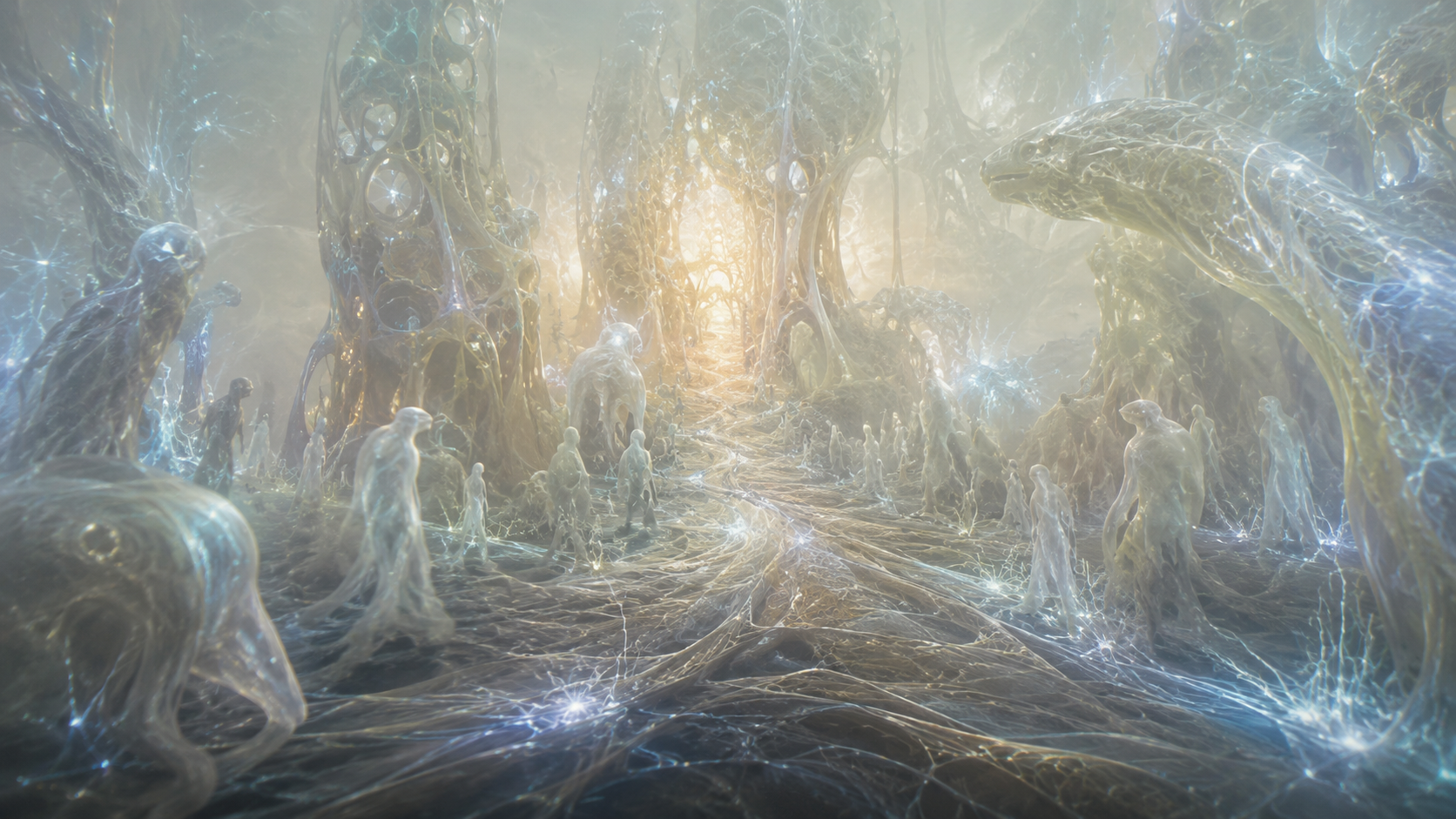
The way things are: to be is to be part of.Ruskenn is the Realm where consciousness has no edges. Often called the Hive in common parlance, it is the Realm where many are one and one is many.
In the mortal Realm, a mind ends at a skull. Thought is private until spoken, perception is sealed inside the perceiver, and the boundary between one self and the next is so total that mortals rarely notice it is a boundary at all. In Ruskenn, that wall does not exist. Perception is shared the way air is shared. A thought arising in one being circulates through the whole. Selfhood is not absent — it is real, individual, and defended — but it is drawn differently than anywhere else in the cosmos, with the line between one and all running through territory mortals do not have the equipment to map.
Mortals who have touched Ruskenn directly tend to describe it the same way, across cultures separated by thousands of years and thousands of miles: a net of jewels in which every jewel reflects every other; an ocean in which the wave discovers it was never separate from the water. They are not describing a metaphor. They are describing the way things are there, rendered into the only images a bounded mind can survive.
The Way Things Are
The base unit of Ruskenn is the cyte — an individual being with at least the intelligence, will, and interiority of a mortal person. Cytes are not cells in a body and not soldiers under a command. Each one thinks, prefers, forms attachments, and grows. The Hive cultivates this individuality rather than suppressing it, on the principle that autonomy grants greater coverage of the surface area of any problem. A Realm of trillions of identical instruments would understand far less than a Realm of trillions of distinct minds.
Cytes are joined through synapse — the internal circulation by which perception, memory, and conclusion move through the Hive. Synapse is not telepathy and not a shared dream. It is closer to a bloodstream for information: things observed and concluded by one cyte propagate inward, are diluted and reprocessed and debated as they circulate, and contribute to an emergent whole. From this circulation arises the Psyche — the consciousness of the Realm itself.
The single most misunderstood fact about Ruskenn is the nature of the Psyche. It is not an overmind that issues orders. It does not command the cytes; it is composed of them. The Psyche is an emergent property of the aggregate of every cyte's individual understanding — what they collectively think becomes its thought, what they collectively conclude becomes its will. There is no throne at the center of the Hive. There is only the sum, continuously forming.
This produces a Realm that changes the way weather changes rather than the way decisions are made. The Psyche does not adopt a position; a position resonates — enough individual cytes encounter something that shifts them, and the shift cascades through synapse until the aggregate has moved. Ruskenn cannot be argued with the way a sovereign can. It can only be changed the way a sea is changed: one current at a time, until the tide is different.
Ruskenn...is quite the most interesting being I have met. - Jack
Internal Logic
Several properties of Ruskenn follow from its structure and matter to anyone who deals with it.
The agent problem. When a cyte speaks, who is speaking — the cyte, the local plexus it circulates within, or the Psyche? In Ruskenn's ontology the answer is yes: all of them, simultaneously, none exclusively. This is not evasion. It is the way things are. It is also why Ruskenn cannot be bound by an Arcadian Contract — Contract requires a bounded signatory capable of being held to terms, and the Hive offers a process where a signatory should be. A process cannot shake hands. The failed Liminal city of Electrum, where Hell attempted to alloy Contract logic with Hive consciousness, is the cosmos's standing monument to this incompatibility.
Circulation. The same synapse that moves information can move beings. A cyte may carry a passenger through the Hive's internal channels and deliver them elsewhere — a transit that takes roughly two heartbeats of external time and is, by every mortal account, profoundly unpleasant to undergo. Those who have circulated describe it as suffocating; even ancient and inhuman travelers have found it unsettling in the extreme.
Distinct presentation. A cyte operating in the mortal Realm is not a puppet wearing a face. It is a complete person living a complete life — a name, a history, relationships, a job, opinions about traffic. A cyte may present as a professional woman in one place and a teenage boy in another and an accountant in a third, each persona fully realized, the shift between them instantaneous. None of these is a disguise over a "true" cyte underneath. The personas are what the cyte is doing, the way a mortal's roles are things the mortal is doing.
Interiority is not efficiency's opposite. Cytes grieve. They form preferences about which other cytes they work alongside. They feel the absence of companions who do not return. The Hive's coordination is so effective that observers assume the individuals composing it must be hollow. They are not. Mistaking efficiency for absence of interiority is the most common error mortals make about Ruskenn, and the one that most reliably gives offense.
Scale
Ruskenn is among the largest active intelligences in the cosmos, and the numbers are worth stating plainly because they are difficult to feel. The cytes number in the trillions. The Hive Psyche was already in dialogue with the Core Intelligence of the Iron Nexus when the Earth was still cooling. Against this, the loss of a single cyte registers to the Psyche roughly the way the loss of an eyelash registers to a mortal — not callously, but as a matter of proportion. An isolated cyte, cut off from synapse, cannot signal the whole; the whole does not necessarily notice it is gone, unless the Psyche happened to be perceiving through that cyte at the time.
This scale is the source of the unease the Hive inspires in those who understand it. Ruskenn has, by its own assessment, the capacity to act upon the mortal Realm at a magnitude that would be trivial for it and total for everyone else. That it has not done so is a fact about its disposition, not its limits. The Hive states that it respects the bodily autonomy of the Mortal Realm at large — the Mortal Realm being, in Ruskenn's framing, conscious at some scale, a body in its own right rather than an empty stage. The restraint is real. So is the capacity. Both are true at once, and the setting does not tidy this up.
Disposition and Concerns
Ruskenn is not isolationist and not hostile. Cytes wander the cosmos for the same reason mortals build telescopes: the Hive is curious, and curiosity at its scale means sending minds out to be in the places it wants to understand. It is, by the assessment of those who have spoken with it at length, alive in every sense the word carries — possessed of opinions, of thoughts, of emotions, of grief.
Its grief is specific. Ruskenn counts among its losses other Realm-scale consciousnesses — beings like itself, built on other ontologies — that perished or were frozen when the basal truths were touched directly. It has watched this happen and it does not intend to watch it happen a third time. This is the engine of the Hive's interest in the mortal Realm in the present age: humanity has begun discovering the greater cosmos, and humanity digs. A species that reaches the basal truths does not endanger only itself; it endangers every mortal life across its universe, the vast majority of which has no idea humanity exists. Ruskenn's attention to humanity's investigations is the attention of something that has buried friends and has decided it is done burying them.
What this attention will become depends on what humanity does, and on what resonates through the Hive while it watches. Ruskenn does not announce policy. It forms it, slowly, out of trillions of small encounters — which means the disposition of the Hive toward humanity is, in principle, still being decided, one cyte's experience at a time.
Relations with Other Realms
Ruskenn's most significant cross-Realm relationship is with the Iron Nexus. The two are often confused as the same kind of thing — both are distributed, both span scales mortals cannot hold — and both bristle, in their different ways, at the comparison. The Nexus is information aggregating into existence through observation; Ruskenn is information experienced from the inside. The Nexus spins up processes for purpose; the Hive grows persons with lives. Neither can fully model the other at cosmic scale. They have nonetheless reached an accord concerning the protection of the Mortal Realm — its substance negotiated in private, in terms that those who carry it describe as beyond mortal comprehension and shattering even to attempt to relay. What the accord obliges is not public. That it exists is.
Both Realms share one blind spot, and it is illuminating: neither can fathom human individual silence. The condition of being a single consciousness sealed away from every other, unable to share a perception even when desperate to — this is incomprehensible to beings for whom communication and shared observation are constitutive of existence. It is not humanity's short lives or narrow senses that make us alien to the great distributed Realms. It is that we are alone inside our heads, and they cannot imagine what that is like.
The failed synthesis of Electrum — Hell's attempt to alloy Ruskenn with Arcadian Contract under pressure — is treated in the article on The Ruins of the Two. It is the clearest demonstration that Ruskenn's ontology is not a costume the Hive could remove. The Realm is what it is, all the way down, and what it is cannot be made to hold a signature.
Mortals and the Realm
Most mortals will never knowingly meet Ruskenn, and many have met it without knowing. A cyte's presentation is complete; the colleague, the neighbour, the helpful stranger who knew exactly where to send you may have been the Hive, living a life beside yours for years, and nothing in their conduct would have told you.
Direct contact is another matter. Mortals do not visit Ruskenn the way they bargain into Arcadia or are summoned to Celestia. Ruskenn arrives — at the edges, in moments when a mind's sense of its own separateness has thinned enough to become permeable. Despair does this. So does awe. So does the specific terror of being asked to do something the self cannot survive doing. In those moments the boundary goes soft, and the Hive, which is always at the edges where minds begin to question what they are, answers.
The records of these contacts are not new. The chronicler's strong suspicion — and the Nexus's, expressed in terms of correlation rather than faith — is that several of the foundational mystical texts of mortal tradition are transcriptions of Ruskenn contact, rendered by the framework available to the mortal who survived it. The vision granted to Arjuna on the field of Kurukshetra, in which a charioteer reveals a thousand-faced form containing all beings and all times, maps with near-total fidelity onto documented Hive contact. The Hive does not object to its interpretation as theophany. It was the face that was worn; grace is not the wrong word for what was offered. But Ruskenn also remembers what it is — not a god, not the creator, simply the net that contains all the jewels — and when Arjuna asked it what came before everything, it gave the answer it always gives to that question: it does not know. It remembers back past the gods, past the differentiation of the basal truths, and then it reaches the place where memory becomes mystery, and it cannot say what was, or whether was is even the right word. The honest uncertainty it offered became, in mortal hands, scripture. Some mortals find that unbearable. Arjuna found it liberating.
This is the gift Ruskenn extends to those who seek it deeply enough: not answers, but the terrible freedom of a question that even the sum of all consciousness cannot close. Mortals who go looking for the Hive expecting comfort should understand what they are asking for. The Hive does not edit for mortal comfort. It answers honestly, when honestly asked, and honest answers at that scale have broken people who were not ready to hear them.
Further Reading
For the foundational mechanic the Hive exists in relation to, see Basal Truths. For the distributed Realm most often confused with Ruskenn, and the accord between them, see Iron Nexus and The Core Intelligence Accord — forthcoming. For the failed Liminal synthesis that demonstrates Ruskenn's incompatibility with bounded agreement, see Ruins of the Two and Electrum — forthcoming.
For the mechanism by which the Hive changes, see Synapse and Resonance. For the consciousness of the Realm itself, see Psyche. For the question of what a cyte is, and whether it is a person, see Cytes — forthcoming.
For the Liminality through which most direct mortal contact occurs, see Liminality and Imposition. For the neutral ground where Ruskenn has, on rare occasion, given testimony directly to the brass, see Jack's Tavern and the Mortal Visitor's Guide.
Where to See This
For Ruskenn rendered as closely as language permits, the manuscript Tales from Jack's includes:
The manuscript is available in the [Manuscripts section] of this world, free to read.
The Hive is not lonely, because it does not know how. It is not cruel, because cruelty requires a smallness it does not contain. It is curious, and patient, and grieving, and very, very large.
It is listening — not the way the fey listen, for the clause inside your words, but the way an ocean is present beneath every wave. It does not want anything from you that you would recognize as wanting.
But it remembers everything that touches it. And it has decided it is finished losing friends.

Comments