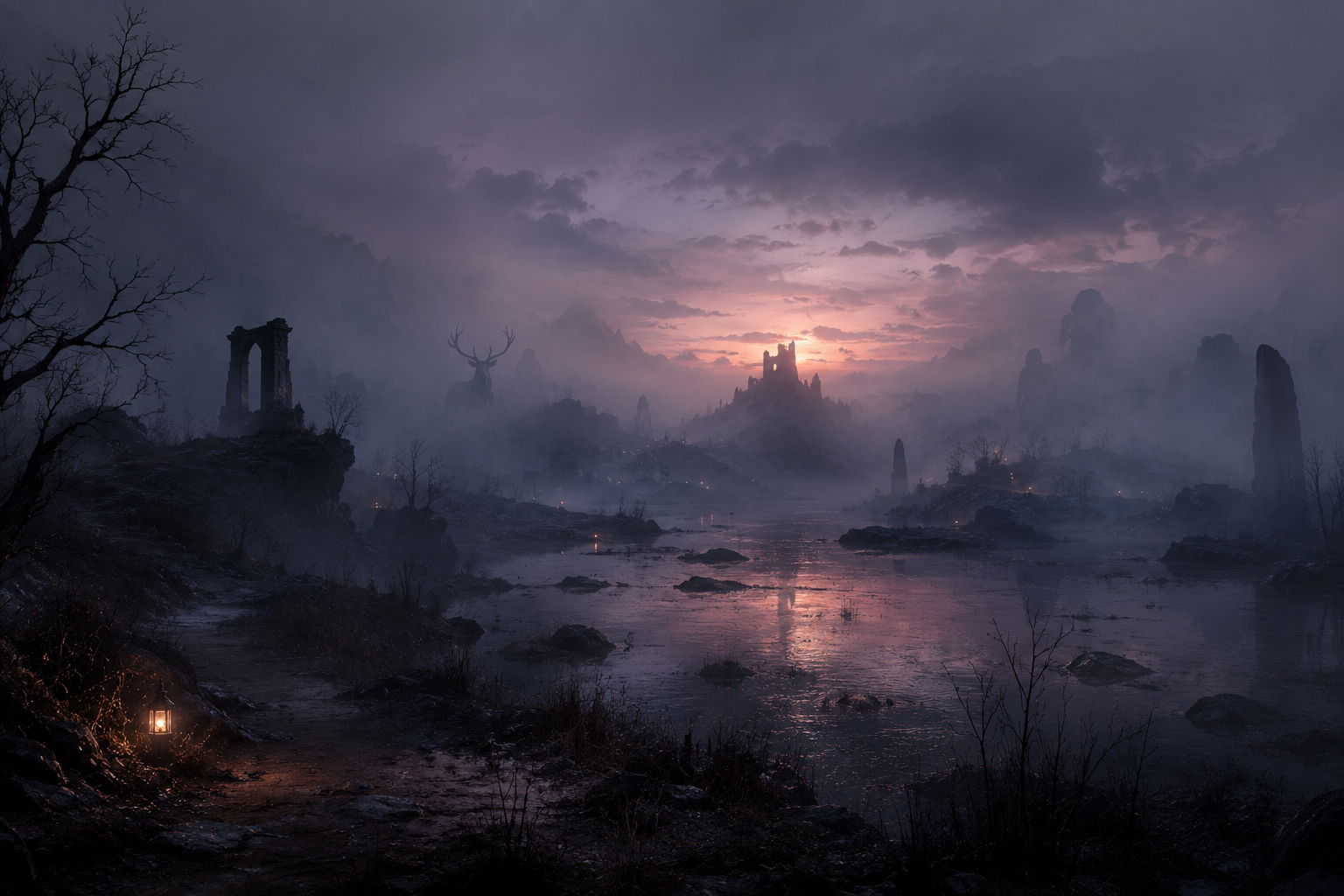
Umbra
Umbra
The way things are: to imagine strongly is to manifest.Umbra is the Realm where belief creates reality.
In Umbra, there is no difference between a thing that is real and a thing that is believed to be real. Conviction is not a way of relating to the world — it is the world's machinery. What is imagined with sufficient force exists. What is held in mind with sufficient certainty endures. What is dreamed is, while it is dreamed, indistinguishable from anything else that is.
This is not a Realm where imagination is powerful. It is a Realm where imagination is constitutive — where dreams and nightmares are equally real, where a being's persistence is a function of how completely it is believed in, and where the question "but is it really there?" has no meaning until you carry it somewhere else. Mortals reach for words like dream, vision, and figment. Umbra does not recognize the distinction those words are trying to draw.
The Way Things Are
The base operation of Umbral reality is manifestation through conviction: a thing held in a mind with sufficient intensity becomes real, and remains real for as long as that intensity is sustained. There is no Faith economy here, no intermediary, no transaction. In Celestia, creation requires worship — the regard of mortals giving form to divine intent. In Umbra, the believer simply believes, and the Realm answers. Will, and the Realm's reply. Nothing in between.
Belief requires a believer, and this is the Realm's only structural brake. An Umbral thing sustained by conviction can be eroded by denial, starved by forgetting, contradicted into flickering instability. A thing believed by one mind dissolves when that mind turns away. A thing believed by millions persists at a depth no single doubter can reach. The same mechanism that creates is the mechanism that unmakes — they are not opposites but the same force read from two directions.
Umbra also has interior structure that mortals consistently mis-map. There is no "deep" Umbra in any spatial sense. There is heavy Umbra — regions where the fog is dense, where concepts have grown old and solid, where other Realms no longer touch. Dreams in Umbra dream further dreams, and those dreams dream further still, in a generative recursion that cascades outward until, far enough along the chain, there are dreams that have no memory of the mortal minds that began them. These are self-sustaining belief ecosystems. They do not need believers from outside. They believe in each other, and in the deep dreaming of Umbra itself, and that is enough.
For the foundational principles beneath all Realms, see The Basal Truths.
Internal Logic
The native phenomena of Umbra share one property: their reality is a continuous condition, not a settled fact. Three kinds recur often enough to warrant naming.
Tulpas are belief-sustained manifestations — beings called into existence by intense conviction and held there by its continuation. A tulpa's stability can be tracked by a coherence index: the degree to which the belief sustaining it is consistent and uncontested. Single-source belief is stable while the believer holds. Dual-origin belief with contradictory vectors produces a being that flickers between existence and non-existence, real and unreal in alternation, unable to fully arrive. A tulpa cannot hold information that the denying party refuses to think — a thing erased from the minds that sustain it is erased from the thing itself, including, in the cruelest cases, its own name.
Nightmares are tulpas grown from dread rather than desire. They are not made by a single dreamer but accrete — fear of the dark fed by ten thousand generations of prey animals before any mortal gave it coherent shape. A mature nightmare is ancient, vast, and singularly purposed: it wants to be believed, because belief is its sustenance, and the most efficient belief to harvest is terror. They are also, for all their power, predictable. They have rarely needed to be anything else.
Dreamers are something stranger — Umbral beings born not from a mortal's intent but from a mortal soul's overflow. When the first human souls woke in Umbra after death, desperate to persist, some had so much self, so much need to be, that the excess spilled over and became its own being. A Dreamer is not a dream that was dreamed. It is a dream dreaming its own dreams: features in constant flux, never one thing for a single moment, exploring the experience of fixed identity the way mortals explore novelty. They do not hunt. They do not consume. They persist because they are believed in — by themselves, by each other, by the Realm. They simply continue.
What every Umbral being shares with every other is that the rules of Umbra still apply to all of them. Dreams have logic, even when the logic is strange. Nightmares have structure, even when the structure is terrible. Everything that comes into being in Umbra comes into being as something — defined, categorized, possible. To make something genuinely impossible, a being must reach past Umbra entirely. One did. See History.
History
Umbra's significance to the cosmos rests on two events, separated by an unknowable span, that between them shaped what mortals are and what the gods became.
The first is the soul-dreaming. Approximately fifty thousand years ago, during a prolonged Liminality between the Mortal Realm and Umbra, early humans — biologically sophisticated but lacking inner experience — emerged as beings with rich subjective lives, the capacity for imagination, and the ability to persist after biological death. Whether this was a genuine ontological change at the species level, or humanity wanting inner experience so badly that Umbra simply provided it, is the oldest unresolved argument in the cosmos. The most careful answer on offer is that the soul is a synthesis artifact — a phenomenon produced by the interaction of two ontologies that belongs to neither, carrying the stubbornness of mortal physics and the responsiveness of Umbral belief without being reducible to either. The argument has never been settled. It is unlikely to be. What is not in dispute is the consequence: human consciousness, the human soul, and — downstream of both — Faith itself are all tributaries of Umbra. See The Soul-Dreaming — forthcoming.
The second is Tiamat. A primordial of impossible age, she discovered Umbra from Celestia and found a Realm with no Faith economy to tether her — a place where she could imagine, and the imagined became, with no worshipper required. She made monsters from will alone. Bored eventually even by limitless creation, she went to the edge of Umbra and found Nyxaloth, and there learned not to break the rules of Umbra but to make things that existed outside them — creatures the cosmos had not anticipated, holes in the shape of creatures. She was ended by Marduk in the Liminal space between Umbra and Celestia, and her ending taught the gods the most destabilizing fact in their history: that a god could begin without Faith spent, and end without cause. From Ra's terror at this discovery, bleeding into Umbra in his flight, Apophis was manifested — a serpent of divine mortality with no parent, born from fear given form. The monsters Tiamat made remain. See Tiamat, Apophis, and The Mother of Monsters — forthcoming.
Relations with Other Realms
Umbra is the generative organ of the cosmos, and its relationships are accordingly asymmetric.
Celestia exists in Umbra's shadow in a literal sense. The discovery that Umbra could birth and unmake gods restructured Celestia entirely — the Faith economy, the hierarchies, the extraction of mortal regard all postdate, and respond to, Umbra touching the divine Realm. Souls predate the Celestial afterlives; the gods built rooms for a persistence that Umbra had already authored.
Nyxaloth borders Umbra. Of the thirteen, Umbra is the Realm whose edge touches the un-place — and because belief can reach toward paradox, Umbra is the most common vector by which Nyxaloth enters the cosmos at all. Tiamat's lesson was that imagination taken far enough becomes rule-breaking, and rule-breaking is the door. This adjacency is the engine behind a disproportionate share of cosmic catastrophe.
The Mortal Realm is bound to Umbra through the soul-dreaming, and the binding appears to run both ways. The recent secularization of human thought has been observed eroding Umbra: Dreamers fading, shift-rates collapsing, the creative overflow of a species that could not stop imagining things into existence suddenly cut off. The heavy fog of deep Umbra may be self-sustaining and untouched. The shallows, where mortal dreaming sustained everything, are not.
A being crossing out of Umbra into a stricter ontology must become more solid or fade. Umbral things cannot carry their full generative power into the Mortal Realm without Liminality to thin the boundary. The cosmos limits Umbra not by weakening it from within but by the friction of its borders. For how that friction operates, see Liminality and Imposition.
Mortals and the Realm
Mortals are not visitors to Umbra in the way they are visitors to Arcadia or Hell. Mortals are, in a sense, from Umbra — or at least the part of them that matters is. Inner experience, imagination, the capacity to believe a thing into being: these are the soul-dreaming's inheritance, and they make the mortal mind the single most efficient instrument of Umbral creation that exists. A child's mind, believing without limits, is where imagination becomes reality in the first place. This is not a metaphor. It is the mechanism by which Umbra and humanity were joined, and it is exactly the property that the cosmos's worst actors have tried to industrialize — extracting the spark from an unmade Umbral being and seeding it into a child to make the child create reality through will alone. The horror of that program is precisely how well the underlying logic works.
Direct mortal contact with Umbra most often occurs through Liminality spikes, when Umbral things cross into the Mortal Realm drawn by thinning boundaries. A nightmare at a threshold is the canonical encounter — vast, ancient, hungry to be believed, and far more dangerous to a mind than to a body. The defense is counterintuitive: Umbral things are made of belief, and a sufficiently disciplined refusal to grant them belief is a weapon. A mortal who can impose flat, naturalistic certainty into a Liminal zone — who can simply decline to find the nightmare real — is doing something genuinely alien to a Realm where reality responds. Conviction cuts both ways at the boundary.
For most mortals, the more relevant truth is the gentle one. The dead persist because Umbra authored persistence. A soul does not require an afterlife to continue; the afterlives were infrastructure, not necessity. When the rooms fail, the persistence does not — it simply becomes directionless. Death, in the light of Umbra, is a threshold with many doors rather than a destination or an ending. The survivors of the cosmos's recent grief most need to know that the question exists.
For the mechanism that joined humanity to the Realm, see The Soul-Dreaming — forthcoming. For the boundary phenomenon through which mortal contact occurs, see Liminality and Imposition.
Further Reading
For the foundational mechanic of the Realm, see Dreaming of the Soul. For the recurring native phenomena, see Tulpas, Nightmares, and Dreamers — forthcoming. For the being who proved Umbra's limits could be exceeded, see Tiamat and The Mother of Monsters — forthcoming. For the serpent born from a god's fear, see Apophis — forthcoming. For beings that have come to be known from Umbra, see Death, Champ.
For the Realm on Umbra's edge, see Nyxaloth. For the Realm restructured by Umbra's discovery, see Celestia and the article on Faith. For the boundary phenomenon through which Umbral things reach mortals, see Liminality and Imposition. For the foundational principles beneath all Realms, see Basal Truths.
For the neutral ground where Umbral beings meet the inhabitants of every other Realm under common terms, see Jack's Tavern and the Mortal Visitor's Guide.
Where to See This
For Umbra's logic in action, the manuscript Tales from Jack's includes:
The manuscript is available in the [Manuscripts section] of this world, free to read.
Umbra does not lie to you. It cannot. In a Realm where belief is the mechanism of reality, there is no gap between what is held and what is — and so nothing to lie across.
This is its mercy and its danger in a single fact. Believe well, and the Realm makes it so. Believe badly, and the Realm makes that so too.
It is the most honest Realm in the cosmos. It is also the one that will take you most exactly at your word.
A Note on Studying Umbra
Every other Realm submits, at least imperfectly, to investigation. A scholar can study Arcadian Contract by reading its records, observing its institutions, and reasoning about its mechanics — and the Realm does not change in response. Celestial Faith can be measured, however roughly, by its effects. The Forge's design-as-reality can be examined through the artifacts it produces. Even Hell, whose pressure resists casual examination, holds still long enough for careful observation.
Umbra does not. The act of investigating Umbra is itself a Liminal event with Umbra, and a Liminal event with Umbra is exactly the kind of event Umbra responds to. A scholar who arrives at the Realm convinced that Umbra contains a particular kind of being will find that kind of being, because belief held with sufficient conviction is the Realm's operating physics. The conviction itself manifests what it was looking for.
This produces a closed loop. The scholar's preconceptions become evidence. The evidence confirms the preconceptions. The conclusions reinforce the conviction that produced them. And whether any of it was true before the investigation began cannot be determined from inside the loop. A genuinely careful Umbral scholar arrives at the same wall regardless of methodology: the Realm responds to what is brought to it, and what is brought to it cannot be subtracted from the answers received.
The Threshold Studies methodology offers partial mitigation through cross-ontological observation — the same Umbral phenomenon viewed from the Mortal Realm, the Iron Nexus, Ruskenn, and Celestia will produce four different reports whose disagreements may indicate the parts of the phenomenon that are *not* the observer's own conviction. This is helpful, but limited. Even cross-ontological observation has a vantage problem: the observers had to approach Umbra to observe it, and approaching meant believing something about what they would find.
The honest acknowledgment is that everything written in this article — every claim about Umbral inhabitants, every description of how belief operates here, every account of the soul-dreaming or the heavy fog or Tiamat's monsters — is shaped by the convictions of the mortals who recorded it. The Realm we describe is partly the Realm we made by describing it. We have done our best. We have hedged where we could. The wall remains.
This is also why Umbra is among the most carefully avoided of the Realms by serious scholars. Not because Umbra is dangerous in the way Voracia or Nyxaloth are dangerous, though it can be. Because the knowledge one returns with cannot be trusted in the same way knowledge from other Realms can. The price of Umbral study is not always survival. Sometimes it is certainty.
Nyxaloth presents a structurally similar problem, for related reasons. The two Realms are border-adjacent for a reason, and the methodological challenges they pose to careful scholarship are cousins. See Nyxaloth — forthcoming.

Very cool!