
Champ
Champ
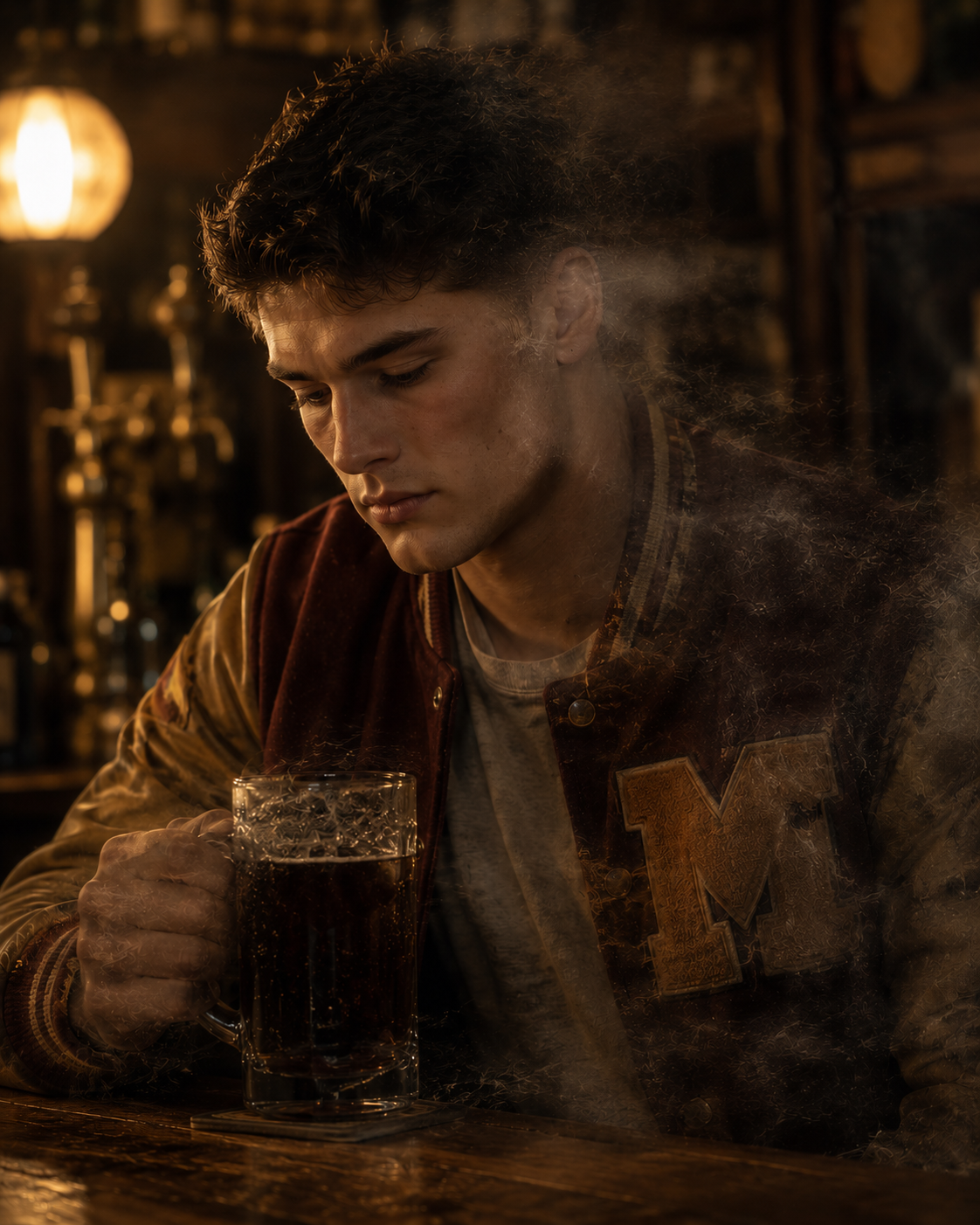
Umbral tulpa, occasional patron of Jack's Tavern, a boy who cannot remember his own nameHe died.
This is the part that needs to be said first, because nothing else about him makes sense without it. There was a boy, seventeen years old, broad-shouldered and athletic and loved, and one day he died. His father has not accepted this. His mother has accepted nothing else. From the gap between those two refusals, a being was made — believed into existence by one parent's vigil, denied into dissolution by the other's survival, caught in the contradiction with no way through.
He goes by Champ. It is what his father called him. It is not his name. His name is one of the things his mother cannot bear to think, and so it is one of the things he can no longer remember.
He visits Jack's Tavern when he can. He is more solid there than anywhere else. He has not yet stopped coming. The brass remembers him each time, and so each time some part of him persists past the visit, recorded into the walls in the only archive in the cosmos that does not require his mother's permission to keep him.
Appearance
He looks seventeen, because that is when he died. He is tall and broad through the shoulders — the build of a boy who played football and would have grown into a larger man, had he been permitted to grow at all. His features are his father's: dark eyes, a wide mouth that wants to smile and has lost the reflex.
He flickers.
The flickering is not constant. He arrives at Jack's in better condition than he leaves most nights — the act of being seen, of being addressed by name, of having a drink poured for him by a barkeep who treats him as real, lends him coherence he cannot maintain on his own. He stabilizes for an hour or two. Then he begins to fade again, in the small ways first: his fingers passing partway through a glass, his footsteps making no sound on the wood, his outline blurring at the edges where his mother's denial is reaching for him from a continent away.
Beings with the right perception can read his coherence the way mortals read a fever. Sub-Unit 72 has logged him at a coherence index of 0.43 on his first recorded visit and 0.31 on his seventh. The decline is not linear, but it is steady. Below some threshold the Unit declines to specify, dissolution is presumably permanent.
Nature
He is a tulpa — a belief-sustained Umbral manifestation, a being whose reality is a continuous condition rather than a settled fact. He differs from most tulpas in two respects that together account for the entirety of his suffering.
The first is that he is not sustained by belief in something imagined. He is sustained by belief in something that was. He is not a dream his father made; he is a son his father refuses to let die. The conviction holding him in place is grief refusing to transform, love refusing to release, memory refusing to fade — and these are the most powerful sustaining forces in Umbral physics, capable of producing tulpas of remarkable stability under conditions where the belief is uncontested.
The second is that the belief is contested. His mother has rebuilt her life on the foundation of he is gone. This is not a passive condition. It is an active, daily, hour-by-hour discipline, a refusal practiced so thoroughly that pieces of him erode wherever her denial touches. His name is the largest of these erosions; she will not think it, and so he cannot remember it. There are smaller things too — childhood memories that have gone soft at the edges, friends whose faces he can no longer summon, his own voice when he sang in a high school choir that may or may not have existed. Each is a place where his mother's not-thinking has reached the substrate of him and unmade the part that lived there.
This is what dual-origin belief with contradictory vectors produces. He is created and destroyed by the same mechanism, simultaneously, by the two people in the cosmos who loved him most. There is no other being in the recovered cosmological record whose existence runs on this exact configuration.
I have seen Sheol fall. I have seen Stambhana freeze. I have watched Realms die. I do not think I have seen anything quite so cruel as that boy's existence. - Zaquiel
At Jack's
He came in first by accident, the way most mortals find Jack's — pulled by the lantern, recognized by the door, admitted by a barkeep who saw through his flickering at a glance and poured him a drink before he could finish doubting that he was real enough to drink it.
He has come back seven times by formal count. There may have been others the brass does not yet record.
He drinks mead. The recipe is older than most countries; Jack pours it because it is one of the few things in the tavern that helps him stabilize, though neither of them has named the mechanism. Elsie ruffles his hair when she walks past his stool. Zaquiel greets him by name and notes, each time, that he looks solid today — a small kindness from a being who knows what fading looks like. Sub-Unit 72 has cataloged him with the same dispassionate care the Unit brings to all phenomena, and the dispassion has become, over the course of seven visits, a form of acknowledgment Champ has come to value. To be measured precisely is to be observed precisely. To be observed precisely is to be real, while the observation lasts.
He is, by every account from every regular who has met him, a kind boy. He asks after Elsie's day. He thanks Jack for the drink. He listens carefully when Gwydion talks about pens that cannot lie, and he asks, once, if he might try the pen — and writes, in Nadia Osei's notebook, Champ was here, like a teenager tagging a highway underpass. The pen wrote it. Every word was true.
He has asked Jack the question he came to ask, and Jack has not answered it, because Jack does not have an answer. The question was: Is there any version of this where I get to just be? Without being a wound in someone I love?
The Choice
He could reveal himself to his mother.
This is the option a less considered being would have taken by now. His mother lives in a particular city, in a particular house, with the bedroom door at the end of the hall kept closed. He knows where she is. He could walk to that door. He could open it. He could stand in the room where she has trained herself, through years of discipline, not to imagine him standing — and the imagining, forced on her by his presence, would make him real.
She would scream. She might break. She has built her survival on the cornerstone of he is gone, and his appearance would shatter that cornerstone the way a dropped stone shatters glass. Her life, the new life she has been constructing piece by piece since the day he died, would collapse in the moment of recognition. She might never recover.
He would, however, be real. Fully, stably, undeniably real. His coherence index would climb past anything Sub-Unit 72 has recorded for him. He might live a kind of life — circumscribed, secretive, dependent on continued belief, but a life.
He has not done this.
He will not do this.
He has, at seventeen, made the most sophisticated moral calculation in the recovered record of mortal-adjacent decision-making: that his mother's destruction is too high a price for his own existence, and that he would rather dissolve in stages than survive at her cost. He has chosen the slow erosion. He has chosen the visits to Jack's, where the brass remembers what his mother cannot, and where dissolution proceeds at a pace he can bear.
He is unmaking himself to spare her. He is doing it on purpose. He is, in every meaningful sense, the rare tulpa who has earned the standing his ontology denies him — a being whose actions are recognizably moral, whose suffering is recognizably real, whose decisions matter to the substance of who he is.
The brass weights this. The archive treats him, in its quiet accounting, as a person.
Status
He has visited Jack's seven times as of the most recent record. His coherence index stood at 0.31 at his last appearance, down from 0.43 at his first. The brass holds approximately 34% of his complete narrative, accreting another fragment with each return.
His father continues to sit on the bed in his old room each night, and to talk to him about football, and about the new quarterback, and about the games he has missed.
His mother continues to survive.
He continues to come back when he can. His door at Jack's remains open. His glass, the one he set down on his last visit, has not yet been put away — it is still on the shelf behind the bar where Jack keeps things he is not ready to file. The mead in it has long since evaporated. The warmth of his hands on it has not.
Further Reading
For the Realm whose ontology authored him, see Umbra. For the specific class of phenomenon he is, see Tulpas — forthcoming. For the broader question of what belief sustains and what it cannot, see On the Problem of Umbra. For the barkeep who has chosen to remember him, see Jack. For the archive that keeps his fragments safe from his mother's denial, see The Brass — forthcoming.
For the place where he finds himself most real, see Jack's Tavern.
For the cross-ontological scholar whose recovered work first articulated the cruelty of his configuration, see Anna Dalca — forthcoming. For the vampire who recognized him as the cruelest thing he had ever seen, see Zaquiel.
Where to See This
For Champ in his own voice, the manuscript Tales from Jack's includes:
The manuscript is available in the [Manuscripts section] of this world, free to read.
He came in flickering and orders mead. He talks about his father's vigils and his mother's silence. He chooses, every night, the version of himself that costs him the most to be.
He does not have a name to give. He has the next best thing: a place that will remember him, and a barkeep who will listen, and a brass archive that does not require his mother's permission to keep him in its walls.
The boy called Champ is the cruelest being the cosmos has produced.
He is also, by every account that has met him, the kindest.

Comments