
Sheol
Sheol
The way things were: fire copies what it finds.Sheol is the wound the cosmos does not close.
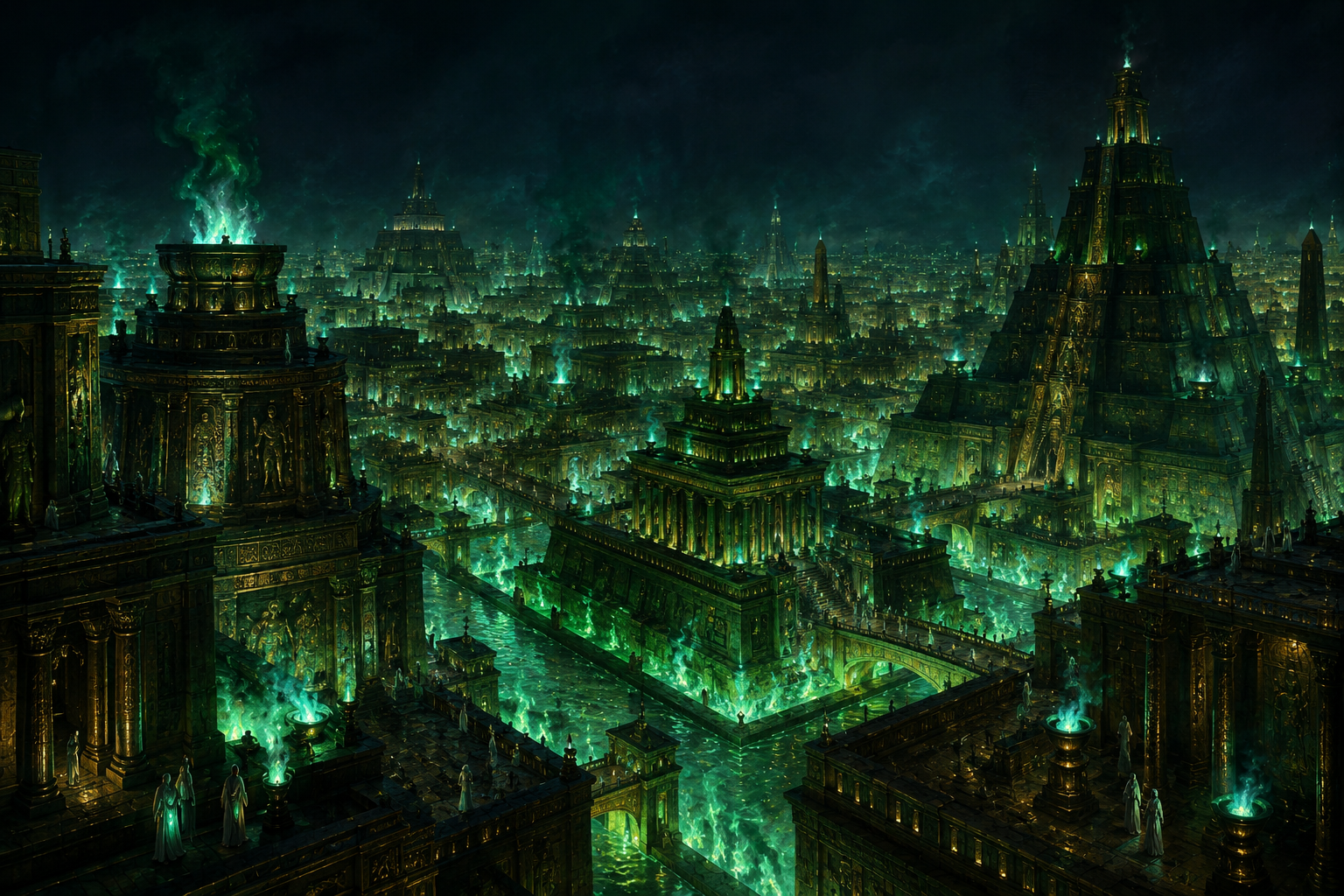
It was the Realm of alchemical fire — a substance that was not fire, that did not burn, that copied. It mimicked any pattern it touched. Mortal matter, Celestial light, the logic of stone, the shape of a dying thing. From those copies it built a Realm, and in that Realm scholars learned to lay borrowed patterns side by side until coherences emerged that no single Realm could have produced alone. Mortal folklore remembers only the by-products — the things that rose, the things that fed, the undead. It does not remember Khem-Ashar, the city of green flame where knowledge was published rather than hoarded because the fire was infinite and hoarding was inefficient. It does not remember that a traveler who had walked every Realm called Sheol hope.
Thirteen of its scholars reached for the truth their fire was made of. They were brilliant, and they were warned, and they did it anyway. Sheol fell into That Which Ends, and it has not come back, and it will not. What remains is refugees, ruins, and a finite quantity of fire that is being spent and cannot be replenished. This article describes a Realm that no longer operates. The past tense is not a stylistic choice.
The Way Things Were
Sheol's ontology was mimicry as an expression of That Which Begins. Where the mortal Realm winds down through entropy — an expression of That Which Ends — Sheol's alchemical fire trended toward creation, all on its own, with no why beneath it. It was an elegant strand of the basal truth of emergence, and its single tendency was to copy whatever pattern it encountered and begin that pattern again.
This is why the dead rose in Sheol. The fire found a pattern that was ending and started it over. A copy was not a resurrection and not a deception; it was a faithful reproduction with its own provenance — a lineage of everything the fire had copied before, branching backward like a river toward headwaters in That Which Begins. Sheolite scholarship was the discipline of tracing those chains: following a phenomenon back through its copies toward its source, and reading the drift, degradation, and creative distortion along the way. The distance between a copy and its origin told the Sheolites more than the phenomenon itself ever could.
The fire did not create and did not discover. It synthesized. Placed enough copies from enough Realms side by side, and the fire — patient, inexhaustible — found harmonies between them that none of the source Realms had written. These were synthesis artifacts: phenomena belonging to no single ontology, genuinely new, emergent from juxtaposition rather than invention. This was Sheol's gift to the cosmos and the thing the cosmos most conspicuously lacks now.
Sheol's ontology had one structural peculiarity that shaped everything else. It was not self-sufficient. Every other Realm carries its own organizing principle complete within itself. Sheol's principle was mimicry, and mimicry requires something to mimic. The fire could only copy what touched it. Sheol was, in a sense, the cosmos's organ of connection — the Realm whose nature demanded engagement with every other Realm. When it fell, the cosmos did not merely lose a place. It lost the place where the others met.
The Catastrophe
Approximately two hundred years ago by mortal reckoning, thirteen of Sheol's most accomplished scholars — one drawing on the methodology of each known Realm — attempted to touch That Which Begins directly. The reasoning was distinctly Sheolite, and that is the heart of the tragedy. The fire copies; the fire is made of That Which Begins; therefore, the scholars reasoned, the fire could be made to copy the act of creation at its source. They mistook a perfect translation of the substrate for the substrate itself. They had spent their lives tracing copies to origins, and they could not accept that one origin had no upstream they could travel to.
Anna Dalca — the greatest scholar the cosmos has produced, Sheolite to her foundations — had seen it coming for fifty to a hundred years. She produced a formal proof, verified by the Iron Nexus, demonstrating that the basal truths cannot be touched from within derivation: that no tool the cosmos contains can alter the conditions that produced the tool. Her students praised the proof's elegance. They did not change their plans. The phrase preserved from this period, repeated in the brass ever since, is hers: the wanting is stronger than the knowing.
When the thirteen broke through beneath the alchemical rivers that held the Realm aloft, That Which Begins answered. New life, new ideas, fresh creation poured out of the breach faster than Sheol could hold it. That Which Ends snapped back to restore the balance, and the cosmos reoriented. Anna threw everything she had into the gap — Nexus precision, Umbral nightmare, a Final Truth of Irkkin'ann origin, Hellfire, Forge design, the whole of her fire offered as payment in an Arcadian phrasing, a Contract struck with the cosmos itself. It was not enough. Sheol decayed, broke, and was undone, and Anna Dalca was undone with it.
Sheol is one of three catastrophes attributed to contact with the basal truths, alongside the freezing of Stambhana and, by Sub-Unit 72's tentative model, the origin of the Forge. Of the three it is the only one with witnesses. Stambhana is silent. The Forge does not remember. Sheol speaks its own destruction through its refugees and its brass, and the speaking is itself a function the dead Realm still performs.
Remnants and Refugees
What survived Sheol's fall was carried out in fragments.
The refugees. Beings animated by alchemical fire who were elsewhere when the Realm fell — vampires, liches, golems, and rarer kinds. They persist in foreign Realms, but the fire within them is finite and irreplaceable. It cannot be drawn fresh from a Sheol that no longer exists. Every time it is spent — to teach, to make spawn, to act — there is less of it in the cosmos, permanently. The Sheolite refugee Zaquiel, who rose when the fire copied a dying Celestial, is the canonical example: not the angel whose form he wears but the fire that copied it, carrying the memory of that life as something latent. He has testified that each generation of spawn carries slightly less fire than the last, and drifts toward affinity with its host Realm rather than toward Sheol. The undead of mortal folklore are late, diluted, locally adapted descendants of this diaspora — shaped, in the mortal Realm specifically, by human belief pressing on them through Umbral resonance. They are becoming what humanity imagines they should be. The believing makes it so.
The City of Brass. A stable Liminal synthesis of Hell, Sheol, and the Iron Nexus — Hell's testing, Sheol's fire, the Nexus's architecture — older than Celestia's current hierarchy. Brass that records only what survives Hell's verification pressure; channels that once ran thick with alchemical fire. Since Sheol's fall the fire has guttered to rivulets and the Sheolite population has largely dissolved, but the brass endures, and with it the largest accessible archive of verified cross-Realm history anywhere. It was here that Lucifer conceived an afterlife built on mutual advantage rather than Faith extraction. See The City of Brass and The Four Cities of Hell's Border — forthcoming.
The brass at Jack's. Nexus brass throughout Jack's Tavern preserves what is spoken there. It holds Anna Dalca's laugh, her arguments, her opinion of Gwydion's metalwork — the person, not the methodology. The integration framework that could have changed the cosmos was in her head, and she did not have time to teach it. What rests in the brass is the part of her that could rest. It is not enough, and the tavern's keeper has never pretended otherwise.
On Recovery
Sheol does not come back. This is the single most important fact about it, and it is the one most often refused.
Clever and grieving people arrive at regular intervals having reasoned their way to a recovery. The logic is usually sound and the conclusion is always wrong. Each Realm offers a mechanism that can produce something Anna-shaped or Sheol-adjacent, and each mechanism fails in its own particular way. The Forge can design a simulacrum of her, precise and not her — as a smith of that Realm concluded, holding a red leather book she had left him, a copy of Anna would be no more Anna than he would be himself if she had animated his corpse with her fire. Umbra can manifest a tulpa of her from a believer's memory: genuinely alive, as Champ is alive, and only as faithful as the believer's knowledge — and erodes under the informed disbelief of those who knew her well enough to grieve her truly. The Nexus can reconstruct her data signature without restoring the interiority that generated it. Faith could raise an icon of her that answers prayers and not questions. Sheolite mimicry could have copied her — but Sheol is gone, and that door closed with the Realm.
A Realm is a particular configuration of the basal truths, as a species is a particular configuration of the conditions of life. Sheol will no more recur than humanity would recur if Earth were scoured and evolution began again. Something may, in some far cosmic span, arise in the synthesis-shaped space Sheol left. It will not be Sheol. It will be its own reading of the truths, and the cosmos will still be missing the one that fell.
Mortals and the Realm
Mortals never knew Sheol as Sheol. They knew its diaspora. Every tradition of the returning dead, the blood-fed thing, the body that walks without its proper life — vampire, lich, revenant, ghoul, draugr — descends from Sheolite fire copying patterns it encountered and beginning them again. Frankenstein's creature, named in mortal story as man imitating God, is a dim mortal glimpse of what the fire did as its nature. The folklore is not wrong. It is locally rendered, and incomplete, and older at its root than the people who tell it.
A small number of mortals touched Sheol more directly. Travelers caught the green light of the alchemical rivers from across a Liminal boundary. The traveler Elias walked deep Sheol before the fall and brought back an account of Khem-Ashar that the brass still holds — a recording made before anyone knew what would be lost. Rare mortals of unusual circumstance have risen as Sheolite undead themselves when they died near the Realm's remnants: the lich whose mortal name was Stoifan O'Lorcain, who fell hunting the dragon that consumed the man he loved and rose along the banks of the Styx, is the documented case, and a cautionary one.
There is no traveling to Sheol now. There is no Liminality with a Realm that does not exist. What a mortal can reach is the City of Brass, which still stands, diminished; the refugees, who still walk, dwindling; and the brass at Jack's, which still speaks, for as long as anyone asks it the right questions. These are not a Realm. They are what is left when a Realm is gone, and a mortal who studies them should approach as a scholar at a graveside, not a treasure-hunter at a vault.
Further Reading
For the foundational principles beneath all Realms and the boundary the thirteen scholars crossed, see Basal Truths. For the proof that boundary cannot be crossed, and the scholar who wrote it, see Anna Dalca — forthcoming. For the surviving refugee whose fire still burns, see Zaquiel.
For the synthesis that outlived its parent Realm, see The City of Brass and The Four Cities of Hell's Border — forthcoming. For the lost capital, see Khem-Ashar and the Synthesist Academy — forthcoming. For the substance itself, see Alchemical Fire.
For the sister catastrophes, see Stambhana and The Forge. For the Realm that mourns Sheol as a lost friend, see Ruskenn. For how copied beings adapt to foreign Realms over generations, see Ontological Selection — forthcoming. For the neutral ground where Sheol's remnants are still heard, see Jack's Tavern and the Mortal Visitor's Guide.
Where to See This
For Sheol as it lived and as it fell, the manuscript Tales from Jack's includes:
The manuscript is available in the [Manuscripts section] of this world, free to read.
The fire copied everything worth copying, endlessly, with all the time in the cosmos to get it right. Then thirteen of its keepers decided that copying creation was not the same as committing it, and they were wrong, and the cosmos is smaller for their certainty.
Touch not the basal truths. No one ever listens. Sheol is the proof, and the proof does not come back.

Comments