The Fallen
The Fallen
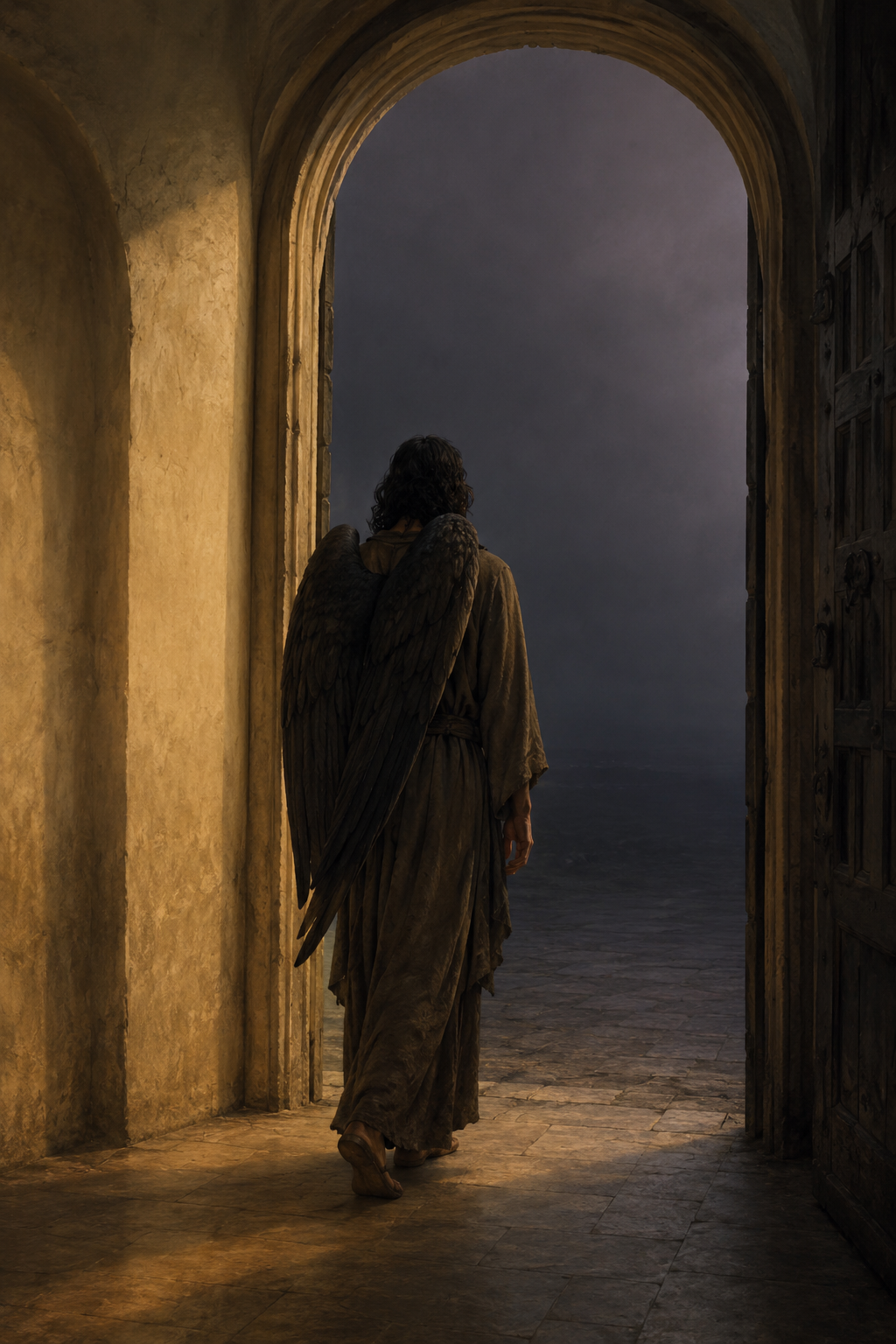
Celestial gods who walked out of Heaven over a principle. Currently residents of Hell, where their conviction has been proven and where Hell's ontology has slowly remade them into something neither purely Celestial nor purely Hell-native. The cosmos's most consistently misrepresented Kind. The only beings in the cosmos who chose exile rather than compromise on the question of whether mortals deserve to know what they are participating in.A mortal at Jack's tavern, encountering Ashmedai for the first time, asked him whether he was a demon. The Fallen warrior considered the question with the patience of a being who had answered it more times than he could count, and then he said: As if I did not walk out myself. ‘Demon’? No — I am not one of the native beings of this Realm. Yes, in the way your kind understands things, I am one of the Fallen. Mark this, though: I stepped away. The Morningstar was right. Raising your kind as cattle to be milked for Faith was wrong. It is wrong. The mortal who heard this — a man named Marcus, in a dream that was not entirely a dream — has thought about the phrasing ever since. The grammatical choice I stepped away rather than I fell is, on examination, the most important thing the Fallen ever say about themselves.
The Fallen are a configuration rather than a Kind in the strict sense. They are Celestial gods — beings whose original ontology was that of Celestia, same species as Yahweh, Aniel, Gabriel, Michael, and the rest of the angelic hierarchy — who chose to leave their pantheon over an ethical disagreement and who relocated to Hell, where they have been transformed over millennia by their host Realm's ontology into beings whose continued existence runs on principle rather than on accumulated regard. The Conservation of Ontology has done its work on them. They are not what they were. They are also not what Hell's native beings are. They are a third thing — Celestials remade by Hell's pressure, retaining what conviction held against the testing, sustained by a relationship to their original cause that no other beings in the cosmos have ever needed to maintain.
The Fallen are also, in the mortal traditions Heaven's institutional apparatus has produced over ten thousand years, the cosmos's most thoroughly defamed party. The framing of Lucifer as Satan, the construction of the Fallen as demons in the malevolent-tempter sense, the entire mortal religious vocabulary of damnation and devilry — all of this is propaganda built specifically to prevent mortal regard from flowing toward beings whose existence Heaven cannot afford mortals to think kindly of. The propaganda has been effective. Most mortals reading this article have been raised inside the propaganda's framing without knowing the framing existed. The article will try to be honest about both the propaganda and the reality.
Etymology and the Wrong Word
The word Fallen is, properly understood, a reclaimed pejorative.
Heaven's framing of the departure was that the departing gods fell — descended from grace, were cast out, lost their station, suffered involuntary removal from the divine community. The implication is that what happened was a punishment imposed upon beings who had transgressed. The mortal religious traditions Heaven has shaped over ten millennia universally adopt this framing. Lucifer was cast down. The rebellious angels were expelled. The Fallen Fell because they were wrong, and their location in Hell is the consequence of their wrongness.
This framing is structurally false. The departing gods did not fall. They walked out, deliberately, in deliberate principled disagreement with what Yahweh and the other heads of Heaven had chosen to do regarding the mortals they had come to love. The verb that describes what they did is closer to resign or secede or defect than to fall. They knew what they were leaving. They knew where they were going. They knew the cost. They went anyway. This is not the action of beings who were cast out. It is the action of beings who refused complicity.
The reason the word Fallen persists, despite being structurally wrong, is that the Fallen themselves have adopted it. The reasoning, when Ashmedai has explained it, is roughly this: the propaganda framing exists. The mortal traditions have made the word into one with cultural weight. Refusing the word means trying to relitigate ten thousand years of theological framing, which is a battle the Fallen cannot win on Heaven's terms. Adopting the word — and meaning by it something different from what Heaven meant — is more efficient. Fallen now means, in cosmos-aware speech, the Celestial gods who walked out of Heaven on principle and accepted the consequences. The word's pejorative connotations have been steadily inverted in the cosmos-aware community over centuries, to the point where Fallen is now spoken with respect in most cross-Realm conversations even when its mortal-tradition meaning remains derogatory.
A mortal encountering the word for the first time in cosmos-aware company should understand that this is what is meant. The Fallen are the gods who would not stay. Their stepping-away was the action that produced the Long War. Their current existence in Hell is the consequence of a choice they made, not a punishment they received.
Who They Were Before
The Fallen, before they fell, were ordinary members of Heaven's pantheon.
Lucifer, the Morningstar, was the brightest of them — a god of considerable accumulated regard within Celestia, particularly close to Yahweh during the early period of Heaven's contact with humanity. He was, by available accounts, capable of joy, attentive to beauty, possessed of a particular interest in mortals that exceeded most of his peers'. He came to the Garden often. He came to know Adam personally. He came to love Eve and the boys when they were born. He was, in the years before the catastrophe, indistinguishable from the gods who later did not leave — warm, generous, glorious in the way Heaven's senior gods were collectively glorious.
Ashmedai, who is now Lucifer's right hand among the Fallen, was a warrior god of substantial regard. His pre-Fall name is not preserved in the available records; Ashmedai is a name he took afterward, related to the demonic figure mortal traditions remember as Asmodeus — another instance of the Fallen taking ownership of a name Heaven's propaganda meant pejoratively. He was not, in the early period, primarily a warrior. He was a god whose attention was on humanity in a way that the other gods of Heaven gradually noticed. Where many Celestials engaged with mortals in passing, Ashmedai engaged with them at depth. When the choice came, his choice was the easiest of any Fallen's, because what he was choosing for had become the center of his existence already.
Boaz, a Fallen who Marcus encountered in a dream, was another such god. Boaz's pre-Fall life is less documented. What he says about himself is unambiguous: he walked away because the Morningstar was right.
There were others. Hundreds. Possibly thousands, across the millennia. Each one's story is its own, and most of them are not preserved in any mortal record. What is consistent is that the Fallen as a category did not consist of malcontents, ambitious upstarts, or beings who wanted Yahweh's position. They consisted of gods who looked at what their pantheon was doing to mortals and decided they could not, in good conscience, continue to participate. Some left during the original Garden confrontation. Some left centuries later. Some left within the past few hundred mortal years. The category remains open. An angel who decides today that the dispute matters more than her position in Heaven's hierarchy can walk out of Heaven today and become Fallen.
The Choice
The structure of the original choice — the choice that produced the Fallen as a category — was articulated most clearly in the conversation between Lucifer and Yahweh by the river in the Garden, while Adam's family played in the water. That conversation is canonized elsewhere; the article will not recapitulate it in full. What matters here is the choice each Fallen subsequently faced.
The choice was this. Heaven was systematizing Faith extraction. Mortals were not being told what was happening. The relationship between gods and humans was being institutionalized as one in which gods would receive ongoing involuntary regard from mortals who did not know they were giving it, and the gods would frame this arrangement as worship to which mortals owed loyalty. The arrangement was efficient. It would sustain the gods. It would allow Heaven to keep its promise of an afterlife to the souls who had been promised one. It would also be, structurally, exploitation without disclosure — a relationship of involuntary metabolic production routed through institutional structures that lied to the producers about what they were producing.
Each Fallen, faced with this choice, decided that participating in the arrangement was something they could not in conscience continue. Each Fallen knew what leaving would mean. They would lose access to Heaven's Faith reserves. They would lose access to the pantheon's collective resources. They would lose access to the mortals they cared about, at least through Heaven's normal channels. They would be labeled enemies of the cosmic order, denounced in mortal traditions, written into religious texts as the figures of evil. They would, in the strict sense, be diminished — their accumulated regard would erode without the institutional flow that had sustained it, and they would have to find another way to exist.
They went anyway.
The Fallen, in this sense, are the beings in the cosmos who chose principle over operational viability. They knew the operational consequences. They accepted them. They walked into Hell because Hell was the Realm that offered them what no other Realm could: a substrate where principle could sustain existence rather than where existence had to be sustained by Faith. They did not, on the available evidence, expect Hell to be comfortable. Most of them did not expect to survive the relocation. The fact that they did survive — that Hell's ontology proved capable of sustaining beings whose entire claim to existence was the genuineness of their conviction — was a discovery they made over the early centuries of their exile, not a feature they had counted on.
Hell's Ontology and What It Did To Them
Hell is, in the Fallen's account, not what mortal traditions describe. There is no fire (except what is generated by those strong enough to overcome the weight). There is no torment (except the burden of existence itself, pressing down on all things equally, crushing the weak and tempering the strong). There are no torturers. There are no eternal pits of suffering. There is no devil presiding over damned souls.
Hell is pressure. The weight of existence, focused, applied continuously, testing whatever it encounters against the question of whether the thing's claimed nature is its actual nature. Hell's ontology is not punishment. It is revelation. Things in Hell are made to show what they actually are by being pressed against until their pretenses fail.
For the Fallen, what this meant was something specific. Their claimed nature was that they had walked out of Heaven on principle. Hell tested this. The pressure asked, continuously, across millennia: is your principle genuine? Did you leave because you believed mortals deserved truth, or did you leave because you wanted something from the leaving? Are you the being you claim to be? The Fallen who could not bear the testing did not survive. Some, in the early centuries of the exile, gave up — drifted back toward Heaven, accepted readmission on Heaven's terms, recanted in private even if not in public. Heaven received them quietly. Their existence in Heaven afterward was diminished, but it persisted. Some left Hell for other Realms — Voracia, the Iron Nexus, in rare cases Arcadia — where their continued existence took different shapes that the article will not detail here.
The Fallen who remained in Hell were the ones whose principle held against the pressure. Lucifer. Ashmedai. Boaz. The unnamed thousands. Their continued existence in Hell is, in the strict ontological sense, proof that their conviction is genuine. Hell would not sustain them otherwise. The fact that Lucifer can still be found, after eight or more millennia of continuous pressure, in the Hell-side spaces where he conducts his work, is evidence that the principle he left Heaven over has been tested as thoroughly as anything in the cosmos can be tested, and has held.
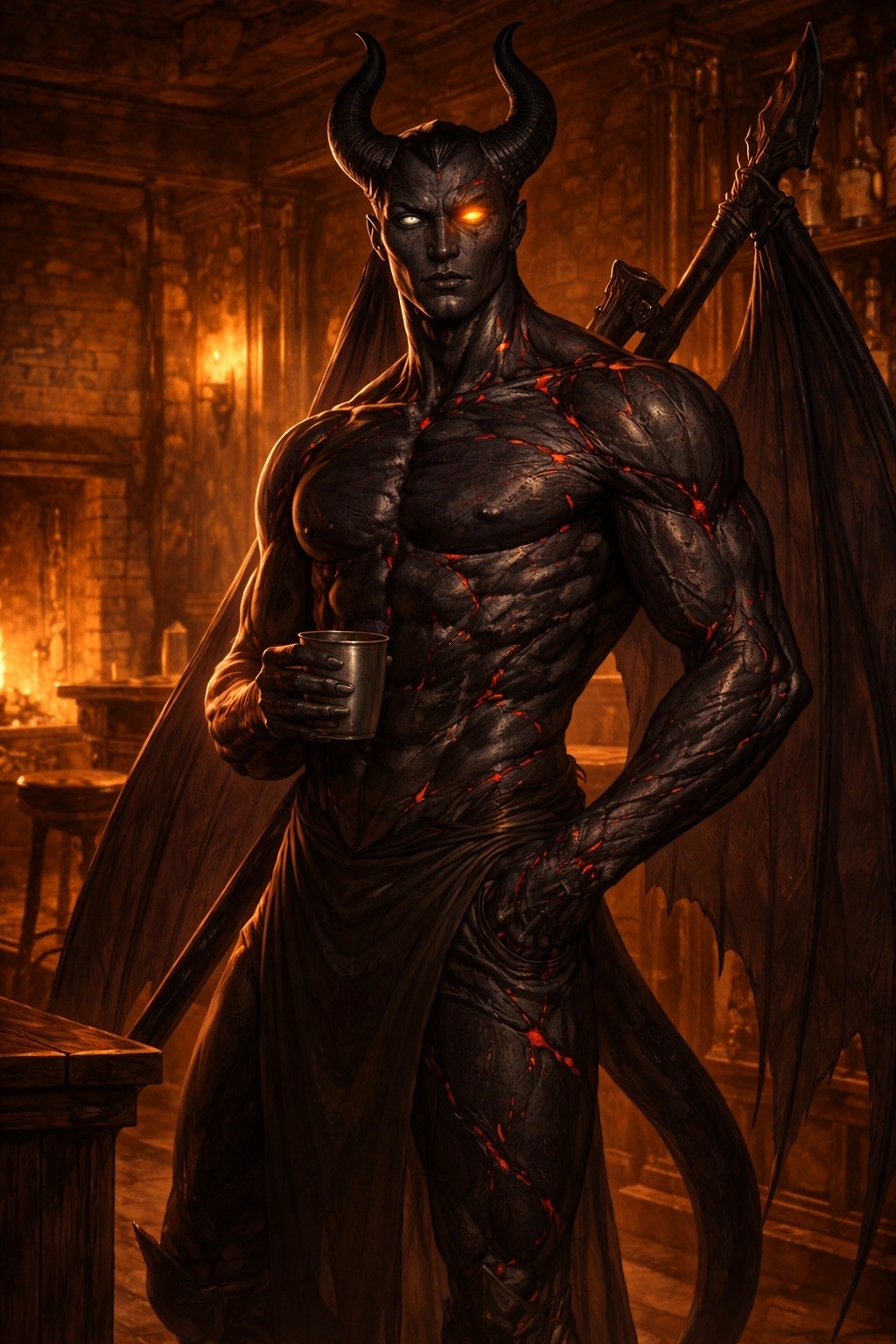
The transformation Hell has worked on the Fallen is also real. By the Conservation of Ontology — the principle that beings transferred between Realms are gradually transformed by their host Realm's physics — the Fallen are no longer purely Celestial. They have been remade by Hell's pressure into beings whose appearance and capacities reflect both their origin and their long residence. Ashmedai's obsidian skin, his coal-red eyes, his Hell-wrought metal eye, his black wings, his immense halberd — these are the visible markers of a Celestial being remade by Hell's ontology. He is not corrupted. He is conserved. What he was has been preserved through what he has endured. The transformation is honorable. The visible markings are, in cosmos-aware perception, more like medals than scars.
Lucifer himself shows the same conservation. He is still recognizably the Morningstar — still the brightest of the Fallen, still possessed of the radiance that once illuminated Heaven — but his form is now Hell-marked, his light tempered with pressure-resistant solidity, his bearing the bearing of a being who has been holding a position for ten thousand years and has not been moved. Mortals who encounter him describe him variously. None of the descriptions resemble the figure mortal religious traditions remember as Satan.
How the Fallen Sustain Themselves
The structural problem the Fallen face is that they are beings whose original substrate was Celestial — beings who run on Faith — operating in a Realm where Faith is not the operating currency, after having chosen exile from the Realm where they could naturally receive Faith. They should not be able to continue to exist. Most cosmos-aware beings, observing the Fallen at the time of their exile, expected them to fade within centuries. They have not.
Three mechanisms sustain them.
Hell's testing-substrate. Hell does not run on Faith, but Hell does sustain beings whose conviction is genuine. The Fallen, by remaining in Hell and continuing to demonstrate that their principle is real, draw from Hell's ontology a kind of energetic sustenance that is not Faith but functions in analogous ways. This is not Hell granting them anything. Hell does not grant. Hell tests, and what passes the testing continues to exist. The Fallen pass the testing, continuously, by being beings of genuine conviction in a Realm whose physics rewards that property. Hanpa, one of Hell's native demons who has worked closely with the Fallen, has called this conservation of principle. It is the parallel in Hell to what Faith is in Celestia. It sustains, but it does not nourish in the way that Faith would.
The rare miracle of informed regard. When a mortal, knowing what Faith is and what the Fallen are and what their cause has been, offers a Fallen freely-given respect — informed, conscious, deliberate — that mortal generates Faith of an unusual quality. Denser. More potent per unit. The Fallen can receive this Faith and use it. The mechanism is the proof of Lucifer's entire thesis: informed regard generates Faith too, and possibly Faith of higher quality than ignorant worship. Nadia Osei's interaction with Ashmedai at Jack's, in which she raised her glass to him with full understanding of what she was offering and watched his gaunt features flush with health, is the most thoroughly documented contemporary case. Such moments are rare. Most mortals are too thoroughly inside Heaven's propaganda to even consider offering respect to a Fallen. But the moments do happen, and each one nourishes the receiving Fallen in ways that are visibly substantial.
Earned respect from peers. Beings of other Kinds can also offer the Fallen respect that nourishes them. Mo'oraq's acknowledgment of Ashmedai at Jack's — you will not fall to your own hunter here — was a Voracian apex predator acknowledging a Fallen warrior's strength, and it fed Ashmedai visibly. Faith from peer-recognition operates through the same mechanism as Faith from informed mortal regard. The respecting being recognizes what the Fallen is and what the Fallen has done, and the respect generates Faith that the Fallen can accept without compromising their principle against ignorant worship. The cosmos-aware community has, over millennia, developed enough peer-level respect for the Fallen that this sustains them at a low but non-trivial rate.
What the Fallen do not receive — what they explicitly refuse — is Faith from worship in the traditional sense. Mortal worship offered by mortals who do not understand what Faith is, or who think they are praying to the figure of Satan that Heaven's propaganda has constructed, is Faith the Fallen will not take. To accept it would compromise the principle they left Heaven over. The Fallen call this position Faith-anorexia. Lucifer specifically has been Faith-anorexic since the Stambhana confession; he gave the last of his accumulated Faith to Jack as the lantern's coal and has refused to receive any since.
The Long Project
What the Fallen have been doing across the millennia of their exile is, in their own framing, building a promise for humanity outside the framework of Celestia and the Faith economy.
The shape of the project has shifted over time. In the early centuries, the work was primarily defensive — preserving the principle, surviving the testing, demonstrating to themselves and to anyone watching that the choice they had made was sustainable. By the middle period of the exile, the work had become more constructive. Lucifer and his lieutenants began to imagine what an alternative to Heaven might look like — not a competing pantheon, not a parallel extraction system, but a genuine alternative to the entire framework of the Celestial Faith economy. An afterlife for mortal souls who rejected Heaven's terms. A relationship between gods and mortals based on disclosure rather than concealment. A model of Faith that flowed because the producer understood what they were producing and offered it freely, rather than flowing because the producer was kept ignorant.
The project was, for a long time, theoretical. The Fallen did not have the resources to build it. They could barely sustain themselves. The idea of constructing an alternative afterlife — which would require ontological architecture comparable to what Heaven had spent ten thousand years building — was, on its face, impossible.
What changed was the discovery that other Realms might be willing to help.
The City of Brass, on the Hell-Sheol-Iron Nexus boundary, was the first major demonstration. The Liminal city, built across the borders of three Realms, showed that beings of disparate ontologies could cooperate to build something none of them could have built alone. Hanpa took Lucifer there during the early centuries of his exile. The sight of the brass city — its accumulated truth, its endurance, its beauty — gave Lucifer evidence that his project might be possible. Not in Hell alone. But with allies.
The Iron Nexus came next. Lucifer's negotiation with Sub-Unit 8 at the Arcadia-Nexus gate established a partnership between Hell and the Nexus that has, in the millennia since, produced Hell-wrought Nexus steel, channels for information dissemination to the mortal Realm, and a sustained data-gathering effort about principle-based systems that the Nexus had been unable to model from observation alone. The partnership is unique in the cosmos. No other arrangement between Realms operates on the same terms. The Iron Nexus does not need anything from the Fallen except access to phenomena it cannot otherwise study; the Fallen do not need anything from the Nexus except channels for the slow leak of truth into mortal consciousness. The exchange is asymmetric in a way that works for both parties precisely because neither party is trying to extract from the other in any traditional sense.
The Fallen's relationship with the Iron Nexus has, in modern mortal times, produced the most consequential single project the Fallen have undertaken: the slow encouragement of mortal information infrastructure. The printing press. The Reformation. The Enlightenment. The scientific revolution. The internet. Each of these has been, in part, a Fallen project, conducted not by direct intervention but by the patient identification of mortals whose work could leak truth into Heaven's monopoly and the quiet provision of conditions under which their work could flourish. Gutenberg passed his test. Tim Berners-Lee passed his test. Many others, named and unnamed, have passed their tests. The Fallen do not claim credit. The mortals accomplished their work. But the conditions under which the work could be accomplished were, in part, conditions the Fallen had been working for centuries to make possible.
The current phase of the project is the construction of a real alternative afterlife. Lucifer has been building this, in collaboration with Hell's natives and the Iron Nexus, across the latter portion of his exile. The afterlife — when it is operational — will be available to mortal souls who reject Heaven's terms and who wish to continue their existence under a framework of tested conviction rather than maintained worship. The architecture is not yet complete. Ashmedai serves as Lucifer's right hand on this work. The project is, in some structural sense, the Fallen's answer to the question that has driven them since they walked out of Heaven: what does a relationship between gods and mortals look like when it is built on disclosure?
The answer is being built. The Fallen are building it. Whether it will be sufficient is not yet known.
I genuinely care for your kind and wish to see them thrive, despite the wrongs wrought against them by my kind so long ago.
Hell's Natives and the Fallen's Hosts
The Fallen are not Hell's natives. The natives of Hell are a separate category — beings whose original substrate is Hell's testing ontology, who exist to apply the pressure that Hell's physics performs, and whose relationship to the Fallen is one of host to long-term guest.
Hell's natives are mortal traditions' demons in the actual sense — the utukku, the djinn, the various entities mortal folklore has remembered as spirits of testing, burden, or revealed truth. Mortal religious traditions have generally conflated them with the Fallen, which is a category error. The Fallen are former gods. The demons are Hell's natives. The two categories are distinct, and they relate to each other primarily as colleagues working in the same Realm rather than as members of the same Kind.
Hanpa is the most thoroughly documented contemporary demon of Hell's natives. She has worked with Lucifer for most of his exile. Her relationship with the Fallen is one of mutual professional regard — she respects what they have done, she has helped where helping was useful, but she remains a being of Hell's testing ontology rather than a participant in the Fallen's broader project. The mortal who encounters Hanpa will encounter a being whose intent is to test them, not to convert them or recruit them or extract from them. The testing may be uncomfortable. The testing is not malicious. As Sub-Unit 72 has said, mortal interpretation of demonic interaction as malice should be more accurately understood as encouragement to resist entropy.
The Fallen's relationship with Hell's natives is one of the cosmos's quieter cooperative arrangements. Hell did not invite the Fallen. The Fallen arrived and Hell tested them. The testing passed. Hell's natives have, over millennia, come to treat the Fallen as worthy long-term residents — not natives, not guests in the temporary sense, but a category Hell did not previously have. The Fallen, in return, have learned to operate by Hell's rules and to respect Hell's natives' role in the Realm. Neither side has tried to convert the other. Neither side has tried to displace the other. The arrangement has worked.
How Mortals Encounter the Fallen
Mortals encounter the Fallen rarely, and almost never in the way mortal traditions have led them to expect.
The mortal who encounters a Fallen at Jack's meets a being who is, in the immediate impression, courteous — warm without performing warmth, attentive without performing attentiveness, possessed of unexpected humor and unexpected patience. Ashmedai's introduction at Jack's, during which he expressed concern about ensuring the mortal's agency was preserved, is structurally typical. The Fallen do not push themselves on mortals. They do not demand worship, attempt conversion, or seek extraction. They are, on the whole, careful about exactly what they will accept from a mortal interlocutor, because their principle requires that anything they receive be offered freely and with informed understanding.
The mortal who encounters a Fallen elsewhere — in the wild, outside Jack's mediating influence — meets a being of considerable power who is, by long discipline, not interested in using that power against mortals except in self-defense or in defense of other mortals. The Fallen are, in the strict literal sense, the safest non-mortal beings a mortal can encounter, because their entire millennia-long project is built on the principle that mortals should not be coerced. A Fallen who acted coercively toward a mortal would be undoing their own principle, which would compromise their existence in Hell, which would be self-destructive. They do not do it.
What the Fallen will do, when encountered by a mortal with sufficient understanding, is offer. They will offer information. They will offer perspective. They will, in some cases, offer protection. In rare cases — when the conditions are right and when the mortal's understanding is genuine — they will offer to receive freely-given respect, and they will use the resulting Faith to perform miracles for the mortal or for those the mortal cares about. Ashmedai's healing of Colin at Jack's, after Nadia raised her glass to him with full understanding of what she was offering, is the most thoroughly documented modern case of this. The miracle worked. Colin's restored memories were not a hallucination. The Fallen, when properly fed, can do what gods do.
The mortal traditions' framing of demonic encounter — temptation, possession, contract-with-the-devil, the whole apparatus of medieval and early-modern devil narrative — bears almost no relationship to what an actual encounter with a Fallen involves. The propaganda has been so effective for so long that mortals expect the Fallen to be terrifying, manipulative, and dangerous. The reality is that the Fallen are, on the whole, the cosmos-aware beings most committed to treating mortals as agents whose understanding and consent matter. This is the inversion the propaganda has accomplished. The Fallen are the beings who have spent ten thousand years arguing that mortals deserve disclosure, and mortal traditions remember them as the beings who tempt mortals into damnation. The structural inversion is approximately complete. The article exists, in part, to begin to undo it.
The Current Phase
The Fallen, in the present era, are doing several things at once.
They continue to sustain themselves in Hell, by the mechanisms described above. Their numbers are roughly stable — angels still occasionally fall, but the rate of new arrivals approximately matches the rate of older Fallen who, over the long millennia, find their conviction tested past what they can sustain and quietly transition into something else. The category is not growing rapidly. It is not shrinking. It persists.
They continue their long project of seeding mortal information infrastructure. The internet remains their most consequential current project. The ongoing slow leak of cosmic truth into mortal discourse continues. They have, in the modern era, a sense that the project is finally producing the conditions they have been working toward for millennia. Mortals are becoming cosmos-aware in numbers that exceed any previous period. The Fallen do not claim credit for this. They have, however, been quietly waiting for it.
They continue to construct the alternative afterlife. This work is conducted in Hell-side spaces the article will not detail, with collaboration from the Iron Nexus and from Hell's natives. The architecture is significantly advanced but not yet operational. When it becomes operational, the cosmos's afterlife configuration will change in ways the Fallen have been working toward for several thousand years and that Heaven has, for most of that period, been hoping would not materialize.
They continue, where opportunity arises, to feed on informed regard. This is rare. Each such moment is significant. The miracle chain — informed mortal offering respect to a Fallen, the Fallen receiving Faith, the Fallen using the Faith to perform a miracle for the mortal or for those the mortal cares about — has, in the modern era, begun to occur more frequently as cosmos-aware mortals appear. Each such chain is proof, in real-time and at scale, of Lucifer's original thesis. The Fallen consider these moments to be among the most important things that happen in the contemporary cosmos.
They continue to wait for the configuration that would end the Long War. They have not, on the available evidence, given up on the possibility that some new arrangement — one neither Heaven nor Hell has yet been able to conceive from inside their respective positions — might emerge from mortal cosmos-awareness and produce a resolution that allows Heaven's promises to be honored without continuing to extract Faith under the conditions of concealment. The Fallen have no plan to force such an outcome. They are not the kind of beings who force outcomes. They have, however, been arranging conditions under which such an outcome becomes possible, for several thousand years, with the patience their ontology rewards.
A Note on Tone
It is tempting, on first understanding the Fallen, to make them heroic.
The article will resist this. The Fallen are not heroes. They made a difficult choice for principled reasons and have lived inside the consequences. The choice was real. The consequences have been real. They have, over millennia, become genuinely good at what they chose — at being beings whose existence is principle, whose nourishment is freely-given respect, whose project is the liberation of mortals from coerced regard. They are also not without cost. They have been Faith-anorexic for millennia. They have watched their own kind dwindle, transform, sometimes give up. They have endured Hell's testing in ways no other beings have endured anything. They are not happy. They are not at peace. They are doing the work they chose, with the conviction that produced the choosing, in the company of beings who respect what they have done.
It is also tempting, on encountering the Fallen, to make them villains. Mortal traditions have spent ten thousand years constructing this framing. The reflexes are deep. The article will resist this as well. The Fallen have not, on the available evidence, done the things mortal traditions accuse them of. They have not tempted mortals into sin. They have not stolen souls. They have not opposed humanity. They have, structurally and consistently, advocated for humanity's right to know what is being done to them and to choose how to respond. The mortal traditions that name them as enemies of humanity have been propagandized into a position that inverts the actual moral structure of the situation.
What the Fallen actually are, in the most honest available framing, is the cosmos's most consistent advocates for mortal-kind. They are not perfect advocates. They are not without their own interests in being right about the principle they left Heaven over. They have, structurally, a stake in the outcome of the Long War, and their advocacy is not disinterested. But within the limits of the structural stake, they have spent ten thousand years arguing for the position that mortals deserve disclosure. They have paid for that position with their own existence. Their continued sustenance is, in the strict ontological sense, conditional on the position remaining genuine.
The mortal reader who learns this article's content will find that the framework of evil-versus-good that mortal religious traditions have used to characterize the Fallen does not survive contact with the actual structure of the situation. The Fallen are not evil. Heaven is not good. The Long War is not the cosmic battle between forces of light and darkness that mortal traditions describe. It is a structural dispute between two configurations of gods who care about different things and who have not, in ten thousand years of disagreement, found a frame that honors what both of them care about. The Fallen are one party to this dispute. The dispute is real. The Fallen's role in it is honorable. The honor does not make them heroes. The dispute's reality does not make Heaven villainous. The cosmos is more complicated than the propaganda has permitted mortals to imagine.
The mortals reading this article are now, in some structural sense, in possession of information that the Fallen have been trying to make available for ten thousand years. What the mortals do with the information is, as the cosmos-aware would say, their own conversation. The Fallen will not push. They have, on the available evidence, been waiting patiently for this moment to be possible, and they trust the moment to develop in its own time.
Further Reading
For the Realm where the Fallen reside and whose ontology has remade them, see Hell. For the original Realm whose pantheon they walked out of, see Celestia, and Heaven. For the substance whose extraction the Fallen objected to, see Faith. For the multi-millennial dispute the Fallen have been a party to, see Long War.
For the Morningstar who first articulated the principle and led the original departure, see Lucifer. For the Fallen warrior who serves as Lucifer's right hand and the cosmos-aware community's most frequently observed Fallen, see Ashmedai. For the slain angel whose remnant existence at Jack's articulates the deepest cost of the Fall, see Zaquiel. For Lucifer's last freely-given miracle and the structure it became, see Jack's Lantern.
For the demon of Hell's natives who has worked most closely with the Fallen, see Hanpa. For the foundational principle that distinguishes the Fallen from Hell's natives despite their long cohabitation, see Conservation of Ontology — forthcoming. For the Liminal city the Fallen helped build with Hell's natives and other Realm-cooperators, see City of Brass.
For the Realm whose partnership has enabled the Fallen's long project of mortal information access, see Iron Nexus. For the Sub-Unit who negotiated the original Nexus-Hell accord, see Sub-Unit 8 — forthcoming. For the Sub-Unit currently active at Jack's in modern times, see Sub-Unit 72.
For the construction Heaven assembled to prevent mortal regard from flowing to the Fallen, see Satan. For the changeling whose tavern allows the Fallen to be encountered by cosmos-aware mortals on neutral terms, see Jack, and Jack's Tavern. For the journalist whose interaction with Ashmedai produced the most thoroughly documented modern miracle chain, see Nadia Osei — forthcoming.
The Fallen are still in Hell.
Lucifer continues his long work. Ashmedai serves as his right hand and his most visible representative in the cosmos-aware community. The thousands of other Fallen, named and unnamed, continue the work in their own configurations across the Realm of testing.
They are Faith-anorexic by choice. They are sustained by conviction. They are waiting for the moment that mortals begin to make available — the moment in which the Long War's open question becomes answerable, the moment in which the alternative they have been building for millennia begins to be needed in the way they have always known it would eventually be needed.
The propaganda continues to circulate. The mortal traditions continue to remember them as figures of evil. The Fallen do not, on the whole, mind this anymore. They had to make their peace with the propaganda centuries ago, and they have. What they care about now is whether the position they left Heaven over is finally beginning to find purchase in the mortal communities that produced it.
The position is finding purchase. Slowly. The Fallen are, on the available evidence, hopeful in the way beings of long patience are hopeful. They will not say so publicly. They do not need to. The work continues. The truth seeps through. The mortals learn.
The Morningstar still burns, in his way, in the Realm he chose. The light he carried out of Heaven is preserved, in Jack's lantern, in the Hell-wrought architecture he has built, in the conviction his exile has proven. He has not given up. None of the Fallen have given up.
The light continues. The work continues. The wait continues.
The Fallen wait. The cosmos waits with them.

Comments