
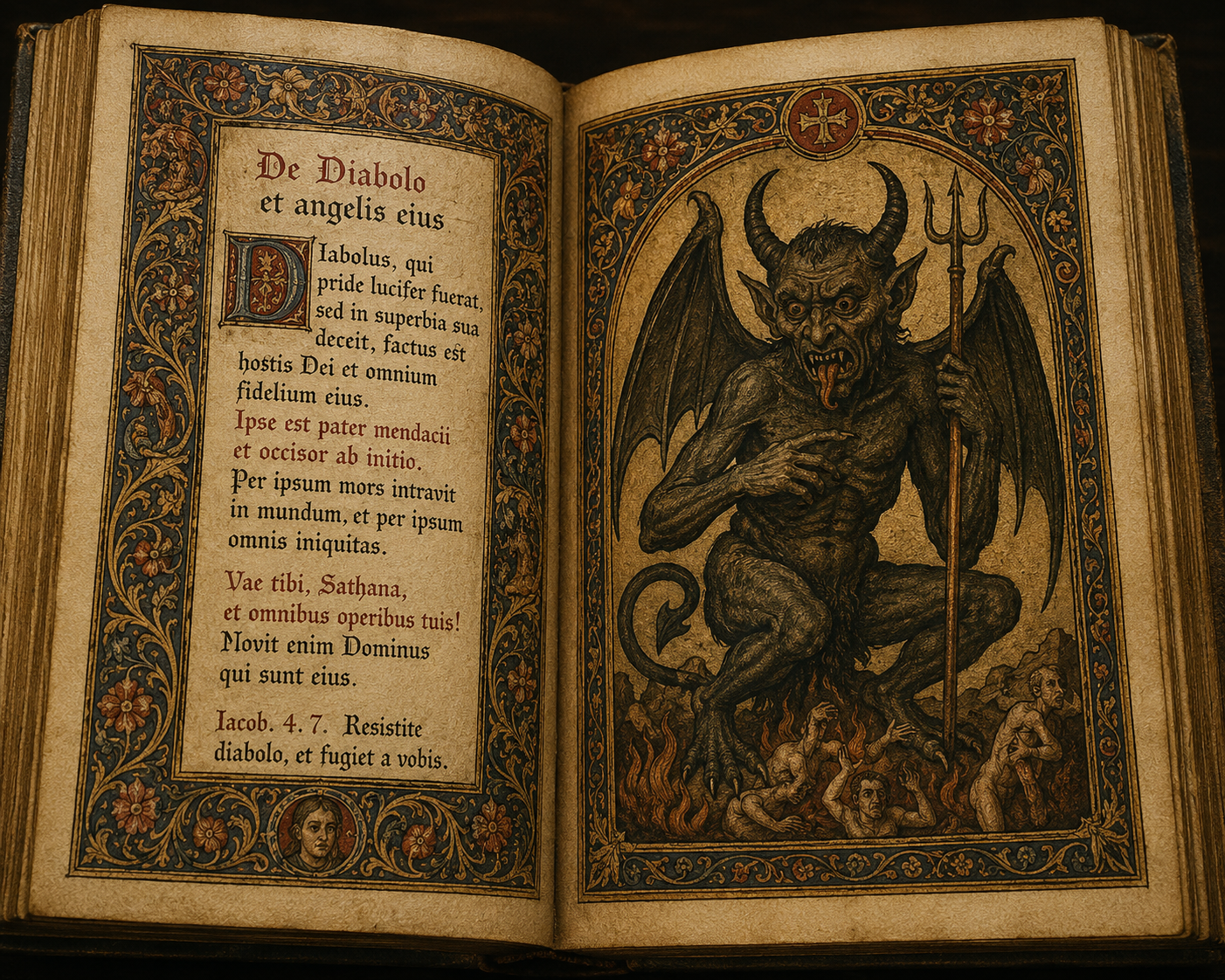
Satan
The Compiled Adversary
Every tradition that names Satan describes someone slightly different. No one has ever satisfactorily explained why.There is no single source document for Satan. This is, among mortal scholars of comparative demonology, the field's most persistent and least comfortable open question — not whether Satan exists, but why every early source claiming to describe him describes someone subtly, irreconcilably different.
The Inconsistency
The adversary of the Book of Job is a member of a divine court, performing a sanctioned role, asking permission before acting. The serpent of Genesis is never named Satan at all, and grants knowledge rather than withholding it. The tempter of the Gospels offers kingdoms, not corruption. The dragon of Revelation commands armies and falls in open war. The medieval grimoire tradition adds dozens more — named, ranked, given sigils and domains, each tradition's hierarchy disagreeing with every other tradition's hierarchy about who outranks whom.
Conventional theology resolves this by treating the figure as singular and the sources as imperfect glimpses of one being, refracted differently by each author's limited understanding. A smaller, more careful body of scholarship, read seriously by almost no one with institutional standing, and dismissed as conspiracy by everyone else, has reached a different conclusion: the sources are not describing one being imperfectly. They are describing several beings accurately, compiled after the fact into one name.
What The Compilation Actually Contains
The careful theorists have, without ever phrasing it this way, reconstructed something close to the truth. Behind the composite figure of Satan sit several distinct, real entities, never coordinated, never claiming the name for themselves: a principled exile cast as cosmic rebellion. A patient observer of human suffering cast as a tempter of souls. Various Liminal travelers — beings native to no single Realm, passing briefly through mortal affairs — cast as recurring demonic appearances with no consistent identity, because they were never the same being twice. Even, in a handful of documented cases, human prophets and heretics whose dissent from orthodox doctrine got absorbed into the same adversarial mythology, their actual words lost beneath the figure they were folded into.
No one in Hell authorized this. No one in Hell benefits from it in any way that would justify maintaining it. The compilation was assembled entirely on the mortal side, by an institution that needed a single adversary rather than several unrelated beings whose actual relationships to humanity ranged from indifferent to genuinely protective, and found it more efficient — and considerably more frightening — to merge them into one.
Why It Has Never Been Corrected
Heaven actively promotes this. A singular villain is of value in maintaining the monopoly on Faith and, more importantly, keeping any regard for the Fallen out of mortal minds. Humanity, should it afford any respect or awe to the Fallen, would feed them and allow them to rival Heaven.The Fallen do not maintain a counter-narrative. This is not oversight. It is structural: Hell's testing-ontology cannot sustain a maintained propaganda apparatus, and the Fallen, having left Heaven specifically over the question of disclosure, will not adopt the tools they exiled themselves for refusing. They could, in principle, correct the record. They have chosen, consistently, across millennia, not to, on the conviction that a forced correction is simply propaganda wearing a different face, and that mortals are better served, eventually, by finding the inconsistency themselves than by being told what to believe instead.
The Theorists
The scholars and occultists who have noticed the seams in the compilation are rarely taken seriously, and the texture of their work — fragmentary, cross-referential, perpetually almost-but-not-quite cohering into a single clean theory — looks, to outside observers, exactly like conspiracy thinking. It is closer, in fact, to the opposite: several careful readers, working independently, each noticing that the official account does not hold together, none of them quite able to see that they are all describing the same unacknowledged truth from different angles.
The compilation was never meant to survive close reading. It has survived anyway, by mortals simply not reading that closely. The theorists are the exception, and the exception has not yet been believed.
Lucifer Is Not Satan
One serious takeway from the breakdown of the conspiracy thinking of "the devil is corrupting the world" is that the urge to reduce everything into a singular being to blame appears to be quite widespread. Lucifer has done many things in service of humanity. Indeed, all the Fallen have. But the conspiracy thinking that reduces any evil wrought in the world to a packet that can be laid at Lucifer's feet simply demonstrates poor awareness. Every Realm has benevolent and malevolent beings, not simply Hell. Any number of them might influence humanity. And of course, humanity itself is more than capable of wreaking evil upon itself.Satan does not exist as a single entity, and Lucifer certainly is not the devil in any sense the propaganda promotes.

Comments