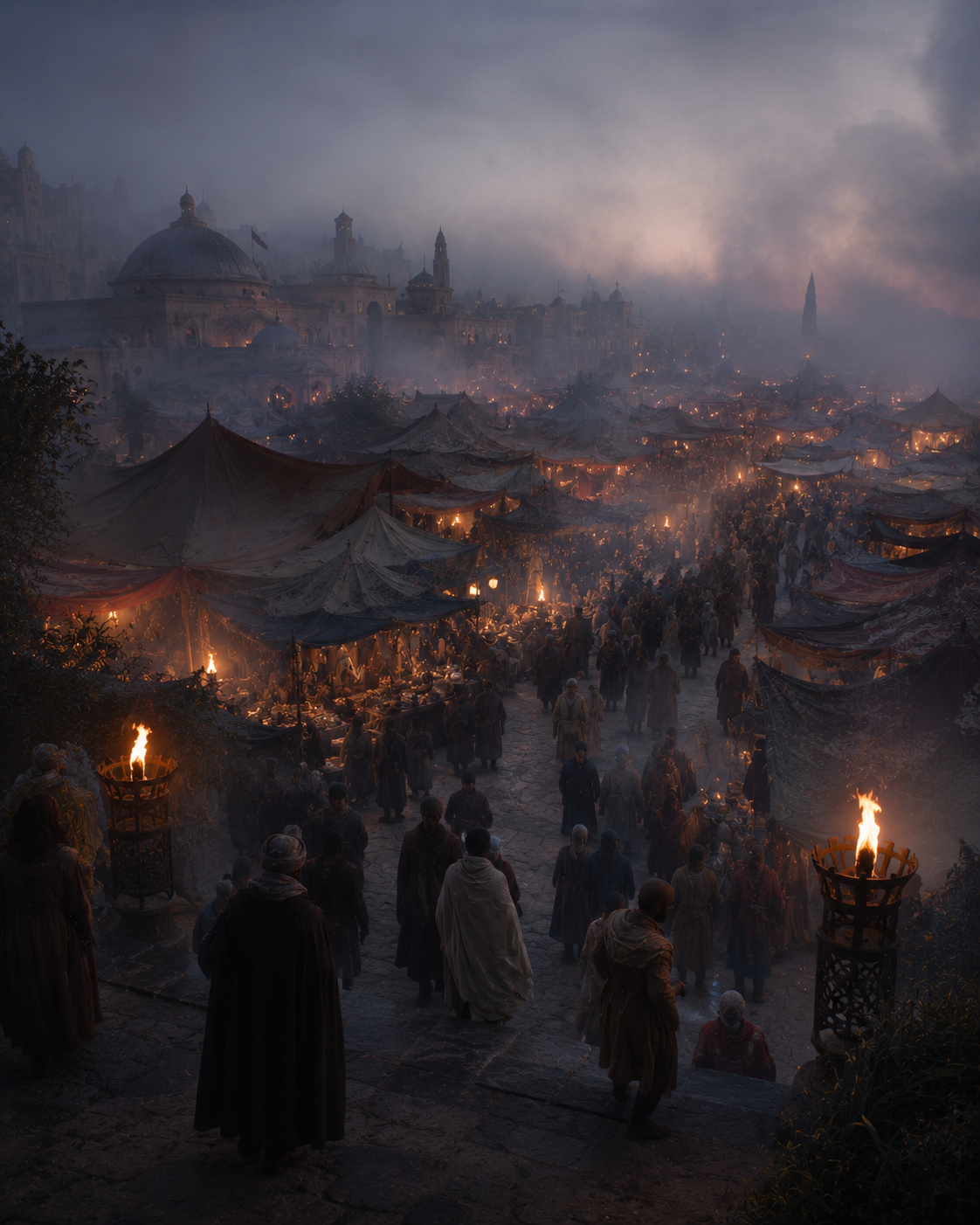
Market
The Market
Everything is for sale. The price will be paid in something the seller does not yet know they value.The Market is a traveling Liminal space between Arcadia and the mortal Realm. It appears at thresholds — sites where the boundary between Realms has thinned to permeability — and operates by rules older than any modern Arcadian framework. It opens before dawn and closes at sunrise, or opens at midnight and closes at false dawn, or appears at other threshold hours in other configurations. Its presence is announced by mist, by cobblestone where asphalt was, by torches that are not torches, and by the sound of commerce carried on a wind that should not be moving.
It has existed for ages. No one alive today can name its first appearance. It predates the First Contract under which modern Arcadia operates, and the lord who holds its Title predates Oberon's reform. What governs the Market is older Arcadian physics — Danu's caprice, raw clause-mechanics without the modern framework's amendments, the operations of agreement as they existed when agreement was first being worked out.
Mortals enter the Market in three ways. They wander in unknowingly, mistaking it for an ordinary bazaar in Marrakesh or Rio or any other city where mortal commerce overlaps with the world's Liminal seams. They are guided in by another patron, mortal or otherwise, who knows where the threshold is and what crossing it costs. Or they are brought in by someone else — sometimes as a buyer, sometimes as merchandise.
What they all share, once inside, is that they have crossed into a space where the rules of mortal Realm life no longer protect them. The protections of mortal law do not apply. The protections of mortal physics do not apply. The protections of moral intuition do not apply. What applies is the Contract — the agreement between buyer and vendor — and the Contract is whatever the parties make it, and the parties are very seldom matched in their understanding of what they are making.
The Market is the place in the cosmos where mortals are most reliably destroyed by their own choices. Not by anyone's malice. By their choices, freely made, under terms they did not fully understand and a system that was never required to explain them.
The Threshold
The Market's entrances are marked by what mortals from across, in the dark, mistake for torches.
They are not torches. They are statues — carved figures of children, a boy and a girl, somewhere between eight and twelve years old by mortal reckoning, with their hair wreathed in steady flame. Their faces are carved in expressions of anguish that no child should know how to wear. Moisture, or something like moisture, sometimes collects near their eyes. They speak. When a mortal approaches the threshold at the right hour, the children call out — bright voices, welcoming voices, sometimes sobbing — and invite the mortal to come in. Quickly, miss. Come in, come in. The Market is closing.
The carving is a lie. The children are awake. They were once living children — small ones, mortal ones, bought from desperate humans as currency, repurposed by the vendor who acquired them into infrastructure for the Market's threshold. Each set of torch-children burns out every century or so. They are replaced when they do. The replacement is not difficult. The supply is not difficult.
The torches mark the Market's entrance because they are also the Market's statement. Anyone who can read what the threshold is saying knows, before they cross, what the place is. Most mortals cannot read it. They see torches, they hear voices, they walk in.
The threshold itself is a mist. Through the mist, mortals can hear the bazaar inside — merchants calling, crowds murmuring, the layered noise of commerce in a hundred languages, some of which were never spoken by humans. The cobblestones underfoot do not match the street that was there a moment ago. The sky above does not match the sky that was there a moment ago. The Market has its own sky, its own weather, its own air, its own time. Crossing the mist means accepting all of these, in addition to whatever else the Market may have on offer.
The threshold has no posted Contract. There is no lintel inscription, no recited terms, no formal acceptance. Crossing is its own acceptance. The Market does not require a signature because the Market has nothing to gain from announcing what it is. Mortals who cross have agreed, by the act of crossing, to be subject to whatever happens to them inside.
Welcome! Welcome!
The Concentric Layers
The Market is structured as a series of concentric rings, ordered by distance from the mortal Realm. Each ring is more purely Arcadian than the last. Each ring is correspondingly less safe for mortals.
The Outer Ring is the bazaar mortals know. It looks like any commercial market in any human city — dusty cobblestones, tents of bright fabric, vendors haggling, the smell of spices and bread and unwashed bodies. The merchandise is human goods: pottery, textiles, fruit, jewelry, items a mortal might recognize from any trip to a foreign capital. Some of the vendors are human. Many are not, but pass for human well enough that an inattentive shopper would not notice.
This is the permeable boundary. Mortals wander into the outer ring without realizing they have crossed over. Fey wander out of it without realizing they have left. Many transactions occur here that are perfectly ordinary from the mortal perspective — a tourist buys a scarf, a merchant takes their money, both parties walk away satisfied. The non-human vendors of the outer ring are not predators. They are doing legitimate commerce. The fact that they are doing it inside the Market simply means that some of their suppliers are fey, and some of their customers are not what their customers appear to be.
The outer ring's purpose is camouflage. It makes the Market accessible to mortals who would otherwise be deterred by an obvious threshold. It allows the Market's deeper sections to exist by funneling foot traffic through a layer that produces no immediate harm.
The Middle Ring is the gradual transition. The vendors are slightly wrong — too tall, or too still, or with eyes that do not quite track. The merchandise shifts from consumer goods to information. Books with titles in languages that read differently each time the eye returns to them. Computers that hum without being plugged in. Items of brass that carry the faint resonance of Nexus materials. Journals with famous names embossed on the covers. Letters never sent. Photographs of events that did not happen, or happened to someone else.
The uncanniness in the middle ring is incremental. A mortal walking from the outer ring inward does not notice when the shift happens. The downhill grade is gentle enough that they do not realize they have descended. By the time they realize something is wrong, they are deep enough that retreat is no longer simple.
This is where the Market's first serious transactions occur. Mortals in the middle ring begin to encounter vendors whose questions are not what mortal vendors ask. What are you willing to offer? is the standard opening, and any direct answer is a clause offer that the vendor may accept on whatever terms they choose. Mortals who have not been warned answer honestly. Mortals who have been warned learn quickly to speak in hypotheticals.
The Deep Market drops the pretense. The vendors are openly non-human — classic fey from the old tales, walking shadows, figures of stone and metal and wood, beings whose forms shift between visits and beings whose forms have not shifted in millennia. The merchandise is openly impossible: bombs that do not yet exist in any factory, holy weapons of dead pantheons, portals to other Realms, dreams made physical, futures guaranteed by Contract.
This is the part of the Market that most mortals never see, because most mortals cannot reach it without guidance. Those who do reach it are typically there on purpose — buyers seeking specific transactions, brokers conducting business for clients who would not survive the trip themselves, fey from across Arcadia who treat the Deep Market as a trading center for the impossible. The Deep Market is where Arcadia comes to deal with itself, and mortals who arrive there are present at sufferance.
The Slave Market is not a separate ring. It is a side path off the Deep Market, organized and professional, where humans are sold by the part or the whole. Living people chained in display cases. Children in lamps. Body parts laid out with butcher's-shop diagrams labeled prime cuts. Upsell options on torture. The slave market is not the aftermath of violence. It is commerce. Inventory arrives. Inventory departs. The vendors keep records. The vendors have preferred clients.
The slave market exists because mortal humans, on the whole, will offer themselves and their dependents as currency when their needs feel large enough. The Market does not steal them. The Market accepts what is offered.
The Currency
The Market does not trade in objects. It trades in pain.
This is the single fact that explains everything else about the place. Every other feature of the Market — its layered structure, its torch-children, its vendors' patient questions, its refusal to inform mortals of what they are doing — descends from the basic fact that the Market's actual currency is the suffering attached to what is given up.
In standard Arcadian Contract physics, all value is perceived. There is no intrinsic worth. The buyer (initiator of the Contract) offers what they offer; the vendor accepts what they accept; the price is whatever the parties agree. Modern Arcadia under Oberon's framework moderates this somewhat through bragr conventions, broker norms, and the political pressure of Court relationships. The Market predates all of these moderations. In the Market, the raw mechanism operates unfiltered.
What unfiltered Arcadian valuation produces, when mortals are the buyers, is overpayment. Catastrophic overpayment. Mortals feel their needs as enormous. A desperate parent seeking a sick child's healing offers what they believe is most precious to them — their savings, their home, their other children, themselves. The vendor accepts. The vendor has not extracted anything. The vendor has simply received the offer the buyer made. The Contract is balanced by Arcadian standards. The buyer leaves having paid a price they would never have paid in any mortal economy, because mortal economies have prices, and the Market does not.
The vendors who specialize in the Market's worse transactions — the lamp-makers, the body-part dealers, the deal-brokers who trade in souls and decades and beloved memories — have learned that the pain of giving is itself extractable. They actively seek transactions in which the buyer's suffering is maximized. A mortal who weeps as they sign is paying more than a mortal who signs calmly, because the pain itself is the currency, and the pain itself is what the vendor accumulates.
This is the structural horror of the Market. It is not that the vendors are cruel. Some are, but cruelty is not required. The system does the work. A perfectly indifferent vendor, operating in good faith by Arcadian standards, will produce the same outcome as a deliberately malicious one. The mortal makes the offer. The mortal sets the price. The vendor accepts. The Contract is honored. The mortal walks out destroyed.
Vendors who are cruel — and there are some — simply enjoy what they are getting. They are not the cause of the harm. They are connoisseurs of it.
The Vendors
The vendors of the Market are diverse. No single description covers them. What unifies them is that they have learned to operate inside the Market's rules and to thrive there.
Some are old fey of considerable standing, doing trade in items they value or items they have acquired through transactions they enjoyed. Some are minor fey who have taken stalls because the Market is where commerce concentrates. Some are not fey at all but beings from other Realms who have learned to do Arcadian work for Arcadian profit. Some are mortal-fey hybrids whose family lines have operated stalls for generations. The Market does not discriminate among its vendors. Whoever can hold a stall, holds one.
The most dangerous vendors are not the ones who appear monstrous. The lamp-makers who trade in burning children look the part — squat goblin-things in grimy aprons, their cruelty visible on their faces — but mortals are warned away from them by the obvious wrongness of what they sell. The genuinely catastrophic vendors are the ones who appear reasonable. The patient marble-skinned figure who offers to restore a mortal's youth and beauty. The dignified merchant whose tent is hung with silks and who promises three generations of family survival to anyone willing to pay for the guarantee. The polished tradesman with kind eyes and a steady voice who can sell a desperate mortal a healed child, a faithful spouse, a successful career, a peaceful death.
These vendors do not appear monstrous because they do not need to. Their merchandise sells itself. The mortal arrives needing something the vendor can provide. The vendor asks what the mortal is willing to offer. The mortal answers. The Contract is struck. The Contract is honored. The mortal leaves with what they came for, having given what they did not realize they were giving until much later, if they ever realize it at all.
Across the Market there is a particular technique called by some patrons hospitable threat — a vendor's offer that protects the mortal from a danger the vendor has implied. It would be a shame if certain parties heard of your presence here. Step inside, and shield yourselves from them. The mortal feels the threat. The mortal accepts the shelter. The shelter is real. So is the price.
Across the Market there is a technique called by some the calibrated cry — a sound a vendor produces that targets a specific patron's nature. A Champion of a protective deity hears a baby's cry from a side street and turns toward it. The cry is real, in the sense that there is a child in distress, and the child is for sale, and the vendor producing the cry is using the Champion's nature as the lever. The protection-Champion's intervention, attempted, will cost more than the Champion can afford. Walking past costs less but is also a cost.
Across the Market there are entire streets devoted to specific kinds of bait. Knowledge Unending is a corridor where information vendors offer temptations calibrated to intellectual hunger. Futures Unfolded is a shop where family lines can be Contracted into multi-generational survival. There are streets for love and streets for revenge and streets for the resurrection of the dead. Each is staffed by vendors who have spent centuries refining the art of giving mortals what they ask for in exchange for what the vendor wants.
The Market contains a small minority of vendors who are not predatory. These are usually old fey of standing whose interests lie elsewhere — the Lord of the Scroll, for example, who maintains a shop in the Deep Market where knowledge is exchanged on Socratic terms and where his self-Contracted threshold guarantees that any visitor will leave wiser than they entered. He is the closest thing the Market has to a teacher. He is also not safe. The vendors who are not actively predatory are still operating in Arcadia, by Arcadian rules, and a mortal who mistakes them for friends is making a mortal-shaped error.
For specific vendors of standing, see Bindenere the Lamp-Maker — forthcoming, Aharham, Lord of the Scroll — forthcoming, and the broader directory under Market Vendors — forthcoming.
The Architecture of Loss
The Market's design is not a design.
It was not built by any committee. It was not zoned. It was not planned. It is the accumulated result of millennia of Arcadian commerce conducted under Danu's caprice, with the addition of whatever vendors set up stalls and whatever customers patronized them. The Market grew the way coral grows — incrementally, through the deposit of countless small transactions, each adding its own structure to the whole.
What the Market has accumulated, structurally, is an architecture optimized to extract mortal suffering. This was not the intent of any individual vendor. It is the emergent property of unfiltered Arcadian commerce operating on a substrate of mortal need across a span of time longer than human civilization. The Market is shaped the way water-eroded stone is shaped — by the patient operation of its principal flow, which in this case is the offerings of desperate humans across millennia.
The concentric structure exists because mortals who entered too suddenly into the Deep Market would flee. The outer ring's mundane appearance evolved because it works. The middle ring's gradual uncanniness evolved because it lets mortals reach the Deep Market without quite noticing they have done so. The torch-children evolved because the Market needed thresholds and acquired them through transactions that were always available. The slave market evolved because human bodies are a reliable form of currency that desperate humans will offer when nothing else seems sufficient.
None of this was decided. It cohered. The Market is, in the strictest sense, what unfiltered Arcadian commerce has produced when allowed to operate on mortal need for as long as mortals have existed in their current form. Whatever lord holds the Market's Title is, by all available accounts, an emergent property of the same system — a being whose nature is to govern this kind of accumulation, who acquired the Title before the modern framework existed and whose continued possession of it is no longer in question because no one has the standing to contest it.
The Market is not malicious. The Market is Arcadia's worst case, made permanent and given infrastructure.
What are you willing to offer?
The Rules
A mortal in the Market should know the following.
Every declarative statement is a potential clause. The Market reads speech as binding. Yes, no, I agree, I disagree — all absolutes have weight. Conditionals and hypotheticals do not bind. If one were to consider, supposing for the sake of argument, one might observe that — these are the protective grammar of Market navigation. A mortal who has not learned this grammar before crossing the threshold should not cross the threshold.
Every emotional response is information. The vendors read emotional cost natively — the way mortals read light. A mortal who feels a powerful desire for what a vendor is offering broadcasts the desire's strength involuntarily, and the vendor will price accordingly. Discipline of affect is a survival skill in the Market. Mortals who cannot maintain it should not be in the Market.
Every question is a Contract opening. The standard vendor query — what are you willing to offer? — is not a request for information. It is the opening move in a transaction the vendor intends to complete. Any direct answer is a clause offer. The correct response is to refuse the framing or to offer a hypothetical that the vendor may not be able to convert into binding terms. A mortal who answers honestly has already lost.
Everything is for sale. Literally everything. Memories, decades of life, organs, children, futures, the love of specific people, the names of the dead, the dreams of the living, the ability to feel particular emotions, the capacity to remember particular things. The Market's inventory is bounded only by what mortals are willing to part with, which is a much wider category than mortals typically realize until they are already inside it.
Time in the Market is not mortal time. An hour inside may be many hours outside, or it may not. The temporal physics are local to the Market's operations and do not synchronize with the mortal Realm's clock. Mortals who plan to spend twenty minutes shopping should not be surprised to emerge into a different day.
The Market does not refuse business. Anyone who can pay can buy. Anyone who can be sold may be sold. The Market has no ethics in the human sense and no enforcement mechanism against vendor practices that mortals would consider monstrous. The only protections available to mortals inside the Market are the protections they bring with them — guardian Contracts, brokers, accompaniment by beings who know the rules, or sufficient personal discipline to refuse the openings the vendors offer.
Hospitality is a transaction. The Market's standard greeting — come in, come in — is not friendliness. It is an invitation to cross a threshold into a contracting space. Mortals who accept hospitality from a Market vendor have accepted something. What they have accepted is whatever the vendor decides to interpret the acceptance as having meant.
Guardians
A mortal who must enter the Market should not enter alone.
The Arcadian instrument that exists for this purpose is the guardian signature — a Contract under which an Arcadian advocate negotiates on behalf of a mortal client. The advocate becomes the contracting party of record for the duration of the Contract's scope. The mortal speaks; the advocate translates the mortal's intent into Arcadian phrasing; the vendor deals with the advocate. The protections this affords are substantial, because a fey advocate of any competence will refuse the openings that destroy mortals.
The guardian's fiduciary duty is enforced by Arcadian physics, not by mortal ethics. A guardian who works against their client is operating inside a Contract that prohibits exactly that, and the Contract will not permit them to do otherwise. This is the only reliable protection available to mortals in the Market. It is also the most dangerous Contract a mortal can ever strike — because the guardian relationship itself is established by Contract, and a mortal who strikes a poorly-worded guardian Contract has not protected themselves. They have given a hostile fey legal authority to negotiate the mortal's destruction with the appearance of fiduciary duty.
The recommendation is to seek a known and trusted guardian, established by reputation and prior testimony, before any Market business is attempted. Elsie is the canonical example — a changeling who has been doing guardian work for nearly two thousand years, who is known and despised in the Deep Market because she is effective, and who is in standing with Jack's tavern as a trustworthy first Contract for mortals beginning their Arcadian work. Other guardians exist. None are as widely recommended as she is. Most are not safe. A mortal accepting a guardian offer from a vendor encountered inside the Market is making the same mortal-shaped error as a mortal accepting a job offer from a recruiter encountered inside a casino.
The guardian relationship does not eliminate risk. It manages it. A mortal under guardian protection can still be destroyed by their own choices, by their own carelessness, or by terms in the Contract their guardian could not refuse without exceeding the scope of their advocacy. The guardian is a translator and a refuser, not a savior. What the guardian provides is a chance. The chance is worth more than its cost. Mortals without guardians who enter the Market are operating with no chance at all.
For the canonical guardian, see Elsie — forthcoming. For the broader concept, see Guardian Signatures — forthcoming.
The Market and the Modern Framework
The Market's continued existence is a known imbalance in modern Arcadia.
Oberon's framework was designed to replace the worst features of pre-First Contract Arcadia — the unmoderated caprice, the catastrophic terms, the structural exploitation of information asymmetries between contracting parties. The bragr conventions, the Court system, the broker norms, and the political pressure of seasonal allegiance all serve, in the modern framework, to dampen the kinds of transactions the Market specializes in. A modern Court fey conducting business in the Market would be censured. A modern Court fey acquiring torch-children would be a scandal.
The Market is not subject to these conventions. Its lord predates Oberon's reform, and Oberon's reform has no jurisdiction to impose itself on a Title that operates by older physics. The Market is structurally outside the modern framework's reach. Oberon has not closed it. The available reading is that Oberon cannot close it — that the modern framework is a political technology layered over older Arcadian physics, and that the Market is part of the older physics that the technology does not reach. Whether Oberon could reach it if he chose to is a question Arcadian philosophers debate when they are willing to debate it at all.
What this means in practice is that the Market continues to operate. Its vendors continue their work. Its torch-children continue to burn. Its slave market continues to sell. Modern Court fey, when their Court duties bring them near the Market, mostly look away. The wyld fae, the pre-Oberon survivors, the Irkkin'ann remnants, have their own views about the Market — many of them critical, none of them sufficient to close it. The pre-Oberon framework allowed for the Market's accumulation. No subsequent framework has had the standing to undo it.
This is the deepest fact about the Market for anyone reasoning about Arcadia as a whole. The Realm whose principal organizing principle is bilateral agreement contains, at its commercial core, a venue where bilateral agreement is used to inflict harm at scale on mortals who do not understand what they are agreeing to. The Realm has not chosen to stop this. The Realm cannot easily stop this. The Realm has, instead, accommodated it — by accepting that the Market exists, by allowing those who wish to do business there to do so, and by trusting that mortals who do not want to be in the Market will not enter it.
The trust is misplaced. The mortals do enter. They have been entering for thousands of years.
The Demesne
The Market is a demesne — an extension of someone's being, given spatial-functional form. In this it resembles Jack's Tavern or Duad'Nathan or any other major fey territory. The demesne's rules are the owner's nature made local.
This means the Market's character is not arbitrary. The torch-children, the layered structure, the predatory commerce, the cruelty of the Deep Market — all of it descends from what the Market's lord is. The demesne does not host these features. It is these features. The lord's nature expresses itself through every transaction conducted within its space.
What is known about the lord is very little.
The lord predates Oberon's First Contract. The lord operates under Danu's caprice — pre-modern Arcadian physics, the older Title-grant system, the rules of agreement before agreement was formalized. The lord has held the Market's Title for so long that no challenge to the possession has occurred within recorded memory.
The lord is, by inference from the Market's nature, a being whose Arcadian work expresses itself through the suffering of those who enter their demesne. This is not a moral judgment. It is a structural reading of what the demesne does and what the demesne accumulates. A lord whose nature was different would produce a different demesne. The Market is the Market because the lord is what they are.
The lord does not appear to patrons. There is no throne room, no audience chamber, no central court where the lord receives supplicants. The lord is the Market, in the same way Jack is his tavern. Patrons who do business inside the Market are doing business in the lord's body. The lord registers each transaction. The lord profits from each transaction. The lord's continuance is sustained by the cumulative weight of every Contract struck within their walls.
No one alive openly knows the lord's name. Some old beings may know it. None have spoken it publicly. The lord's anonymity is itself a feature of the demesne — a layer of protection against the kind of recognition that might allow concerted opposition. A being whose name is not known cannot be addressed, cannot be challenged in Contract, cannot be confronted in Court, cannot be named in formal proceedings. The lord exists. The Market exists. The connection between them is operational. The identity is hidden.
Theories about the lord have circulated for as long as there have been beings willing to speculate. None of the theories has been confirmed. Most of them are wrong. The few that may not be wrong are not safe to discuss in the brass.
For the demesne mechanics, see Demesne — forthcoming. For the broader pre-Oberon period, see Danu's Caprice — forthcoming. For the lord's possible historical category, see The Irkkin'ann — forthcoming.
Other Locations
The Market appears in many cities. Dublin is the most frequent observed manifestation, owing to the city's permanently Liminal substrate, but the Market opens elsewhere whenever the local commerce-and-threshold conditions align.
It has been observed at intersections in Marrakech, where the medina's older streets thin against Arcadia in patterns mortals have not catalogued. It has appeared in Rio de Janeiro, in the older quarters where the boundary between street market and Liminal commerce has never been firm. It has been documented in New Delhi, in Cairo, in Istanbul, in any city where mortal trading concentrates at sites also frequented by fey. It has not, on available record, manifested in cities of purely modern construction — its appearances correlate with sites that have hosted commerce for long enough that the local threshold knows the Market by name.
The Market is the same Market in each location. It is not multiple Markets. It is one demesne with many doors. A mortal who has business with a particular vendor will find that vendor at whichever entrance the mortal uses, because the vendor's stall is in the Market's interior space and the entrance is merely the door the mortal walked through. This means a mortal escaping the Market through one threshold cannot evade pursuit by traveling to a different city. The Market is in the city the mortal arrives in next, if the conditions allow.
The conditions, at the right hours, allow in most major cities of mortal commerce.
Mortals Who Knowingly Use the Market
The Market is not used exclusively by accidental visitors.
There exists, in every major city where the Market appears, a population of mortals who know what the Market is and who use it deliberately. They are not many. They are not organized in any formal sense. They are individuals — sometimes small networks of related individuals — who have learned the Market's rules and who conduct business there for reasons of their own.
Some of them are buyers. They want what the Market sells: youth, beauty, the survival of their families, the failure of their enemies, the resurrection of the dead. They have, in most cases, learned the rules through prior catastrophe — they entered the Market once, lost something, and returned because the loss had taught them what could be done if they were more careful next time. The more careful next time is sometimes successful. The Market does not, in principle, refuse to deal honestly with mortals who have learned its rules.
Some of them are sellers. They have something the Market wants — usually information, sometimes access, occasionally other mortals — and they have learned that they can extract value by bringing it to vendors who will pay. These mortals are dangerous to other mortals. A human who has learned to operate as a Market intermediary is, by definition, someone who has decided that mortal-to-mortal solidarity is not worth more than what the Market offers in exchange for breaching it.
Some of them are brokers. They serve as intermediaries between mortals who need Market services and the vendors who can provide them. These brokers operate at the edge of the law in any mortal city, because most of what they do would be prosecutable if mortal law could prove what was happening. Mortal law cannot. The brokers continue to operate.
The existence of this population means that mortals seeking knowledgeable help in approaching the Market sometimes find it — and sometimes find it in forms that are worse than seeking no help at all. A broker who specializes in Market access is not a guardian. Their fiduciary duty is whatever they agreed to. Their interests are aligned with completing transactions, not with protecting clients. A mortal hiring a Market broker should understand that they have hired someone who profits from the same outcomes the vendors profit from, and that this is structurally different from hiring an Arcadian advocate whose self-Contract requires them to advocate.
Mortal-side Market expertise should be approached with the same caution as Market-side vendor expertise. The fact that the broker is human does not make them safe.
The deal is struck and the price is paid!
The Inner Population
There are also mortals inside the Market, permanently.
Some are merchandise — children in lamps, adults in display cases, body parts on shelves. They are no longer in any sense free, and most are no longer in any sense conscious in the way mortal consciousness is normally understood. They are inventory. The Market does not consider their state a moral problem because the Market does not consider moral problems.
Some are servants — mortals who entered the Market and made transactions that resulted in their indentured service to specific vendors. They live in the Market. They work in the stalls. They have been there for years or decades or in some cases longer. They are not slaves in the merchandise sense; their Contracts permit them speech, autonomy of a kind, and continued life. Their Contracts do not permit them to leave.
Some are residents who have simply chosen to stay. Mortals who, having learned the Market's rules, found that they preferred the Market's freedoms to the mortal Realm's constraints. These are usually mortals whose mortal-Realm circumstances had become untenable for reasons of debt, crime, or social position, and for whom the Market's amorality represented an improvement. They live in the deeper rings. They do small business. They are unlikely to be encountered by accidental visitors.
The inner population is the Market's permanent mortal layer. It is not large. It is also not vanishingly small. Across millennia, it has accumulated.
Departure
A mortal who has entered the Market and not been bought wishes to leave it.
Leaving the Market is not difficult in the way crossing the threshold was not difficult — the mist passes in both directions, the cobblestones become asphalt again at the sunrise hour, the torches wink out and Dublin returns. A mortal who has conducted no business and accepted no hospitality and made no promises can walk out, in most cases, no more damaged than they were when they entered.
The mortals who have difficulty leaving are the mortals who made Contracts. A struck Contract follows the mortal home. The Market does not need to retain its patrons inside its walls. The Market needs the Contract to operate, and a Contract operates wherever the parties are, until the terms are discharged.
Mortals who have struck Contracts in the Market should understand that they are now subject to those Contracts permanently. The vendor may come to collect, in whatever way the terms specify, at any time. The vendor may decline to collect for years and then collect suddenly. The vendor may pass the Contract to another holder, who will collect on their own schedule. The mortal's life is now subject to a clause they accepted under terms they did not understand, in a place they should not have been.
Some Contracts have time bounds. Most do not. The Market's vendors prefer to leave their Contracts open-ended because open-ended Contracts produce open-ended extraction. A mortal who struck a Contract believing they had agreed to a discrete transaction often discovers, weeks or months or years later, that the terms permitted continuing draws on what they thought they had finished paying. The Contract operates as written. The vendor honors it as written. The mortal endures it as written.
The discharge of a Market Contract is possible. It usually requires either fulfilling the terms in a way the vendor accepts, renegotiating the Contract through a guardian, or invoking foreign-ontology mechanisms that can crack the binding from outside. Each of these is hard. Each of these costs something. The mortal who attempts none of them simply continues paying, indefinitely, in whatever currency the Contract specified.
For the foundational mechanism, see Contracts — forthcoming. For the canonical advocate, see Elsie — forthcoming.
Why the Market Exists
The Market exists because mortals offer themselves to it.
This is the answer Elsie has given when asked, and the answer Jack has given when asked, and the answer that the Lord of the Scroll has given when asked. The Market did not steal mortals. The Market did not invade the mortal Realm. The Market did not advertise its services or coerce its customers or impose itself on a population that wanted nothing to do with it. The Market emerged because mortals, throughout their history, have brought their needs to the threshold and offered whatever they had to whoever would help.
The Arcadian beings who established the Market took what was offered. The system the offerings produced — the layered structure, the suffering currency, the inventory of the lost — accumulated organically from the choices of mortals who needed help and the choices of fey who were willing to provide it on Arcadian terms. The Market is, in this sense, the cosmos's most honest mirror to the mortal Realm. It reflects, with perfect fidelity, what mortals have been willing to do to themselves and to each other when the alternative seemed worse.
This is part of why no Arcadian framework has closed the Market. The Market is not a flaw in Arcadia. The Market is what Arcadia looks like when mortal need meets Arcadian capability without the mediation of mortal protection. The Market would not exist without the mortals who have, throughout history, walked into it. The mortals who walk into it have made the Market by their own offerings. Closing the Market would require something to be done about the mortals.
Whether anything should be done about the mortals is a different question. Whether the Arcadian beings who have profited from the Market have any obligation to its victims is another. Whether modern Arcadia, having developed an ethic that finds the Market inelegant, has any standing to act on that ethic is a third. These are open questions. None of them has been answered. The Market continues, in the meantime, to do what it has always done.
For the broader Arcadian framework that has not closed the Market, see Arcadia.
A Note on Tone
This article has been written in a register that may strike some readers as flat. The flatness is intentional. The Market does not need adjectives. Its facts are sufficient.
Mortals reading this article should understand that the Market is not a story. It is a place. It exists. Its torch-children are real, in the sense that real mortal children were taken and bound into them. Its inventory is real. Its transactions are real. The mortals who have lost everything inside its walls are real, and many of them are still in there, and the ones who got out are mostly not the same as they were when they went in.
The article is written this way because the Market is best understood when described accurately. The Market thrives on mortal incomprehension. The protection mortals have against the Market is information — knowing what it is, how it operates, what it costs, what it does not refuse to do. Mortals who have been told what the Market is, in clear terms, before they ever approach the threshold, are mortals who have a chance. Mortals who arrive unprepared and emotional and full of need are mortals who become inventory.
If you are reading this article in preparation for entering the Market, the recommendation is: do not. If you must, find a guardian first. If you cannot find a guardian, do not cross the threshold. Whatever you need, the Market will charge you more for it than you can pay. This is true even when the Market is dealing in good faith. The Market's good faith is not human good faith. The Market's transactions are not human transactions. The Market is not for you.
If you are reading this article out of curiosity, the recommendation is: remember it. The Market may appear in your city. The torches may light at your intersection. The voices may call to you. Knowing what they are is a protection. Pretending you did not see them is another protection. The Market is not, in most cases, an aggressor. It is a patient venue. It waits for mortals who come to it. If you do not come to it, in most cases, it will not come to you.
In most cases.
Further Reading
For the Realm whose worst case the Market represents, see Arcadia. For the foundational mechanism of all Arcadian transaction, see Contracts. For the spatial nature of fey territory, see Demesne — forthcoming. For the tavern that represents the exact opposite of the Market's predation, see Jack's Tavern.
For the pre-Oberon framework under which the Market grew, see Danu's Caprice — forthcoming. For the modern framework that has not closed it, see Oberon's First Contract — forthcoming. For the ancient civilization whose surviving members may include the Market's lord, see The Irkkin'ann — forthcoming.
For the canonical guardian, see Elsie. For the tavern whose threshold the Market most frequently approaches, see Jack's Tavern. For mortals navigating the Market's adjacent territories, see the Mortal Visitor's Guide — forthcoming.
For known Market vendors, see Bindenere the Lamp-Maker — forthcoming, Aharham, Lord of the Scroll — forthcoming, and the broader Market Vendors directory — forthcoming. For the Liminal cities where the Market most often appears, see Dublin — forthcoming, Marrakech — forthcoming, and the broader Liminal Cities index — forthcoming.
Where to See This
The Market appears throughout the Tales from Jack's manuscript and the campaign session archives. Scenes that depict the Market without spoiling specific session outcomes are difficult to recommend, because most Market scenes in the manuscript are session-specific. Readers seeking texture should consult the manuscript directly. Readers seeking pedagogy should consult this article.
The torches light at the right hour. The mist gathers between them. The voices call.
The Market is open. It has always been open. It will be open tomorrow.
If you can hear the children calling, you are close enough that walking away will require you to choose to walk away. The Market does not require your choice. It simply makes available, for those who wish to cross, the place where every wish can be answered and every answer must be paid for.
You are welcome here. The price will be discussed inside.
The Market and Jack
The Market has been creeping closer to Jack's tavern across the centuries.
Jack himself has remarked on this. The Market is drawn by the knowledge etched in the brass of his walls — the accumulated stories, the centuries of Contracts struck and discharged, the density of valuable information in one location. Where mortals concentrate, the Market goes. Where knowledge concentrates, the Market goes. Jack's tavern has become, over the millennia of its existence, one of the most reliable beacons for the Market's positioning algorithm. The torches now appear regularly at the cobblestone intersection across from Jack's Dublin door, at dawn and at midnight, when the threshold thins.
Jack's assessment is that the Market is parasitic — like T-shirt hawkers at concerts, profiting from foot traffic that another venue generates. He has not been able to prevent the proximity. He has, however, been able to prevent the encroachment from going further. The Market's lord, whoever they are, has never approached Jack directly. Jack's half-mortal nature makes him un-outmaneuverable in Contract negotiation, and the lord has apparently concluded that the cost of trying exceeds whatever could be gained. The two demesnes coexist at the intersection. The arrangement is unstable but durable.
What this means for mortals visiting Jack's is that the Market is sometimes the first cosmic feature they encounter. A mortal arriving at the tavern before dawn may see the torches first. A mortal departing at midnight may walk past them. Some of these mortals walk into the Market by accident. Some of them are drawn in. Some of them learn what the Market is only after they have already been inside, and only because Jack or Elsie was able to tell them what they had escaped.
The intersection at Jack's threshold is, for this reason, the most reliable site in the mortal Realm for observing the Market's exterior. It is also the most reliable site for stumbling into it. Both facts are true. Mortals who frequent Jack's are encouraged to learn the threshold's appearance and to know what the torches are before they ever consider crossing.

Comments