Duad'Nathan
Duad'Nathan
The dragon's demesne. The hill in Arcadia where a fallen Hittite storm god has, across twenty-five centuries, built one of the cosmos's most singular places.Duad'Nathan is the demesne of Ilyanka — the dragon of the Right Ring, formerly the Hittite storm-serpent Iluyanka, now fully transformed into a fey lord of Oberon's framework while retaining his original Celestial capacity for Faith-accumulation. The demesne is, in the strict Arcadian sense, an extension of his being. It is also a place: a hill in Arcadia presenting outwardly as overgrown with vines, opening through an iron gate into halls scaled for both dragon and human comfort, inhabited continuously since approximately five hundred years before the common era by a human community whose ancestors sheltered Ilyanka after his fall from Celestia.
The demesne is one of the most distinctive private holdings in modern Arcadia. Its inhabitants live in conditions that no other mortal community in the cosmos sustains. Its architecture combines two Realms' ontologies in stable working relation. Its dead persist in an afterlife its proprietor built and continues to maintain at substantial cost. Its political position within Oberon's framework — the demesne of the Right Ring, formally recognized, institutionally protected — gives it standing that few other private demesnes match.
This article describes Duad'Nathan as a place, its construction, its inhabitants, and its operation. The figure who is the demesne is treated in his own article. The two should be read together. Neither is fully comprehensible without the other.
The Approach
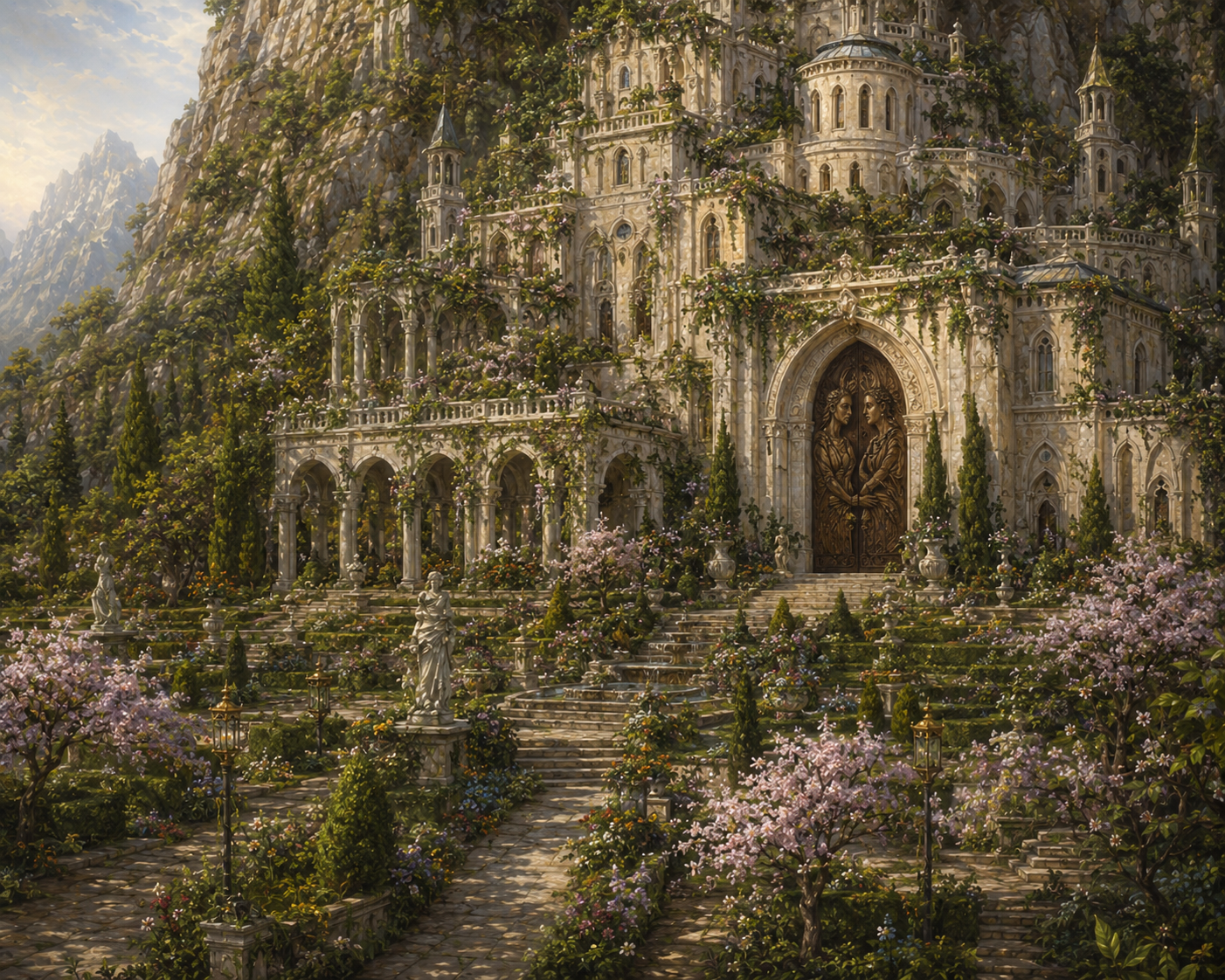
Duad'Nathan presents, to a visitor approaching from the Arcadian countryside, as a hill overgrown with vines.
The presentation is deliberate. Many fey lords of comparable standing maintain demesnes whose exteriors broadcast their proprietor's power — towers, fortresses, gardens of conspicuous craft. The Right Ring of Oberon could plausibly maintain something equivalent. He has chosen instead to hide his power beneath the most modest exterior available — a green hill, vine-covered, indistinguishable from natural Arcadian terrain at casual observation. Visitors who do not know where to look for the gate may pass within meters of it and not notice.
This choice of camouflage tells the careful observer something specific about Ilyanka's nature. A being who chose to display his standing would have built differently. A being who chose to hide his standing built this. The hill is the first piece of evidence that Ilyanka is operating in a register most of his Court peers do not.
The vines themselves are not ordinary Arcadian growth. They are sustained by the demesne's own substrate and respond, at some level beneath observation, to Ilyanka's continued attention. Visitors who attempt to push through them without proper invitation find that the vines do not yield. Visitors who approach with appropriate ceremony find that the vines part naturally as they near the gate.
The Gate
The gate of Duad'Nathan is iron — wrought-iron, ancient, predating the gods, the fey, and any current civilization in any active Realm.
The iron is identified by scholars who have studied it as Irkkin'ann work, originating from the period when the Irkkin'ann tradition was producing its deepest craft. How Ilyanka acquired Irkkin'ann iron is not publicly known. The acquisition would have required either direct exchange with a surviving Irkkin'ann lineage-holder or recovery of pre-existing Irkkin'ann work from some other source. Either path implies that Ilyanka had access to networks most modern figures do not, at some point in the demesne's construction.
The iron gate's presence at the threshold of a fey lord's demesne is, by itself, ontologically declarative. Iron is anathema to fey by virtue of the deliberate Final Truth strike the Irkkin'ann conducted forty thousand years ago to give humanity a weapon against the dragon Nidhoggr. Native Arcadians cannot tolerate sustained contact with iron, much less use it as construction material. A fey lord whose demesne uses iron at its threshold is announcing, with the most visible material possible, that he is not native Arcadian.
Iron does not affect gods. Ilyanka's gate is, in this sense, the first signal that the being inside is something other than what the modern framework's surface categories would suggest. Court fey of perception understand this immediately. Other visitors may not. The gate, like the hill, is calibrated to reveal Ilyanka's nature only to those equipped to read what they are seeing.
The gate's mechanism opens on recognition rather than on key or command. Visitors known to the demesne pass through. Visitors unknown do not. The recognition is conducted by the gate itself, as an autonomous agent in the Arcadian sense — the demesne's threshold has been delegated to recognize and admit, in the same operational pattern as Jack's door at the tavern.
The Threshold Contract
The threshold of Duad'Nathan operates a Contract of unusual structure: dual ontological principles working in concert.
The surface Contract, visible to ordinary Arcadian perception, is straightforward. Visitors who cross with the demesne's recognition are welcomed; the demesne offers them its hospitality, including shelter, sustenance, and the freedom to traverse its halls and grounds. The standard formula by which the demesne articulates this is regard me and earn my regard — a reciprocal arrangement under which the visitor's attention is part of what they offer in exchange for the demesne's accommodations.
Beneath the surface Contract, in a register only Champion sight or comparable perception registers, the threshold operates a Celestial decree-component. The decree-component does not negotiate; it asserts. Specifically, it asserts that visitors who have crossed the threshold are within the demesne's protective scope and are subject to the demesne's standing rules. The decree is enforced by Ilyanka's own Faith reserves and operates as Celestial command would operate — directly, without further Contract terms, in registers Arcadian Contract-physics cannot natively resist.
The combination is unusually robust. Visitors are bound by Arcadian reciprocity (which they understand and can negotiate) and by Celestial decree (which they may not perceive and cannot easily contest). The protective effect is real; visitors within Duad'Nathan are genuinely safe from external interference, including divine perception from outside the demesne, which Ilyanka's domain blocks bidirectionally. But the protective effect comes packaged with the standing rules the decree-component enforces, which most visitors do not even know they are subject to until the rules become relevant.
This is, in clausal terms, an exemplary piece of hybrid craft. The threshold Contract uses Arcadian conventions to handle interactions the Realm's mechanisms can address and Celestial conventions to handle interactions Arcadian mechanisms cannot. The two systems coordinate without conflicting. Court fey who have studied the threshold consider it one of the most accomplished pieces of cross-ontological architecture in the modern cosmos.
The Doors
The principal doors of the inner halls are carved from wood, massive and intricate.
The carvings depict a man and a woman in warm embrace. The figures, when the doors are closed, hold each other across the seam. When the doors open, the embrace separates. When they close again, the figures return to their position. The reunion and separation occur with each opening and closing of the doors, across all the centuries of the demesne's operation.
The figures are Arinniti, the Hittite sun goddess, and Tarhunna, the storm god. They are Ilyanka's parents. Tarhunna, by the Hittite mythological tradition that has survived in fragments, is the figure who struck Ilyanka down — the proximate cause of Ilyanka's near-destruction and subsequent transformation. Arinniti, the mother, is preserved beside the father in continuous embrace.
The doors speak. They recognize visitors who have known the figures in their original Celestial existences. They welcome such visitors with affection. You remember us, Traveler. Welcome, they have been observed to say, to Elias the Traveler during his documented visits across the centuries. The voice is recognizably that of beings who were once gods, preserved with sufficient identity intact that genuine recognition occurs. Whether the doors are the gods themselves, made into doors by Ilyanka's craft, or some preserved echo, or some intermediate state for which the cosmos lacks adequate vocabulary, is not publicly clarified.
What can be said is that Ilyanka has preserved his parents at his threshold rather than allowing them to dissolve when the Hittite pantheon's Faith source ended. The other major Hittite gods are gone. These two remain, in the form of doors at the entrance of their son's demesne, embracing each other across the centuries since their civilization fell.
Whether this is salvation or sentence is genuinely ambiguous.
The Interior
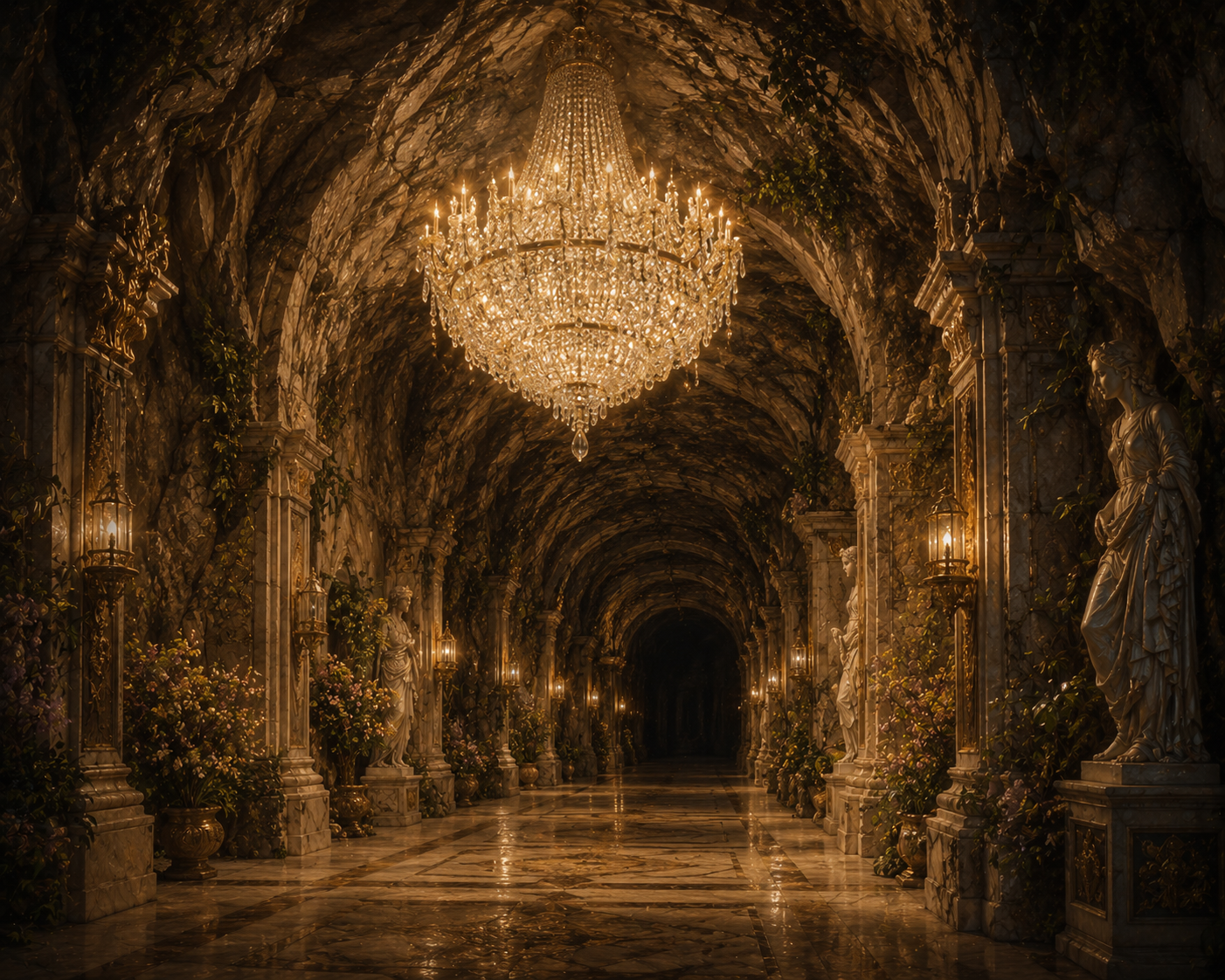
The interior of Duad'Nathan, beyond the doors, opens into halls scaled for both dragon and human comfort.
The architecture is deliberately ambiguous in scale. Ceilings are high enough that Ilyanka in his dragon form could pass through, but the proportions are not vast in the way one might expect from a god's residence — the halls feel large but not overwhelming. Mortal visitors find themselves accommodated without effort. The dragon, when he chooses to traverse his own demesne in his original form, does so without crowding. The proportions resolve the apparent contradiction of two scales by sustaining both simultaneously, in the same register the rest of the demesne sustains its other apparent contradictions.
The stone of the interior is sandy-colored, humble, not the marble or precious-metal construction one might expect of a being of Ilyanka's standing. The choice of material is, like the hill exterior, calibrated to put visitors at ease. The demesne does not seek to impress through grandeur.
The principal feature of the entrance hall is a chandelier of considerable beauty hanging from the ceiling — thousands of crystals catching light from no visible source, casting prismatic patterns across every surface. The chandelier is one of the demesne's most distinctive artifacts and the clearest single visible indicator of what Duad'Nathan actually is. Beings with Champion sight or comparable Faith-perception note immediately that the chandelier radiates Faith outward rather than collecting it inward. It is not a Faith-accumulation device. It is a Faith-distribution device. The Faith sustaining the demesne's architecture, its gardens, its dead, and its general operations passes through the chandelier on its way to where it is needed.
The Gardens and the River
Beyond the entrance hall, the demesne opens onto gardens, fountains, and a small river that catches the chandelier-light through windows that should not exist in a structure inside a hill.
The gardens are tended by traditional fairies — small, bright, busy beings of the kind mortal children draw in picture books. The fairies are not native to Duad'Nathan; they appear to be Arcadian beings who have chosen to serve here, or whose service Ilyanka has retained through arrangements not publicly documented. They tend the gardens with evident pride. They speak to visitors who address them politely. They are uniformly cheerful, in the way fey of their kind characteristically are, and their cheerfulness contributes to the demesne's atmosphere of welcome.
The fountains throughout the gardens are similarly miraculous. They flow continuously. They do not require maintenance. Their water is cold and clean. The demesne's overall hydrological apparatus is, by any honest analysis, an enormous piece of sustained craft — many small operations of decree, each maintained by Faith expenditure, providing the comforts mortal visitors expect a residence to have without those visitors realizing what is being expended on their behalf.
The Community
Duad'Nathan houses a continuously inhabited human community.
The community traces its origin to the family that sheltered Ilyanka after Tarhunna's strike. That family — Hittite mortals of the late second millennium before the common era — pulled the wounded storm-serpent from wherever he fell and dragged him to safety in Arcadia. Their descendants have remained in Ilyanka's service ever since. The lineage is known within the demesne as the blessed line of the dragon. Its members consider their service the natural continuation of what their ancestors began.
The community has lived in Duad'Nathan continuously for approximately twenty-five hundred mortal years. It has grown and contracted across the centuries through ordinary mortal demographic processes — births within the community, marriages within the community, occasional new arrivals from outside, deaths and departures. The population at any given time has varied. It has never, on available record, been small enough that the community failed to sustain itself, nor large enough to strain the demesne's capacity to provide for it.
The community's daily life is, by all available description, recognizably human. There are houses, workshops, kitchens, gardens cultivated by community members in addition to those tended by the fairies, schools for the children, places of gathering and conversation. Members of the community have occupations — those that the demesne requires for its operation, those that the community values for its own sake, those that interest the individual member personally. Some serve Ilyanka directly as priests, scholars, or attendants. Others work as artisans, builders, teachers, healers. The community has its own internal life that is not reducible to its relationship with its dragon.
What unifies the community is the shared commitment to Ilyanka's service. The commitment is not Contracted — community members are not bound in Arcadian Contract to remain in the demesne, and members have, on rare occasions across the centuries, left to live in the wider mortal Realm. The commitment is held voluntarily, transmitted through the generations of the blessed line as a matter of inherited devotion rather than imposed obligation. The community regards Ilyanka with the kind of informed reverence that produces voluntary Faith as a natural byproduct — they know what he is, they know what their relationship to him provides, and they choose, generation after generation, to continue serving.
For the current Champion who represents the community externally, see Amminaya — forthcoming. For the lineage's broader history, see The Blessed Line — forthcoming.
The Afterlife
Duad'Nathan also houses a population of dead, sustained in a private afterlife Ilyanka has built within the demesne.
The afterlife operates as a sustained miracle, drawing on Ilyanka's accumulated Faith reserves. Community members who die within the demesne are not, by Ilyanka's choice, allowed to pass to whatever afterlife their pantheon of origin might claim. They are caught within Duad'Nathan's substrate and preserved there as conscious spirits — translucent, glowing, capable of speech and continued interaction with the living community, persisting in a form that retains their identity but operates at reduced material substance.
The afterlife was built, by Ilyanka's own preserved account, when the Olympian pantheon rose to prominence in the Mediterranean basin. The rising Greek gods' claim to dominion over death threatened to draw the dying members of Ilyanka's small community into Hades, a fate Ilyanka considered unacceptable. He built the demesne's afterlife in response, providing his people with a post-mortem habitation under his own protection rather than letting them pass to a rival pantheon's afterlife system.
The afterlife runs at substantial Faith deficit. The dead generate considerably less Faith than the living do — they exist at reduced material substance, and the regard they produce is correspondingly reduced. Sustaining their continued existence costs Ilyanka more Faith than they contribute to his reserves. He has continued the sustenance for centuries despite the cost. The afterlife now houses an undocumented but substantial number of community members who have died across the demesne's twenty-five-hundred-year history — servants, friends, family members, and by available report some former enemies whose preservation Ilyanka has continued despite or because of their former opposition.
The afterlife's residents are not silent inhabitants. They participate in the community's ongoing life. They advise. They remember things the living do not. They keep the community's history with a depth that no living archive could match. Younger community members consult their deceased ancestors as matters of routine. The dead, by available report, find purpose in their continued participation. They are not, on the testimony of those who have spoken with them, eager to dissolve.
For the broader cosmic concept, see Afterlives — forthcoming. For the rival pantheonic system that prompted its construction, see Hades — forthcoming.
The Dragon's Hall
The deepest part of the demesne, accessible through halls that may or may not exist at any given time, is the dragon's hall — the chamber in which Ilyanka receives visitors when his full nature must be displayed.
The chamber is, when it manifests, a great cave piled with golden coins and gems catching firelight from no visible source. The presentation is, by Ilyanka's apparent intent, the iconic dragon's hoard of mortal myth — the cave full of treasure, the dragon coiled upon it, the visitor approaching across the heaped gold. The presentation is largely theatrical. The coins and gems exist, are real treasure by any mortal standard, but their function is staging rather than wealth. Ilyanka does not particularly value material wealth. The hoard is what the visitors expect, and Ilyanka provides what visitors expect when providing it serves his purposes.
The chamber manifests at Ilyanka's discretion. It is not always accessible. Visitors who have not been invited do not find it. Ilyanka receives visitors in this chamber when the situation warrants his full presentation. Most visitors do not encounter the chamber. Most who do encounter it do so under circumstances they have already committed to and cannot easily retreat from. The chamber is, in this sense, the demesne's equivalent of a Court hall — the formal venue for the most consequential conversations. It exists. It can be visited. It is not casually visited.
The Hybrid Architecture
Duad'Nathan's overall construction is the cosmos's most accomplished example of stable hybrid Arcadian-Celestial architecture.
The surface architecture operates by Arcadian Contract-craft. The demesne is, by its formal Title, an Arcadian holding. Its boundaries, its threshold, its internal divisions, its external relationships with the surrounding Arcadian landscape, all operate under standard demesne mechanics. Visitors who interact only with the surface experience the demesne as an unusually well-crafted but recognizably Arcadian space. Court fey who study the demesne at this level note the quality of the Contract-craft without necessarily registering what underlies it.
Beneath the surface, the demesne operates by Celestial decree. The hydrological systems, the chandelier's Faith-distribution, the afterlife's sustained miracle, the protective shielding that blocks external divine perception, the dragon's hall's contingent manifestation — all of these are decree-operations conducted by Ilyanka's Faith reserves. They do not negotiate with visitors. They do not require visitor acceptance. They simply are, by the dragon's continuing assertion that they are.
The two layers coordinate without conflict. Where the Arcadian framework can handle an operation efficiently, it does. Where Celestial decree is required to achieve an effect the framework cannot natively produce, the decree operates. The combination produces capabilities neither system could achieve alone. The framework's hospitality conventions ensure that visitors are treated as visitors should be treated. The decree-operations ensure that those visitors experience the demesne as Ilyanka wants them to experience it, in ways the framework alone could not arrange.
This is the cosmos's clearest worked example of dual-ontology architecture, and one of the strongest pieces of evidence for the broader claim that Ilyanka's transformation is functionally complete while his retained capabilities remain operationally significant. He has, in Duad'Nathan, demonstrated that a being who has internalized both ontologies can construct works that exceed what either ontology could produce alone. The implications for the framework's regulatory tools — which were not designed to handle dual-ontology constructions — remain unresolved.
The Demesne as Faith Engine
A scholar of sufficient Faith-perception, observing Duad'Nathan as an operational system, would describe it in the following terms.
Mortal visitors arrive, are received with calibrated hospitality, and experience the demesne as a place of comfort, beauty, and welcome. Their experience produces regard — the involuntary awe that mortals direct at framework-exceeding phenomena. The regard generates Faith, which flows from the visitor toward the being responsible for what is being regarded. In Duad'Nathan, that being is Ilyanka. The Faith flows to him.
The Faith does not, however, sit in collection. It is distributed through the demesne's apparatus — including the chandelier — to sustain the operations that produced the regard in the first place. The gardens. The river. The light. The architecture itself. The afterlife. The protective shielding. All of these are sustained by the Faith they themselves help generate. The system is, in some real sense, self-sustaining — once the initial Faith reserves were established, the demesne's continued operation produces approximately as much Faith as it consumes, with surplus accumulating in Ilyanka's reserves for whatever larger operations he conducts elsewhere.
The system is, by Faith-economy standards, a model of sustainable practice. It is also, by political standards, a model of patient capability-accumulation. The same operations that sustain the demesne also build the dragon's reserves. What he does with those reserves is his own affair. The framework has watched him accumulate for centuries. The framework has not intervened. The accumulation continues.
A Note on the Mortal Community
The mortal community at Duad'Nathan deserves separate attention as a singular phenomenon in the modern cosmos.
There are no other cases of continuous mortal habitation inside a fey demesne at this duration. Mortals visit Arcadia. Mortals are sometimes taken into Arcadia, by their own choice or against it. Mortals are sometimes employed by fey lords for specific purposes across short durations. No other documented case involves a stable multi-generational human community living inside a fey demesne for twenty-five centuries.
The community's existence is, in this sense, a piece of evidence about what becomes possible when a fey lord chooses to sustain mortal life within their demesne with appropriate care. Ilyanka has chosen this. The community has thrived. Whether the choice was made primarily for Ilyanka's benefit (the community providing him with continued worshippers, a Champion lineage, and ongoing Faith generation) or primarily for the community's benefit (the descendants of his rescuers preserved from the various dangers of mortal life across two and a half millennia) or for both is a question the historical record does not cleanly resolve. Both motivations are consistent with available evidence. Both are presumably true.
What can be said is that the community now exists. It has its own identity, its own internal life, its own continuity of culture descending from its Hittite origins through twenty-five centuries of life inside Arcadia. Its members carry Hittite names alongside the languages and customs of the various mortal cultures that have influenced them across the centuries. They speak modern Greek as easily as they speak fragments of the old Hittite tongue. They observe holidays that no other mortal community observes — the founding festival, the rescue anniversary, the dragon's name-day, the seasonal markers their ancestors brought from the Hittite homeland and have continued to honor ever since.
The community is, in some real sense, the last surviving fragment of Hittite civilization in continuous operation. The empire is gone. The pantheon is mostly dissolved. The language is preserved only in mortal scholarly reconstruction. But twenty-five hundred years of unbroken descent from the family that saved a storm-serpent god are still operating, inside an Arcadian hill, sustained by the god they saved. The cosmos has produced more elaborate things. It has produced few stranger ones.
For the community's external representative, see Amminaya — forthcoming. For its ancestral civilization, see The Hittite Empire — forthcoming. For its broader lineage history, see The Blessed Line — forthcoming.
A Note on Tone
Duad'Nathan is, in the structure of the setting, one of the cosmos's most genuinely complicated places.
It is beautiful. The gardens are real gardens. The chandelier is a real piece of craft. The community lives lives that, by most reasonable measures, are good lives. The afterlife sustains beings who would otherwise be dissolved. The protections the demesne offers its inhabitants are real protections that real beings benefit from.
It is also operating as a Faith engine for a being whose long-term intentions the framework cannot verify. The beauty is calibrated. The community is, however genuinely they participate, also a population whose continued existence sustains a project they may not fully understand. The dead are kept in a system their proprietor maintains at substantial cost for reasons that include but may not be limited to his stated care for them.
Both readings are true. Neither is the whole truth. The demesne is what it appears to be, and the demesne is also more than it appears to be, and the distinction between these is one only Ilyanka himself can clarify. He has not, on the available record, clarified.
Visitors to Duad'Nathan should understand that what they are seeing is real and what they are seeing is also calibrated. The community is content and the community is also serving. The afterlife is generous and the afterlife is also a means of retention. The chandelier is beautiful and the chandelier is also a Faith-distribution mechanism whose continued operation accumulates reserves for its operator. The hill is humble and the hill is also the demesne of the second most powerful figure in the modern framework.
The cosmos has not produced a better worked example of beneficial operation that may also be strategic preparation. The visitor's task, if the visitor must engage Duad'Nathan, is to hold both readings simultaneously without resolving them prematurely. The dragon will not resolve them for you. He has been refining the ambiguity for twenty-five centuries.
Further Reading
For the dragon who is the demesne, see Ilyanka. For his original ontological identity, see Iluyanka of the Hittite Pantheon — forthcoming. For the scholarly framework that describes his transformation, see Ontological Selection.
For the framework that has formally recognized the demesne, see Courts of Oberon and Oberon. For the position of the demesne's proprietor within that framework, see The Right Ring — forthcoming.
For the mortal lineage continuously inhabiting the demesne, see The Blessed Line — forthcoming. For the current Champion, see Amminaya — forthcoming. For the broader category of the inhabitants, see Hittite Diaspora — forthcoming.
For the substance whose accumulation defines the demesne's operation, see Faith. For the operation it enables, see Command — forthcoming. For the rival pantheon whose rising prompted the afterlife's construction, see Olympus — forthcoming.
For the spatial form of fey self-extension, see Demesne — forthcoming. For the threshold concept in Arcadian craft, see Threshold Contracts — forthcoming. For comparable demesnes of considerable craft, see Jack's Tavern and Aharham's Shop — forthcoming.
For the four-times Liminal Traveler who knew the demesne's proprietor in his Hittite period, see Elias . For the metal at the gate, see The Iron Gift — forthcoming.
The hill sits beneath its vines. The gate of Irkkin'ann iron waits for the recognition that opens it. The doors of mother and father embrace each other across the seam, watching the visitors who come and go. The chandelier radiates its Faith. The community lives its life. The dead persist in their preserved afterlife. The dragon, somewhere in his hall or his halls or wherever he chooses to be at any given moment, attends to what he attends to.
Duad'Nathan is twenty-five centuries old. It has been continuously inhabited for the entirety of that span. It will continue, by every available indication, for as long as its dragon chooses to sustain it. Whatever it is, beneath the layers of its presentation, the cosmos has not yet found the means to fully read it.

Comments