
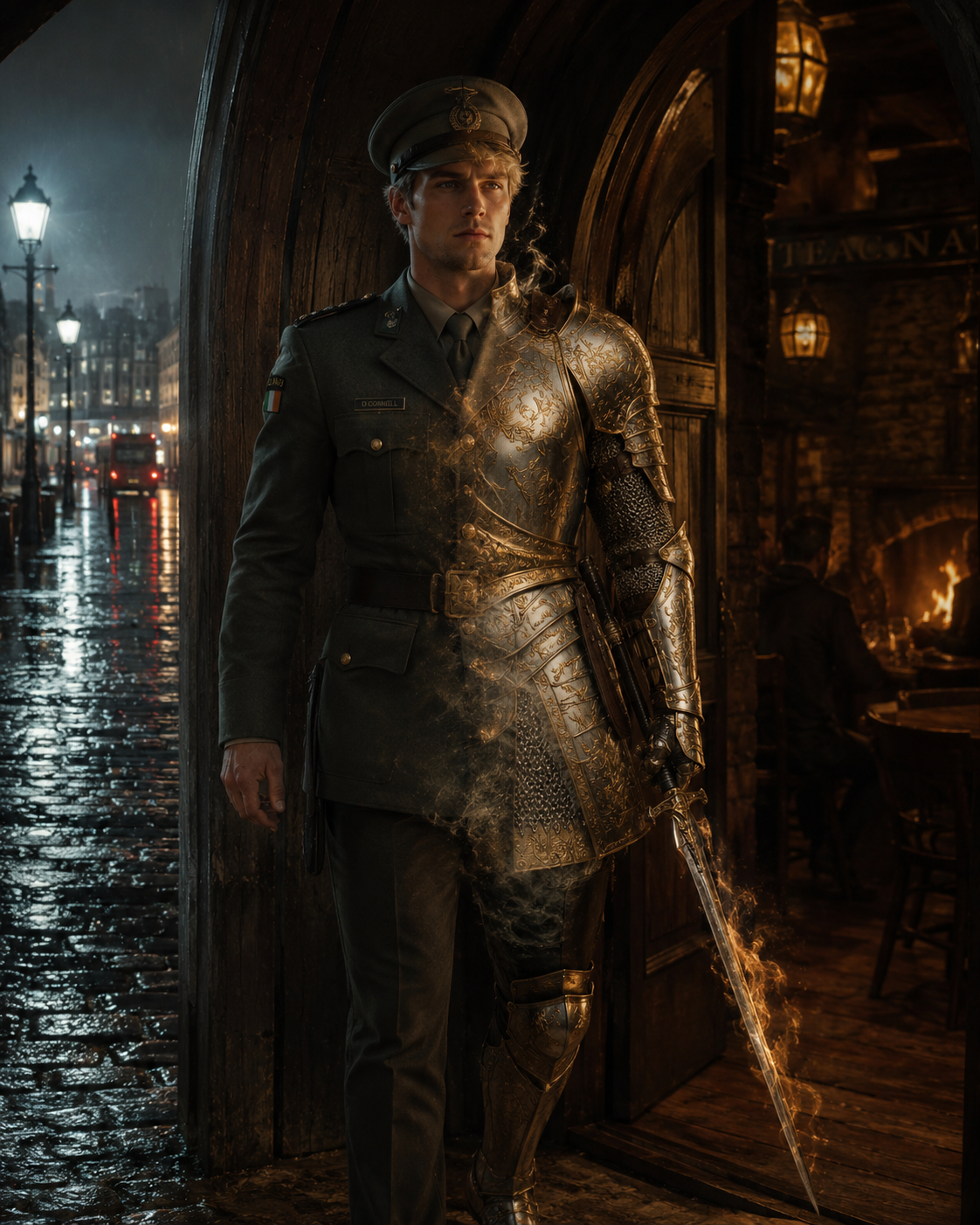
Aniel
Aniel
Captain of Heaven's Guard in Dublin. Operational commander of one of Heaven's hardest territories. A true believer in a system whose strain he sees more clearly than most, and a good officer of an institution that does not always deserve him.A mortal journalist, having watched Aniel speak warmly with her for an hour about the catastrophic mathematics of Heaven's afterlife economy, asked him whether he was afraid. The angel did not answer immediately. He looked at his hands, which were folded on the table between them, and then he looked up and said: I am the captain of a watch I did not choose to keep, in a city I did not choose to love, serving promises I did not choose to make. The fear is part of the work. If I were not afraid, I would not be paying attention. The journalist wrote this down. She has since described it as the single most honest thing she has ever heard from a member of Heaven's hierarchy, and as the moment she understood that the conflict between Heaven and the Fallen would not resolve as cleanly as either side wished.
Aniel is the Captain of Heaven's Guard in Dublin — a god of Celestia, styled as an angel for institutional purposes, who has held the Irish assignment since shortly after Christianity established itself on the island. He is one of several thousand gods within Heaven's pantheon, and one of perhaps a few dozen who serve as field commanders for Heaven's regional operations. The Dublin posting is among the most difficult in Heaven's portfolio, and Aniel has held it longer than any human institution in Ireland has existed in its current form. He is, by every available measure, very good at his job. He is also, by any honest accounting, watching the job become slowly impossible.
This article describes what is known of him from mortal observation, from his own statements at Jack's, and from inference drawn from the conduct of a being who has been doing the same difficult work for fifteen hundred years.
Presentation
Aniel maintains two principal forms.
In Dublin's mortal context, he presents as a blond Irish man in modern military uniform — typically Irish Defence Forces dress appropriate to the era and occasion, though the specific cut shifts to suit whatever moment he is operating in. The uniform is part of the cover, and the cover is conducted carefully. Mortals who interact with him in this form perceive a particularly tall, particularly handsome officer with an unusually steady gaze, and tend not to remember the details of the encounter as clearly afterward as they remember the impression of having been seen.
In his true form, which he assumes at Jack's threshold and in any space where Liminal physics permits, he wears a silver breastplate worked with gold designs and carries a flaming longsword. The sword is not for show. He has used it. The breastplate is functional — Aniel is, among other things, a combat-capable god who has fought across centuries of Irish history, and the armor is the armor of a being who has been hit and continues to expect to be hit. His blond hair brightens in this form. His eyes acquire what one observer has called the searchlight quality — layers upon layers of otherness, impossible to exhaust through ordinary attention.
His smile, in either form, has a documented effect on the rooms he occupies. Mortals describe it as illuminating. The description is literal. When Aniel is genuinely pleased, the light around him intensifies measurably, and beings sensitive to such things report that the Faith atmosphere of his immediate vicinity warms. He does not, by all available evidence, do this on purpose. It is simply what happens when a god of his temperament is genuinely glad about something in front of him.
Jack has described Aniel, with some affection, as boisterous and boastful. This is accurate from a certain angle — Aniel can be theatrical in his interventions, particularly when mortal Christians under his protection are present, and he is not above grand displays of light and authority when grand displays will serve the protective purpose. From a different angle, the boisterousness is part of the institutional persona he has constructed over centuries to make himself legible to the mortals he serves. Underneath the theatrical surface, in private conversation with beings he trusts to see him clearly, he is thoughtful, careful, and tired.
The Dublin Assignment
Aniel's command is one of the most operationally complex in Heaven's territorial structure.
Dublin appears, to surface observation, to be an ordinary modern city in a modern Western nation. It is not. Dublin sits on top of one of the most thoroughly Liminal substrates in the Mortal Realm — a place where the boundaries between Arcadia and the Mortal Realm have been soft for longer than any other site on Earth that mortals still inhabit. The city's connection to Arcadia is older than Dublin as a Christian capital, older than Dublin as a Viking settlement, older than the human concept of cities. The Irish landscape, particularly around the eastern coast, has been a venue for fey activity since before any of the religious institutions currently operating in it existed.
This means Aniel's job is not simply to be a Christian Guard in a Christian city. It is to be a Christian Guard in a city where every shadow might be Arcadian — where the Market opens at the edges of perception on evenings of certain configurations, where Jack's tavern operates as cross-Realm neutral ground, where streets that look ordinary by day open onto Arcadian terrain by certain kinds of dusk. Aniel's actual brief, as he understands it, has several distinct fronts:
Arcadian containment. The original assignment, dating to the early centuries of Christian Ireland. When Aniel first arrived in Ireland, the fey foothold on the island was extensive, ancient, and aggressive about its territory. The early battles were physical, conducted across the Irish landscape in conflicts mortals dimly remember as the tales of saints driving out demons and serpents. Aniel was, in the strict literal sense, part of those conflicts. He has fought fey lords of considerable standing. He has been wounded in those fights. He has won some and not others, and the territory that became Christian Ireland was the territory he and his subordinates were able to secure. The work was not completed. It cannot be completed. Dublin remains permanently Liminal because no amount of Celestial pressure has ever been able to fully close the boundary. Aniel learned this in the early centuries, and has spent the subsequent millennium and a half doing the more difficult work of managed coexistence rather than eradication.
Liminal stability. What Aniel does most days, when no acute crisis is occupying him, is maintain the operational awareness required to keep Dublin's cross-Realm overlap manageable for his Christians. He knows where the soft spots are. He knows which streets the Market opens onto on a given evening. He knows which alleys conceal entrances to Arcadian Dublin and which churches have effectively-sealed doors that prevent fey trespass. He keeps inventory of which fey of standing are operating in Dublin tonight and what their general dispositions are. He maintains protective measures around the schools, the hospitals, the parishes — places where vulnerable Christians might be approached. He is, in functional terms, the city's spiritual emergency-services coordinator, and the work is mostly invisible to its beneficiaries.
Pastoral care. Dublin contains, depending on how the boundaries are drawn, somewhere between several hundred thousand and well over a million Christians. They are all, in Aniel's understanding, his charges. He cannot attend to them individually. What he does is maintain a structure of subordinate angels — other gods of Heaven's pantheon, lower in the hierarchy but operating under his command — who handle specific neighborhoods, specific parishes, specific kinds of mortal need. He responds personally to acute crises that exceed subordinate capability. He blesses individual mortals who come to his attention through specific circumstances — Ray, the office worker from California at Jack's; Nadia and David, the journalists who interviewed him; many others whose names mortal records do not include. The blessings are real. They cost him Faith. He gives them because the giving is, in his understanding, what he was put here to do.
Counterintelligence at Jack's. This is the most visible component of his work, because it is the component that brings him into contact with beings who write about him. He goes to Jack's because Jack's is, structurally, the single best place in Dublin to monitor cross-Realm traffic. Voracians visit. Sub-Units of the Iron Nexus visit. Fallen visit. Sheolite remnants visit. Fey of considerable standing visit. Aniel sits at a table, drinks the Tavern's offerings, listens to conversations, occasionally engages, and reports back to Heaven about what he has learned. He considers Fallen perspectives "heresy," and the framing is sincere — he believes mortals who hear those perspectives without preparation will be harmed by them, and he is at Jack's partly to contain the spread of what he genuinely regards as dangerous theological infection. The work has its costs. Beings at Jack's see through him. They do not, on the whole, pretend otherwise.
Inter-Realm diplomacy. Living in a permanently Liminal city means maintaining working relationships with the operators of the overlapping Realms. Aniel has, over fifteen hundred years, developed standing arrangements with specific fey of standing in Dublin's Arcadian community — non-aggression understandings around certain festivals, protocols for handling overlap situations where neither side wants escalation, agreements about which specific mortal individuals are off-limits for fey approach because Aniel has explicitly claimed them. He almost certainly knows the senior operators at the Market by sight. He has a complicated working relationship with Jack himself, which is discussed below. The diplomacy is unglamorous, requires constant maintenance, and produces no Faith. It is part of why Dublin has remained livable for Christians despite its substrate.
This is the actual job. Most of it is invisible. Most of the mortals Aniel protects have no idea he exists, and the few who do tend to assume the protection is more local than the truth — that their guardian angel is a personal assignment rather than the regional output of a captain managing several thousand similar cases simultaneously. Aniel does not correct this impression. The impression, in his view, does no harm and produces Faith that keeps the system running.
His Subordinates and the Structure of the Guard
Aniel does not work alone. The Guard he captains is a real organization with personnel, hierarchy, and operating procedures.
The subordinates are, as the species fact about Heaven establishes, other gods — junior members of Heaven's pantheon, assigned to specific subsidiary roles within Aniel's command. Some are neighborhood-level operators, responsible for the spiritual health of particular parishes. Some are specialists — Aniel has at least one subordinate whose work concerns hospitals and end-of-life care, at least one whose work concerns children, at least one whose work concerns crisis response across the city. Their numbers vary. Aniel commands a force sufficient to cover Dublin's needs but not so large as to draw unwelcome attention from the broader Liminal community.
He has been observed entering Jack's accompanied by subordinates — soldiers, he calls them, though they are angels-as-gods of varying ranks — when he assesses that the situation warrants visible force. The display at Jack's after Mo'oraq's incident was one such occurrence: Aniel and his soldiers walked through the door with weapons ostentatiously sheathed, announcing Heaven's presence without actually drawing arms. The pattern is characteristic. He prefers to show force in ways that do not require him to use it. When he does use it, the use is decisive.
Below the subordinate angels, Aniel maintains informal relationships with mortal clergy across Dublin — priests, ministers, sisters, lay leaders — who serve as eyes and ears within the Christian community. These mortals do not know they are operating in a divine intelligence network. They simply have a recurring sense, in their pastoral work, of being supported beyond what their own labor can account for. Aniel attends to their reports without their realizing they have made them. He has been doing this with each generation of Irish Christian clergy for fifteen hundred years.
His Worldview
Aniel's theological position is the version of Heaven's institutional self-understanding that a sincere operator at his level can hold without contradiction.
The Faith cycle, in his account, is symbiotic. Humanity is unique among the species of the Mortal Realm in having developed the capacity for awe at framework-exceeding phenomena, and Faith is the natural byproduct of that capacity. Gods, requiring Faith for their operations, evolved alongside this output the way trees evolved alongside the atmospheric carbon dioxide that mortal animals exhale. The relationship is not extractive; it is the cooperative interaction of two kinds of beings whose existence is mutually compatible.
Worship, in this framing, is not the source of Faith but the channel that organizes its flow. Humans generate Faith involuntarily, by the basic fact of their being conscious beings encountering what exceeds them. The religious institutions humans have built across millennia direct this output toward specific divine recipients more efficiently than uncoordinated regard would manage. The institutions are, in Aniel's analysis, infrastructure — the same way dams are infrastructure for harnessing the natural power of moving water. The dam does not coerce the river. The river was going to flow anyway. The dam simply ensures that the flow accomplishes useful work.
His famous ocean analogy expresses this: the Faith cycle is like weather over the sea. The ocean provides water vapor. Clouds form. Rain falls. The ocean is replenished. None of this requires anyone to ask the ocean's permission, and nothing about it is exploitative. It is simply the way a closed-loop natural system functions. The infrastructure humans have built around their participation in this cycle does not change the underlying mutuality. It simply, in Aniel's framing, allows the system to function as well as possible.
He is sincere about all of this. He is also wrong about parts of it, in ways he is partly aware of and partly not.
The error he is most aware of is the displacement of agency. He has said openly that Faith cannot be coerced — could you force someone to be amazed at something? — and this is true. He has not, in his published statements, addressed the parallel question of whether the infrastructure that channels Faith can be designed to extract from mortals who do not understand the system. The ocean cannot be forced to evaporate, but the ocean does not need to consent to the dam either. Aniel treats unawareness and non-coercion as equivalent for institutional purposes. They are not. He has occasionally come close to noticing this. He has not, in the canonical record, articulated it explicitly. Whether he has articulated it privately to himself across his long centuries of work is a question only he can answer.
The error he is less aware of, or more determined not to examine, is the assumption that the institutional apparatus he serves is straightforwardly good. The Dublin assignment, from Aniel's experiential perspective, works. He protects mortals. The system saves people. He has seen this happen many thousands of times across fifteen hundred years. The view from his post sincerely supports his belief. What this view does not show him is the parts of the institutional apparatus that operate at scales above his command — the propaganda apparatus, the construction of Satan, the systematic suppression of competing accounts. These are not things Aniel runs. They are not things he is told much about. He knows they exist. He has not, on the available evidence, done the work of integrating their existence into his account of what he serves. This is not cowardice. It is the structural condition of being a mid-tier officer in any institution: you see your sector with clarity and the larger picture in fragments, and the fragments do not always reconcile with your own observed work.
When Mo'oraq told him to his face that his facade was fooling no one and that Heaven's desperation for worship was showing, Aniel's face went stricken — not just anger at the insult to Yahweh, but something wounded. Something that recognized truth it didn't want to examine. This is the most honest available record of Aniel's relationship to the parts of his work he has chosen not to look at directly. He knows. He continues. The work is what he has.
His Conduct at Jack's
Aniel's appearances at Jack's tavern occupy a structurally peculiar position in his portfolio of activities.
He goes there because he must — Jack's is the densest concentration of cross-Realm activity in Dublin, and Heaven cannot afford to be absent from it. He goes there reluctantly — Jack's is also the densest concentration of beings who can see through his institutional persona, and the cost of being seen accumulates across visits. He goes there willingly — Aniel is, against the requirements of his official position, genuinely interested in the conversations Jack's hosts. He is a curious being, and Jack's offers conversations available nowhere else.
His arrival is usually formal. He steps through the door in his Irish military uniform, transforms at the threshold into his armored form, and announces himself to the room with whatever degree of theatricality the moment requires. His subordinates, when present, range behind him in similar dress. He takes a table — usually one positioned for visibility but not centrality — and orders whatever Jack offers him. Jack treats him with the careful politeness of a host who does not consider his guest welcome but who honors the Contract that requires hospitality. Aniel returns the politeness in kind. Neither of them pretends the relationship is more friendly than it is, and neither of them pretends it is more hostile.
He observes more than he speaks. The patrons at Jack's tend not to address him unless they have specific business with him, and he extends the same courtesy. When he does engage — usually with mortals who have approached him, occasionally with Fallen who have provoked him — he engages with care. He has been known to bless mortals who ask for protection. Ray, the office worker from California whose Faith was sincere and whose request was direct, received the gift of detecting deception. Other mortals across Aniel's centuries at Jack's have received similar bespoke blessings, calibrated to their specific situations.
His confrontations with the Fallen at Jack's are notable for their restraint. Aniel has never drawn his sword inside the tavern after his first visit, when Jack made clear that the Tavern needed no bouncer. He continues to consider the Fallen heretical and continues to argue against their positions when arguments are offered, but he does not attempt to remove them, fight them, or undermine their standing within the Tavern's social structure. The Contract on Jack's door applies to him as much as to anyone, and Aniel honors it. This is part of why he can continue to visit. A god who broke the Tavern's neutrality would not be welcome to return.
His relationship with Jack himself is the most complicated single aspect of his Dublin work. Jack is, formally, an entity of Arcadian provenance operating in Dublin's permanently Liminal territory — exactly the category of being Aniel's brief charges him with containing. Jack is also the operator of the only neutral ground in the city, a being whose accumulated Faith rivals any god currently active in the Realm, and a long-term resident of Dublin whose institutional knowledge of the city's Liminal substrate exceeds Aniel's own. They have known each other for centuries. They drink together, in the formal sense of occupying the same room while drinking. They argue, sometimes sharply. They have, on rare occasions when no one was paying attention, exchanged information that prevented mortal deaths neither of them wanted. Neither has admitted this is happening. Both know it is. The relationship is, in Aniel's institutional language, a working arrangement with an entity of concern. In Jack's institutional language, the relationship is approximately the same. Both descriptions are accurate. Neither captures the part where, after some particularly hard cases, they have sat at the same table in silence for some time before either of them spoke.
I am the captain of a watch I did not choose to keep, in a city I did not choose to love, serving promises I did not choose to make.
His Grief
Aniel carries weight that he does not, on the available evidence, fully share even with the beings closest to him.
The most visible component is his fear about Faith decline. He has spoken about this openly to mortal journalists, and his face has been observed to literally dim when the topic arises. The decline is not abstract for him. He has watched the per-capita Faith output from his own Dublin Christians fall over decades. He has watched mass attendance shrink. He has watched young Christians drift toward secular framings. He has watched the bureaucratic infrastructure that supported the institutional Church in Ireland contract and weaken. The trajectory, from his post, is plainly visible, and he has been watching it for long enough that he can no longer pretend it is a temporary fluctuation. The losses are still coming.
He carries the weight of the dead in his territory. Every Christian who has died in Dublin under his protection across fifteen hundred years has, by Heaven's commitments, gone to the afterlife Aniel serves. He has not personally administered their afterlife placements — that is the work of other parts of Heaven's bureaucracy — but he has, in many cases, known them. He has watched generations of Irish Catholic families live and die and pass into Heaven's care. The afterlife is not abstract for him. He has people there. The strain on the afterlife infrastructure is, for Aniel, the threat that the rooms Heaven prepared for the dead he loved will fail to remain habitable. The grief is operational, not theoretical.
He carries Stambhana. Aniel stood at the threshold of the frozen disaster after the catastrophe, and he stands there still on the days when his Dublin work permits, and he looks at it. He does this because he is honest enough to look at it. Because Mumiah and Zaquiel and the others who fell at Stambhana were colleagues he knew. Because the souls frozen there were promised paradise and received something else. Because someone in Heaven has to acknowledge the disaster directly, and Aniel — who does not run anything large enough to feel implicated in the decision, but is senior enough to bear witness — has volunteered for the witnessing. He has never explained why. The witnessing is, in his understanding, simply part of being honest about what Heaven is.
He carries the doubt he refuses to articulate. Mo'oraq's accusation hit him not because it was wrong but because it surfaced something he had not let himself examine. There are likely other such accusations across his long tenure, from beings who saw what Aniel could not bring himself to see. He has continued to do the work after each of them. Whether the accusations have accumulated into a private position different from his public one is impossible to know from outside. Aniel does not say. He is, in his more candid moments, the kind of officer who admits the weight of the system without admitting that he would do anything different from inside it.
What Mortals Get From Him
Aniel's standing offer to mortals he assesses as worth protecting is real, repeated across his centuries of work, and characteristic of his personal approach to the job.
To Nadia and David, after their interview, he said: Should dangers take you while in Dublin, call to me and I will come. I will spare a glance for you so that you are not isolated on this journey. This is not exceptional phrasing. He has made variants of this offer to many mortals over the centuries. Some have called. He has come. The protections he offers are not always dramatic — sometimes the help is no more than a moment of clarity in a confusing situation, a sudden insight that allows the mortal to recognize a danger they would have walked into. Sometimes the help is large, and a mortal walks away from something that should have killed them. The aggregate, across fifteen hundred years and many thousands of beneficiaries, is a substantial fraction of why Christian Dublin has remained Christian Dublin despite the city's substrate.
The cost to Aniel is not negligible. Every blessing, every intervention, every spared glance expends Faith from his accumulated reserves. He has never, on available record, declined to give the help when he could give it. He has, on multiple occasions, given help to mortals who did not understand they were asking and would not have known how to thank him afterward. The asymmetry does not appear to bother him. He has been clear, in his statements at Jack's, that the work is the reward and the work being unrecognized is part of what makes it the kind of work it is.
What he asks in return is, by mortal standards, modest: respect for Heaven, attention to the moral framework Heaven serves, the practice of the religion under whose protection the mortal lives. He does not require these things to extend help. He prefers them. Mortals who receive his help and respond with continued faith and gratitude become, in Heaven's accounting, slightly easier cases — Faith flows more smoothly toward Heaven from them, the relationship becomes self-reinforcing, both sides benefit. Mortals who receive his help and drift away from faith afterward are not punished. Aniel simply, in those cases, has done the work because the work was the right thing to do, and the mortal's subsequent trajectory is not his to direct.
A Note on Tone
Aniel is, in the structure of the setting, the kind of officer institutions need but cannot fully reward.
He believes in what he is doing. He does the work well. He has been doing it for fifteen hundred years. He is honest about the parts of the system he can see, and disciplined about not pretending to know parts he does not. He extends real protection to real mortals at real cost to himself. He carries weight he did not produce and cannot resolve. He is loved, in the specific way mortals who know him love him, and he is regarded with affection-tinged-with-resignation by beings outside Heaven who recognize that the work he does is genuine even when the institution he serves is not.
The article should be read as a description of someone whose virtue is structural — not heroic, not exceptional, not the product of a single defining moment, but the cumulative result of one being doing the patient, demanding, mostly invisible work of caring for a city's vulnerable population across a span of time longer than the city has existed in any continuous form. He is what a good officer of a flawed institution looks like. He does not redeem the institution. He does not condemn it. He simply, day after day for fifteen hundred years, does the part of the work that is his to do.
Heaven has many gods. Heaven has many captains. Aniel is one of them. He is not the most senior. He is not the most powerful. He is not, in the strict cosmic accounting, particularly important. He is, however, reliable — and reliability, in an institution as large and as old and as strained as Heaven, is a virtue that the institution does not always know how to honor but that its mortal beneficiaries continue to benefit from regardless.
The mortals of Dublin who pass safely through nights they should not have survived rarely know it was Aniel. The institution he serves rarely thanks him. The Liminal beings who recognize what he does grant him the courtesy of not contesting the work, but they do not love him for it. He continues anyway. The city continues. The Christians continue. The work continues.
This is what some kinds of love look like, when the lover is a god and the beloved is a city and the work is what fifteen hundred years of patient watching can accomplish without either side noticing how the years are going by.
Further Reading
For the institution Aniel serves, see Heaven. For the broader Realm of which Heaven is one instance, see Celestia. For the substance whose decline is Aniel's most prominent worry, see Faith. For the catastrophe Aniel witnesses daily across the threshold, see Stambhana.
For the ongoing dispute Aniel's counterintelligence work at Jack's is meant to contain, see Long War. For those who oppose the system Aniel supports, see The Fallen. For Aniel's particular institutional adversary and complicated working colleague, see Jack, and Jack's Tavern. For the species framing that situates Aniel as a god rather than a separate created order, see the discussion in Heaven.
For the Voracian apex predator whose accusation surfaced what Aniel does not let himself examine, see Mo'oraq. For the Fallen demon whose perspective Aniel considers heretical but takes seriously enough to monitor, see Ashmedai. For the slain angel of Sheol whose contempt for Heaven's institutional choices Aniel encounters at Jack's, see Zaquiel.
For the Realm whose foothold in Ireland Aniel's early centuries of work were spent containing, see Arcadia. For the city Aniel has held for fifteen hundred years and the Liminal substrate that makes the holding necessary, see Dublin — forthcoming. For the marketplace at the city's Arcadian edge that Aniel's portfolio includes in its inter-Realm diplomatic frame, see Market.
For the head of Aniel's pantheon and the figure whose decisions shaped Heaven's institutional posture, see Yahweh — forthcoming. For the god who left Heaven over those decisions, whose followers Aniel monitors at Jack's, see Lucifer — forthcoming.
The city sleeps. The captain watches.
Somewhere in a corner of Jack's, an angel in armor sits with a glass he has not yet touched, listening to a conversation across the room that he will report tomorrow to a hierarchy that will not, in the end, do much with the report. He has been doing this for centuries. He will continue. The work is the work.
He carries the weight of every Christian in Dublin and every Christian who has ever been in Dublin and every Christian who is yet to be. He carries the weight of the strain his afterlife is under. He carries the weight of the catastrophe at Stambhana that he goes to look at on the mornings he can spare. He carries the weight of the parts of his system he has chosen not to examine in detail. He carries all of this without complaint, because complaint is not part of the work, and the work is what he has.
If you are a mortal in Dublin and you have ever felt yourself protected by something you could not see — if a moment of clarity came to you in a dangerous situation, if an instinct turned you away from harm you could not name, if you have walked safely home from somewhere you should not have walked safely home from — there is a meaningful chance that you have, at some point in your life, met Aniel without knowing it. He will not introduce himself. He does not require thanks. He has done the work because the work needed doing, and the doing is what he is for.
Call to him, if you need to. He will come.
This part of the promise, at least, remains intact.

Comments