

Species
in Character Options"The world does not choose who lives upon it. It simply waits to see who learns to live together."
The people of Aerith are not a single story. They are the sum of countless lineages shaped by the world’s long memory and its broken design. Each carries traces of what came before the Shattering, when the weave of life flowed without interruption. When that balance failed, entire peoples were changed. Some adapted, some endured through will alone, and some were made new altogether. The result is a world whose diversity is not an accident but a reflection of its history.
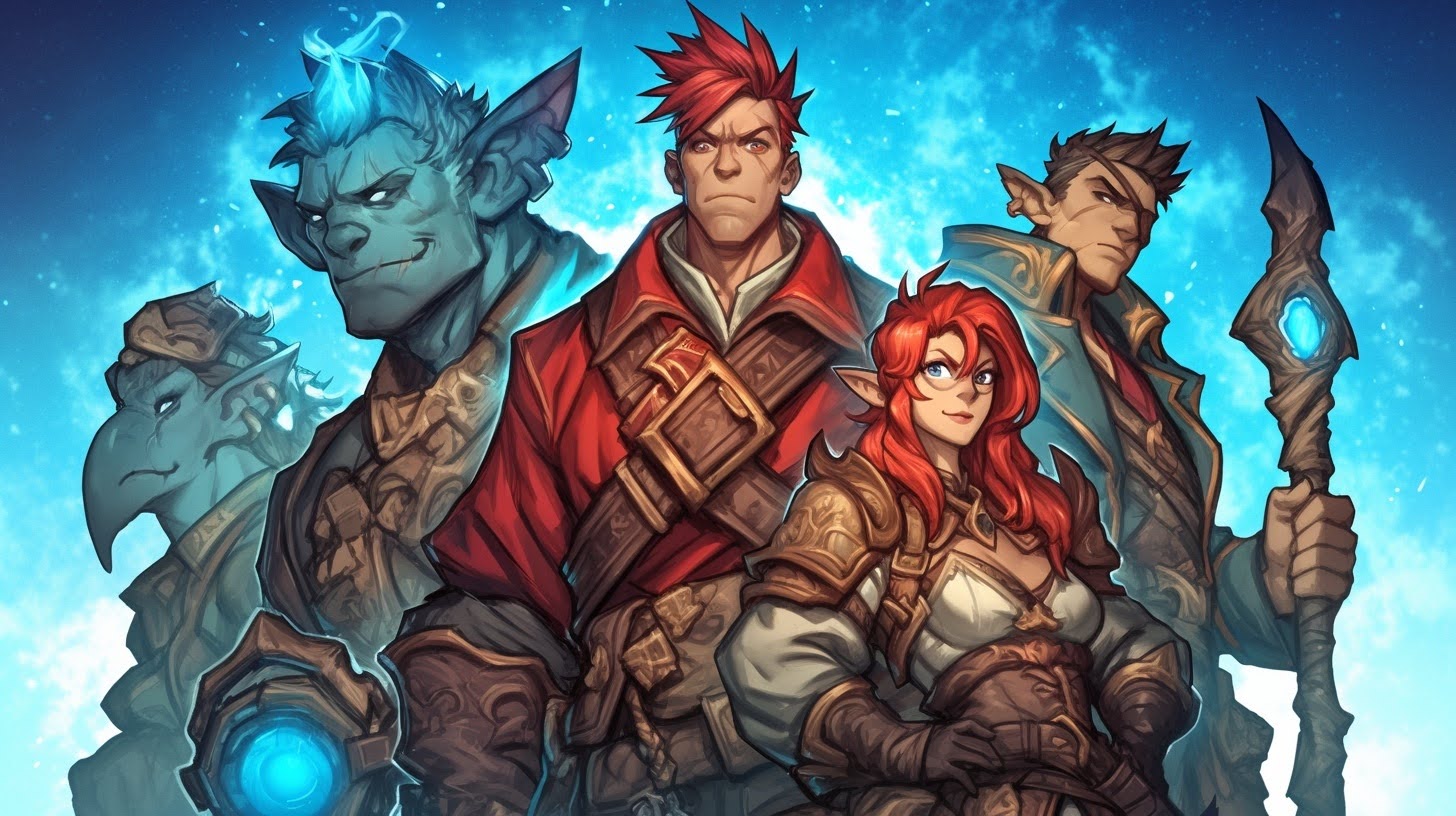
The mortal races form the foundation of civilization. They are the builders, farmers, wanderers, and dreamers whose labor rebuilt what the old empires left behind. Humanity exists in endless variety, molded by climate, culture, and need. Elves preserve fragments of ancient knowledge, their long lives turned toward memory as much as progress. Dwarves are the keepers of craft and endurance, their works standing long after nations crumble. Halflings, gnomes, and other small folk fill the spaces between, shaping the quiet currents of trade, invention, and adaptation that hold the world together.
Beyond these familiar peoples are those who remind the world that the boundaries of life are never fixed. Tieflings and aasimar carry the marks of the planes upon their blood, living proof that divinity and damnation both have human faces. Shifters, changelings, and other altered lineages reflect what happens when spirit and flesh intertwine. Dragonborn, genasi, and other hybrid forms show that the raw matter of creation still bends toward change. Every species tells the same truth in its own way. The world has never been static.
What separates the peoples of Aerith is not their origin but how they interpret it. Each society teaches its children a different answer to the same question: what does it mean to be alive in a world that remembers so many versions of itself? Some see their form as destiny, others as circumstance, and still others as a choice renewed each day. The result is not a hierarchy but a chorus of competing philosophies. The variety of bodies and bloodlines across the world reflects the same uncertainty that defines its gods.
In the wake of the Shattering, many species lost the knowledge of where they began. Some were scattered across realms, their myths reshaped to match their new homes. Others discovered changes within themselves that could not be reversed. Whole lineages now exist as living records of survival, each carrying the memory of some forgotten transformation. A traveler walking across Aerith may pass from one village to the next and find not only new customs but entirely new conceptions of what it means to be mortal.
Despite these differences, coexistence remains the quiet miracle of Aerith. Trade, necessity, and shared struggle have bound the peoples of the world together in ways no single empire ever achieved. Mixed communities fill the cities, where bloodlines blend as easily as languages. Out in the frontier lands, settlements often form around shared purpose rather than shared ancestry. The result is a world held together less by law than by the understanding that isolation no longer guarantees safety.
The study of species in Aerith is as much philosophy as science. Scholars record patterns of lineage, anatomy, and lifespan, but they also record how culture defines these things. A single word can mean something different from one canton to another. The same race might be seen as cursed in one region and blessed in the next. In this way, taxonomy becomes theology. The act of naming a people becomes the act of deciding how the world should remember them.
What unites every race and species, regardless of form, is the drive to persist. From the smallest halfling burrow to the vast citadels built by giants, all share the same need for connection and continuity. The diversity of Aerith is not a burden or a miracle but a fact of existence. Every difference adds to the collective resilience of the world, every variation a reminder that life adapts faster than it breaks.
Across every continent and plane touched by the Umbra, the peoples of Aerith continue to change. Some evolve naturally, others through magic, others through choices made under pressure. New lineages are still being born from the meeting of worlds, proof that the weave of creation remains unfinished. No scholar has yet mapped every race or traced every origin, and none ever will. The world itself resists completion.
To understand the races and species of Aerith is to understand that diversity is its equilibrium. The world survives not through uniformity but through variation, through the endless conversation between what was and what might be. Every face, every form, every name is another answer to the same question that has followed life since the first dawn: what will you become now that the world has changed again?
World Codex
Unless otherwise noted and displayed here here, all "art" is the creation of SolomonJack through Dall-E, Midjourney, Stable Diffusion & LeonardoAI
© Brian Laliberte 1993 - 2026. All rights reserved.
Unknown Shores is an original fantasy setting. Unauthorized reproduction, distribution, or adaptation without permission is prohibited.
This work includes material from the System Reference Document 5.2.1 (“SRD 5.2.1”) by Wizards of the Coast LLC, available at D&D Beyond