


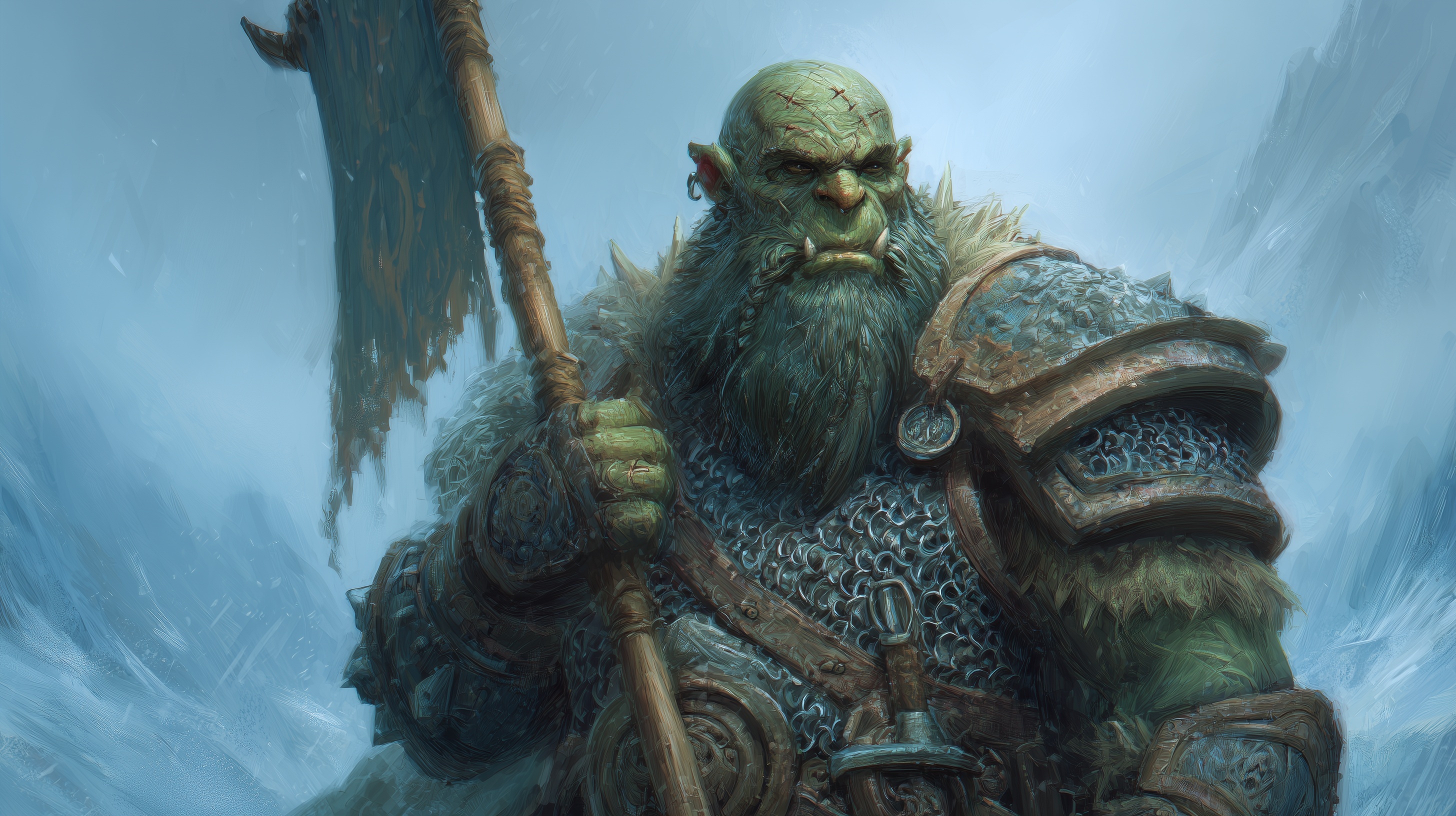
Orc
The First Walkers
"An old orc blacksmith once told me that every blade should have two purposes. The first was obvious. The second was to remind its owner there was always a better reason not to draw it."
Orcs are powerful humanoids renowned for their physical strength, fierce determination, and deeply rooted traditions of family, honor, and perseverance. Though countless legends portray them as little more than raiders or conquerors, those who know orcs understand a people whose cultures value courage, loyalty, and resilience above comfort or luxury.
Broad-shouldered and heavily muscled, orcs possess prominent tusks, square features, and sturdy frames capable of enduring tremendous hardship. Their skin ranges through shades of green, gray, brown, and black, while their hair is commonly worn long, braided, or shaved according to family or tribal custom. Scars are rarely hidden, serving as visible reminders of hardships overcome rather than trophies of violence.
Orc settlements are as diverse as the lands they inhabit. Some clans roam vast plains alongside great herds, while others maintain fortified villages in rugged mountains, dense forests, or windswept badlands. Homes are built to withstand harsh climates and constant use, reflecting a belief that strength should be practical before it is beautiful.
Family and clan form the heart of orc society. Every member is expected to contribute according to their abilities, whether through hunting, craftsmanship, leadership, healing, or defending the community. Respect is earned through action rather than birth, and even the children of celebrated leaders are expected to prove themselves through service.
Orcs believe hardship reveals character. A difficult winter, a failed hunt, or a hard-fought defeat are remembered not with shame, but as lessons that strengthen those willing to endure them. Young orcs are encouraged to test themselves constantly, though wise elders remind them that courage without judgment quickly becomes recklessness.
Many orcs become warriors, smiths, scouts, herders, artisans, or explorers. Their physical strength is admired, but equal respect is given to those who settle disputes peacefully, preserve ancient traditions, or ensure that future generations inherit a stronger community than the one before it.
Feasts are among the most cherished traditions in many orc cultures. Victories, births, successful harvests, reconciled rivalries, and the return of long-absent travelers are all celebrated around enormous communal tables where stories are exchanged as freely as food. An honored guest is expected to leave with a full stomach, a new friend, and at least one story worth carrying home.
"People kept warning me the orcs would test my strength. They never did. They wanted to know whether I'd help carry water before supper."
Genetic Ancestor(s)
Genetic Descendants
Scientific Name
Homo orcus
Lifespan
60–80 years
Average Height
5 ft. 10 in. – 6 ft. 8 in.
Average Weight
180–280 lb.
Geographic Distribution



Comments