


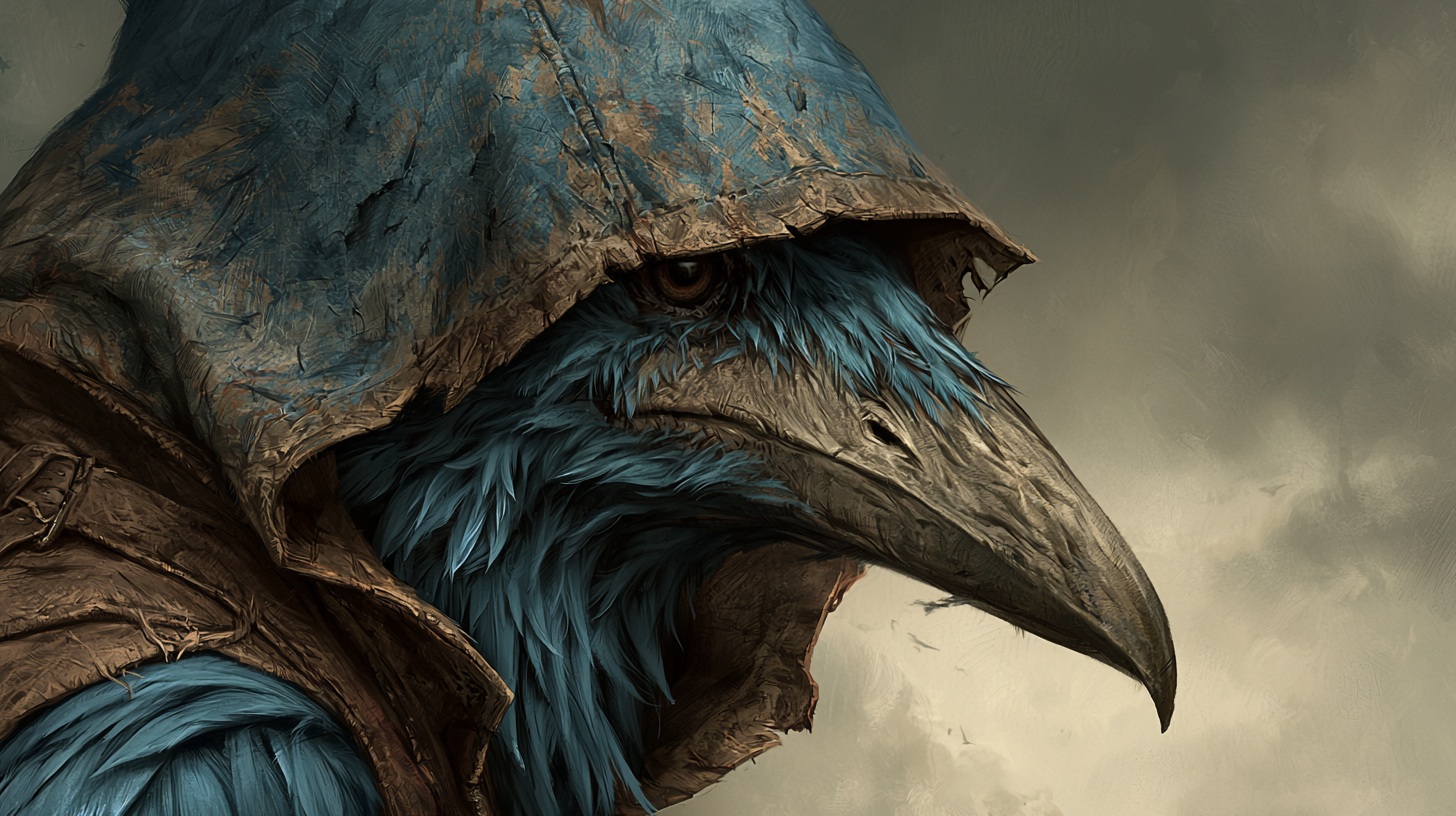
Kenku
Listen & Repeat
"A borrowed voice may repeat wisdom. Only your own choices make it yours."
Kenku are intelligent avian humanoids renowned for their extraordinary memories, remarkable powers of imitation, and relentless ingenuity. Though legends often dwell upon ancient curses that stole their wings or silenced their original voices, kenku themselves are far less interested in what was lost than in what can still be learned. Every sound, every story, and every new skill represents another piece of a world they are determined to understand.
Covered in feathers ranging from glossy black to shades of gray, brown, and white, kenku resemble upright ravens, crows, or other corvids. Their sharp beaks, bright eyes, and nimble hands make them well suited to intricate craftsmanship, writing, and delicate work. Many decorate their clothing with colorful cords, polished trinkets, or carefully collected objects whose stories are as valuable as the items themselves.
Kenku communities often arise within thriving cities, busy ports, or prosperous trade routes where countless voices, languages, and professions provide endless opportunities for learning. Others establish secluded villages where traditions, songs, and histories are preserved through meticulous repetition. Every generation adds new memories to those entrusted to it by the last.
Memory occupies a sacred place within kenku culture. Children are encouraged to memorize stories, songs, conversations, and practical skills from an early age, preserving knowledge with remarkable accuracy. Many families maintain oral histories stretching back centuries, repeated so faithfully that scholars frequently consult kenku elders when written records have been lost.
Creativity among kenku often expresses itself through combination rather than invention. A kenku artisan may unite techniques learned from many masters into something entirely new, while a storyteller weaves familiar tales into unexpected patterns that reveal fresh meaning. They delight in discovering connections others overlook.
Many kenku become scribes, investigators, translators, musicians, merchants, artisans, or adventurers. Their sharp memories and careful observations make them valuable companions, while their talent for reproducing voices, sounds, and languages often opens doors that remain closed to others.
Among kenku, sharing a treasured memory is considered one of the deepest expressions of trust. A parent may pass a favorite lullaby to a child, a mentor might teach the exact words of a long-dead hero, or an elder may preserve the final farewell of a beloved friend. Such memories are treated not as possessions, but as gifts that become richer each time they are faithfully remembered.
"Never assume a kenku wasn't listening. If you said it once, they probably remember every word."



Comments