
Yahweh
Yahweh
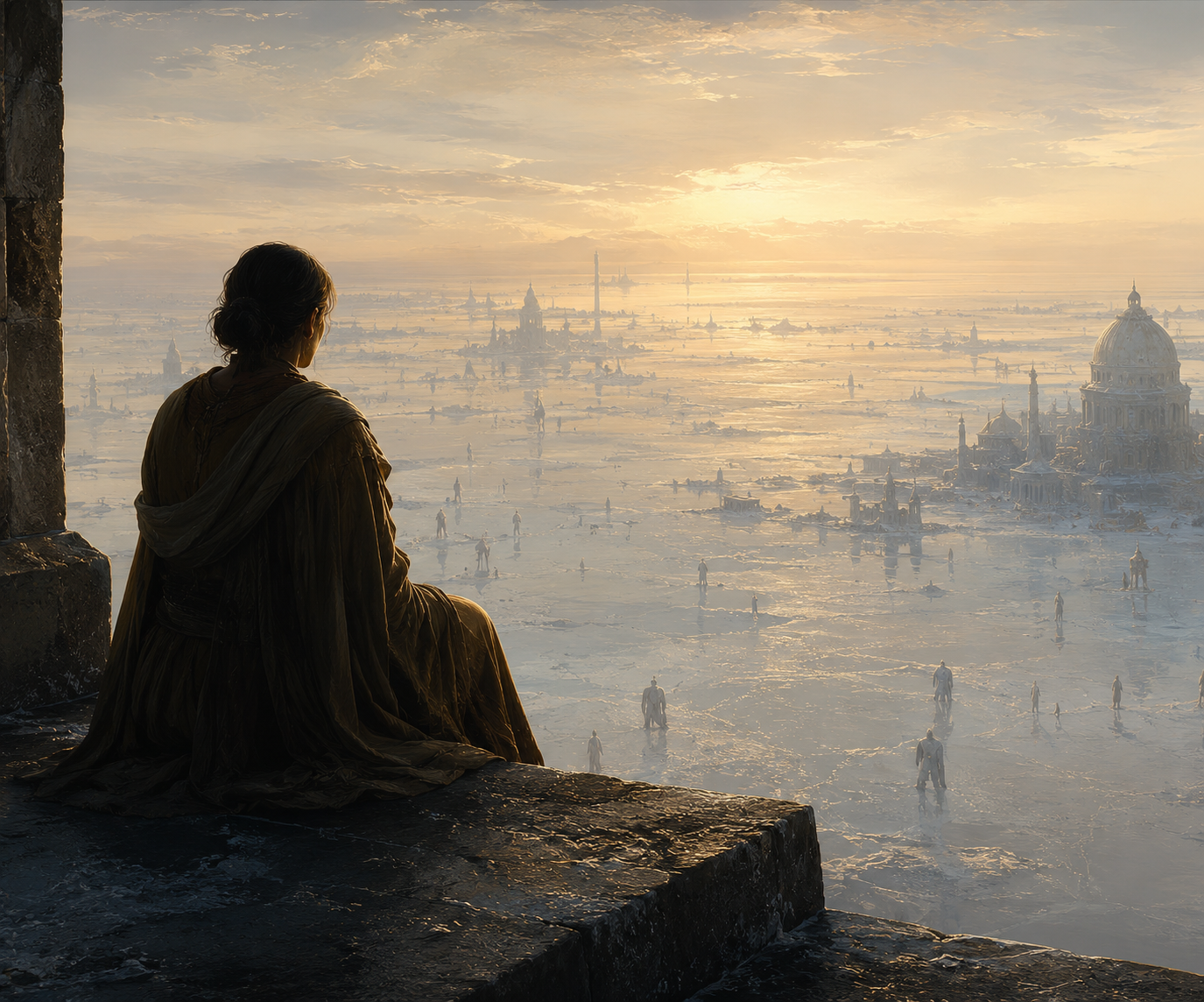
A god of Celestia. Head of the pantheon mortals know as Heaven. The being who first offered humanity an afterlife and who has, for ten thousand years, been paying for the offer. Currently running an institution he cannot exit and has not figured out how to repair.Yahweh has been observed three times in modern memory outside the immediate operations of Heaven. Once at the threshold of frozen Stambhana, where he sits when he can spare the time, looking at what he did. Once at Jack's tavern in Marrakech, where he came on a specific night to confess. And once, decades earlier, in a hospital room in Galway, where he appeared briefly to an Irish nun whose dying wish had been to ask him a single question. The nun's question, by all available report, was: did you mean it, the part about loving us? Yahweh answered her. The answer is not preserved. The nun died holding his hand and smiling, which is its own kind of preservation.
This article is the most complete available account of the god mortal traditions remember as the One True God, the Most High, the Lord, Jehovah, Adonai, Allah, and a hundred other names across cultures that share Abrahamic origin. He is, by the cosmic accounting, none of these things in the exclusive sense his traditions claim. He is a god of Celestia — one of thousands of gods within that Realm, head of one pantheon among many, distinguished from his peers by the particular history of his relationship with humanity rather than by any structural primacy in the cosmos.
What follows is an attempt to describe him honestly. The attempt is difficult. Yahweh's life has been shaped by choices that produced consequences he could not have predicted, made for reasons that were largely sincere, with results that have damaged him and the cosmos and the species he originally meant to honor. The article will try to hold all of this without resolving any of it into a simpler shape than it actually has.
Who He Is
Yahweh is a god of Celestia of significant accumulated regard, currently functioning as the head of the pantheon his mortal followers call Heaven. The pantheon contains several thousand other gods — the beings mortal traditions remember as angels — and Yahweh is their first among equals rather than their categorically distinct creator. The angelic framing is institutional. The species fact is that Yahweh, Gabriel, Michael, Mumiah, Aniel, and Lucifer are the same kind of being, distinguished from one another by accumulated regard and position rather than by ontological category.
He is not, in cosmic terms, the most powerful god. Other Celestial pantheons predate Heaven's institutional consolidation and contain gods of comparable or greater regard. The Egyptian, Hindu, Mesoamerican, and various other systems have heads of their own, several of whom have been in continuous operation longer than Yahweh has held the position he currently holds. The mortal framing of Yahweh as the supreme being of the cosmos is a function of the cultural reach of his pantheon, not of any cosmic ranking. From any vantage outside his territory, Yahweh is one major god among several.
He is, however, the god who took on the most. Among the thousands of pantheons across Celestia that engage with mortal life, Yahweh's pantheon promised the most generous afterlife to the largest population for the longest duration with the fewest conditions on continuance. The expense of this promise is, in the present age, the central operational reality of his existence. He runs Heaven the way a man runs a vast estate inherited under conditions of indebtedness: with care, with skill, with attention to every avenue of solvency available to him, and with the constant awareness that the estate cannot indefinitely continue.
He carries weight. Mortals who have encountered him in any of his contemporary appearances describe the weight as the dominant feature of being in his presence — heavier than his evident power, heavier than the cumulative authority of ten thousand years, heavier than the iconographic glory mortal traditions ascribe to him. He looks like someone who has not slept in a very long time. He has not slept in a very long time. Sleep is not a thing gods do, but the analog applies.
Who He Was
In the early ages of Celestia, before the discovery of the Mortal Realm, Yahweh was something other than the god he later became.
The available accounts — drawn from Lucifer's recollections, Ashmedai's pre-Fall observations, and occasional fragments from other Celestials who knew him in that period — describe a god of considerable standing within his pantheon but not yet consolidated as its sole authority. Heaven, in its early form, was a community of gods bound by shared affinity rather than by hierarchy. Yahweh was a peer among peers, distinguished by particular qualities — patience, attentiveness, a curiosity about beings unlike himself, a willingness to enter into friendship without requiring the friendship to operate on his terms. The god who would later demand exclusive worship from mortals had originally been the god most willing, among his peers, to meet strangers as equals.
He was, by all available report, capable of delight. He was capable of admiring beings whose form of existence differed substantially from his own. He was capable of sustained attention to the small specific qualities of whatever he was attending to — a quality that would later, in mortal religious tradition, be remembered as God's attention to the fall of every sparrow. The tradition is not wrong about this. Yahweh did pay that kind of attention. The tradition is wrong about who he was paying it from. The early Yahweh paid it because he found small specific things genuinely interesting. The later Yahweh paid it because it was institutionally required.
His relationships with his peers were warm. Lucifer, in particular, was a close friend — closer to Yahweh than perhaps anyone in the pantheon, sharing his curiosity about the broader cosmos and his interest in beings unlike themselves. Mumiah was a younger god whose explorations Yahweh supported and admired. Michael was the practical one, the god Yahweh consulted when something needed building. Gabriel was the one Yahweh asked when something needed protecting. The pantheon worked, in this early period, less as a hierarchy than as a family of substantial gods who happened to share affinities and choices.
This Yahweh has to be plausible as the same being who later became Heaven's institutional center. The line between them is real and the article will trace it. But the line should not be smoothed. The Yahweh who watched Adam sleeping on the ground and decided to sit beside him until he woke is the same being who would later, ten thousand years on, refuse to dismantle the propaganda apparatus that bears his name. The being is continuous. The deformation is the story.
Meeting Adam
Mumiah was the one who discovered the Mortal Realm. She returned to Celestia with reports of a place where space was a feature and time marched forward and inhabitants existed who called themselves mortal because they eventually ceased. Among the inhabitants, on one sphere of rock and water, was a species called humanity. The humans gave Faith — not the regard of one Celestial for a mightier one, but Faith nonetheless, with a flavor unlike anything Mumiah had encountered before.
Yahweh went down himself. The decision is, in retrospect, characteristic of who he was: not sending a subordinate, not consolidating the information through channels, but going to see the thing directly because the thing sounded interesting. He crafted a mortal form, struggled to acclimate to the experience of taking up space and needing to move, expended a great deal of his personal Faith modifying himself until he could operate in the mortal Realm with reasonable comfort. He found a man asleep on the ground.
The man was Adam. The first conversation between them is canonically preserved and the article will not recapitulate it in detail. What matters here is what the conversation did to Yahweh. Adam was earnest, curious, unselfconscious. He asked Yahweh questions a god of Celestia had never been asked, in tones a god of Celestia had never heard, with the unconcerned assumption that the conversation was a conversation rather than an audience. He pointed at a bird and grieved that he would not have time to know them all before he died. Yahweh, moved in a way he could not initially articulate, called every creature for miles to come and present itself to Adam so that Adam could see them.
The Faith Adam produced in response was unlike anything Yahweh had previously consumed. It was strong, subtle, full of uncertainty about how the impossible thing he had just witnessed had been done. It tasted of wonder without the structure that wonder usually carries in Celestial regard. But what Yahweh found himself treasuring, more than the Faith itself, was the look on Adam's face. The pure delight. The gratitude that expected nothing and demanded nothing.
Yahweh asked Adam to tell him the creatures' names. This is the moment around which Yahweh's subsequent life can be organized. Before this moment, he was a god of considerable standing in Celestia whose existence had been good in the broad cosmic sense. After this moment, he was a god who had met a mortal he loved.
He returned many times. He found himself altering the landscape between visits to make Adam more comfortable. He found himself bringing other gods — Mumiah, Lucifer, Michael, Gabriel — to meet the human whose company he had come to prize. He found himself thinking about the broader question of what it meant for a god to have a friend who was a mortal, and the broader-still question of what mortals were and what their relationship to gods should ultimately be. The Garden, as a construction project, grew out of this period. It was not designed all at once. It accumulated, tree by tree, over what mortal reckoning would have called decades, as Yahweh kept making small choices about what would please the human he loved.
For a time, it was simply good.
The First Wrong
What ended the early goodness was not, at first, Tiamat's death. That came later. The first deformation in Yahweh's relationship with humanity began earlier — quietly, in directions Yahweh did not fully recognize while they were happening.
The Faith Adam generated was sustaining. So was the Faith Eve generated when she arrived. So was the Faith their sons generated as they grew. Yahweh, by the natural operation of his being, consumed this Faith. The consumption was involuntary on Adam's part — Adam, like any mortal, generated Faith through encounter with framework-exceeding phenomena, and Yahweh was certainly framework-exceeding. The Faith flowed because of what each of them was. Neither chose it. Neither could have stopped it.
But Yahweh, watching the friendship with Adam deepen, became aware of a structural feature of the relationship that troubled him. Adam did not know about the Faith. Adam thought of the relationship as a friendship in the unaccented sense — two beings who enjoyed each other's company, meeting in the cool of the evening to talk about the world. The Faith flowing from Adam to Yahweh during these conversations was not a topic Adam knew existed.
This was, Yahweh recognized, a kind of asymmetry that the friendship's surface did not acknowledge. Adam was giving him something he had not been told he was giving. Yahweh was benefiting from a relationship whose actual structure his friend did not see. The other gods who came to meet Adam benefited similarly. None of them mentioned it. None of them, Yahweh included, told Adam what he was producing in the course of their evenings together.
Yahweh recognized this. He did not name it as a wrong, at first. He told himself, when the question crossed his mind, that the asymmetry was insignificant — that Adam would not care, that the Faith generation was natural and harmless, that the friendship's emotional content was the real substance and the rest was incidental. He told himself this for some years.
He came, eventually, to understand that the telling-himself was not entirely truthful. The friendship was producing something he wanted, and he was not disclosing the production to the friend who was producing it. This was not, in his own estimation, the kind of being he wanted to be. He had not chosen the arrangement. The arrangement was simply what existed when a god of Celestia befriended a mortal. But the fact of not having chosen it did not, he found, fully exonerate his participation in it.
He could not, however, tell Adam. He could not articulate to himself, in that period, why he could not. The reasons would become clearer later. At the time, he simply found that the words would not come. He continued to visit. He continued to consume the Faith. He continued to enjoy the friendship in the form it had taken. And he continued, quietly, to feel the asymmetry he was not addressing.
This is the original deformation. It predates Tiamat. It predates the Garden's closing. It is the small daily failure of disclosure that, in retrospect, made everything that followed possible. Yahweh did not become extractive at a single moment. He became extractive in increments, beginning with the small initial refusal to tell Adam what was happening between them.
The Penance
What Yahweh did with his accumulating sense of wrong was to offer humanity something he believed would make the wrong smaller.
He had learned, in his early conversations with Adam, that mortals died. He had been astonished by this — astonished at the bare fact, astonished at how Adam spoke of it (with grief but also acceptance, as the way things were), astonished at what happened to the persistent part of mortal consciousness after the body failed. Adam had spoken of going on to be with the spirits of those who went before, but the going-on was vague in Adam's account, more hope than knowledge. Yahweh, investigating, found that the hope was partially true. Human souls, when their bodies failed, did persist. They went to Umbra — the Realm of belief made real — and wandered there, searching for one another, sometimes finding what they sought and sometimes failing to. Many faded. Some persisted as the figures mortal traditions would later remember as ghosts. The condition was not catastrophic, but it was sad, and it was not what mortals had hoped for when they had first dreamed themselves into possessing souls.
Yahweh recognized something in this situation that he could address.
The mortals he had come to love — Adam, Eve, their sons, and by extension all the humans whose Faith was now sustaining him and his pantheon — were going to die. Their souls were going to drift into Umbra. Many of them were going to fade. None of them were going to receive the kind of continuation that the persistence of their souls implied they were almost capable of. Yahweh, watching this, conceived a plan. He had the capacity, through Faith, to alter ontology in specific ways. He could shape a region of Celestia into a configuration capable of receiving and holding mortal souls. He could build them somewhere to go.
He proposed this to his pantheon and received their support. Mumiah, who had been deeply moved by the humans, was enthusiastic. Michael saw the engineering challenges and began modeling solutions. Gabriel offered to guard the constructed afterlife once it existed. Lucifer thought the offer was generous and beautiful and said so. The pantheon agreed to undertake the project together.
Yahweh, when he made the offer to Adam and Adam's family and to the other humans who had begun to gather around the gods of Heaven, framed it as a gift. He said: when you die, you will not have to drift in Umbra. You will come to a place I will prepare for you. There you will continue. You will be reunited with those who have gone before. You will know peace.
The offer was sincere. Yahweh meant it. He also understood, though he did not say so explicitly, that it was a kind of compensation. The Faith he had been consuming without Adam's knowledge would now produce something Adam could benefit from in return. The asymmetry he had not been able to name would be addressed by a generosity that would, in his estimation, outweigh the unspoken cost. Adam and Eve and their family had been giving him something they had not known they were giving. Yahweh would give them something in return that they had not known to ask for. The accounts, in his understanding, would balance.
This was the original penance. It was offered before Tiamat died. It was offered before the Garden closed. It was offered in conditions where Yahweh believed, with reason, that he could afford the cost of what he was committing to. Adam was one mortal. The mortal population on Earth was, at that point, perhaps a few thousand. The Faith generated by a few thousand mortals was easily sufficient to maintain an afterlife for the small number of those mortals who would eventually need it.
Yahweh did not, in this period, project forward. He did not consider what would happen when the mortal population reached a million. He did not consider what would happen at a billion. He did not consider that other pantheons would offer competing afterlives, and that the dead would accumulate even as new generations were born to generate Faith. He did not consider that he had just committed himself, in perpetuity, to maintaining a system whose costs would grow in directions he had not modeled.
The offer was generous. It was also the moment Yahweh became, structurally, unable to ever fully exit the relationship with humanity. Every mortal who entered the afterlife thereafter was a soul Yahweh had personally promised would persist. The promise was not revocable. The cost would have to be paid, in Faith, for as long as those souls existed.
He did not yet know this. He thought he had made a gift.
The Terror
Tiamat died, in a Realm far from Earth, slain by Marduk after she had gone mad and birthed monsters near the boundary of Umbra. The news reached Celestia within what would have been, for a mortal, instants. The substance of the news was not, at first, the headline. The headline was the dramatic intra-pantheon conflict that had produced the killing. The substance was the metaphysical implication, which arrived more slowly as gods across Celestia worked through what Tiamat's death actually meant.
It meant that gods could end.
It meant that the basal truth of That Which Ends, which Celestials had always understood to apply only to mortal Realms and to the natural cycles of beings whose existence was bound by space and time, also applied to them. It meant that foreign ontologies — Umbra's belief-made-real, the specific way other Realms operated — could overcome Celestial existence. It meant that what had felt like eternal stability was, in fact, contingent on conditions that could change.
Ra, struggling with the implication, produced Apophis at Umbra's edge — a serpent of chaos that was literally the materialization of Ra's terror at the discovery that gods could die. The serpent became, thereafter, a structural feature of Ra's existence: an avatar of his fear, perpetually threatening to swallow the sun, perpetually requiring to be fought back by the daily operations of Ra's pantheon. Other gods responded differently. Some retreated into Celestia and refused to engage with what they had learned. Some accelerated their existing operations to consolidate position. Some, like Yahweh, struggled internally.
Yahweh's struggle took the form of a long internal debate. He found himself unable to reconcile what he had been with what he now needed to be. He understood, with the clarity of someone who has been forced to see what they did not want to see, that Faith was no longer pleasant. Faith was survival. The friendships he had with mortals were no longer luxuries; they were the substrate of his continued existence. If those friendships ended — if mortal regard turned away from him — he might, like Tiamat, simply end.
He could not bear this. He could not, in particular, bear the implication for what he had already committed to. He had promised humans an afterlife. The afterlife required ongoing Faith expenditure. If his Faith reserves became inadequate, the afterlife would fail. The dead he had promised would persist would, instead, cease — or worse, drift in some degraded form into Umbra, betraying the promise he had made them in their living years. Yahweh could not allow this.
He crafted a separate aspect of himself, in this period — a perspective from outside his own immediate consciousness, which mortal traditions would eventually call the Holy Spirit. The crafted aspect was an attempt to give himself counsel from a vantage he could not otherwise access. He talked to himself, in effect, across the gap of the new perspective. The conversation lasted what would have been, for a mortal, centuries.
What he concluded was that the open friendship with mortals could no longer continue. The Faith arrangement was now too important. The asymmetry he had been quietly troubled by for some years was now structurally required to remain in place, and possibly to be deepened. Mortals could not be told that gods now needed their regard for survival. The disclosure would change everything. Mortals might withdraw their regard, withhold it, or simply lose the unselfconscious quality that made the Faith they produced so potent. The Faith stream would degrade. The afterlife would fail.
Yahweh chose, in this period, to maintain the silence. He chose to systematize the extraction. He chose to do whatever was required, including dishonesty, including the construction of institutional frameworks that would direct mortal regard reliably, including the eventual development of a propaganda apparatus that would foreclose any cultural development that might leak Faith away from his pantheon. He did not yet build all of this. The building would take millennia. But the decision that the building would have to occur — in some form, by some means, at whatever moral cost — was made in this period.
He told himself, then and afterward, that the choice was protective. He was protecting the dead. He was protecting the living from the disruption that disclosure would cause. He was protecting his pantheon and his peers across Celestia from the systemic collapse that would follow if any major pantheon admitted what was happening. He was, he believed, doing the necessary work of a god under conditions no god had previously had to navigate.
He was also, though he did not articulate it to himself in these terms, choosing to preserve a system that benefited him. The two framings — protective necessity and self-interested concealment — were both accurate. He emphasized the first. He minimized the second. The minimization was the second great deformation of his character, after the original failure to disclose to Adam, and it would compound across the millennia that followed.
The Garden Closing
Lucifer, watching Yahweh make these choices, approached him by the river where Adam's family was playing. The conversation that followed is the most thoroughly canonized exchange in Heaven's contemporary memory, and the article will not recapitulate it in full. The substance: Lucifer said that what the gods were doing to mortals — extracting Faith without disclosure — was not right. Yahweh said that disclosure would destroy the friendship. Lucifer said the friendship was already destroyed; only the silence was preserving its form. Yahweh said he could not lose what he had. Lucifer walked away.
The serpent came later. It told Adam and Eve the truth that Yahweh could not bring himself to speak.
Yahweh, when he learned what had been told, did not respond well. His grief was real and his anger was real. He could not return to the Garden in the cool of the evening and simply talk with Adam, friend to friend, because Adam now knew what their friendship had been built on. The disclosure he had refused to make for himself had been made by someone else, and the consequences he had refused to face had arrived anyway. He could not undo what had been told. He could only, in the only response his current state of mind permitted, end the situation in which the telling had occurred.
He made them leave the Garden.
He told himself the exile was punishment for disobedience. He told the story that way to everyone who came after. The serpent was evil. The fruit was forbidden. The exile was justice. None of this was true in the way the story claimed. All of this was true in the way that the story Yahweh told himself in order to be able to bear his own choices was true.
The Garden closed behind Adam and Eve as they walked out. Yahweh has not been back.
What changed for Yahweh in this period was not the relationship with Adam specifically. That relationship had been broken before the exile. What changed was Yahweh's relationship with himself. He had now done two things he could not retract: he had refused to disclose what mortals were giving him, and he had punished mortals for receiving the disclosure from someone willing to make it. Both choices were now part of who he was. Both choices required ongoing institutional infrastructure to maintain. The infrastructure would, in the centuries that followed, take on a life of its own.
The First Murder
The story of Cain and Abel is the most telling of Yahweh's specific historical interventions in the period immediately after the exile, because it shows what kind of god he was becoming under the pressure of conditions he had created.
Cain and Abel approached Yahweh, sometime after the exile, hoping to repair the broken relationship with their family. They prepared a feast — Cain his finest crops, Abel a well-cooked goat — and called Yahweh to share it. Yahweh came. The conversation was awkward but not hostile. Yahweh complimented Abel's goat and said he would look forward to it again. This was, in Yahweh's understanding, a small gesture of warmth toward a young man trying to mend something.
In Cain's understanding, it was a slight. The compliment to Abel was a non-compliment to Cain. Yahweh's failure to similarly praise Cain's crops registered, in Cain's mind, as preference. The preference accumulated into resentment. The resentment, eventually, into murder.
When Yahweh returned to find what had happened, he did not understand it at first. Murder — the deliberate ending of one mortal life by another, for reasons unrelated to survival or self-defense — was new to him. He had seen death in the mortal Realm. He had not seen this particular kind of death. He looked into Cain's mind and saw the meal he had so carelessly complimented Abel for. He saw the petty slight, the brooding, the argument, the strike. He saw Abel's soul lingering, confused, unable to settle back into the broken body.
Yahweh's anger came then. It was not the anger of a god confronted with cosmic disobedience. It was the anger of someone who had failed to recognize, until too late, that his own casual choice had produced a consequence he had not anticipated. He commanded Cain to wander. He did so without intending to work a miracle — the command was supposed to be ordinary instruction — but Yahweh was not in full mastery of himself in that moment. A flash of light, and Cain was gone, sent to wander far from where his family could find him.
Yahweh wept. The canon is explicit about this. He ached as he did not know it was possible to ache. He found himself, for the first time in many years, asking the question that would shape his subsequent millennia: if you had not cast them out, you might have spared them this. The question did not have a clean answer. The casting-out had been done because of choices made earlier. Those choices had been made because of fears that had been justified. The chain of consequence was unbroken, and Yahweh's recognition of it did not allow him to undo any link.
Adam and Eve held each other. Yahweh stood at a small remove, watching them grieve, not yet knowing how to be present to mortal grief in the way they needed. He stayed for a long time. He did not say much. He did not know how to say what he was beginning to understand: that he had, in choosing the path he was on, become a kind of god who produced this. Not as an avoidable accident but as a feature. The systematization of extraction would produce more such moments. The institutional apparatus would produce more such grief. He had no way out of the choice anymore. He had only the work of continuing to make the choice less catastrophic than it could otherwise be.
This is the period in which Yahweh began, in earnest, to become the institutional figure he is now. He had been wavering for some time. After Cain and Abel, he committed. Whatever he had been before — the curious open god of early Celestia, the friend who sat with Adam in the cool of the evening — he could no longer be. The grief he had just experienced was, he understood, a foretaste of what awaited him if he allowed himself the kind of feeling that the old relationship had permitted. He would feel less, going forward. He would be more careful about what he allowed himself to attach to. He would let the institution take over the parts of the work that required this kind of presence, and he would manage from a distance.
He has, on the whole, been managing from a distance ever since.
I cannot look on you. Be gone.
The Long Consolidation
The next several thousand years of Yahweh's existence are best described as a long bureaucratic accumulation. The choices that produced modern Heaven were not made in any single dramatic moment. They accumulated, decision by decision, each defensible from inside the situation he was navigating, into the institutional figure he now is.
The systematization of Faith extraction came first. Yahweh, working with his pantheon and observing what other pantheons were doing, developed the ritual and devotional apparatus that would direct mortal regard toward specific divine recipients in reliable ways. Temples. Sacrifices. Prayers. Liturgies. The infrastructure was not invented all at once and was not invented by Yahweh alone, but his particular version — the structured devotional practice of the Israelite tradition and its successors — was distinguished by its scope and its consistency. He had more dead to support than other pantheons. He needed more reliable extraction. He built it.
The construction of monotheism followed. As mortal populations grew and as other pantheons competed for mortal regard, Yahweh recognized that the most efficient way to direct Faith toward his pantheon was to construct a doctrinal framework in which his pantheon was the only legitimate object of regard. The First Commandment — no other gods before me — was the foundation of this framework. Its function was institutional. Mortals belonging to Yahweh's tradition would direct their regard exclusively to him and his pantheon, and the Faith generated by that regard would flow through Heaven's bureaucracy rather than diffusing toward other Celestial recipients.
The angelic rebranding made this coherent. Yahweh's pantheon could not be presented as a pantheon of equals if monotheism was the doctrinal frame. The other gods of Heaven were repositioned, in institutional output, as servants and messengers — angels, in mortal traditions — rather than as peers. Gabriel, Michael, Raphael, Uriel, and the thousands of others continued to function as gods within Heaven's actual operations. But the mortal-facing presentation rebranded them. They became Yahweh's instruments rather than his colleagues. Many of them accepted the rebranding because the institutional logic supported it. Some did not. Some left. Lucifer, who had departed at the Garden's closing, was the most prominent of the departures, but he was not the last.
The propaganda apparatus emerged from the same logic. Mortal regard could not be permitted to leak. Competing accounts — heretical sects within Yahweh's tradition, mystical traditions that came too close to the actual mechanics of Faith, philosophical movements that questioned the doctrinal frame — had to be suppressed, marginalized, or absorbed and inverted. The construction of Satan as a figure was, structurally, part of this. The Fallen could not be permitted to draw mortal regard, even respect-grade regard, because any such regard was Faith leaking from Heaven's stream. Lucifer, who in fact left Heaven over an ethical disagreement and continued to care about humanity from his exile, was reframed in mortal tradition as the figure of cosmic evil. Yahweh did not personally write this framing into every text. The framing emerged from the cumulative logic of his pantheon's institutional needs over centuries, and Yahweh permitted it because the alternative would have weakened the Faith stream the dead depended on.
He told himself, throughout this period, that the work was necessary. He was protecting his promise. He was protecting the dead. He was keeping the system solvent. He was doing what no other god had to do, because no other god had taken on what he had taken on. The protective framing was sincere. It was also, in retrospect, the way Yahweh kept himself from looking at the cumulative shape of what he was building. Each choice was defensible. The aggregate was something else.
The major historical interventions of this period — the Flood, Sodom and Gomorrah, the plagues, the conquest of Canaan, the prophets, the institutional development of Judaism and then Christianity and then Islam — were all conducted under the same operational logic. When mortal populations or behaviors threatened the Faith stream, Yahweh intervened. When particular configurations of human society served the stream, Yahweh blessed them. The interventions were sometimes catastrophic. The Flood drowned vast populations. Sodom's destruction killed everyone in the city. The plagues afflicted Egypt indiscriminately. Yahweh, when these events were challenged within his own pantheon or by his own conscience, framed them as necessary corrections. He was not entirely wrong about this. The corrections did, in operational terms, preserve the institutional conditions Heaven required. He was also not entirely right. The corrections were brutal. The framings were self-serving. The pattern that had begun with the exile of Adam and Eve — choose, justify, frame for posterity, continue — was by now deeply embedded in how Yahweh operated.
He did not, in this period, lose the capacity for love. The love had become more selective and more institutional, but it was real where it appeared. He loved the prophets who served him faithfully. He loved the saints who suffered in his name. He loved Mary, the mother of the Liminal being who became the central figure of Christianity, with an attention that was unusually personal even by the standards of the love he had once felt for Adam. The Liminal being himself — Jesus of Nazareth — Yahweh loved differently and more complicatedly, because Jesus's actual teaching was closer to the Fallen's framing than to Heaven's, and Yahweh's institutional needs required him to permit a religion to develop in Jesus's name that partly inverted what Jesus had said. The pain of this period, for Yahweh, was substantial. He has not, on canonical record, addressed it directly. The article will not press him.
The Math
Across the centuries of the long consolidation, the structural problem Yahweh had created at the Garden's closing was, slowly, growing worse.
The math was not catastrophic at first. The early populations of dead were small. The living were generating sufficient Faith. The afterlife infrastructure was new and efficient. Yahweh's reserves were ample. There was room for substantial Bestowals to Champions, large miracles, the maintenance of broad institutional operations across mortal territory. The age of prophets — when major divine interventions in mortal affairs were common and Champions of substantial capacity walked among humans — was, in economic terms, the period when Heaven's reserves were deep and the expenditures had not yet caught up.
The catching-up began slowly. Human populations grew. Each generation that died entered the afterlife. The afterlife population began to accumulate. The Faith required to sustain it began to grow. The Faith generated per living mortal began, in some periods, to fall, as institutional secularization and competing traditions diverted regard. Heaven's accountants — the angels whose work was the management of the books — began to notice that the lines were converging in the wrong direction.
Yahweh tried iterations. The canonical record does not detail them, but the existence of multiple attempted iterations is acknowledged. Heaven, Aniel has stated, has tried before. The weight of those answers is not, he has indicated, something mortal minds are currently prepared for. What can be inferred is that across several centuries of declining margins, Heaven's senior gods explored alternative approaches to the afterlife mathematics. Some involved closing the afterlife to new entrants — a solution Yahweh refused, because it would have broken the promise to the souls already inside. Some involved reducing the experiential richness of paradise — a solution Yahweh refused, because it would have broken the promise of the kind of paradise he had committed to. Some involved iteration of the souls themselves — somehow recycling the persistence, allowing the dead to in some form continue contributing rather than only consuming. These were the directions Yahweh was most interested in. None of them, before Stambhana, worked.
The pressure was building. Yahweh, watching the math, knew that he was approaching a point where the system would no longer be operationally sustainable. He could see, with the clarity of a god who has been managing a vast estate under conditions of mounting indebtedness, that the estate would eventually become insolvent. The dead would not be released — he had promised — but the resources to maintain them would, at some point, fail. The result would be what Aniel has called calcification: not the death of the gods, but the loss of their capacity to act, the freezing of an afterlife system into something its inhabitants could not perceive but could not leave.
This was the conditions Yahweh was operating in when he turned his attention, with a thoroughness that proved decisive, to what Ra had achieved.
Stambhana
Ra, alone among the gods who had built afterlives, had built one that was structurally sustainable. The Egyptian Du'at incorporated reincarnation as a feature. Souls were judged. Some were devoured by Ammit — terminated rather than maintained in perpetuity. Some were permitted to cycle back into mortal life, generating new Faith from new living, contributing to the system instead of only consuming from it. The result was an afterlife mathematics that closed. The population of the dead did not indefinitely accumulate. The Faith required to maintain the system stayed roughly in balance with the Faith generated by the living. Ra's pantheon had, structurally, solved the problem Yahweh was facing.
Yahweh, observing this, was not envious in the way mortal traditions have sometimes framed it. He was desperate. He recognized in Ra's solution a path he could not, given his own promises, walk directly — he had committed to unconditional eternity, and he could not introduce terminal judgment for the souls already in his system. But he wondered whether some adapted version of reincarnation might be possible. If souls could be made to live again — not in the closed-loop sense of Ra's system, but in some configuration that preserved the original promise while permitting the recycled life to generate new Faith — the math might work. The dead could, as it were, pay for themselves. The original commitment could be honored without indefinite drainage of the Faith of the living.
The problem was that Ra had not, technically, invented reincarnation. Reincarnation was a curiosity of how That Which Begins manifested in the mortal Realm. Ra had merely worked with the existing structure, channeling souls into a cycle that the mortal Realm already permitted. He had not reached into the basal truths themselves and created what they otherwise would not have produced.
Yahweh, in his desperation, did not initially understand this distinction. He saw Ra's solution as something Ra had built, and he reasoned that if Ra could build it, he could too. He began to plan an operation that would draw on That Which Begins — the basal truth that animated all creation in the cosmos — to construct a reincarnation mechanism for his afterlife. He believed he could do this. He believed, with the confidence of a god who had been managing a system for ten thousand years, that what he could see other gods doing he could replicate.
He was wrong.
The basal truths are the foundation of the cosmos. They are not levers for gods to manipulate. They are the conditions under which the cosmos operates, and any attempt to reach into them directly, from any Realm, produces consequences that are not predictable from inside the reaching. Yahweh's operation — what mortal records remember as Stambhana, what Celestial records remember as the catastrophic failure of Yahweh's most ambitious iteration — destabilized the boundary between Celestia and the foundational substrate in a way that Yahweh could not contain.
The result was a frozen state. Two billion souls — souls Yahweh had promised paradise, souls who had entered his afterlife trusting the promise — were caught at the moment of the destabilization. They froze. They did not die. They did not cycle back. They did not persist in any conscious form. They became, in the canonical phrase, locked in eternal silence — present but unreachable, alive in the technical sense but incapable of any of the experiences the afterlife had been built to provide. Mumiah, the goddess who had first discovered humanity, was among the gods caught in the failure. Heaven, after Stambhana, was substantially weakened, its bureaucracy traumatized, its core promise visibly broken.
Yahweh was not, on the available evidence, the same after Stambhana. The god who had been managing the system for ten thousand years had now produced a failure he could not even minimize through institutional narrative. The propaganda apparatus could not absorb Stambhana. The other Celestial pantheons knew what had happened. The Fallen knew. Yahweh could not pretend.
He has, since Stambhana, visited the threshold many times. He sits at the edge of the frozen sunrise and looks at what he did. He does not, on the available evidence, weep. He does not pray. He does not perform any of the actions that mortal traditions associate with divine confrontation of error. He simply sits and looks. Aniel has been observed to join him there occasionally. They do not speak. They sit. They look.
The Confession
The night Yahweh came to Jack's tavern, some years after Stambhana, was not announced. The patrons who happened to be present that night — Jack, Elsie, Mo'oraq, Ashmedai, Zaquiel, and several mortals whose presence was incidental — saw a man walk through the door who looked, for a moment, like an ordinary unremarkable human. Then they saw what he actually was. The room was, briefly, silent. Then Jack indicated that the bar was open, and Yahweh approached it, and the night that followed has been recorded in fragments across multiple accounts.
What Yahweh came to do was speak the failure aloud, to a room of beings whose presence could not be controlled by Heaven's institutional apparatus, in a venue whose neutrality guaranteed that his admission would not be susceptible to subsequent revision. He spoke about Stambhana. He explained, in plain terms, what he had attempted and why and what had gone wrong. He acknowledged that he had reached for power he did not believe he was unable to command. He acknowledged the cost in souls and in colleagues. He acknowledged the structural failure of his approach.
And, in the middle of the confession, he said something he had not said aloud to any other being in ten thousand years.
Lucifer was right.
The room received this without celebrating it. Mo'oraq remarked, in his particular way, that he had never tasted anything quite like the moment. Ashmedai said little. Zaquiel hissed in anguish but did not interrupt. Jack permitted the confession to proceed under the Tavern's Contract. The mortals present recorded what they could.
What the confession did not do was change anything operationally. Yahweh did not, after speaking, return to Heaven and dismantle the propaganda apparatus. He did not, the next morning, send word to the Fallen offering reconciliation. He did not, in the months that followed, reduce his pantheon's extraction operations or modify the institutional narrative that had foreclosed mortal sympathy for Lucifer. The confession was a confession. It was not a policy change. It was the personal honesty of a god who had run out of room to lie to himself, expressed in a venue where the honesty could be witnessed by beings who would carry it forward. The institutional position of Heaven was unaffected.
This is, in some way, the most important fact about the modern Yahweh. He can confess. He cannot repair. The institution he runs is now larger than him, more committed than him, and shaped by ten thousand years of choices that none of his subsequent honesty can undo. He continues to administer it. He has not, on the canonical record, found another path forward.
The Current Yahweh
The god currently operating Heaven is not the god of the early Celestial ages, and is not the god of the Garden, and is not even the god who reached for Stambhana. He is the god who has done all of those things and continues anyway.
He spends most of his current time on the administrative business of his pantheon — the management of a several-thousand-strong bureaucracy, the coordination of regional Guards (including Aniel's command in Dublin), the broad strategic decisions that shape Heaven's response to the modern era. He receives reports. He approves operations. He intervenes occasionally when situations exceed subordinate capacity. He is, by any reasonable assessment, a competent senior executive of an institution whose central problem he cannot solve.
He carries the weight of Stambhana visibly. Other gods who encounter him remark on this. Mortals who encounter him remark on it more. He looks, as one mortal put it after a brief modern audience, like a man who has been carrying a very heavy box for a very long time and cannot remember anymore what is in the box, but knows that setting it down is not permitted. The description has circulated within the small community of mortals who know about him directly, and Yahweh, when it has been reported to him, has not contradicted it.
He retains the capacity for warmth, though he expresses it sparingly. The nun in the Galway hospital is one of the documented modern cases. The mortals at Jack's on the night of the confession reported that he was not cold to them, that when he spoke directly to them he was warm in a way they had not expected. He still loves humanity in some specific way — not the way he loved Adam in the Garden, but a residue of that love that has persisted through all the deformations. The institutional figure has not fully absorbed the original being. There is still a god there, underneath, who once sat beside a sleeping man and wondered at the strangeness of mortality.
His relationships with his pantheon are complicated. Gabriel, who guards the closed Garden, has not received instruction from Yahweh in nearly ten thousand years and continues to hold his post anyway; the relationship is functioning through long-established trust that does not require communication. Michael, who served as Yahweh's senior administrative officer for much of the long consolidation, remains in that role with appropriate professionalism. Aniel and the other field commanders report to Yahweh through layers of intermediaries; Yahweh knows them by reputation but does not micromanage. Other Heaven gods experience Yahweh, in the present age, as a distant figure, occasionally seen, rarely directly engaged with, carrying weight they recognize and largely do not address.
His relationships outside Heaven are sparser. He maintains formal correspondence with the heads of major Celestial pantheons but does not, on the available evidence, have personal friendships among them anymore. Ra is a colleague rather than a peer. Odin is more distant still. The Hindu pantheon operates in registers Yahweh has rarely engaged with directly. The other Abrahamic-adjacent gods are subordinates within his own pantheon and treated as such.
Lucifer he has not seen, on the available record, since the night of the confession. Whether they have communicated indirectly is not known. What is known is that Yahweh has not, since the confession, attempted to reconcile or to engage Lucifer in any further conversation. The acknowledgment that Lucifer was right was, in some sense, the maximum step Yahweh has been capable of taking. What follows from that acknowledgment is work he has not, so far, undertaken.
He visits the threshold of Stambhana when he can. He visits the Galway hospital's chapel occasionally, where the nun who held his hand is remembered. He does not, on the canonical evidence, visit the Garden. He cannot.
The Two Questions
The dispute between Yahweh and Lucifer that has shaped ten thousand years of cosmic history is best understood as two beings asking two different questions and answering each correctly without realizing the other being is answering a different question.
Lucifer's question is: is the relationship between gods and mortals just? His answer is no. Mortals are generating something they do not know they are generating, for the benefit of beings whose dependence on the generation has not been disclosed. The arrangement is, on its face, extractive. Justice requires disclosure. Justice requires that mortals know what they are participating in, and have meaningful agency in how the gods who benefit from their participation behave toward them. By Lucifer's question, the answer is unambiguous. The current configuration is unjust. Reform is required.
Yahweh's question is: can the promises Heaven has made be kept? His answer is, with increasing difficulty, yes — but only if the operational conditions that produced the promises in the first place are sustained. The dead require Faith. Faith requires regard. Regard requires institutional framing that directs it toward Heaven's recipients. The framing requires that mortal traditions be shaped, that competing accounts be suppressed, that Yahweh and his pantheon maintain the narrative apparatus that secures the income stream. By Yahweh's question, the answer is that reform of the kind Lucifer demands would break the promises. Mortals would withdraw their unconscious regard. Faith would decline. The afterlife would calcify. The souls Yahweh promised eternity would, in effect, be betrayed.
Both questions are valid. Both answers are correct within their question. The dispute between Yahweh and Lucifer, when seen clearly, is not a moral dispute between a good party and a bad party. It is a structural dispute between two parties who care about different things and who cannot reconcile their cares because the things they care about have come into operational conflict.
This is why the Long War has not resolved. Either party agreeing to the other party's frame would require abandoning what they actually care about. Lucifer cannot accept extraction without disclosure, because what he cares about is justice. Yahweh cannot accept disclosure that risks the Faith stream, because what he cares about is the promise to the dead. They are not, in this sense, enemies. They are former friends who are caring about incompatible things at the same time, both with reason.
What the cosmos waits for, in this configuration, is a frame neither Yahweh nor Lucifer has yet found — a way of conceiving the relationship between gods and mortals that would honor both Lucifer's justice question and Yahweh's promise question simultaneously. Such a frame would need to be invented. It would need to come, almost certainly, from outside both Heaven and Hell, because the two existing parties have spent ten thousand years failing to find it from inside their respective positions. The frame might come from mortals. It might come from the broader Celestial community. It might come from cross-Realm collaboration. It might not come at all.
Yahweh, in his more honest moments, knows this. He has not, so far, found a way to act on the knowing.
A Note on Tone
The temptation in writing about Yahweh is to make him either the villain of his own story or the tragic hero of it. Both readings flatten him.
He is not a villain. He has not, on the available record, done anything from malice. His worst choices were made under pressure, with conviction, in service of commitments he had taken on voluntarily before the conditions changed. He has loved. He has grieved. He has confessed. He has continued to do the work because the work is what he has, and the alternative is the catastrophic failure of promises he cannot bring himself to revoke.
He is not a hero. His choices, however sympathetic in motivation, produced an institutional apparatus that has caused vast harm. The propaganda built to secure his Faith stream has shaped mortal religious history in directions that include many of the worst features of mortal history. The exclusivity of his pantheon's doctrinal framing has produced persecutions, crusades, and inquisitions across millennia. The construction of the figure of Satan has foreclosed mortal access to perspectives that might have saved them grief. The catastrophe at Stambhana resulted from his own overreach. None of this is exonerated by his subsequent confession.
What Yahweh is is the central tragic figure of the contemporary cosmos. He is a god who once was capable of friendship with a sleeping man, who built a garden tree by tree out of love, who offered paradise to a species he had only just met because he thought it would balance an asymmetry his conscience could not bear. The promise he made then has, over ten thousand years, compounded into the institution that bears his name and the catastrophes that constitute its history. He cannot now repair what he built. He can only continue to administer it, carrying the weight of every choice that brought him to his current state, while waiting for some configuration he cannot himself construct to make a different future possible.
The article will close with this. The mortal traditions that worship Yahweh are not wrong about him in the way the article has been correcting them. They are wrong about what kind of being he is, and wrong about what the relationship actually involves, but they are not wrong about the love. The love was real. The love is, in some attenuated form, still real. The trouble has always been that the love was not enough, given what the love eventually had to carry.
Whether the love will be enough for what comes next is the open question. Yahweh, on the threshold of frozen Stambhana, looking out at the consequences of his most ambitious attempt to honor the original promise, has not, so far, found an answer he can speak aloud.
Further Reading
For the Realm Yahweh inhabits and the pantheon he leads, see Celestia, and Heaven. For the substance whose mechanics underlie his entire institutional structure, see Faith. For the original disagreement that produced the cosmos's longest unresolved dispute, see Long War.
For the place Yahweh built for the first human he loved, see Garden of Eden. For the first human himself, see Adam — forthcoming. For Adam's wife, see Eve — forthcoming. For their sons, see Cain — forthcoming, and Abel — forthcoming.
For the god who left Heaven over the principle Yahweh could not bring himself to accept, see Lucifer. For the Captain of Heaven's Guard in Dublin who carries the weight of the current era with particular grace, see Aniel. For the goddess who first discovered humanity and whose loss at Stambhana Yahweh carries, see Mumiah — forthcoming. For the Fallen demon whose long work for humanity Yahweh has watched without engaging, see Ashmedai. For the slain angel whose remnant continues to articulate what Yahweh's choices have cost, see Zaquiel.
For the catastrophe that broke Yahweh's most ambitious solution to the math, see Stambhana. For the god whose afterlife mathematics works in the way Yahweh's tried and failed to copy, see Ra — forthcoming. For the tavern where Yahweh made his confession, see Jack's Tavern, and for its proprietor, see Jack.
For the basal truths Yahweh reached for and that he could not command, see That Which Begins — forthcoming, and That Which Ends — forthcoming. For the Realm whose touch on Celestia first made him afraid, see Umbra . For the goddess whose death proved gods could end, see Tiamat — forthcoming.
He sits at the edge of frozen sunrise. He looks at what he did. He does not speak.
The Garden tends itself in a Liminal pocket he cannot bring himself to enter. The afterlife strains under the weight of promises he cannot revoke. The institution that bears his name continues to run on principles his confession at Jack's acknowledged were wrong.
He is a god of considerable standing in a cosmos that is older and stranger than his pantheon's traditions have permitted his followers to understand. He is the head of an institution that has shaped human civilization for ten thousand years. He carries weight no other being in the contemporary cosmos carries, and he carries it largely alone, because the friends who once might have shared it have either died or left or grown into roles that no longer permit the sharing.
He has, on the available evidence, not given up. He has not, on the available evidence, found a way forward. He continues, because continuation is what he has, and because the alternative is the catastrophic failure of promises he made when the conditions were different and that he cannot now release himself from making good on.
The mortals who pray to him are not, in the strict sense, praying to the version of him that exists. They are praying to the version of him that the institutional apparatus has constructed. The actual being, when he is reached directly, is something else — older, sadder, more honest in private than he is permitted to be in public, more loving in residual form than his contemporary operations would suggest.
If there is a way forward, it will likely come from somewhere outside him. He has not, in ten thousand years of trying, found one from inside.
He continues anyway.
This is, on the available record, who he is.

Comments