
Reaper's Crown
The Reaper's Crown is an interesting and unique species of fungus that shares characteristics more commonly associated with plants. Unlike other types of fungi, which typically disperse spores without the need for external stimuli, the Reaper's Crown requires a process resembling pollination to initiate spore distribution. This unusual requirement has made it increasingly rare, as no known insects have been observed engaging in this role. It has only been found in one location in a forest in western Drakemyst.
The mushroom of this fungus is notable for its distinctive cap, which is divided into five sections that bend upwards, creating a crown-like appearance. The spores are located within the intricate folds found on the underside of these sections. Every part of the fungus is toxic to animals and plants, which complicates its survival and reproduction rates.
Within this temporal rainforest lies a particularly fascinating area known as the Withering Vale. This section contains a patch of these mushrooms, surrounded by a stark absence of other life. The Withering Vale is often described as an ecological dead zone, devoid of animals and even plant life. It is hypothesized that the area contains a large patch of this fungus because it derived from the death of a large animal near a mushroom, which provided an enormous influx of nutrients for the fungus to grow. As the fungus expanded, it established itself over a larger area, creating a deadly circle; any unsuspecting animal wandering within would soon meet its end, falling prey to the toxic fungus and contributing to its growth.
At the base of a mushroom, insects and small animals succumb to the effects of the poison. Their bodies eventually decompose, enriching the soil and concurrently providing nutrients for the growth of the fungus. Interestingly, even scavengers such as rover beetles, which typically feed on the remains of deceased animals, avoid the carcasses littered beneath these ominous mushrooms.
This particular behavior can be attributed to vacuoles within the mycelial cells, which contain a potent toxic compound, while vacuoles present in the mushroom cap, which excrete the black slime, contain a distinct yet equally harmful substance.
The mushroom of this fungus is notable for its distinctive cap, which is divided into five sections that bend upwards, creating a crown-like appearance. The spores are located within the intricate folds found on the underside of these sections. Every part of the fungus is toxic to animals and plants, which complicates its survival and reproduction rates.
Geographic Distribution
The distribution of this particular fungus is exceptionally rare, and it is classified as a critically endangered species. A handful of specimens have been discovered in a remote section of a vast rainforest located in western Drakemyst. Researchers have stated that the unique life cycle of this fungus involves animals succumbing to its toxins and subsequently decomposing over the mycelium. This has provided an intriguing explanation for the fungus's survival in the absence of its natural symbiote. This phenomenon allows the fungus to retain a reliable source of nutrients, ensuring its continued existence in certain locations, as it has failed to spread beyond its tropical habitat.Within this temporal rainforest lies a particularly fascinating area known as the Withering Vale. This section contains a patch of these mushrooms, surrounded by a stark absence of other life. The Withering Vale is often described as an ecological dead zone, devoid of animals and even plant life. It is hypothesized that the area contains a large patch of this fungus because it derived from the death of a large animal near a mushroom, which provided an enormous influx of nutrients for the fungus to grow. As the fungus expanded, it established itself over a larger area, creating a deadly circle; any unsuspecting animal wandering within would soon meet its end, falling prey to the toxic fungus and contributing to its growth.
Anatomy & Morphology
The mushroom secretes a black, slimy liquid that drips from its cap, creating a foreboding presence in its environment. This slime is highly toxic, acting as a lethal defense mechanism that swiftly kills almost any life that comes in contact with it. Remarkably, the toxicity of this fungus extends far beyond mere contact, altering the ecological dynamics of its surroundings. Nearby flora seem to instinctively avoid established mycelium in the vicinity of a sprouting mushroom, implying the expansive mycelial network also emits a toxic substance.At the base of a mushroom, insects and small animals succumb to the effects of the poison. Their bodies eventually decompose, enriching the soil and concurrently providing nutrients for the growth of the fungus. Interestingly, even scavengers such as rover beetles, which typically feed on the remains of deceased animals, avoid the carcasses littered beneath these ominous mushrooms.
This particular behavior can be attributed to vacuoles within the mycelial cells, which contain a potent toxic compound, while vacuoles present in the mushroom cap, which excrete the black slime, contain a distinct yet equally harmful substance.
Black Death Cap
Scientific Name
Sacrophagus myxoniger
Origin/Ancestry
Unknown
Conservation Status
Critically Endangered
Body Tint, Colouring and Marking
White with a slimy black liquid covering it.
Geographic Distribution
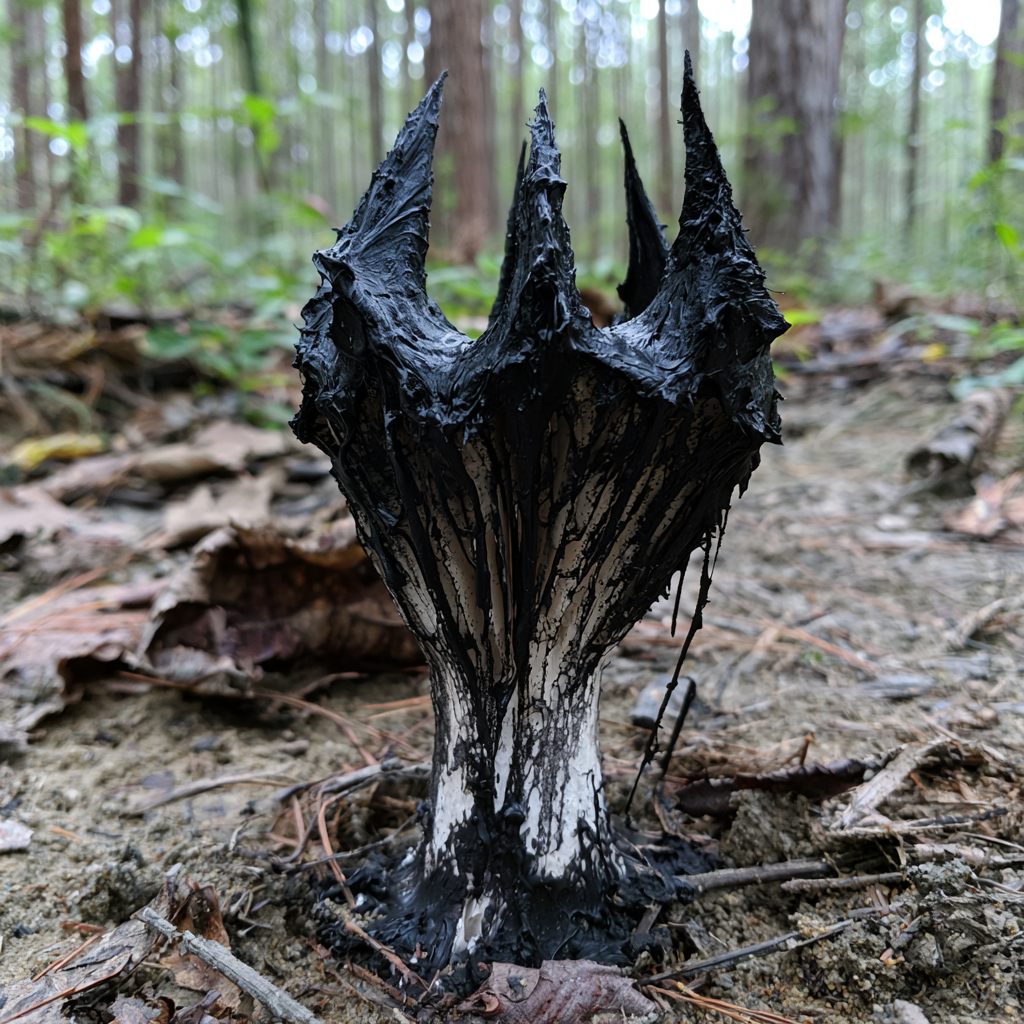
A Reaper's Crown mushroom in a forest — AI Concept by Nulcheck (via Midjourney)
Reproduction
Similar to other basidiomycetes, Reaper's Crown reproduces only through sexual spores, yet also has a distinct reproductive strategy that sets it apart from many of its fungal relatives. Interestingly, unlike typical fungi that often self-fertilize, Reaper's Crown requires haploid spores sourced from other specimens to successfully form a mature diploid gamete cell, from which a new specimen of this fungus can grow. Research suggests that a now-extinct beetle once played an essential role in the life cycle of the Reaper's Crown fungus. This insect is believed to have been the sole carrier of its spores, effectively "pollinating" the mushrooms as it traversed the forest floor. Subsequently, a mature spore would then exhibit similar behaviors of other fungal spores, relying on environmental cues, such as light, moisture, and temperature, to germinate and begin growing the fungus. This symbiotic relationship likely facilitated the spread of the fungus in its habitat, allowing it to establish more widespread populations. However, a significant challenge for the fungus is the presence of a black, slimy liquid that envelops the mushroom. This viscous, toxic substance protects the mushroom from predators and the immature spores from dispersal through the air. Subsequently, the extreme toxicity of the slime would ensure the death of insects and other animals, thereby enabling the mushroom to thrive and prolong its existence until a beetle inadvertently participates in its reproduction. As a result of these unique adaptations, the Reaper's Crown fungus is no longer widely distributed within its native forest. Currently, only a small number of individual specimens are known to exist.Uses, Products & Exploitation
In the early 900s, a dedicated mycologist was conducting extensive research on the rare fungus that had come under threat of extinction. When accidentally exposed to an acidic solution, the mycelial cells produced an excess of chitin nanomaterials. This biopolymer exhibited remarkable properties, making it an excellent candidate for bioplastic production. The discovery was groundbreaking, sparking a new interest in natural materials and leading to a significant boost in the industry. As the years progressed, advancements in genetic engineering led another scientist to develop a genetically modified strain of the fungus. This version was engineered to produce various forms of chitin, and at a much more efficient rate. Additionally, the modification altered the fungus's reproductive mechanisms, enabling a more streamlined and convenient method of replication and large-scale production. The introduction of this genetically altered fungus prompted a small debate among mycologists and taxonomists. Many argued that this modified fungus should be reclassified, as it no longer conformed to the original species' taxonomic criteria, particularly because fungal classifications often hinge on reproductive methods.Trivia
References
1. "Toxicoscordion paniculatum" — on Wikipedia, October 14, 2025.2. "Andrena astragali" — on Wikipedia, March 30, 2026.
3. "Aspergillus niger" — on Wikipedia, March 26, 2026.
4. "Bioplastic" — on Wikipedia, May 18, 2026.
5. "Five different chitin nanomaterials from identical source with different advantageous functions and performances" — on ScienceDirect, February 1, 2019.







Very cool! (You've already grabbed the badge so woot!)
Glad you liked it! Thank you for hosting the challenge!
> Root Directory is my hub world <
Legends of the Dragonguard • /dev/null
Summer Camp 2026