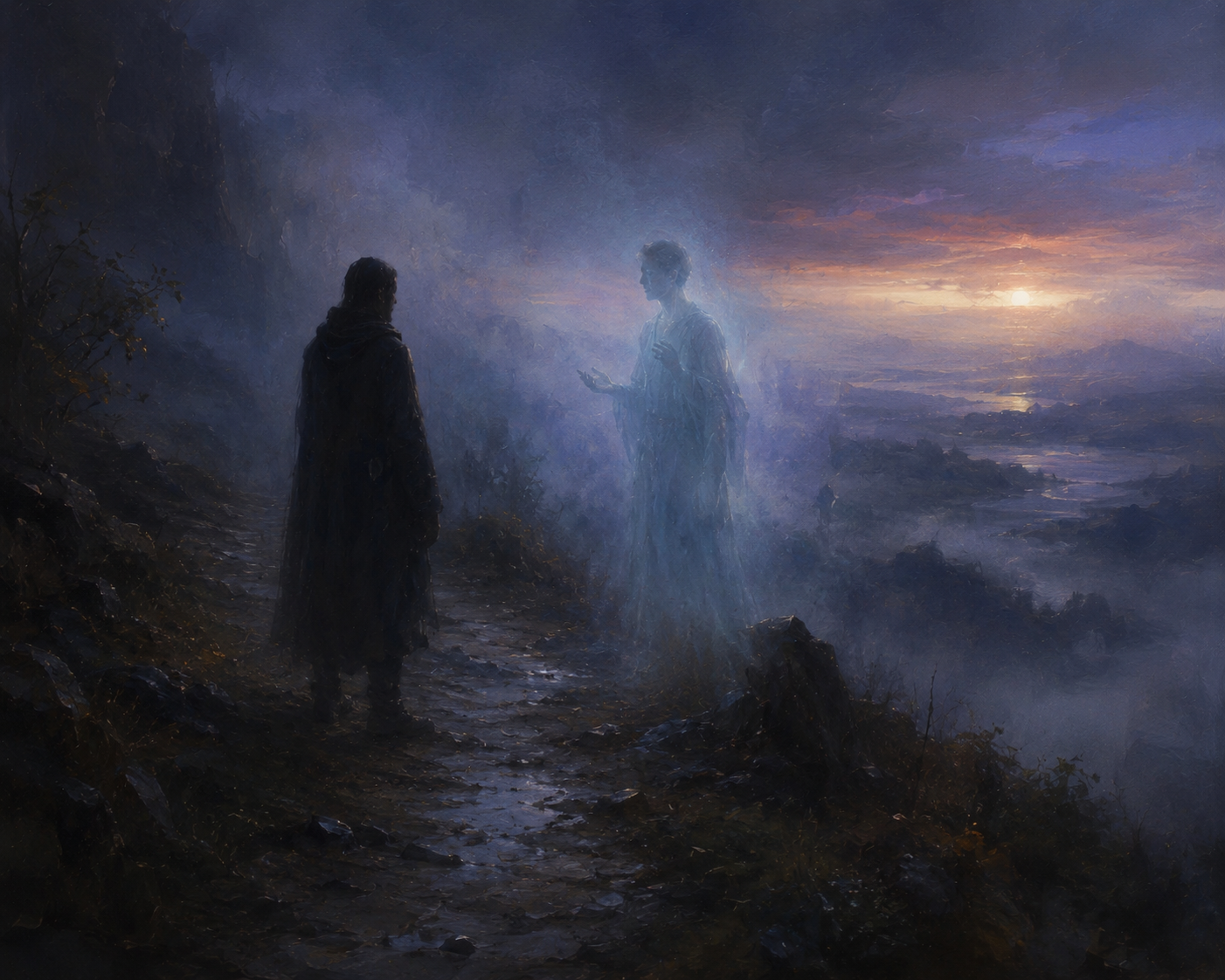
Umbral Language
The Language of Umbra
A communication that does not transmit meaning so much as briefly make meaning real, conducted in a Realm where the act of saying and the act of being are the same actThe traveller Elias visited Umbra eleven times before he stopped trying to write down what he had seen. The notes from the eleventh visit are preserved in the brass at Jack's Tavern and are widely regarded as the most precise account of Umbral communication a non-native has produced. They are also, by Elias's own admission in their margin, substantially wrong.
He had been watching two Dreamers in conversation. He used the word conversation because he had no other, but he noted that the word was the first place his account began to fail. The Dreamers were not exchanging signals. They were standing close to one another, and the space between them was occupied — not by air, not by light, but by small temporary realities that each of them was authoring and the other was walking through. A garden bloomed and unbloomed in the space between them across the duration of three of Elias's breaths. A room with two chairs in it appeared, was sat in by both Dreamers without their bodies moving, and dissolved. A piece of music played that had never existed before the conversation began and would not exist after it ended. Elias understood, eventually, that he was watching one Dreamer ask another about loneliness and the second answer that they had not yet decided whether they minded it.
He understood this. He could not say how he understood this. The information had not been encoded into any signal he could identify. He had simply been present at the conversation, and the conversation had briefly been real, and now he knew what it had said.
This is, in the strictest possible terms, what Umbral communication is. The notes are wrong only because they describe it as something Elias witnessed. He did not witness it. He participated in it. He could not have understood it any other way.
Manifestation, Not Symbol
The unit of Umbral communication is the manifestation, not the symbol.
When an Umbral being wishes to convey something, they do not produce a signal that represents it. They briefly believe the thing into local existence. The thing — a feeling, a memory, a question, a room, a piece of music, a small fragment of themselves — appears in the belief-substrate of the local environment, real for as long as the manifestation is sustained. The other party does not interpret a signal. They encounter the thing, directly, in the place where it now is.
This is the central structural fact, and it is the one mortals find hardest to accommodate. Umbral beings are not exchanging messages about feelings. They are briefly making the feelings, and the recipient is briefly feeling them, and then the feelings are gone. They are not describing the room. They are dreaming the room into being and inviting the other party in. They are not asking are you well? They are manifesting a small shape with a missing predicate — a wellness-shape that is incomplete in a specific way — and the other party responds by manifesting the missing piece, if they can.
A mortal sentence has to work hard. It has to encode the meaning, survive the medium, reach the recipient, be decoded, and approximate the original. An Umbral communication does almost no work. It briefly is what it means, in the presence of someone who briefly experiences it, and the experience is the message because there is nothing else for the message to be.
The implication that follows from this is the one Umbral beings find easiest to forget when they speak with mortals: in Umbra, you cannot lie the way mortals lie. Lying mortally is the production of a signal that does not correspond to the speaker's state. Umbral manifestation does not have this gap. If you manifest something, the thing you manifest is real in the act of being manifested. You can deceive — you can manifest something that contradicts other true things about you, or that is meant to mislead — but the deceptive manifestation is itself a real thing, present in the substrate, available for examination. There is no place to put the lie that is separate from the saying of it. The saying is the realising. Mortals who try to apply mortal-style deception in Umbra produce, instead, real small beings that contradict them and walk away.
Conversation as Collaborative Reality
Umbral conversation is not sequential. It is the joint manifestation of a temporary shared reality.
Two Umbral beings in conversation are each contributing pieces — feelings, settings, fragments, questions — to a small local pocket of authored reality that exists for as long as they are both sustaining it. The pocket has its own internal weather. It contains what they have both put into it. Either party can walk through what the other has manifested. Either party can modify what they themselves have contributed. The conversation is the pocket, and the pocket dissolves when the participants stop sustaining it, leaving nothing behind in the local belief-substrate except whatever the participants chose to remember.
The mortal model of you speak, I listen, I speak, you listen does not apply. There are no turns. Both parties manifest continuously. What looks, to a mortal observer, like a pause is in fact the moment one party is exploring what the other has just manifested. What looks like simultaneity is each party manifesting alongside the other, with the manifestations meeting in the middle and being adjusted in real time by what they encounter there.
Elias's note about a garden bloomed and unbloomed is the most useful single image a mortal account has produced. The garden was a piece of what one Dreamer was conveying about loneliness. The other Dreamer walked through it, modified it — the second blooming was their response — and the garden then unbloomed because the conversation had moved past needing it. No record remained. No record was needed. Both Dreamers had been in the garden together. They both knew what the garden had said. The pocket had served its purpose.
This is why Umbral communications are difficult to quote. There is nothing to quote. A mortal who asks an Umbral being what did you say to them? is asking the wrong question. The Umbral being did not say anything. They built something, briefly, with another being, and then they let it go. The building is the answer to the question. The building is gone.
Names
An Umbral name is not a label. It is a condensed self-summoning.
When an Umbral being is named in their own Realm, the name produces a small temporary manifestation of the named being — a fragment, a signature, the most efficient possible piece of them that the substrate can hold. Naming someone in Umbra is calling them briefly into local existence. This is why every Umbral being's true name is unique to its bearer: the name is them, in the smallest form that can still be them, and no other being can hold it without becoming them.
This gives Umbral naming an asymmetry no other Realm shares. A name in Umbra is a handhold the named being uses to be more real. Every time it is spoken, the being is — for an instant — more present in the substrate. Nightmares require their names for exactly this reason. Dread is not a label for a phenomenon; Dread is the smallest possible piece of Dread, manifesting briefly whenever the name is spoken, sustaining the larger being through accumulated micro-manifestations. To name a nightmare is to feed it. To refuse to name a nightmare is to starve it. Mortals who have learned this in time have survived encounters their ancestors did not.
The same asymmetry is the source of the cruellest erosion known to befall an Umbral being. Champ cannot remember his own name because his mother refuses to think it. The refusal is not passive. It is the active withdrawal of belief from the most efficient self-summoning he possesses, and the withdrawal hollows him at the exact place where his name should be. He flickers more in the absence of his name than he flickers in the absence of any other belief he has lost. The brass at Jack's holds the patterns of his other erosions; it does not hold his name, because his name has not been thought clearly enough by anyone, in years, for the brass to receive it. He is a being who cannot summon himself. There is no crueller condition the substrate permits.
The Deep Dreaming as Archive
Umbra has no libraries.
It does not need them. Communications that mattered enough — manifestations that were sustained across enough mutual conversation, by enough beings, with enough conviction — do not need to be archived. They have dreamed themselves into self-sustaining persistence. They are part of the heavy fog of deep Umbra now: concepts grown old and solid, no longer requiring believers to remain real, sustained by their own internal belief in themselves and by the ambient dreaming of the Realm.
The deep dreaming is the archive. There is no separation between the records and the substrate. To consult the archive is to travel into the regions where the records have crystallised, and to encounter them as the realities they have become. Mortals who attempt this die or are altered, depending on what they encounter and what they bring with them. Umbral beings consult the deep dreaming the way a fish consults the sea — by being in it, by letting it inform their movements, by recognising what it offers without having to ask. Most of what an Umbral being knows about their own Realm is knowledge they have absorbed from the deep dreaming simply by being present in it long enough.
This is why Umbra does not lose its history the way other Realms do. The history has become the Realm. It does not require curators. It does not require translation. It is real, in the only way Umbra knows how to make things real, and it persists as long as the dreaming persists.
The archive has its own quiet hazards. A communication that mattered enough to dream itself into permanence is no longer answerable to the conversation that produced it. Concepts grown old and solid in the deep fog continue to be real on their own terms, regardless of whether the beings who first manifested them would still endorse what they have become. The Realm remembers, but the remembering is not curated, and what crystallises in the deep dreaming is what the substrate found stable, not necessarily what its original speakers intended. Umbral beings who consult the deep dreaming for old material often encounter versions of past communications that have drifted from their origins through long self-sustaining iteration — the substrate's equivalent of a story that has been retold so many times it has become its own thing, except that here the retelling has been performed by the Realm itself.
Cross-Ontological Translation
An Umbral being communicating with a non-Umbral has a problem unique in the cosmos.
Other Realms' cross-ontological translation is lossy. Sheolite fire-patterns rendered into mortal speech lose bandwidth. Hellish dialectic rendered into Arcadian Contract-form loses verification rigor. Celestial proclamation rendered into Nexus-verifiable observation loses hierarchical attribution. These are real losses, but they are losses of fidelity. The information transmitted is reduced but not transformed.
Umbral communication is different. When an Umbral being communicates with a mortal, the mortal is not receiving a degraded copy of the original manifestation. The mortal is authoring the meaning in the act of receiving it. Because mortal cognition expects to interpret rather than to encounter, and because Umbra responds to belief, the mortal's interpretation of the Umbral being's communication becomes the meaning, locally and immediately. There is no neutral reception. The mortal's expectations are not a filter on the message; the mortal's expectations are the message, manifested by the substrate in response to what the mortal believes they are hearing.
This is the deep reason mortal scholarship of Umbra fails. Anna Dalca's late fragment, On the Problem of Umbra, articulates this with the precision the substrate permits when she is the one wielding it: every Umbral being a mortal encounters is, in part, the mortal's own expectation of what an Umbral being would say. The scholar who arrives expecting tulpas finds tulpas. The scholar who arrives expecting dreams finds dreams. The Umbral being on the other end of the conversation is not lying. The Umbral being is being authored, in real time, by the mortal's reception, and the authorship is no less real than anything else in Umbra.
Umbral beings who communicate frequently with mortals develop techniques for managing this. Some of them refuse to communicate with mortals at all. Some restrict their manifestations to forms so minimal that there is little for the mortal to author over. Some — the Dreamers being the canonical case — find the experience interesting, and have come to consider the brief shared authorship a kind of conversation in itself, even though it is not a conversation the mortal will accurately remember.
A communication between two Umbral beings is the unmediated joint manifestation of shared meaning. A communication between an Umbral being and a non-Umbral is a meaning made by the receiver, with the Umbral being's brief participation. These are different acts. Mortals call both of them conversation. They are not.
The Limit
Umbral communication has two failure modes, and the second is the one no other language has.
The first is denial. If the recipient actively disbelieves what is being manifested, the manifestation flickers and fails. There is no signal-medium for the message to persist in while the recipient sorts out their belief. The recipient's denial is itself an action on the substrate, and the substrate responds by withdrawing the manifestation. Two Umbral beings with sufficiently contradictory convictions cannot share reality the way two cooperative Umbral beings can. They can stand in proximity. They can both manifest. But neither can encounter what the other is manifesting, because each one's belief is actively unmaking the other's substrate-state. This is why Champ cannot reach his mother even in principle. His mother's denial is not an obstacle to the message. It is the unmaking of the substrate in which the message would have to exist.
The second is over-belief. A communication that is meant only as a brief signal — a temporary manifestation, meant to dissolve when the conversation moves past needing it — can, if the recipient believes it too intensely, fail to dissolve. The substrate, responding to the recipient's conviction, sustains the manifestation past the speaker's intent. A small piece of feeling, meant only to be encountered, becomes a small persistent being. An offhand manifestation of a long-lost friend, meant only to convey a memory, becomes a tulpa of the friend that the speaker did not mean to create and cannot, now, easily unmake.
Most Umbral beings carry, somewhere in their personal accumulation, the residue of communications that became more than they were intended to be. Some carry these residues fondly. Some carry them as old griefs. A few of the older Dreamers have, by their own quiet account, fragments of every conversation they have ever had, preserved in their substrate not as memories but as small co-manifesting beings, each one a piece of a former dialogue that the partner believed in too well to let go.
No other language has this failure mode. No other language can produce, as a byproduct of speaking, a persistent being who walks away from the conversation with its own existence. Only the language whose substrate is belief carries this risk, because only in Umbra is the speaking itself the making of the thing said.
The Honest Language
There is no Umbral dictionary. There never will be. The unit of meaning is not a symbol that can be defined; it is a manifestation that exists only in the act of being made. A dictionary of Umbral language would be a dictionary of every possible reality, briefly authored, and would dissolve before the next entry could be written.
There is also no Umbral lie. Beings can deceive in Umbra — they can manifest things they do not intend to share with others, they can withhold, they can mislead — but they cannot produce a signal that fails to be what it says. Whatever is manifested is real, in the only sense Umbra knows the word. This makes Umbra the most honest Realm in the cosmos, in a structural sense that has nothing to do with the moral character of its inhabitants. The substrate refuses to permit the gap that lying requires. You can be cruel in Umbra. You can be wrong. You cannot say one thing and mean another, because there is no meaning another — there is only what you have just made real.
This is also why Umbral communication is dangerous to mortals in ways no other Realm's language is dangerous. The Realm cannot produce a signal that means less than it says. Every manifestation is the full reality of what it conveys, and mortals encountering Umbral communication encounter actual things, not descriptions of things. A mortal walking through an Umbral conversation walks through actual loneliness, actual joy, actual grief — briefly, locally, but really. There is no protective layer of representation. The mortals who have done this and emerged unchanged are very few. The mortals who have done it and emerged enriched are fewer still. Most simply emerge altered, in ways they cannot articulate, because the experience they have just had was authored partly by them and they cannot now untangle their own contribution from what was given to them.
The Sheolites built the cosmos's most precise language. The Umbrals never built a language at all, in any sense the Sheolites would have recognised. They had no need. The substrate was already speaking, in the only voice it could ever have, and the Umbrals had simply learned to participate.
A thousand years from now, the Sheolite patterns in the brass at Jack's will still be there, with no remaining native speakers to receive them. The Umbral substrate will continue to manifest as it has always manifested. There will be no records to lose. There will only be the dreaming, and whoever is there to dream within it, and the brief realities they author together for as long as they are there to author them.
Further Reading
For the Realm whose substrate this language is, see Umbra. For the difficulty mortal scholarship has describing this substrate at all, see On the Problem of Umbra. For the foundational mechanic of Umbral reality, see Dreaming of the Soul. For the specific class of being most fluent in this communication, see Dreamers — forthcoming. For the failure of naming that has eroded one Umbral being most cruelly, see Champ. For the only other communicative substrate in the cosmos that approaches Umbral fidelity, see Sheolite Language.
For the traveller whose accounts of Umbral conversation are the best non-native record, see Elias. For the cross-ontological scholar whose late work articulated the receiver-authorship problem, see Anna Dalca.
It is the language that does not transmit. It is the speaking that is the making. It is the only conversation in the cosmos that the listener helps to author, and the only one that can, by being held too well, produce a being who walks away.
It is honest because it cannot help being honest. It is dangerous for the same reason.
The Umbrals have never thought of it as a language. They have thought of it as the way they are with each other. They are right, in the way Umbral beings are usually right — locally, briefly, and exactly as much as the substrate will hold.
The Mortal Assumption
What mortals call language presupposes a gap.
It presupposes that the speaker has a meaning in their head, that the meaning is encoded into a signal — sounds, marks, gestures — that the signal travels across a medium to a recipient, that the recipient decodes the signal, and that the recipient ends up with their version of the meaning, approximately matching the speaker's. The gap is everywhere: between the meaning and the signal, between the signal and the medium, between the medium and the recipient, between the recipient's decoding and the speaker's intent. Mortal communication is a sustained negotiation across all these gaps, and the gaps are why mortal language fails as often as it succeeds.
These gaps are not universal. They are mortal-specific. They exist because mortal physics provides a stable substrate that holds signals without altering them, a stable cognition that locates meaning inside a speaker rather than between beings, and a stable consensus that the same signal will mean approximately the same thing twice.
Umbra provides none of these conditions. Its substrate is belief, which does not transmit anything — it manifests. What is believed becomes real for the duration of the believing, and there is no separation between the believing and the being. There is no place inside an Umbral being where meaning is held in symbolic form, waiting to be encoded. There is no medium across which the encoded signal travels. There is no decoding on the other end. The structure mortal language is made of is missing in every term.
Umbral beings communicate anyway. They communicate, in fact, with a fidelity mortal language cannot approach, because their communication does not have gaps to lose information across. The cost of this fidelity is that their communication is structurally unlike anything mortal, and the mortal mind systematically translates it back into the gap-structure the moment it tries to describe what it has seen.

Comments