
St. Cuthbert Below
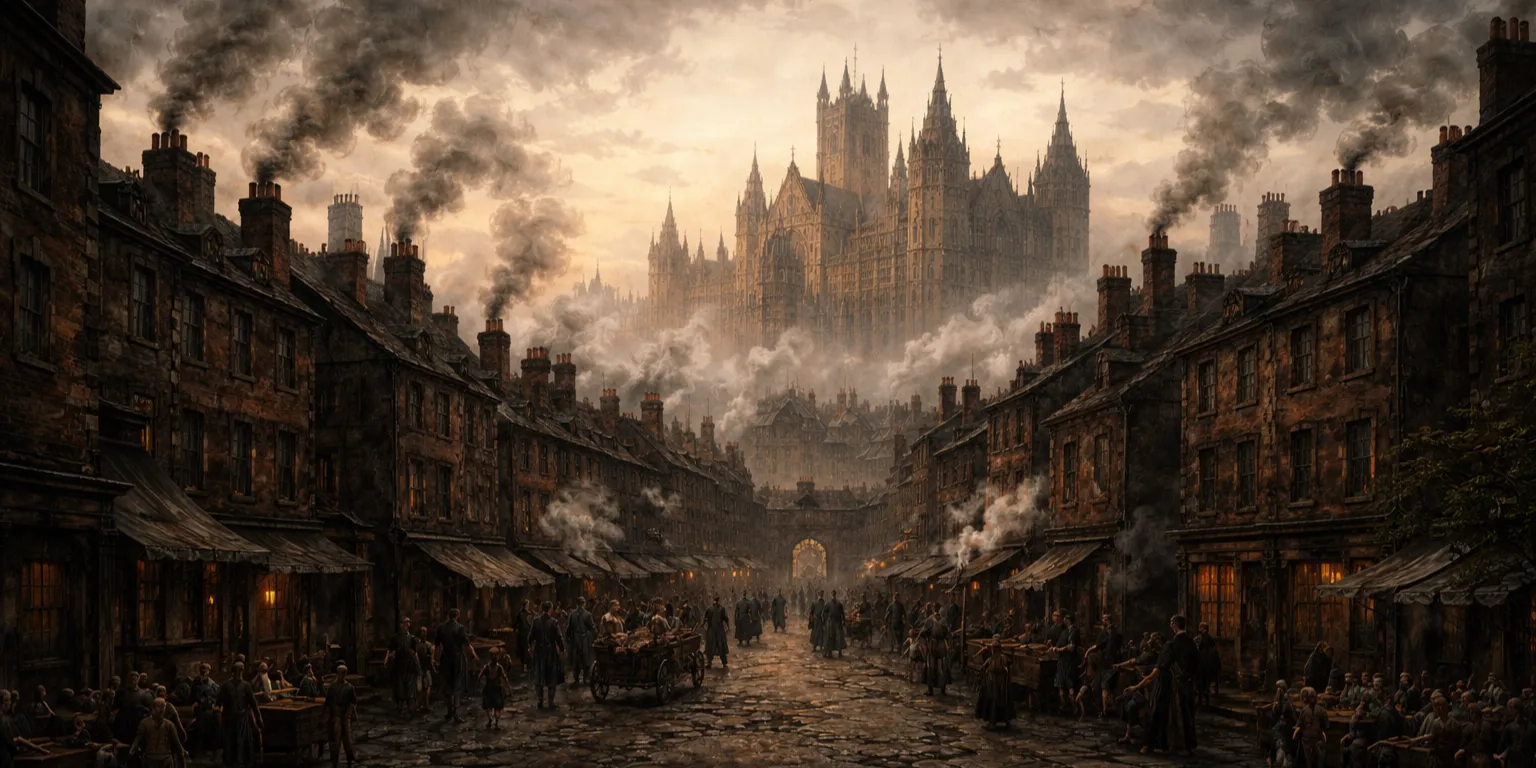
Technically speaking, the district of St. Cuthbert Below is not in the city of Lundeinjon at all, despite being located in the heart of the west bank and surrounded by the city on all sides. It is, legally speaking, the Liberty of St. Cuthbert, owned and controlled wholly by the Church of Albion. Over the last one hundred and fifteen years, however, its autonomy from the municipal government of Lundeinjon has been slowly eroded, as Parliament has passed a variety of laws removing various prerogatives of Liberties and the clergy. Today, the district exists in a state of transition, where ecclesiastical and civil authorities often clash over jurisdiction, so occupied with one another that many common folk can avoid their notice with little effort.
Demographics
St. Cuthbert Below is the poorest district in Lundeinjon's west bank area, with dense tenements crowding the streets of Crocus Hill and Coldwell. Gangs of adolescent pickpockets and sneak thieves are common in these neighborhoods, and each knows the precise boundaries of its territory. The area is also home to the administrative center of the Church of Albion, which employs thousands of lay persons and clergy in every capacity, from clerks and secretaries to cooks, cleaners, and other servants. The concentration of clergy in St. Cuthbert Below is higher than anywhere else in the Empire, all working to keep the bureaucracy of religion moving.
History
The Liberty of St. Cuthbert is older than the Empire itself, having been created in 1511 by King Edmund VII of High Albion to house the nascent General Conclave of the Church of Albion. The region was given over to ecclesiastical authority, and for the next two centuries it remained largely separate from the authority of the city surrounding it. Criminals would often flee into the Liberty to escape pursuit and claim sanctuary, for it lay outside the jurisdiction of the city and its civil courts. Between those seeking sanctuary and those seeking charity, the Liberty gathered many of Lundeinjon's poorest residents, and it remains the poorest district west of the Lunde today.
Unsurprisingly, the autonomy of the Liberty of St. Cuthbert caused a wide variety of issues and rankled the city authorities, who have gradually eroded it through legislation. The first major blow came in 1718, when Emperor Edmund I forced the ecclesiastical High Court of Morals to move from the Liberty into the newly constructed Greyspire as part of his legal reforms. This did not change the traditions or jurisdiction of the ecclesiastical courts, but the move was seen as a sign that the Church of Albion was no longer a purely independent judiciary.
Another major blow came in 1765, when Parliament passed legislation banning the charging of tolls for the use of streets within Liberties - a practice already abolished in most of the Empire, but which lingered in the Liberty of St. Cuthbert. This led to a week-long riot, led by lay residents of the Liberty at the instigation of the clergy. In the end, the toll gates were torn down and the streets of the Liberty of St. Cuthbert became public thoroughfares.
Two further blows came in 1789 and 1790. First, the Police Act established that the newly formed Lundeinjon Metropolitan Police Force could establish a constabulary within the Liberty of St. Cuthbert and enforce the laws of the city within its bounds. This did not remove the authority of the ecclesiastical bailiffs, and the two forces remain in place today, with frequent clashes over the minutiae of jurisdiction. This was followed in 1790 by the Sanctuary Act. Historically, the Liberty was a legal sanctuary where civil debtors could not be arrested; the Sanctuary Act modified the law such that "sanctuary" applied only to those seeking spiritual penance, not those fleeing financial obligation. This led to the arrest of many impoverished gentlemen who had taken refuge from their debts within the Liberty and allowed the constables stationed in the district to carry out their duties in full.
The 1789 Police Act also led to what many of the clergy considered the greatest insult of all: Lundeinjon's municipal map. The final map of the city's constabularies, drawn up by the LMPF, placed the cathedral of St. Cuthbert-on-High and its immediate surroundings in the district of Highcourt, while placing the rest of the Liberty in the district of St. Cuthbert Below. This division was seen as a deliberate attempt to break the power of the Liberty by separating it into two parts and continues to be a sore point forty years later.
These and other acts have resulted in the district being largely incorporated into the city structure, rather than remaining an autonomous unit. The Church of Albion no longer controls the borders of the district with tolls and bailiffs, nor is it capable of barring entry or excluding civil authorities. It still owns most of the land within the Liberty, but holds no prerogatives beyond those of any other landholder.
Feeling its power slipping, the Church has responded by increasing its force of bailiffs and initiating a crackdown on "moral crimes," especially sacrilege, which it defines as any offense against the Church or a member of the clergy. Robbing a vicar, stealing from a churchyard, refusing to tithe, or slandering a bishop are all considered sacrilege, to be tried in an ecclesiastical court according to the rules and traditions laid down by the High Court of Morals. Such offenses are treated as having precedence over civil crimes, allowing the bailiffs to take custody of those accused of both, regardless of the wishes of the city authorities. This struggle has caused many headaches in the halls of Greyspire and shows no sign of ending.
Points of interest
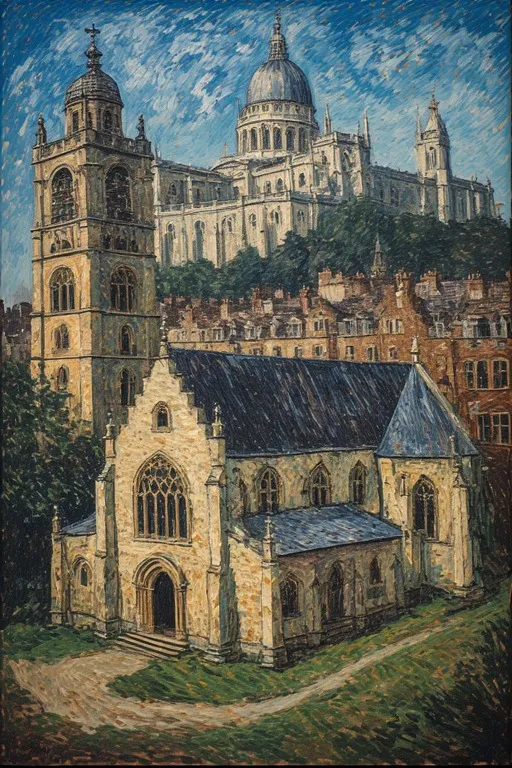
The Liberty of St. Cuthbert revolves around one major landmark: the Archbishop's Palace. Built in 1180 as the seat of the Archbishop of Lundeinjon, the palace was seized by the Crown when High Albion split from the Old Churchin 1510. In 1511, it became the administrative center of the Church of Albion, home to the General Conclave, the gathering of bishops and archbishops that determines matters of theology and church policy.
The palace houses offices for each of the archbishops of the Church, and for many of its bishops as well, although these are often occupied only by a few clerks handling routine matters, except when the bishop is in the city. Possession of an office within the Archbishop's Palace is considered a mark of status within the ecclesiastical hierarchy, and such offices are fiercely contested. Those unable to secure one instead maintain offices in the “Procurator Houses” that surround the palace.
The Archbishop's Palace is also home to the Archbishop's Library, the official library of the General Conclave and the principal repository of the Church of Albion's records. It is overseen by the Registrar of the Church and contains an extensive collection of materials relating to ecclesiastical history, including the archives of the archbishops dating back to the 12th century, as well as those of other church bodies and various missionary and charitable societies. Among its holdings are manuscripts dating back to the 9th century. It is also the site where the Church stores copies of the Parish Registries, which are intended to record all births, deaths, and marriages within the Empire. These registries vary in quality depending on where and when they were compiled, but they remained the most comprehensive record of the Empire's population until Parliament instituted the Imperial Census in 1801.
Outside the immediate vicinity of the palace, the district is marked by poverty and institutions of charity and correction. The neighborhood of Coldwell, in the northern part of the district, is home to two complementary institutions: the Coldwell House of Correction and the Coldwell Workhouse.
The Coldwell House of Correction is a prison maintained for the exclusive use of the ecclesiastical High Court of Morals, one of the Empire's four High Courts. Its inmates are convicted of moral crimes such as adultery, sacrilege, or blasphemy. It houses both male and female prisoners, kept strictly segregated, and enforces strict rules of silence. Inmates are required to speak only when ordered to do so. The institution makes heavy use of the treadmill and other forms of hard labor, with the stated aim of reforming inmates through penance.
Adjacent to the prison, the Coldwell Workhouse provides housing and occupation for up to five hundred impoverished persons, and also distributes out-relief to the district's widows, aged, and infirm. It was originally constructed in 1707, when it could accommodate only ninety people, but has since been greatly expanded and now includes an infirmary and a chapel. It also contains apartments for the Master of the Workhouse and a committee room for meetings of the Poor Relief Board, a body established by the Church of Albion to oversee its charitable efforts within Lundeinjon.
Also in the Coldwell neighborhood is the Church of St. Mary-in-the-Cold. It is home to the Coldwell Sisters, an order of women who have dedicated their lives to the Church and to ministering to the poor. They are often found in and around the Coldwell Workhouse, where they provide care for the aged and infirm.
The eight bells of St. Mary's peal out a distinctive melody, known simply as Cold Mary's Chimes, which can be heard across the neighborhood.
On the southern side of the district lies the neighborhood of Crocus Hill, which blends into Monksfield behind St. Cuthbert-on-High. Here stands The Foundling Hospital for Deserted Children. Founded in 1719 by Horace Waite, a sea captain and philanthropist, it is dedicated to the care, maintenance, and education of abandoned children. Though not formally an institution of the Church of Albion, the Archbishop of Lundeinjon sits on its board of directors.
The hospital primarily cares for abandoned infants and very young children; children older than twelve months are seldom admitted, except in cases such as war orphans. At its height, it takes in up to four thousand infants a year.
Crocus Hill is also home to the Crocus Hill Ragged School, a charitable institution dedicated to the free education of destitute children. In addition to schooling, it provides food, clothing, lodging, and other missionary services. Established by the Church of Albion, it aims to steer poor children away from crime and vice and toward becoming productive and upright members of society. Its curriculum emphasizes reading, writing, arithmetic, and religious instruction.
Since its founding, the Ragged School has been the subject of ongoing debate in the editorial pages of The Albion Mirror, with letters both praising and criticizing the institution. It has been particularly criticized by the trustees of The Greythorne Trust for being overly permissive in its admissions, while members of The Fraternal Order of the Common Need have defended it and praised its efforts.
Related Articles
Visions of St. Cuthbert Below
Below are paintings of St. Cuthbert Below by some of Lundeinjon's most prominent artists.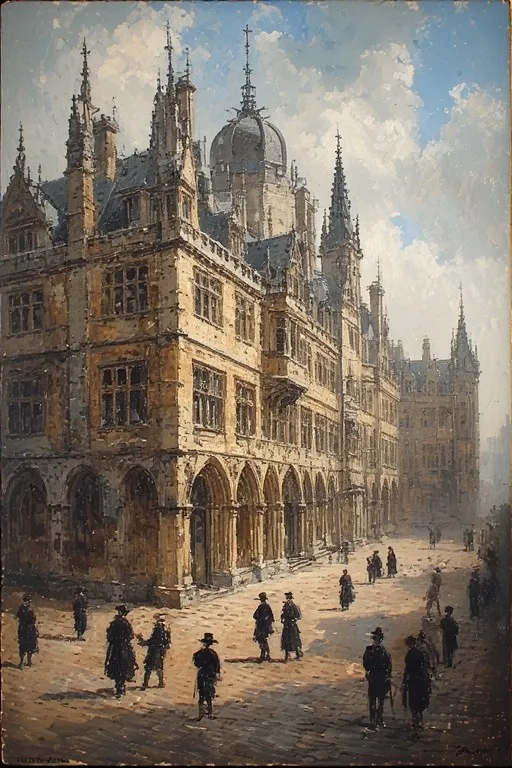
Archbishop's Palace, East Wing by Kersage Ashy
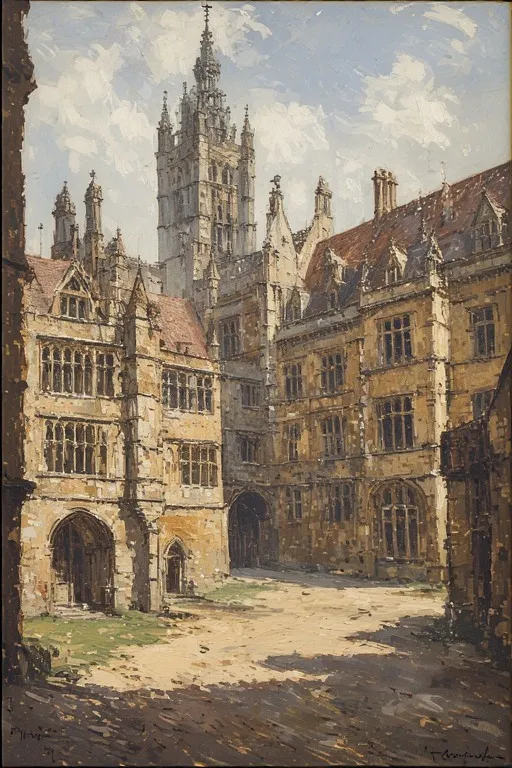
Archbishop's Palace, West Wing by Kersage Ashy
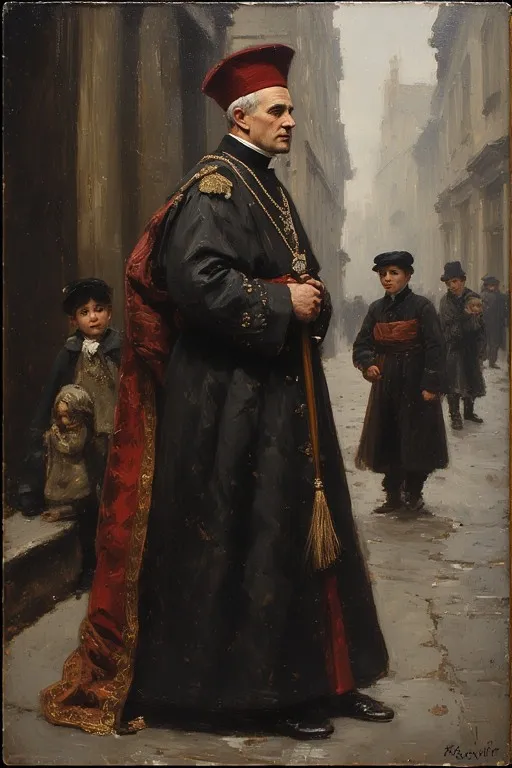
Charity by J.S.A. Carver
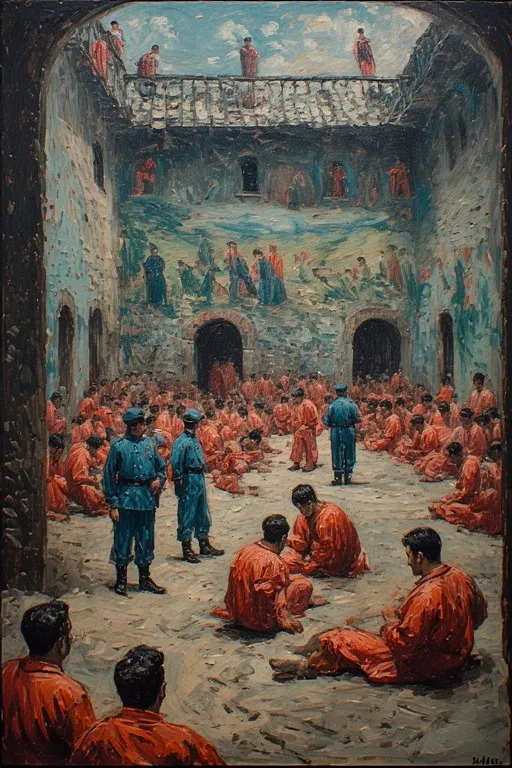
Coldwell House of Correction by Maex Darles
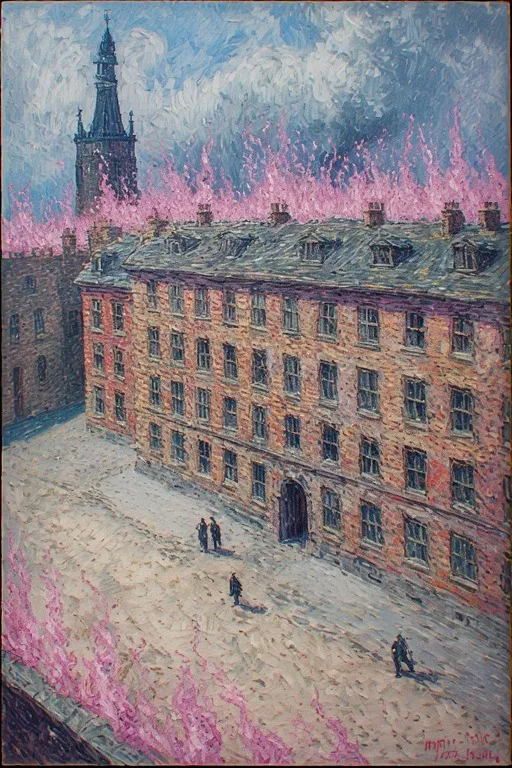
Coldwell Workhouse by Georges Deoilles
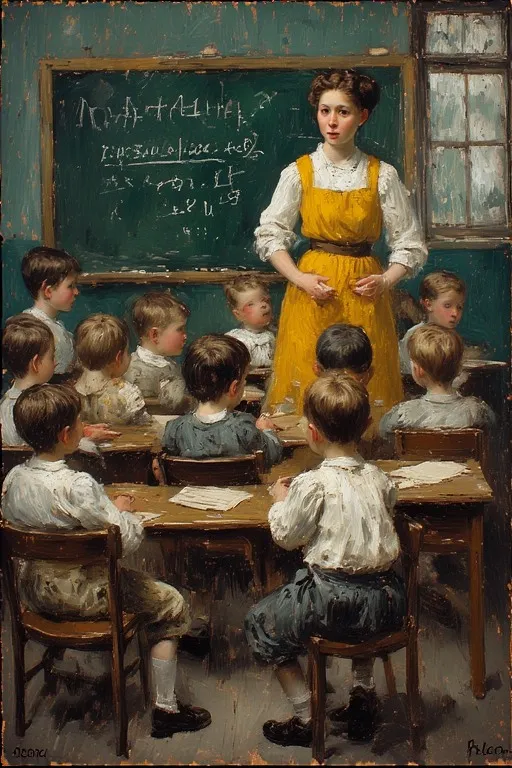
Crocus Hill Ragged School by Kersage Ashy
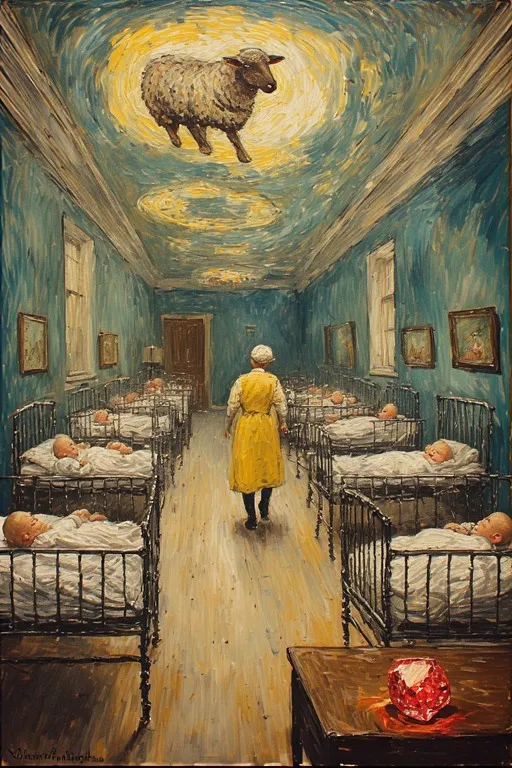
Foundling Hospital Ward by Kersage Ashy


Comments
Author's Notes
Thanks to Daernhelm for making the images in "Visions of..."