


Lost Choir
The Forgotten & The Innocent
"The cruelest ghosts are not the dead. They are the lives we promised would be different if only they waited a little longer."
The Lost Choir is born where hope endured longer than life itself.
Unlike many undead, it is not created by hatred, vengeance, or a refusal to accept death. Every soul within the Choir shared a final conviction that someone would come. A rescue party was on its way. Reinforcements would arrive before the walls fell. The mine would be opened from above. The ship would return with the tide. The storm would eventually break. A loved one would keep the promise they had made.
Some of those promises were genuine.
Many who became part of the Lost Choir were never truly abandoned at all. Parents searched until exhaustion claimed them. Soldiers died trying to reach trapped comrades. Entire rescue expeditions disappeared alongside those they hoped to save. Friends crossed impossible distances only to arrive days too late. Yet death has little interest in explanations. It preserves emotion far more faithfully than truth.
When these spirits gathered, they did not remember the reasons no one came.
They remembered only waiting.
Over years, decades, and sometimes centuries, individual memories faded into one another. Names disappeared. Faces blurred. The places where they died became indistinct. Even the identities of those they waited for slowly vanished. All that remained was an overwhelming certainty that someone had promised to return, and that the promise had never been fulfilled.
That certainty binds the Choir together more completely than chains ever could.
The Lost Choir does not seek revenge upon those who abandoned it because it no longer remembers who those people were. Instead, it drifts through the world searching for the living, hoping to awaken the same unbearable certainty within them. Every encounter is an invitation to remember every farewell that ended without reunion, every rescue that arrived too late, every friend left behind, and every promise that life itself prevented from being kept.
This influence is subtle.
The Choir does not fill minds with terrifying visions or supernatural commands. Rather, it reshapes memory. Necessary retreats begin feeling like personal betrayals. Difficult decisions become impossible to justify. Faces long since forgotten return unexpectedly to the forefront of the mind. Survivors often describe becoming convinced they have neglected some urgent responsibility, though they cannot immediately explain what it might be. The feeling persists until every old regret begins demanding attention at once.
Communities haunted by a Lost Choir seldom recognize its presence immediately because the changes appear entirely natural. Families become reluctant to let loved ones travel. Merchants postpone long journeys despite favorable weather. Rescue parties refuse to abandon hopeless searches long after supplies should have run out. Physicians exhaust themselves treating patients whose conditions cannot be reversed because walking away begins to feel morally impossible. Military commanders delay necessary withdrawals until defeat becomes inevitable. None of these choices are made through magical compulsion. Each simply feels like the only acceptable decision.
Eventually, entire settlements become trapped by their own inability to let go.
Places where the Lost Choir manifests almost always bear witness to prolonged waiting. Collapsed mines where trapped workers listened for digging that eventually stopped. Besieged fortresses whose defenders watched the horizon for allies that never arrived. Isolated islands where signal fires burned until the last of the fuel was gone. Villages quarantined during plague, prisons forgotten by the kingdoms that built them, expeditions buried beneath avalanches, and ships trapped within ice for winters that never seemed to end all provide fertile ground for the Choir's formation.
Such places share one defining characteristic.
Hope survived long enough to become its own form of suffering.
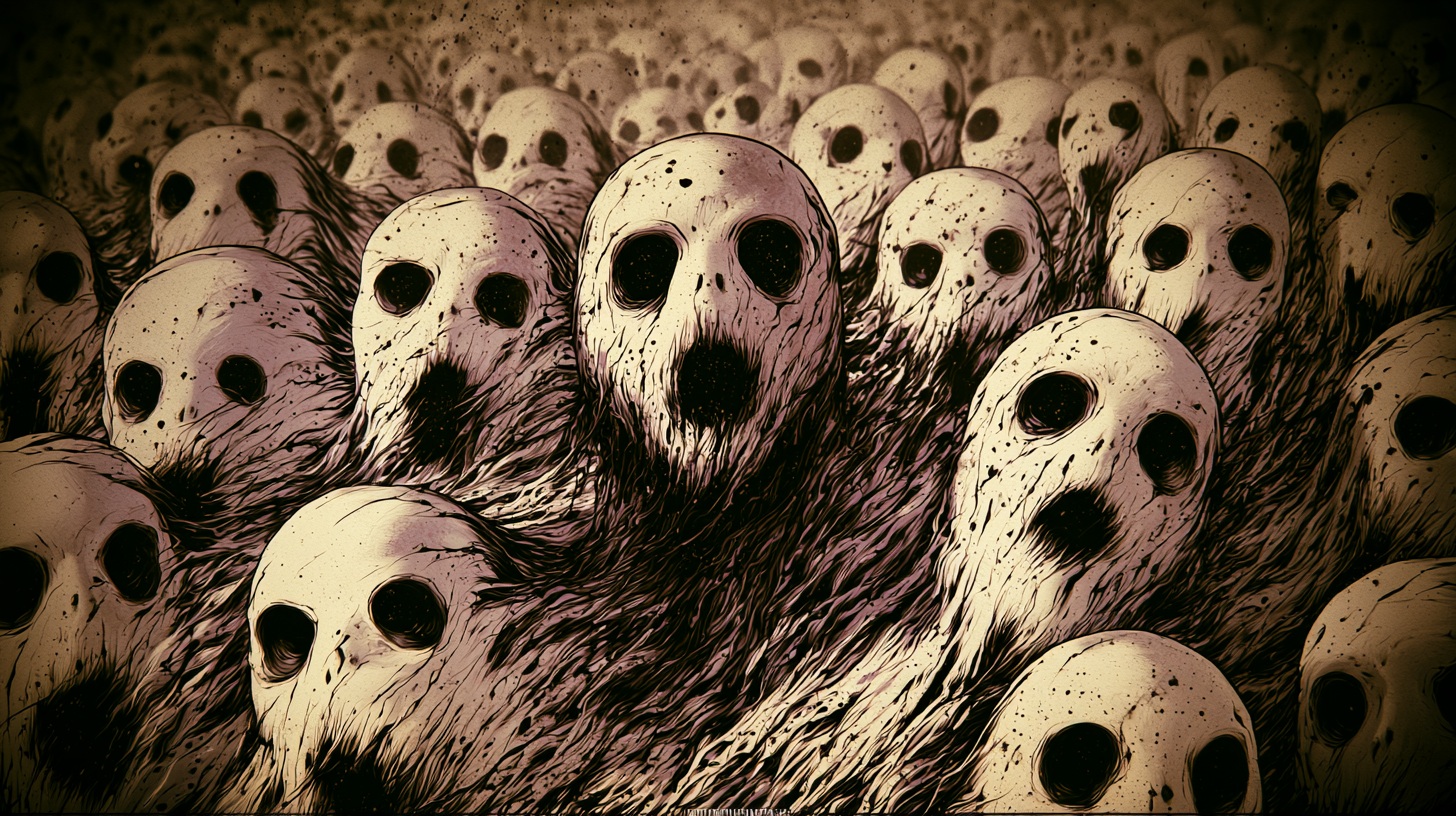
Witnesses describe the creature as a drifting congregation of spectral faces suspended within a pale veil of mist. The faces belong to every ancestry, every age, and every walk of life. Children drift beside old soldiers. Sailors hover beside miners. Nobles share the same mournful silence as beggars. None display anger. None scream. Their expressions remain remarkably calm, their eyes fixed upon the living with quiet expectation rather than hostility.
Many survivors later admit the most unsettling aspect of the encounter was the overwhelming sensation that the Choir recognized them.
Not as enemies.
As someone it had been waiting for.
Natural philosophers have struggled to classify the Lost Choir alongside other forms of undead because its behavior appears almost compassionate at first glance. It rarely rushes to attack. It seldom displays overt malice. Instead, it approaches slowly, surrounding its victims with voices that seem less accusatory than hopeful. Only gradually does that hope become unbearable, as every unanswered farewell and every impossible obligation begins pressing against the mind until reason itself gives way beneath the weight of remembered responsibility.
Priests often distinguish the Lost Choir from spirits born of anger or despair. It is neither furious nor hopeless. It exists in a state between the two, forever suspended within the final moments before disappointment becomes acceptance. In that sense, the Choir is still waiting. It has simply forgotten what it expects to arrive.
Those fortunate enough to survive an encounter frequently discover that the haunting does not end when the creature disappears. For weeks afterward they may hesitate before saying goodbye, find themselves writing letters they never intended to send, or awaken from dreams convinced someone is still waiting for them somewhere. Small delays begin provoking unexpected guilt. Forgotten obligations feel heavier than before. Promises, even trivial ones, become difficult to make without lingering unease.
Most eventually recover.
Some never entirely do.
The Lost Choir understands something the living spend their entire lives trying not to acknowledge. Every farewell carries the possibility of becoming the last. Every promise to return depends upon a future that no one is ever truly guaranteed. Most people continue living despite that uncertainty.
The Lost Choir cannot.
It remains forever suspended in the endless moment between hope and heartbreak, still waiting for footsteps that will never come.




Solomon? What are you doing to your players? There have been a concerning amount of choirs in the last several days, I worry for their safety. Jokes aside, a wonderful creation as always my friend!
Your freind,
The Graiffe
Working hard at Summercamp 2026
Heh. D&D is seriously lacking in monsters based on heavy emotion etc. memories, dream manifestations, all that stuff. I needed it for my mega-campaign/dungeon crawl playtest, so we had to make them ourselves. And you're right. Perhaps I've tormented the party for too long with these.... but perhaps not. ;)
I vote... not. Its never too much (:<
Your freind,
The Graiffe
Working hard at Summercamp 2026