

M-50WB Wide Bloom
M-50WB Wide Bloom
Official designation (illicit trade): M-50WB “Wide Bloom”
Common street names:
Big Cuisinart
Room Sweeper
Carpet Cutter
Wideboy
Angel Harp (used in some Eros and Titan circles)
“You throw Wide Bloom when you don’t want witnesses.”
Origin and manufacture
The Wide Bloom variant is not produced by any recognized defense contractor.
It emerged about 40 years after the original M-50 patents expired, first appearing in Mars orbital chop shops and later in underground fabs on:
• Eros
• Chendiuria industrial slums
• Titan shadow yards
• Europa fringe stations
• Deep Belt smuggler hubs
Most are built from:
• Reclaimed surplus M-50 casings
• Reverse-engineered wire spools
• Overclocked micro-deployment motors
• Black-market smart fuse chips
Production is small-batch and inconsistent. No two runs are exactly identical.
Primary modification
The Wide Bloom alters three core systems:
- Wire spool capacity: Spools carry 60 to 90 percent more monomolecular filament than standard.
- Deployment geometry: Instead of forming a tight 1.5 m square grid, the net blooms outward into a stretched diamond lattice.
- Expansion impulse: Uses an illegal high-density capacitor burst to overdrive the deployment frame.
Result: much larger but less mechanically stable net.
Effective net dimensions
Standard M-50: 1.5 m x 1.5 m
Wide Bloom: 2.3 m x 2.8 m (average)
Some unstable units exceed 3 m on one axis
Cut spacing
Standard: 25 mm cube grid
Wide Bloom: 25 to 35 mm irregular grid
Edges often tighten under tension
This produces uneven cutting patterns and more catastrophic tissue disruption.
Operational range
Standard M-50: Optimal 25 to 40 m
Wide Bloom: Optimal 15 to 28 m
Reduced range due to heavier internal mass and power draw.
Beyond 30 m, many units fail to fully deploy.
Fuse and trigger systems
Available fuse types (black market):
• Impact
• Proximity burst
• Short-delay airburst
• Manual remote trigger (rare)
Military-grade programmable fuses are uncommon and extremely expensive.
Failure rates are high: 6 to 12 percent misfire or partial bloom.
Deployment behavior
When functioning correctly:
• Canister opens in 2.3 ms
• Frame petals flare outward
• Wire lattice snaps into tension
• Net stabilizes for 0.6 to 0.9 seconds
During that window, anything intersecting the field is diced.
After tension collapse, wires recoil violently, often shredding surroundings.
Damage profile
Designed purpose: anti-drone interdiction
Actual use: anti-personnel area denial
Effects on personnel:
• Full body sectioning
• Limb detachment
• Organ extrusion
• Armor slicing up to light powered armor
• Partial penetration of medium exosuits
Because of uneven spacing, victims are rarely “clean-cut.” Trauma is worse than with standard M-50.
Collateral damage:
• Cuts structural supports
• Shreds cabling
• Ruins bulkheads
• Can destabilize walkways
It is notorious for causing secondary collapses.
Power system
Modified high-density capacitor pack
Output: 2.4x standard M-50 deployment energy
Tradeoff:
Battery degradation
Higher overheating risk
Occasional spontaneous discharge
Some units self-detonate if stored improperly.
Safety features
Almost none.
Most lack:
• Arming safeties
• Transport locks
• Temperature governors
Smugglers often ship them disassembled.
Accidental activation accounts for many deaths in fabrication rings.
Legal status
Banned everywhere under LOAC and colonial arms treaties.
Possession penalties:
Mars: life imprisonment
Chendiuria: capital offense in some districts
Titan: permanent exile
Europa: immediate seizure and detention
Corporate zones: summary execution
Even criminal syndicates restrict their use.
Typical users
Wide Bloom variants are used by:
• High-tier mercenary teams
• Assassination crews
• Pirate boarding units
• Elite gang enforcers
• Corporate black ops denials
Street gangs rarely use them due to cost and danger.
Notable syndicate links:
• Red Dragons (limited stock)
• Basalt Cartel (Eros)
• Kestrel Syndicate (Titan)
• Vantablack Ring (Europa)
Cost estimates
Per unit, illicit market:
Mars underground: 18,000 to 32,000 credits
Chendiuria: 39,000 to 55,000 credits
Eros: 42,000 to 62,000 credits
Titan: 20,000 to 40,000 credits
Europa: 25,000+ credits
Custom programmable fuse models can exceed 90,000 credits.
For comparison: standard M-50 usually sells for one-third of that.
Maintenance and shelf life
Maintenance and shelf life
Nominal shelf life:
5 to 7 years
Realistic shelf life:
2 to 4 years
Failure rate increases sharply after 30 months.
Requires:
• Climate control
• EMI shielding
• Quarterly capacitor refresh
Most users ignore maintenance.
Tactical doctrine (unofficial)
Among experienced operators, Wide Bloom grenades are used only when:
• Total area denial is required
• Collateral damage is irrelevant
• Escape routes are blocked
• Psychological shock is desired
Known accidents
Widely circulated incidents include:
• Eros Dock 19 massacre: partial bloom killed both attackers and targets
• Chendiuria Red Market collapse: net severed load supports
• Titan Shaft Riot: overuse caused hull breach
These incidents helped cement its reputation as “too dangerous for sane professionals.”
Relationship to LOAC
Wide Bloom variants are explicitly named in later LOAC revisions as prohibited escalation weapons.
Use against personnel qualifies as:
• War crime
• Terror weapon deployment
• Mass casualty device
No legitimate military force acknowledges using them.
Reputation
Among combat professionals, the Wide Bloom is viewed as:
• Effective
• Unreliable
• Morally radioactive
• Career-ending if discovered
Owning one is often enough to get someone killed by rivals who do not want that heat nearby.
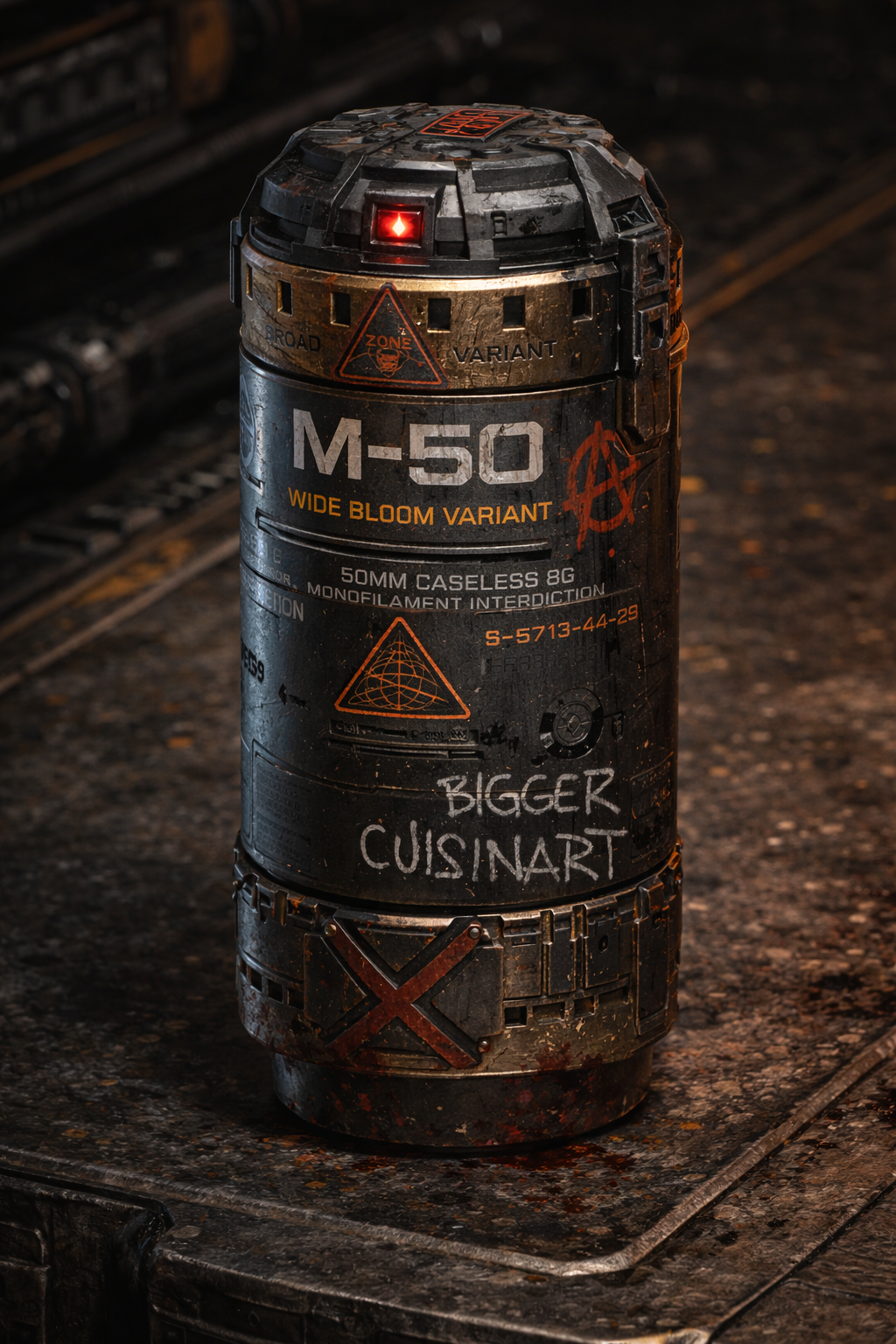
Exceptionally rare and very dangerous.
All artwork by me using ChatGPT.

Comments