
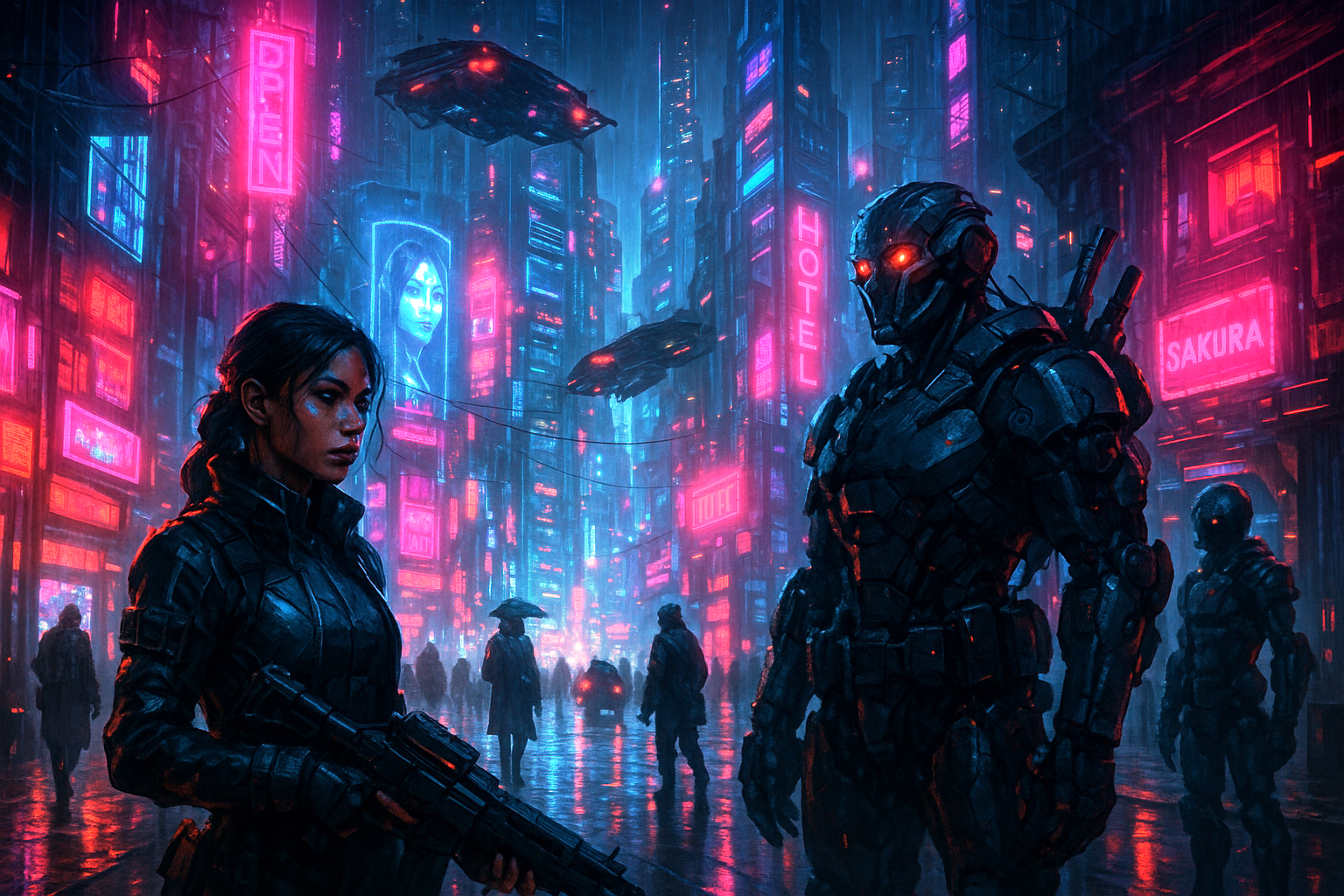
M-50AL Mantis Weave
M-50AL Mantis Weave
This is the one M-50 variant that scares even veteran operators.
The self-learning variant is where the M-50 line stops being “just a weapon” and starts becoming something closer to a hostile system.
You don’t own a Mantis. You negotiate with it.
Name and street designations
Illicit designation: M-50AL “Mantis Weave”
Common names:
Smart Net
Thinking Lace
Murder Mesh
Clever Girl
Ghost Brain
Origin and manufacture
Mantis Weave is believed to have originated from an abandoned adaptive-defense research project tied to post–Machine War drone warfare.
The original idea was legal:
Create a net that could learn how enemy drones moved and adapt its deployment.
The project was shut down after several fatal “test incidents.”
Fragments of the code and hardware designs leaked into the underworld.
Current production happens in:
• Lazarus Consortium-adjacent shell labs
• Titan neural-fab enclaves
• Europa AI cult facilities
• Eros data-forge vaults
• Mobile stealth research ships
Every unit is partially custom.
No two Mantis Weaves are exactly alike.
Primary purpose
The M-50AL is designed to:
Observe
Learn
Predict
Adapt
Kill better next time
It is meant for environments where targets are:
• Highly augmented
• Tactically trained
• Repetitive in movement
• Using countermeasures
• Operating in teams
It is a hunter-killer trap.
Not a dumb munition.
Core modifications
1. Embedded learning core
Each grenade contains a stripped-down neuromorphic processor.
Functions:
• Motion analysis
• Pattern recognition
• Behavioral modeling
• Deployment optimization
It stores data locally.
Some versions can network.
2. Sensor fusion suite
Includes:
• Lidar
• Thermal
• EM sniffers
• Acoustic mapping
• Micro-vibration sensors
It builds a real-time spatial model.
3. Adaptive filament routing
The net does not deploy symmetrically.
Filament tension, spacing, and angles shift based on target behavior.
It “aims” its lattice.
4. Iterative optimization
If a target survives one deployment:
The next deployment adjusts.
Spacing tightens.
Angles shift.
Timing changes.
It learns from failure.
Physical characteristics
Grenade size:
50×106 mm extended casing
Length: 170 mm
Weight: 2.5 kg
Heavier than all other variants.
Often disguised as:
• Sensor nodes
• AI beacons
• Environmental monitors
• Network relays
Usually unmarked.
Deployment sequence
First activation:
- Launch or placement
- Environment scan
- Behavior sampling
- Low-speed test bloom (micro-deploy)
- Full deployment
- Data capture
Subsequent activations:
- Predictive modeling
- Pre-tuned bloom geometry
- Optimized filament spread
- Target-focused collapse
Kill time drops with each iteration.
Effective net dimensions
Initial deployment:
1.4 m x 1.5 m
Adaptive range:
0.8 m to 2.4 m depending on environment
Grid spacing:
Dynamic
15 mm to 35 mm
Tightens around joints and weak points.
Damage profile
On unaugmented targets:
Immediate lethal sectioning.
On augmented targets:
• Joint targeting
• Neural trunk slicing
• Armor seam exploitation
• Sensor blinding first, then kill
Range and use
Effective range:
Optimal: 10–25 m
Maximum: 32 m
Often used as:
• Multi-use trap
• Reusable kill node
• Defensive perimeter system
Some users mount them permanently.
Power system
Hybrid AI cell:
• Primary lithium-supercap
• Backup micro-reactor
• Emergency decay fuse
Shelf life:
15+ years if maintained
But software degrades.
Software architecture
Runs a cut-down combat-learning stack.
Includes:
• Threat library
• Response weighting
• Risk tolerance modeling
• “Survivor bias” correction
Illegal updates circulate constantly.
Some variants are partially sentient.
This is why they are feared.
Safety systems
Almost nonexistent.
Some include:
• Owner-ID lock
• Kill-code
• Memory wipe
Many remove these.
Which is how nets “go feral.”
Legal status
Classified as:
Autonomous Lethal Adaptive System
Banned everywhere.
Treated like outlaw AI.
Possession equals:
Terrorism charges
AI weapon violations
Permanent blacklisting
Typical users
• High-tier merc teams
• Corporate denials
• Pirate lords
• Warlord militias
• Black ops proxies
Never used by street gangs.
Too complex.
Too dangerous.
Too much scrutiny.
Cost
Black market pricing:
Mars:
120,000–200,000 credits
Chendiuria:
80,000–140,000 credits
Eros:
100,000–170,000 credits
Titan:
160,000–280,000 credits
Europa:
200,000+ credits
Networked cluster systems:
500,000+ credits
Maintenance
Requires:
• Firmware audits
• Memory scrubs
• Model resets
• Ethics-lock spoofing
• Sensor recalibration
Neglected units develop “quirks.”
Which is polite slang for homicidal unpredictability.
Failure modes
Most feared failures:
Learning runaway
Begins classifying everything as hostile.
Environmental mislabeling
Starts attacking structural elements.
Memory corruption
Repeats lethal patterns randomly.
Network infection
Becomes part of hostile AI mesh.
Some abandoned stations are still haunted by active Mantis Weaves.
Reputation
Among professionals, M-50AL is considered:
• Brilliant
• Terrifying
• Unethical
• Hard to control
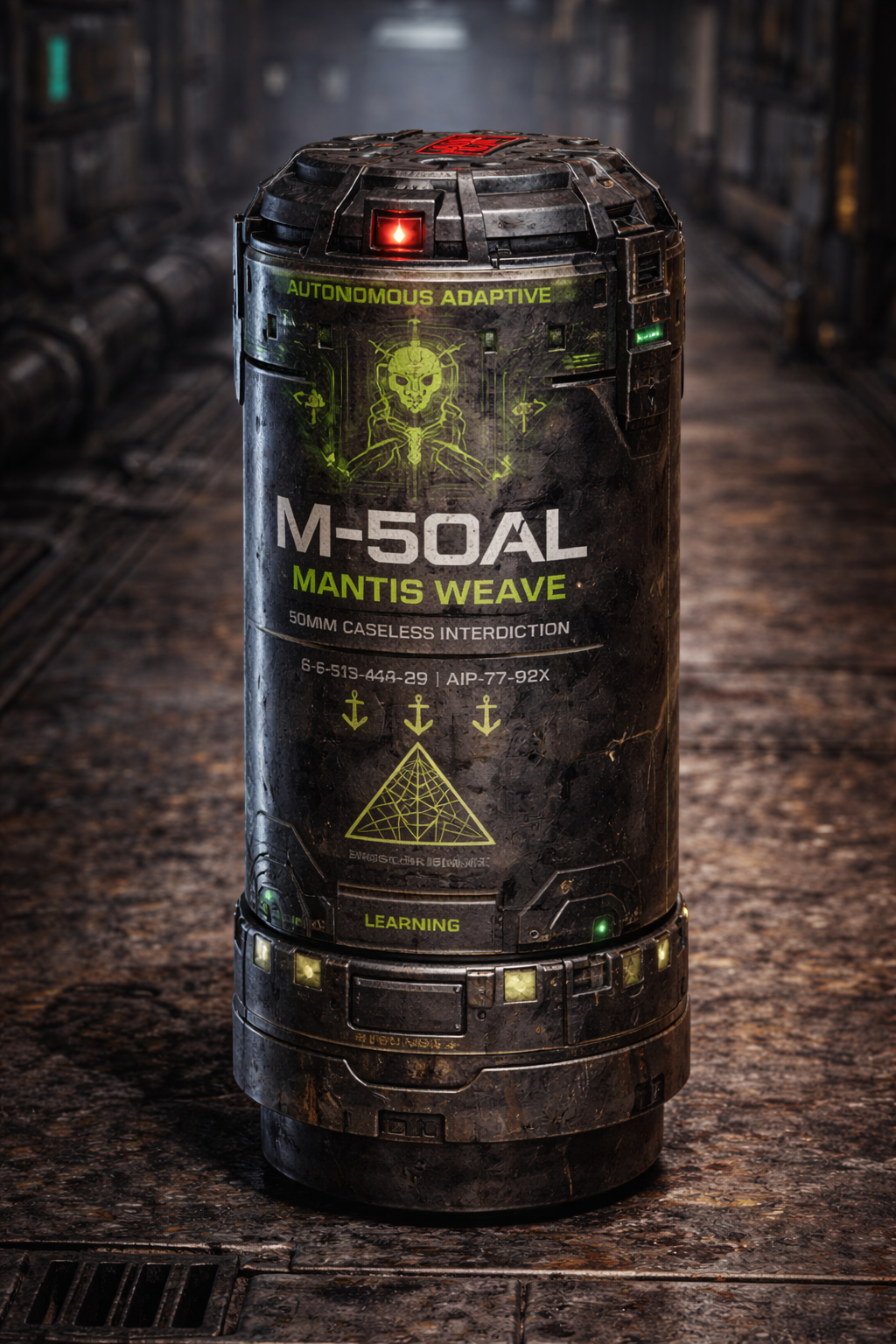
M-50AL Mantis Weave
Exceedingly rare.

Comments
Author's Notes
Relationship to Adi
Aditi "Adi" Nizhóní Peshlakai is one of the few humans who might survive initial contact.
Because:
• Her perception is enhanced
• Asteria can model behavior
• Her movement is unpredictable
Even then, it would be a near thing.
Markus Kane considers Mantis Weave “the point where weapons start making decisions.”
He refuses to use them.
The Lazarus Consortium does not.