

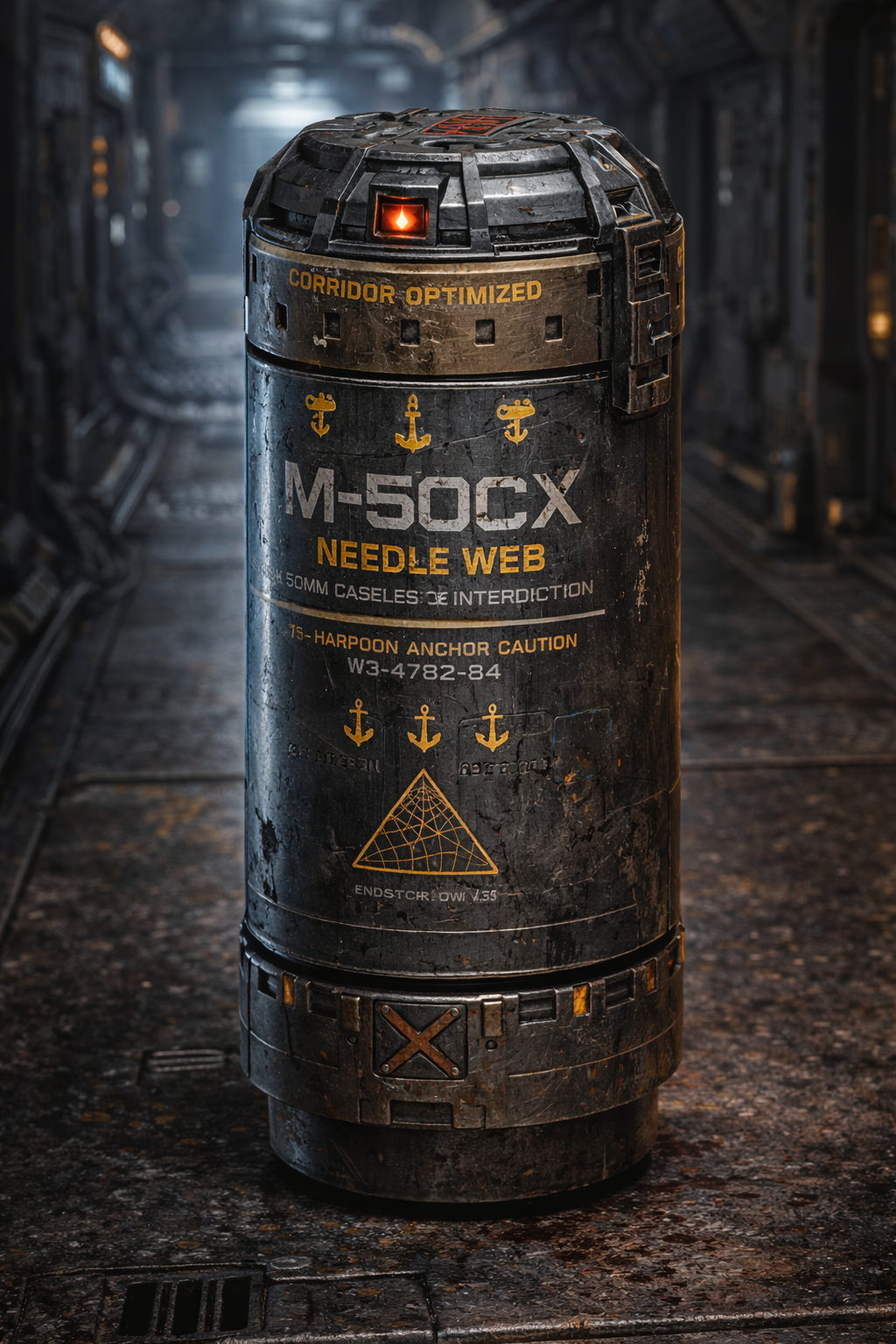
M-50CX Needle Web
M-50CX “Needle Web”
“Throw it and own the hall.”
Name and street designations
Illicit designation: M-50CX “Needle Web” (no official designation exists)
Common names:
Hall Reaper
Spine Hall
Needle Lace
Corridor Cutter
Wall Whisper
Origin and manufacture
The Needle Web appeared first in Titan orbital slums and Europa tunnel habitats about 90 years after the original M-50.
It was developed by boarding specialists and station-raider crews who needed something deadlier than flashbangs but quieter than explosives.
Primary production sites:
• Titan shadow yards
• Europa ice tunnels
• Eros pressure vaults
• Chendiuria lower-tier fabs
• Decommissioned asteroid habitats
Most are assembled from:
• Salvaged M-50 frames
• Custom directional filament spools
• Modified proximity scanners
• Tunnel-mapped deployment chips
Each unit is tuned for specific corridor widths.
Primary purpose
The M-50CX is designed to dominate:
• Hallways
• Boarding tubes
• Access tunnels
• Maintenance shafts
• Habitation corridors
• Cargo walkways
It creates a wall-to-wall cutting curtain instead of a square net.
It is a choke-point weapon.
Core modifications
1. Directional deployment
Instead of blooming outward in all directions, the Needle Web projects laterally.
Wires anchor to opposite walls.
Forms a vertical cutting sheet.
2. Wall-seeking anchors
Micro-harpoons embed in:
• Metal bulkheads
• Ceracrete
• Cryspoly frames
• Composite panels
Anchors tension the net instantly.
3. Adaptive width control
Sensors scan corridor width before deployment.
Net adjusts from:
0.9 m to 3.2 m wide
4. Depth layering
Instead of one grid, it deploys three staggered layers.
Each offset by 8 mm.
This defeats armor gaps.
Physical characteristics
Grenade size:
Standard 50×106 mm casing
Length: 162 mm
Weight: 2.3 kg
Heavier than baseline due to anchor systems.
Often painted matte gray or maintenance yellow to blend in.
Deployment sequence
- Launch: Thrown or fired down corridor.
- Wall scan: Lidar maps corridor.
- Anchor fire: Four micro-harpoons embed.
- Web projection: Filaments deploy laterally.
- Layer tension: Three grids snap into place.
- Active window: 0.6 to 0.8 seconds.
- Collapse: Wires retract and disintegrate.
Total cycle: under one second.
Damage profile
Against personnel:
• Full torso bisect
• Limb severance
• Head removal
• Armor slicing at joints
• Internal organ pulping
Victims are often cut into stacked slabs rather than cubes.
Against power armor:
• Joint failure
• Cable severance
• Sensor destruction
• Partial penetration
Against drones:
• Total destruction
Collateral damage:
• Wall scoring
• Structural weakening
• Atmosphere leaks
• Cable destruction
Repeated use can compromise hull integrity.
Range and use
Effective range:
Optimal: 12–22 m
Maximum: 30 m
Most effective in confined spaces.
Open areas reduce effectiveness.
Power system
Directional capacitor array
Output: 1.7x standard M-50
Balanced for sustained tension rather than expansion.
Shelf life: 6–9 years
Fuse options
Common illicit fuses:
• Proximity sweep
• Beam-break trigger
• Motion cascade
• Remote detonation
• Manual tripwire
Tripwire versions are popular for ambushes.
Safety systems
Minimal.
Usually only:
• Transport lock
• Single arming delay
Many units lack fail-safes.
Misfires are lethal in confined spaces.
Legal status
Explicitly banned under corridor warfare restrictions.
Classified as:
“Internal Space Interdiction Weapon”
Possession equals automatic prosecution in most jurisdictions.
Typical users
• Boarding teams
• Pirate assault crews
• Station raiders
• Corporate cleaners
• Tunnel gangs
• Smuggling convoy escorts
Often used in ship takeovers.
Cost
Black market pricing:
Mars: ~22,000–38,000 credits
Chendiuria: ~24,000–35,000 credits
Eros: ~38,000–52,000 credits
Titan: ~50,000–75,000 credits
Europa: ~85,000+ credits
Custom width-tuned models: +40 to 80 percent.
Maintenance
Requires:
• Anchor calibration
• Filament refresh
• Sensor alignment
Neglected units lose accuracy.
Tactical doctrine (unofficial)
Used when:
• You control the corridor
• You expect pursuit
• You want zero survivors
• You need silence
Notable incidents
Rebus Station Hijack 2611 CE
Two CX units stopped a security team in seconds.
Phobos Freight Raid 2633 CE
Collapsed a cargo tunnel.
Titan Shaft Siege 2721 CE
Used repeatedly, caused decompression.
M-50CX
Exceptionally rare.

Comments
Author's Notes
Relationship to Adi
Adi would recognize these instantly.
She would avoid corridors where one might be deployed.
Kane considers them “professional pirate tools.”
If she ever sees one in play, she knows:
Someone planned the fight.
Someone owns the space.