
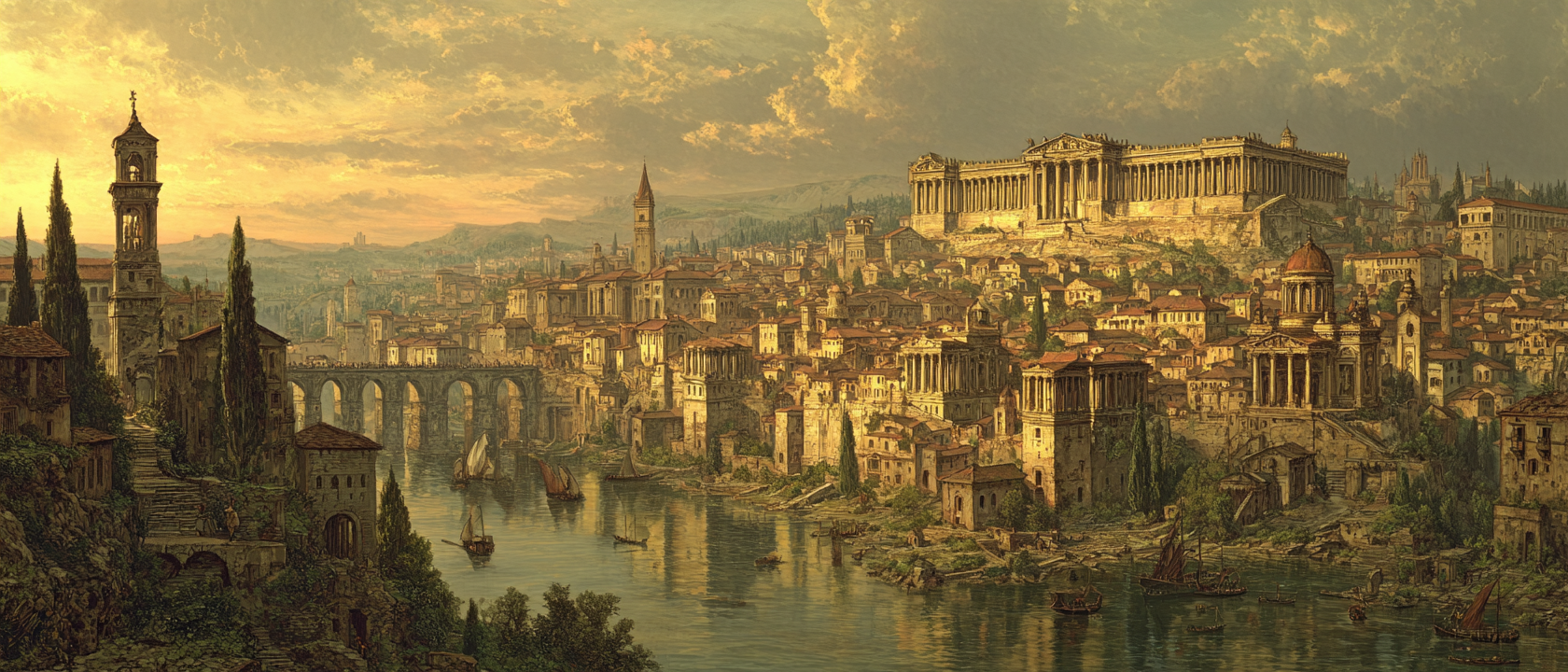
SUBURA
The Working City · District · Nova Romae
"The Subura is not a district. It is a consequence. Every decision made in the Senate Quarter, every structure built on the Palatine, every ship unloaded at the harbour, every wagon of grain arriving from Septentrionalis — all of it eventually produces, as its residue, the Subura. If you want to understand what Nova Romae actually is, you live here."
The Subura is not a single district but what happens when a city grows beyond its plan, repeatedly. The three ring walls that successive expansions built and then outgrew are still readable in the street plan: their old gate-arches are now intersections with names that locals still use, their wall lines are the wide ring roads that curve through otherwise rectilinear streets, their towers are warehouses and tenements and, in one case, a school whose students are learning to read in a structure that once held archers. The Subura is loud, dense, occasionally dangerous, frequently vibrant, and fundamentally the city that the grand boulevards and marble temples exist to serve. If Nova Romae is the Empire's mind, the Subura is its heartbeat.
Demographics
Three hundred and fifty thousand people, the largest population of any district by a considerable margin. Roman citizens, freedmen, slaves, provincial immigrants, the children and grandchildren of everyone who has come to the capital seeking something in the last twelve centuries. The Subura contains every social stratum except the very top: artisans, merchants of the second rank, the professional class who cannot afford Trans-Fluminis, soldiers on leave, the recently arrived, the long-established, the families who have been on the same street for eight generations, and the families whose tenure is counted in weeks. The working language is Latin but the neighbourhood shrines address deities in six languages.
Government
The Subura is governed by the Praefectura Urbis through the Cohortes Vigilum and the Aedilitas, but the practical governance of this many people in this much space is substantially local — block wardens, neighbourhood associations, the informal authority of long-established families, the social structures of the guild system, and the particular authority that the Via Obscura exercises in the spaces between official jurisdiction. The Vigilum's twelve stations include six in the Subura; the remaining six cover the inner districts with their smaller populations. Marca Servia visits Subura stations more frequently than any other district.
Defences
The Castra Meridiana's northern gate — the Porta Praetoria — marks the Subura's southern boundary and constitutes the most significant military presence adjacent to the district. The Vigilum stations are the routine security infrastructure. The Via Obscura is, in a real sense, part of the security architecture of the Subura: the network's operators have stronger interests in the district's stability than most officials, because their business depends on a functional environment and they have the local knowledge to maintain it. Servia's 'managed coexistence' with the Via Obscura is most practically expressed here, in the Subura, where official and unofficial authority overlap most extensively.
Industry & Trade
The Subura produces most of what Nova Romae consumes domestically: the artisanal goods, the food preparation, the small-scale manufacturing, the services of every description that eight hundred thousand people require. The Mercatus Magnus at the district's commercial centre is the daily transaction point for the city's subsistence economy. The workshops of the Subura supply the construction industry, the Legions' equipment needs, the food processing, the textile work, and the hundred other productive activities that the Senate Quarter and Trans-Fluminis purchase the output of without thinking about the input. The Subura is also, less formally, the location of the grey economy: the goods that occupy a more ambiguous legal position, the services not advertised publicly, the information that moves through the Via Obscura and whose price is set by what it is worth to the right person.
Infrastructure
The Subura's infrastructure reflects its relationship with the city's planning history: the inner portions, within the old second ring, have full access to the Aqua Magna's supply network and the main sewer system. The outer portions — the third ring and beyond — have partial sewer access, with the outer edges relying on drainage channels that the Aedilitas manages on a reactive rather than preventive basis. The outer Subura floods in severe rain. It has flooded in severe rain for six centuries. The Aedilitas files annual reports. The flooding continues. A building in the outer Subura has been flagged as structurally unsound — housing approximately four hundred people. The demolition order has been delayed three times at the request of the building's owner, who has connections in the Mercatorum. Vox is running out of patience. The building is running out of structural integrity.
Guilds and Factions
The Subura's guild system organises the city's artisanal and trade workforce — approximately forty recognised guilds covering everything from bakers to bridge-maintenance workers, each with its own meeting hall, internal governance, and relationship with the Praefectura's market regulation office. The guilds are the primary formal civic institutions below the Senate level for the Subura's working population, and their leadership constitutes a political voice the Praefectura takes seriously when it chooses to hear it.
The Via Obscura's Subura operators are the district's most significant informal institution — more influential in some streets than the Vigilum, better informed than the guilds on specific matters, and connected to the city's political institutions in ways that are not officially acknowledged by either side. Servia's three assessments to Balbus about the Subura organising movement have all described the Via Obscura's posture toward it as watchful neutrality. She believes this is accurate. She is mostly right.
History
The Subura has existed as long as Nova Romae has been larger than its plan — which is to say, since the second century. It has always been the part of the city that the plans did not account for, populated by the people the plans did not specifically anticipate and sustaining the life that the planned districts require but do not provide for. It has been described, in every century, as simultaneously vital and problematic. The descriptions have been accurate in every century. They have produced little sustained improvement in the outer Subura's infrastructure, which is the Aedilitas's most persistent administrative failure and the neighbourhood associations' most persistent complaint.
For full chronological detail, see: Annales Mundi.
Points of interest
The Mercatus Magnus is the central market of the Subura: a covered space three hundred yards long, open daily, selling everything that can be legally sold and several things that occupy a more ambiguous position. The eastern end is food — produce from the agricultural provinces, fish from the harbour, spices from the Solarhet trade brought up through the halfling islands. The western end is craft goods. The central section, under the highest part of the roof, is where the traders come from furthest away, bring the most interesting things, and charge the least predictable prices, with provenance most carefully not enquired into. A trader in the central section recently acquired something she believes came from the pre-Rift world through the Old City's black market. She has no idea what it is or what it does. The person who sold it to her has not been seen since.
The Insula Septem Viarum is not a specific building but a type and a legend: the great tenement archetype, its name attached to the most storied block in the Subura's oral history. The block warden of a major insula near the eastern ring road has been organising her tenants. Three hundred signatures on a petition regarding the diversion of grain subsidy funds toward Rift XIII preparations. She is preparing a second petition that includes an accounting of where the diverted funds went, obtained from a source she has not identified. The source is in the Praefectura. Balbus knows there is a leak. He has not yet identified which office.
The Via Obscura is not a single location but a system — a set of relationships between people and places that moves information, goods, and people in ways that do not appear in official records. It has existed in some form since the third century and has survived multiple eradication attempts by being more useful than its absence. It has recently accepted a contract for surveillance of six Academy scholars from an anonymous client whose identity the operators have not established. The operators are beginning to find this uncomfortable.
Tourism
The Subura is fully accessible — there are no restricted areas, no gates, no passes required. Visitors are advised to observe standard precautions appropriate to a dense urban environment of three hundred and fifty thousand people, which is advice that locals find slightly condescending and which is nonetheless accurate in the outer areas after dark. The Mercatus Magnus is a standard visitor destination: nowhere else in Nova Romae is the full scope of the Empire's commercial reach so immediately visible in a single space. The neighbourhood shrines scattered through the inner Subura constitute an informal tour of the city's religious diversity that no official guide provides.
Architecture
The Subura's defining architectural form is the insula — the great tenement block, seven to ten storeys tall, housing hundreds of families each. The Insula Septem Viarum is the archetype: ground floor shops, increasingly crowded residential floors above, the rent inversely proportional to the floor. A new resident arrives in the city and rents a room on the seventh floor. Eight years later, if things have gone well, they are on the fourth. This is not a metaphor. This is how the Subura works.
Beyond the insulae are the workshops, the stables, the small temples to minor divinities and halfling hearth-gods, the neighbourhood bakeries and thermopoliae that feed the working population, the schools, the inns, and the occasional surviving structure from an earlier ring wall that has been absorbed into the urban fabric without anyone quite deciding what it is now. The outer Subura, beyond the third ring road, is the least formally maintained part of Nova Romae: buildings of varying quality, street surfaces that the Aedilitas inspects and repairs on a schedule driven by complaint volume, and an infrastructure relationship with the city's sewer network that is imperfect and periodically floods.
Geography
The Subura occupies everything outside the formal ring development — the third, fourth, and outer rings of the city's concentric expansion, from the old ring roads outward to the Castra Meridiana's wall on the south and the city's informal boundary with the hinterland farmland on the north and east. This is a very large area containing a very large population: approximately three hundred and fifty thousand people in the city's densest, most varied, and least formally administered territory. The terrain is flat — the Subura occupies the low ground between the hills of the inner city — and the street grid becomes less regular the further out you go, the original survey plan giving way to organic development shaped by drainage, land ownership, and the logic of foot traffic.
Access
Access Fully publicly accessible.

Comments