
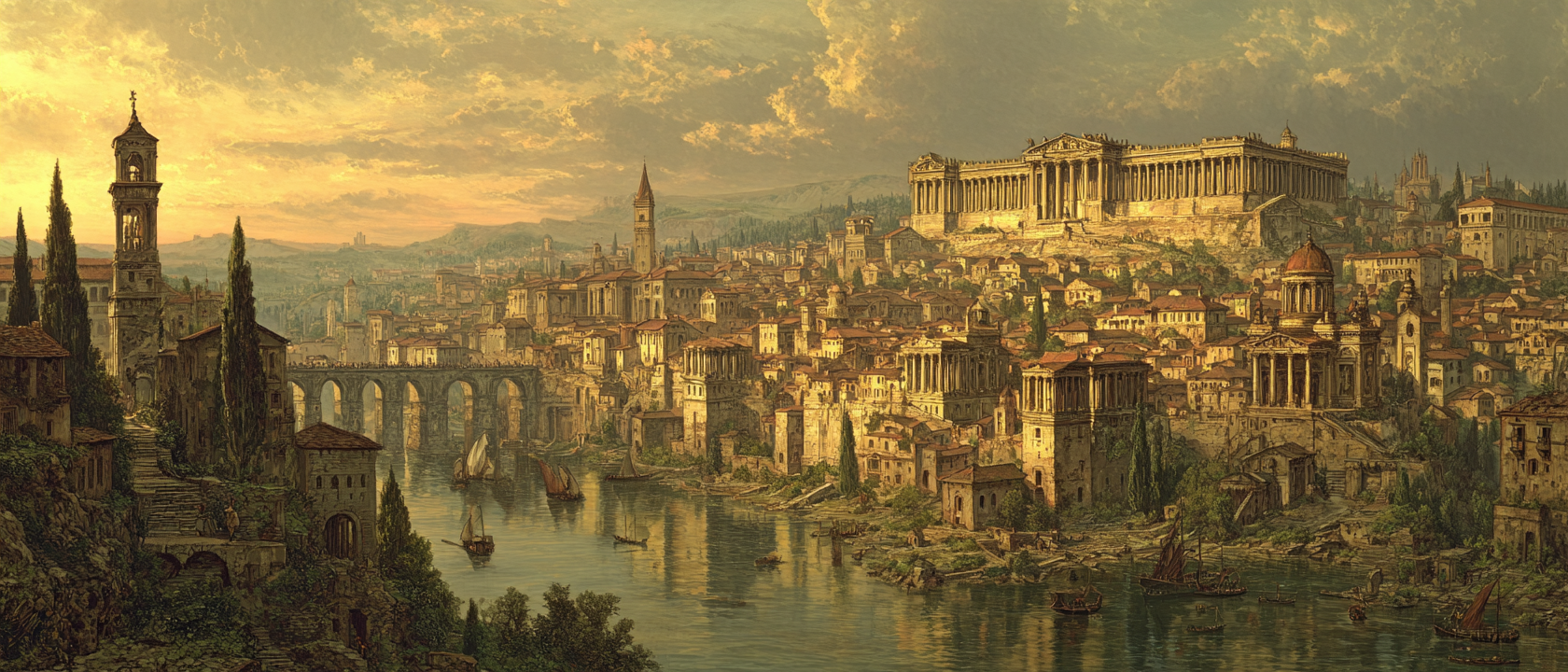
PORTUS NOVAE ROMAE
The Harbour District · District · Nova Romae
"Every ship that arrives at the Portus carries something the city needs. Some of what it carries is listed on the manifest."
The harbour of Nova Romae sits where the Fluminis Magnus meets the city's southern edge — the point where the river, which has carried everything the Empire produces northward and everything it imports southward, meets the infrastructure built to manage that flow. Twelve major wharves, a hundred smaller berths, acres of warehousing on reclaimed waterfront, and the constant presence of ships from every port the Roman trade network reaches. The river runs north from here to the Inland Sea, approximately a hundred kilometres upstream, connecting the capital to Lacusum and the great interior trade network. It runs south toward the coast and the open water beyond, where the halfling routes to Brindala and the Solarhet trade begin. Everything that arrives in Nova Romae from elsewhere arrives here first.
Demographics
The harbour district's permanent population of approximately eighty thousand includes the maritime working community — pilots, chandlers, dock-workers, riggers, the maintenance crews for the wharves and warehouses — and the commercial community that manages the trade: the factors, freight agents, customs officials, harbour administrators, and the money-changers and notaries whose offices cluster at the Customs House. The daily transient population of several thousand includes crews in port, merchants awaiting cargo, diplomatic parties in transit, and the significant number of people who arrive in Nova Romae by river or sea and whose first experience of the city is the harbour district. What they find here shapes what they think the city is.
Government
The harbour is administered by the Praefectura Portus — a sub-office of the Praefectura Urbis, with its own budget and its own staff, under the Praefectus Portus currently serving his eighth year. The harbour administration manages vessel registration, cargo inspection and customs collection, berth allocation, the maintenance of the wharves and navigation infrastructure, and the coordination with the Castra Meridiana's southern gate that controls the land-side access. The Customs House's revenue constitutes a significant fraction of Provincia Urbis's tax income. The accuracy of the customs records is, in Varro's estimation, the most consistently falsified government documentation in Nova Romae, a distinction achieved through sustained collective effort by every party involved.
Defences
The harbour's primary security is the customs inspection system and the Praefectura Portus's inspector staff — focused on what enters the city rather than on military defence. The Castra Meridiana's presence to the south provides an implicit military backup for serious incidents. The river provides natural boundary on the western side. The Vigilum station at the harbour district — one of the twelve city stations — handles the routine security of a port environment, which is to say: disorder among sailors, theft from warehouses, the occasional violent dispute over cargo, and the management of people who have arrived in the city from elsewhere and not yet established which local rules apply to them.
Industry & Trade
The harbour district is where the Empire's trade network makes physical contact with the capital. Everything produced in the provinces that is not transported overland arrives here: grain from Septentrionalis, wine from Insularis, ore from Montium Ferri, manufactured goods from the provincial capitals, and the luxury imports whose value per weight justifies the sea voyage — tabaxi spices and dyes arriving through the halfling route, dwarven specialist goods that come overland to the coast and then by ship to the capital. The river barge services connecting Nova Romae to Lacusum operate from the northern wharves; the coastal trade from the southern wharves; the long-distance southern route ships from the dedicated deep-water berths at the harbour's outer end.
The Mercatorum's harbour presence is the second most significant institutional commercial force in the district after the Praefectura Portus itself — with permanent agents at the major wharves, relationships with every significant shipping operation, and an information network whose reach into the harbour's daily operations is more complete than the customs records.
Infrastructure
The harbour's infrastructure is the most practically significant in Nova Romae. The navigation lights maintained by the Pharus Magnus lighthouse guild — their Nova Romae station at the harbour's southern end — mark the river approaches and the deep-water channels. The warehousing district's fire suppression infrastructure, upgraded in the seventh century after a fire destroyed a significant section of the southern wharves, includes water reservoirs and a pumping system that the Aedilitas points to when explaining why dwarf engineering partnerships are worthwhile. The river pilot service — mandatory for vessels above a certain size — is operated by a guild whose institutional knowledge of the Fluminis Magnus's channels and currents constitutes an irreplaceable navigational resource.
Guilds and Factions
The River Pilots' Guild is the harbour's most institutionally significant organisation after the Praefectura Portus — mandatory for large vessels, their pilots boarding at the river approach and guiding ships to berth under a liability system that has produced an unbroken safety record for three centuries. The guild's political influence in the harbour district is significant; the pilots are the most respected professional body in the area, and their guild hall is where the harbour's informal governance actually occurs.
The Dock Workers' Association is the largest single organisation in the harbour district by membership — approximately six thousand registered members who control the labour of cargo handling under a rate system negotiated with the Praefectura Portus every five years. The most recent negotiation was contentious. The next one is in three years and both parties are already preparing.
The Mercatorum's harbour agents constitute an informal network rather than a formal organisation, but their collective knowledge of cargo movements, vessel schedules, and commercial transactions makes them the most comprehensively informed group in the district. Several of the Mercatorum's parallel railway negotiation communications have moved through the harbour district's information infrastructure.
History
The harbour has been at this location since the second decade after the Permutatio — the original wooden wharves replaced by stone in the first century, the reclamation programme beginning in the third century, the deep-water berths added in the fifth. The great warehouse fire of 623 A.P. destroyed approximately a third of the southern warehouse district and produced the fire suppression infrastructure upgrade that has prevented a comparable incident since. The halfling route from Brindala was established in 1005 A.P., following the vassal arrangement, and the halfling presence in the harbour district has been a constant since — initially cautious, increasingly integrated, currently simply a fact of harbour life that the permanent community regards as unremarkable and that new arrivals find surprising.
For full chronological detail, see: Annales Mundi.
Points of interest
The Customs House on the central wharf is the harbour's administrative heart and its most formally impressive building — the point through which all cargo declarations pass, where the import duties are assessed and collected, and where the Praefectura Portus's enforcement staff is based. The records kept here are the most comprehensive commercial documentation in Nova Romae and the most comprehensively annotated with corrections to the original declarations. What the Customs House actually knows about the flow of goods through the harbour is substantially more than the official records show, and the inspectors have decided, over centuries of practice, which discrepancies are worth pursuing and which are the cost of maintaining a functional commercial environment.
The Nauta's Quarter is the residential and social heart of the harbour's permanent maritime community — the inns, the guild halls, the shrines to the river gods and the sea gods and, increasingly, the halfling harbour-protection deities whose response rate to maritime petitions has made them popular beyond the halfling community. The guild hall of the river pilots , the oldest continuously operating professional institution in Nova Romae, occupies a building on the quarter's northern edge that has been on the same site since the second century. The pilots know the river's moods in a way that charts cannot capture, and they charge accordingly.
The deep-water berths at the harbour's outer end accommodate the large southern-route vessels — the ships that make the run to Portus Meridiani and, with halfling escort, to the Brindala routes and beyond. The halfling vessels that dock here are immediately distinguishable from Roman ships by their handling characteristics; a halfling pilot on a halfling vessel in the harbour's outer approaches is a routine sight, but one that the harbour's older hands still pause to watch, because the quality of the seamanship is, by any objective measure, different. Merry Burrowfoot has docked here four times. Each time, she left within a day. Nobody has ever seen her stay.
Tourism
The harbour district is fully accessible and receives a continuous flow of visitors who are not there for trade: pilgrims who arrived by river and have not yet moved into the city proper, provincial Romans making their first visit to the capital, the relatives of sailors meeting vessels in port. The river barge service from Lacusum deposits several hundred passengers at the northern wharves daily. The Nauta's Quarter's inns are the cheapest reputable accommodation in Nova Romae — not cheap by provincial standards, but affordable compared to the inner districts — and the harbour's food vendors serve a range and quality that reflects eight hundred thousand people's need to eat.
Architecture
The harbour's architecture is functional without apology. The great warehouses — stone and timber, four storeys, their walls thick enough to maintain stable temperature for sensitive cargo — line the streets behind the wharves in blocks that have the organised density of military infrastructure. The Customs House on the central wharf is the harbour's one deliberately impressive building: white marble, well-maintained, its facade communicating that the Empire takes its import revenue seriously. The Nauta's Quarter, the residential district of the permanent maritime community, occupies the northern section of the harbour district in buildings that are older and more varied than the warehouses and that have the particular character of places where people have been living alongside the same work for many generations.
Geography
The harbour district occupies the southern edge of the city's eastern bank, between the Castra Meridiana's western wall and the river. It has expanded progressively onto reclaimed waterfront over twelve centuries, adding wharves and warehouse space as the trade volume required — the current footprint is approximately three times the area of the original harbour. The Fluminis Magnus broadens slightly where it passes the harbour, a natural deepening that accommodates larger vessels than the river's upper reach can manage. The twelve major wharves are arranged in a shallow arc following the river's edge; behind them, the warehouse district extends inland to the ring road boundary where the Subura begins.
Access
Access Fully publicly accessible. Deep-water berths require harbour authority authorisation. Customs House — official business only.

Comments