
NOVA ROMAE
The Imperial Capital · City · Provincia Urbis
You cannot understand Nova Romae the first time you see it. You can only begin the process of understanding it, which will take the rest of your life and will not be complete when you die.
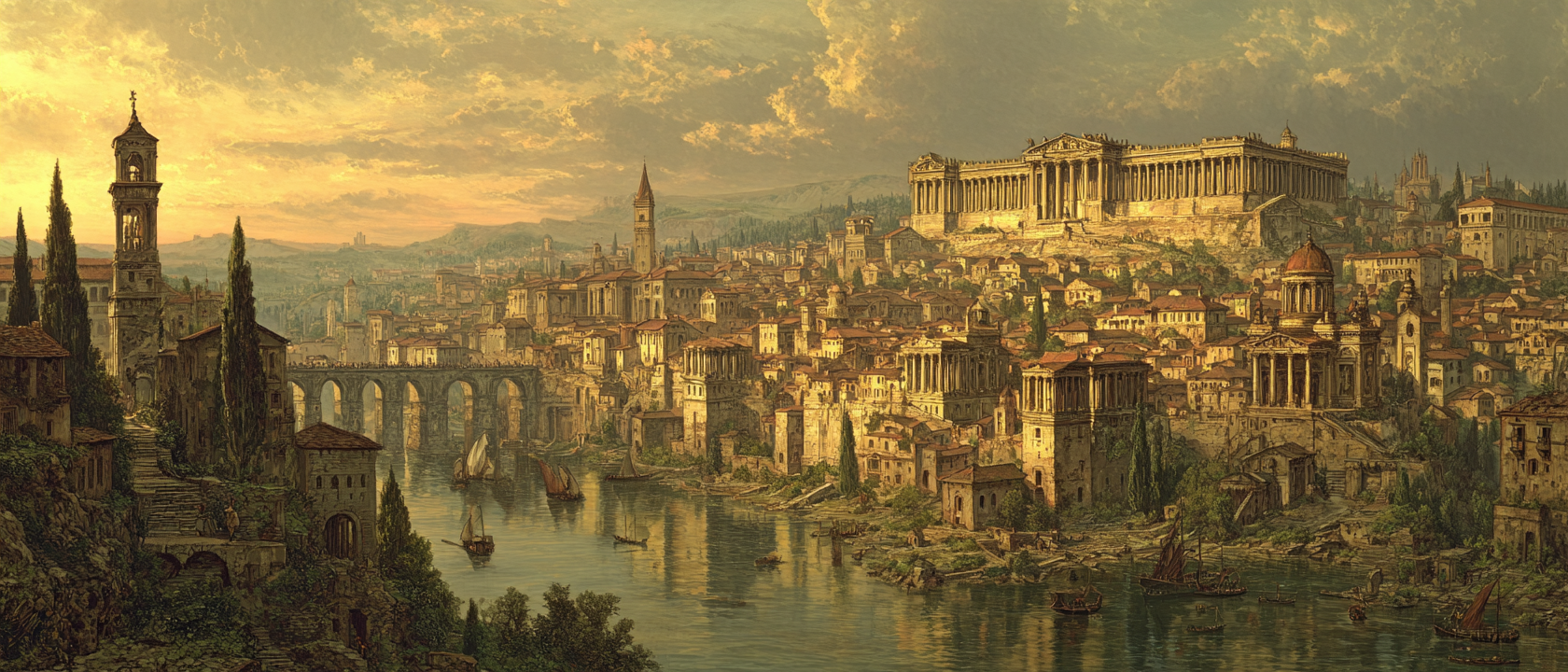
Nova Romae is the largest city in the known world, by a significant margin, and the seat of the only empire in Aethermarch. It was not built on new ground: a Roman provincial town of perhaps eight thousand souls existed here before the Permutatio, transposed with everything else on the morning of Year One, and twelve centuries of expansion have accumulated around that original kernel until the original streets are now the heart of something that has nearly a million people in it. It spans both banks of the Fluminis Magnus, the Via Principalis runs through it like a spine, and from the summit of the Palatine Hill on a clear day you can see the southern coast forty miles distant.
There is no second city in Aethermarch to set beside it. Lacusum, the great port on the Inland Sea, is perhaps a third its size and vastly more commercially energetic. Neb-Khet, the southern trading city, is wealthy and strange. Thalgrimm, in the Iron Spine, is a wonder of underground construction. None of them are Nova Romae. Nova Romae is what twelve centuries of Roman ambition, Roman engineering, Roman political complexity, and one very unusual morning looks like when it has had sufficient time to compound.
Nova Romae is the largest city in the known world, by a significant margin, and the seat of the only empire in Aethermarch. It was not built on new ground: a Roman provincial town of perhaps eight thousand souls existed here before the Permutatio, transposed with everything else on the morning of Year One, and twelve centuries of expansion have accumulated around that original kernel until the original streets are now the heart of something that has nearly a million people in it. It spans both banks of the Fluminis Magnus, the Via Principalis runs through it like a spine, and from the summit of the Palatine Hill on a clear day you can see the southern coast forty miles distant. There is no second city in Aethermarch to set beside it. Lacusum, the great port on the Inland Sea, is perhaps a third its size and vastly more commercially energetic. Neb-Khet, the southern trading city, is wealthy and strange. Thalgrimm, in the Iron Spine, is a wonder of underground construction. None of them are Nova Romae. Nova Romae is what twelve centuries of Roman ambition, Roman engineering, Roman political complexity, and one very unusual morning looks like when it has had sufficient time to compound.
Demographics
The population of approximately eight hundred thousand is predominantly Roman by descent — Latin-speaking citizens and freedmen of the old Roman heritage, supplemented by generations of naturalised immigrants from every province. Citizens constitute roughly sixty percent of permanent residents; freedmen and their descendants a further twenty-five. The remaining fifteen percent are resident non-citizens: a permanent dwarven merchant community of some eight thousand in the Foreign Quarter, halfling traders and their families, tabaxi diplomatic staff, and a significant population from the outer provinces whose cultural identity is Roman by law but whose families' origins are a complex record of the Empire's twelve centuries of expansion.
The city's social topography is vertical as much as geographic: the Palatine and the Senate Quarter house the powerful, the Capitoline the priestly, the Academy district the scholarly, Trans-Fluminis the wealthy. The Subura houses everyone else, in a hierarchy by floor that a newcomer learns within a week — the higher your floor, the lower your income. The slave population, which the official census has not counted since 800 A.P., is estimated by Academy demographers at between forty and eighty thousand, a figure that has declined significantly since the early centuries through manumission and through the gradual restriction of the slave trade that the Senate has enacted in stages over three hundred years without ever quite completing.
Government
The Emperor governs from the Palatine Hill. The Senate — six hundred men and women of patrician blood — administers from the ring below. These two institutions govern the Empire of Aethermarch: setting policy, commanding the Legions, conducting foreign relations, administering the provinces. The daily life of eight hundred thousand people is governed separately by the Praefectura Urbis under Praefectus Urbi Gaius Numerius Balbus, who administers the water supply, the streets, the markets, the watch, the fire brigades, building permits, public festivals, the grain distribution, and the thousand other mechanisms of urban survival that the Senate considers beneath its notice and that would, if they failed, make the Senate's opinions entirely academic within a fortnight.
In 1200 A.P. the Senate is divided across three identifiable Rift XIII factions: the conservatives under Senator Marcus Fabius Corvinus, who believe Rome should position itself from maximum strength and want two additional legions mobilised; the reformers under Senator Livia Serena Aquila, who argue for the goblin treaty as strategic necessity before the political landscape changes; and the Mercatorum, the organised merchant faction with no formal membership and no address, which is currently conducting parallel negotiations with the dwarven railway delegations that the Senate's official trade committee is not fully aware of.
DM ONLYDefences
Nova Romae maintains two primary military formations within the city. Legio II Palatina — four thousand soldiers — occupies the Castra Palatina on the Palatine Hill's northern face, its sole function the defence of the Emperor and the palace complex. They are the best-equipped soldiers in the Empire and have not fought a real engagement in sixty years, which their counterparts in the frontier legions find a reliable source of commentary. Legio VI Urbana garrisons the Castra Meridiana at the city's southern edge: a full legion in permanent stone barracks laid out with exactly the logic of a campaign encampment, the gate logs constituting one of the most complete sets of continuous records in Nova Romae.
The Cohortes Vigilum — city watch, approximately three thousand — operate from twelve district stations under Tribune Marca Servia. The ring walls of earlier centuries remain standing and function as internal fallback positions. A city of this size and symbolic importance could not be defended against a determined assault by any force on the primary continent; the defences are designed for civil order and against opportunistic threat, not siege.
Industry & Trade
Nova Romae produces administrative authority, judicial decisions, religious sanction, and cultural product. It does not, in the main, produce food or goods — those flow inward from the provinces. What it exports is the framework within which all provincial production becomes commercially viable: the road network, the legal system, the currency, the military infrastructure that makes trade possible across a continent. The commercial heart is the harbour district, where the Fluminis Magnus connects the capital to Lacusum and the Inland Sea trade network a hundred kilometres north, and to the southern ports linking to Brindala and, via halfling vessels, to Solarhet. The Mercatus Magnus in the Subura handles the daily commerce of eight hundred thousand people.
The dwarven railway negotiation, if concluded, will fundamentally alter Nova Romae's relationship to the Iron Spine and the northern provinces. Roman engineers briefed on the proposal have been quiet in a way that suggests careful thought about what a four-hour connection between the capital and the Iron Spine means for military logistics as well as commercial ones. The Mercatorum understands the commercial implications clearly and has been positioning accordingly for three years, in parallel with and ahead of the Senate's official committee.
Infrastructure
Three aqueducts supply the city. The Aqua Magna, the largest, delivers water from the hill country forty kilometres east; the Aqua Secunda and Aqua Minor supplement it, together feeding the public fountains, the thermae, and private connections for those who can afford the annual fee. The sewer system, largely rebuilt in the fourth century with dwarven assistance, drains to the Fluminis Magnus south of the harbour. Together, reliable water supply and functional drainage constitute what I consider the most significant public health achievement of the Roman-dwarven collaboration — more consequential, in practical terms, than any of the celebrated architectural monuments.
The road network radiates from the golden milestone in the Forum Novum: the Via Principalis north to the Inland Sea, the Via Orientalis east toward Sylvanmere, the Via Militaris west to the frontier, the Via Australis south to the coast. Every distance in the Empire is measured from this point. The Pons Magnus carries the Via Principalis across the Fluminis Magnus to Trans-Fluminis — dwarf-engineered in the sixth century, still the widest single-span bridge in the known world. Roman engineers who calculate how it bears its own weight generally stop calculating. This has been the professional consensus for five centuries.
Districts
Nova Romae comprises nine principal districts. The Palatine Hill — Collis Palatinus — is the highest point and the administrative core: the Imperial palace complex, the Castra Palatina, the Emperor's private temples, and the terraced gardens open to the public on the first and fifteenth of each month. Population approximately eight thousand residents, forty thousand staff and daily visitors. From the hill's summit, on a clear day, the southern coast is visible. From every district of the city, in all directions, the Palatine is visible. This is not accidental.
The Senate Quarter — Regio Senatus — occupies the ground between the Palatine's eastern face and the Forum Novum: wide colonnaded streets, senatorial townhouses behind high walls, the Curia Aethermarchensis at its centre. In 1200 A.P. a place of considerable political tension primarily expressed in the language of social obligation — dinner parties, corridor conversations, the precise ordering of names on documents. The Thermopolium, adjacent to the Curia, is the private dining club where Senate business that cannot be conducted officially is conducted unofficially. The food is excellent. The walls, if they retained memory, would know more about Roman politics than any archive.
The Capitoline — Capitolium — is the most sacred hill in Nova Romae, its great temple complex in continuous operation for twelve hundred years. Roman clerics who have trained elsewhere report their abilities function at measurably higher capacity on the Capitoline than anywhere else in the world. At the hill's base, the Free Temples provide officially sanctioned space for halfling religious practice: six active temples maintained by the Hearth-Keepers, warm and fragrant with cooking smells and beeswax candles, frequented by Roman worshippers more often than the College finds theologically comfortable.
The Old City — Urbs Antiqua — is the geographic heart of Nova Romae, the kernel around which twelve centuries of expansion have accumulated. These streets, this market square, this river-path were Roman before the Rift. The preserved section constitutes the most emotionally significant district in the city. The Antiquarium Urbis, established in 300 A.P., houses what the memorial district cannot contain. The Academy District — Academia Imperialis — occupies quiet streets between the Capitoline and the Senate Quarter, home to the Imperial Academy and the Bibliotheca Maxima. The Forum Novum — a rectangle of white stone a quarter mile long — is where the Empire publicly performs itself. Trans-Fluminis is what Nova Romae became when it crossed the river: every dining room facing east across the water, looking back at twelve centuries of history in the morning light.
The Subura is not a single district but what happens when a city grows beyond its plan, repeatedly. The three ring walls of successive expansions are still readable in the street plan: old gate-arches are now intersections, wall lines are wide ring roads, towers are warehouses and tenements and, in one case, a school whose students are learning to read in a structure that once held archers. The Subura is loud, dense, occasionally dangerous, frequently vibrant, and fundamentally the city that the grand boulevards and marble temples exist to serve. If Nova Romae is the Empire's mind, the Subura is its heartbeat. The Harbour District — Portus Novae Romae — sits where the Fluminis Magnus meets the city's southern edge: twelve major wharves, a hundred smaller berths, acres of warehousing, and the constant presence of ships from every port the Roman trade network reaches.
Guilds and Factions
The Senate is the Empire's legislative and administrative authority — six hundred active members, divided in 1200 A.P. across three Rift XIII factions. Day-to-day senatorial business continues under the surface tension; the factions express themselves in the Thermopolium's dinner arrangements and in which proposals reach the floor on which days, not in open confrontation. The Mercatorum — no formal membership, no charter, no meeting minutes, no address — is the third major political force alongside the senatorial conservatives and reformers: less ideological than either, more consistent than both, significantly better funded.
The College of Pontiffs governs Roman state religion. The Pontifex Maximus has been conducting theological correspondence with the High Priest of Solarhet for two years. The Living Goddess has read it. He does not know this. The Imperial Academy Faculty governs the Academy's disciplines and the Bibliotheca Maxima's collections and access controls. The field of Comparative Cultural Studies — established forty years ago at my instigation — remains controversial among the more traditional faculties and is currently producing the most significant scholarship on Rift XIII of any institution in Aethermarch.
The Via Obscura is the informal name for the network of relationships that moves information, goods, and people through the Subura in ways that do not appear in official records. It has existed in some form since the city's third century and has survived multiple eradication attempts by being more useful than its absence. It has recently accepted a contract involving surveillance of specific Academy individuals from an anonymous client whose identity the operators have not yet established. The Cohortes Vigilum under Tribune Marca Servia operates with a working relationship with the Via Obscura that she describes as managed coexistence, involving information exchange she has not fully documented officially.
DM ONLYHistory
Nova Romae predates Aethermarch. The town that became the capital was already Roman — twelve generations deep, a functioning provincial settlement with its own history and its own habits — when the Eighth Permutatio of Year One transposed it into a new world. Year One is not the founding date. It is the morning everything changed. The first two centuries were expansion and consolidation: the Legions pushing outward, first encounters with the dwarves and then the other peoples, the first wars and the first treaties. The Imperial declaration came in 203 A.P., when Governor Marcus Aurelius Corvus styled himself Emperor and the Senate formalised an arrangement it had been embodying for a century.
The dwarven engineering alliance, established in the third century, enabled the construction that transformed a provincial capital into something genuinely unprecedented. The Imperial Academy was founded in 700 A.P. The current Emperor, Gaius Aurelius Maximus, has ruled since 1100 A.P. The succession is unresolved. The Pale Wanderer is at peak brightness.
For full chronological detail, see: Annales Mundi.
Points of interest
The Palatium Imperatoris (Palatine Hill summit, not publicly accessible without Imperial appointment) — a complex of interconnected buildings covering the hill's summit, built and rebuilt over twelve centuries until the original structure is now a core around which eight subsequent emperors have added their architectural ambitions. The current Emperor's private quarters are in the oldest section, a studied signal about where he considers his authority rooted. The palace employs approximately four thousand people, not counting the guard. Obtaining an audience is a campaign goal in itself. Being summoned without requesting one is either a great honour or a very bad sign.
The Horti Palatini (Palatine Hill southern terraces, open to the public on the first and fifteenth of each month) — the most beautiful space in Nova Romae. The gardens contain plants from every part of the known world, including specimens brought from Solara by the tabaxi diplomatic mission and specimens of Sylvanmere forest flora that the Academy's botanists tend with considerable anxiety. The Sylvanmere specimens are declining in a way that does not match any known disease. An Academy scholar has written a report. The report has been filed.
The Bibliotheca Maxima (Academia Imperialis, four floors and a basement; restricted sub-basement requires Faculty authorisation) — the most complete archive of inter-cultural scholarship in Aethermarch. The restricted sub-basement contains documents the Academy has decided are too dangerous, too disturbing, or too theologically irregular for general access. Something has been removed from this section within the last year under a faculty authorisation code belonging to a scholar who died fourteen years ago. The librarian who identified the discrepancy has been investigating quietly for three months.
The Locus Primus (a low stone enclosure in the Platea Prima of the Urbs Antiqua, publicly accessible) — marks the point where the Permutatio exchange is believed to have occurred. Built in 103 A.P. by the first Aethermarch-born generation, using stone from pre-Rift structures deliberately chosen for the purpose: the memorial is built from what was already Roman, already here, already standing when the world changed. The most visited single location in Nova Romae.
The Curia Aethermarchensis (Senate Quarter, public galleries hold two hundred observers) — the senate chamber itself: white marble and dark timber, its floor inlaid with a map of the known world in coloured stone that was accurate in 600 A.P. and has not been updated since, a source of ongoing academic complaint. The Senate meets on the first, tenth, and twentieth of each month.
The Pons Magnus (carries the Via Principalis across the Fluminis Magnus, sixth century, dwarf-engineered) — still the widest single-span bridge in the known world, wide enough for two carts abreast in each direction with covered pedestrian walkways on either side. Roman engineers who calculate how it bears its own weight generally stop calculating. This has been the professional consensus for five centuries and shows no signs of changing.
The Antiquarium Urbis (Urbs Antiqua, open to the public, twelve centuries of Roman occupation in four galleries) — the pre-Rift section is the most affecting: a farmer's tool from two miles outside the city, unremarkable until you understand it predates everything. A junior curator has recently found a document in the Contact Collection referencing something the Romans encountered in the early years after the Permutatio that does not appear in any official history. The document is old enough to be authentic. She has told no one and is trying to verify it. She is running out of time before the collection is reorganised for the Rift XIII commemorative exhibition.
The Castra Meridiana (city's southern edge, Legion jurisdiction, restricted access) — permanent base of Legio VI Urbana, a legion camp in stone and marble laid out with exactly the logic of a campaign encampment. The gate logs — logging every departure and entry at all hours — constitute one of the most complete sets of continuous records in Nova Romae and one of the most restricted. A researcher at the Academy recently requested access for a historical project. The request was denied. She has found another way to obtain them.
Tourism
Nova Romae receives visitors from every part of the known world. Roman citizens from the provinces arrive constantly: for legal proceedings, religious pilgrimage, trade, and the fact that a Roman who has not seen the capital has not fully understood what being Roman means. The dwarven community of the Foreign Quarter operates the most sophisticated commercial infrastructure in the city after the Mercatorum itself. Halfling traders maintain the largest civilian non-Roman presence and are regarded by the Subura with the specific affection that competence and good food generate over two centuries of coexistence. Tabaxi diplomatic personnel occupy the embassy compound on the Senate Quarter's edge, formally welcomed and carefully watched. Their diplomatic pouch has recently received a communication that did not originate from the High Priest's office; the lead diplomat has locked it in the mission safe and is trying to determine whether it came from the Living Goddess directly, which would be unprecedented, and what she is supposed to do if it did.
Architecture
Nova Romae is built in stone, by Roman instinct and dwarven capability, and the city's architecture is its own historical record. The oldest structures in the Old City are modest provincial Roman work — stone and timber at the scale of a town that did not yet know what it was going to become. The second and third centuries brought the first great ambitions: aqueducts, ring walls, the covered market halls of the third ring. These are the structures where Roman design first met dwarven technique, and the results exceeded what Roman engineering alone could have achieved. The great towers of the inner ring walls, the bridge across the Fluminis Magnus, the span of the covered markets — all of these exceed what Roman technique should permit.
The characteristic visual grammar of Nova Romae is white marble and tufa stone, colonnaded facades, and triumphal arches at the major intersections of the ring roads. The Subura is the exception to all of this: dense, vertical, improvised, buildings of varying quality rising seven and eight floors where the plan ran out and people built upward because there was nowhere left to go outward. The Subura is loud and not beautiful. It is where eight hundred thousand people actually live, and it is consequently the most important architectural fact about Nova Romae.
Geography
Nova Romae sits in the south-central lowlands of Aethermarch, on the Fluminis Magnus at a point where defensible high ground above the flood line made the original settlement logical. The Palatine Hill rises one hundred and sixty feet above the Forum Novum at its base — visible from every district of the city in all directions, from the earliest days deliberately used as the seat from which the city is governed and seen to be governed. The city now spans both banks of the river. The western bank — Trans-Fluminis — was reached in the sixth century via the Pons Magnus; the eastern bank retains the original concentric ring structure, its ring roads tracing the old wall lines outward from the Old City core.
The Fluminis Magnus runs north from the harbour district toward the Inland Sea, a hundred kilometres upstream, connecting the capital to Lacusum and the great interior trade network. Forty kilometres east, the hill country provides the tufa and limestone the city has been quarrying since its first century of expansion. The southern coast lies one hundred and fifty kilometres south. Nova Romae thinks of itself, correctly, as a river city that happens to be connected to everything.
Climate
Temperate. Warm summers with occasional extended heat in the seventh and eighth months; mild winters where frost is uncommon within the city proper though the hinterland farmland can freeze in the coldest years. Significant rainfall in the eighth and ninth months — the sewer system handles the runoff with the competence dwarven engineering designed into it, though the outer Subura, largely outside the original sewer network, floods in severe storms. The Romans who live in the capital regard its climate as adequate and have never spent enough time elsewhere to develop perspective on this assessment.
Natural Resources
Temperate. Warm summers with occasional extended heat in the seventh and eighth months; mild winters where frost is uncommon within the city proper though the hinterland farmland can freeze in the coldest years. Significant rainfall in the eighth and ninth months — the sewer system handles the runoff with the competence dwarven engineering designed into it, though the outer Subura, largely outside the original sewer network, floods in severe storms. The Romans who live in the capital regard its climate as adequate and have never spent enough time elsewhere to develop perspective on this assessment.
The commercial heart is the harbour district and the Mercatus Magnus.
Imports almost all food from the provinces; exports the institutional framework that makes provincial production commercially viable.

Comments