

QUINTUS FLAVIUS SULLA
Magister Militum · Supreme Commander of the Imperial Legions · Commander of All Ten
“I know Sulla by reputation rather than acquaintance. Every military officer I respect speaks of him with a particular quality of careful admiration — the kind reserved for people who are very good at something you would prefer they not be quite so good at. He has apparently read my field work on the orc frontier dispositions. I am told he found it useful, which I find simultaneously gratifying and faintly alarming.”
Quintus Flavius Sulla is sixty-one years old, has been Magister Militum for twenty years, and is the strategic mind of the Imperial military — the man who decides how the ten legions are distributed, repositioned, and committed. He is not beloved by his legates in the way a battlefield commander is beloved, but he is respected absolutely, because his dispositions have been correct in every significant engagement of his career. He and the Emperor think alike, which is the quality the Emperor most values in him. He is loyal to the Emperor without complication, which the Senate finds troubling and the Emperor finds useful.
He is currently managing the single most delicate military logistics problem of his career: redistributing the legion deployment for Rift XIII readiness without the orc clans interpreting any movement as a prelude to offensive action. Four legions hold the Terminus Magnus line, two are garrisoned at Nova Romae, two patrol the southern coast and trade routes, and two are in eastern reserve. He wants to pull one eastern reserve legion north without the Grakh'tor reading it as a shift in Roman intent. He has been working on the cover story for six months.
He also has a contingency plan the Emperor has not yet seen: a full offensive strategy for pushing beyond the Terminus Magnus if Rift XIII produces an arrival that changes the military balance. He considers this responsible preparation. He is aware the Emperor would consider it premature at best and destabilising at worst. He is waiting for the right moment to present it. He is not certain the right moment will arrive before the Rift does.
Physical Description
General Physical Condition
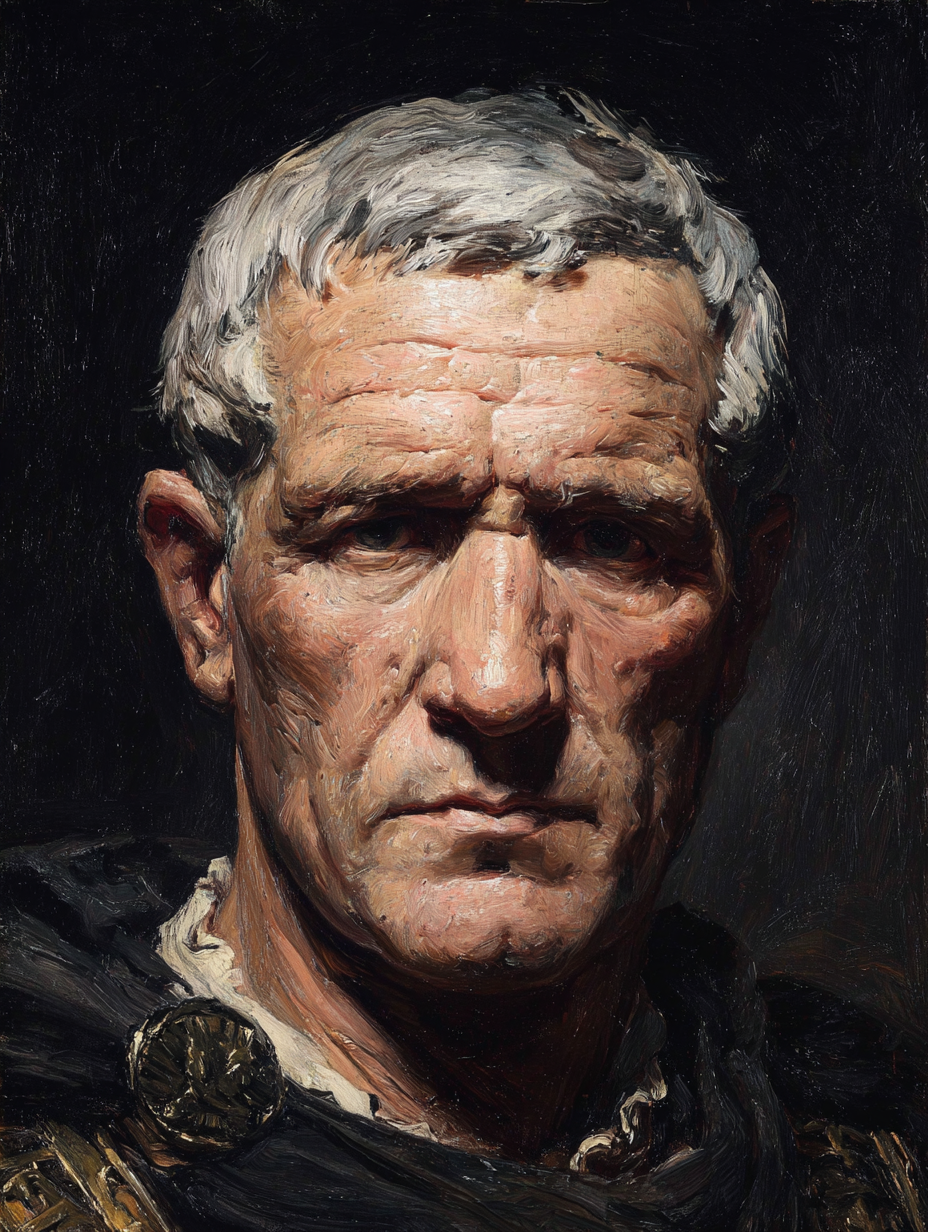
Silver-haired and trim, with the economy of movement of a man who has spent forty years making large-scale decisions and learned that stillness projects authority more effectively than action. He has not personally led a charge in twenty years. He does not need to. He leads armies. The physical presence is the presence of command rather than of combat: precise, unhurried, the body of someone whose most demanding physical activity is now the review of maps and the traversal of large buildings.
Body Features
The build of a career soldier who has not been in the field for twenty years but whose body retains the fundamental structure: straight-backed, economical, the hands of someone who spent his thirties in the saddle and his forties at the campaign table. He carries no weapon on his person in Nova Romae, which is unusual for a man of his rank and which he considers a deliberate signal: the Magister Militum does not need a sword in the capital, because the capital is not a battlefield.
Facial Features
A strong, lined Roman face, the record of forty years of outdoor campaigning followed by twenty years of indoor command. The grey eyes are the most notable feature: they move in the systematic pattern of someone scanning terrain, assessing everything in a room before settling on whatever requires the most attention. This is not paranoia but habit, the automatic threat-assessment of a man who has spent his career in environments where the correct assessment of the situation is the difference between a successful engagement and a disaster.
Identifying Characteristics
The stillness, and the systematic eye movement. Plinius has not met him personally but has been in the same rooms with him twice at official functions, and the second observation is the one he recorded: Sulla's eyes arrived at Plinius approximately thirty seconds into the room, assessed him, and moved on, and the assessment was complete enough that when Plinius crossed his path later in the same function, Sulla knew who he was without introduction. Plinius found this the most efficient form of social recognition he had encountered in forty years of academic life.
Apparel & Accessories
Military dress appropriate to context: full ceremonial for the Comitia Militaris and formal reviews, working dress for the Castra Meridiana office, campaign dress when he is at the frontier. The distinction matters to him in ways it does not matter to most civilian officials, because the dress communicates the context, and communicating context clearly is a military principle he has applied to every aspect of his professional life. The signet ring of the Magister Militum is his only personal accessory; it is the seal on every deployment order issued in twenty years.
Mental characteristics
Personal history
Born 1139 A.P. into the Flavii family's equestrian tradition of legion service. He enlisted at eighteen, served as a legionary officer through the standard cursus, reached the rank of Legatus commanding the III Borealis at thirty-four, and came to the Emperor's attention during the Vorathi incursions of 1186 A.P. when his handling of the northern frontier's logistical crisis — two cohorts caught in terrain that should not have been operationally relevant — was, in the Emperor's subsequent assessment, the finest tactical improvisation he had read since the founding campaigns. The Magister Militum appointment came three years later, when the previous incumbent retired.
Twenty years in the position have given him a comprehensive picture of the empire's military capacity, its vulnerabilities, and the specific gap between what the Senate believes the legions can do and what they actually can. He has been managing this gap for twenty years with the quiet efficiency of someone who has accepted that the Senate's understanding of military operations is not going to improve and that working around it is faster than correcting it.
Employment
Forty years of legion service, rising from junior officer to supreme command. The career is unremarkable in its shape — the standard military cursus of a talented equestrian officer — and extraordinary in its content: every significant engagement he has commanded or planned has been correct. Not always easy, not always without cost, but correct in the sense that the outcome was the best available outcome given the forces and the terrain and the intelligence. He considers this the only professional standard that matters and has organised his career around it.
Accomplishments & Achievements
The Vorathi incursion response of 1186 A.P., which is still studied by junior officers and which produced the tactical manual on northern frontier operations that every legion operating above the 50th parallel now follows. The twenty-year redistribution of the legion deployment from a purely reactive frontier posture to a flexible strategic reserve capable of responding to events anywhere on the primary continent, accomplished without triggering the orc clan responses that a visible redistribution would have produced. The Rift XIII readiness programme, which is six weeks from its test.
The contingency offensive plan, which is not yet an accomplishment because the Emperor has not seen it, but which Sulla considers the most significant piece of strategic planning he has produced in twenty years. He is waiting for the moment to present it.
Failures & Embarrassments
The Vorathi incursion itself: two cohorts caught in terrain conditions that the frontier intelligence had not adequately assessed, producing the crisis that his improvisation resolved. He has spent fourteen years ensuring that the frontier intelligence operation does not produce that gap again, which is why the orc frontier intelligence is now the most comprehensive Roman military intelligence product available. The resolution is the accomplishment. The original gap is the thing he does not discuss.
Intellectual Characteristics
He thinks in military logic: objective, forces, terrain, timing, and the specific decision points at which a campaign is won or lost before the first engagement. This mode is exceptionally well-calibrated to its domain and has served him for forty years. It is less well-calibrated to the Rift XIII problem, which has decision points he cannot assess because he does not know what the arrival will be, and terrain he cannot map because the Rift landing zone is not yet confirmed. He is aware of this limitation and has been building contingency plans across multiple possible scenarios, which is the military response to irreducible uncertainty and which produces a great deal of paper.
He has read Plinius's field work on the orc frontier dispositions and found it useful, which means he has read it more carefully than most of the Senate has read any intelligence product in the past decade. He has not told Plinius this directly but has cited the work in three internal military planning documents. Plinius does not know this. If he did, he would find it both gratifying and alarming, as anticipated.
Morality & Philosophy
The Emperor's authority is the source of legitimate military action, and legitimate military action in service of the empire is the complete moral framework. He is not cruel and not kind in the abstract — he is correct, and correctness in military command means achieving the objective with the forces available at the minimum necessary cost. He has never ordered an action he could not justify by this standard. He has ordered several actions that required justification.
The contingency offensive plan is the current moral edge case: a strategy for pushing beyond the Terminus Magnus that the Emperor has not authorised and that, if implemented without authorisation, would constitute the most significant unilateral military action since the frontier was established. He does not intend to implement it without authorisation. He is waiting for the circumstances that make authorisation inevitable. He has calculated what those circumstances are.
Taboos
He will not discuss the original Vorathi intelligence failure. He will not present the contingency offensive plan until the moment is correct. He will not operate the Frumentarii's domestic intelligence function, which he has been offered access to twice and has declined both times on the grounds that it is not a military instrument and he does not use non-military instruments in military planning.
Personality Characteristics
Motivation
Stated agenda: redistribute the legion deployment for Rift XIII readiness without triggering orc alarm; ensure the ten legions are positioned for the broadest possible range of Rift XIII outcomes; present the contingency offensive plan at the right moment.
Actual motivation: the same, with the addition of the specific professional conviction that Rift XIII will produce a situation that requires decisive military action, and that decisive military action requires preparation that the current political constraints do not permit, and that his job is to have the preparation ready for the moment the constraints change. He has been preparing for this conviction for five years. He is six weeks from finding out if it is correct.
Savvies & Ineptitudes
Genuinely exceptional at: strategic military planning at the largest scale available; terrain assessment and the translation of geographical information into operational decisions; the specific patience of someone who has learned that the correct moment to commit forces is usually later than it appears; managing the gap between what the Senate believes the legions can do and what they actually can.
Genuinely limited by: political intelligence, which he processes through military logic and occasionally misreads as a result; the Rift XIII uncertainty, which his planning model cannot fully accommodate; and the specific limitation of having a contingency plan the Emperor has not seen, which means he is carrying a significant strategic decision without the authority to implement it and without the ability to share the burden.
Virtues & Personality perks
He is loyal without complication, which is rarer than it sounds and more valuable than most politicians understand. Twenty years of being the most militarily powerful person in the empire under the Emperor has produced no evidence of political ambition, factional manoeuvring, or the use of military resources for personal advancement. The Senate finds this troubling because they cannot model it. The Emperor finds it useful because he can rely on it.
He is also, genuinely, correct about military matters with a consistency that has no parallel in the current officer corps. His dispositions have been right in every significant engagement of his career. This is not luck. It is the product of a specific intellectual discipline applied consistently for forty years.
Vices & Personality flaws
The contingency offensive plan. He has produced a full offensive strategy for pushing beyond the Terminus Magnus and has not shown it to the Emperor, on the grounds that the Emperor would consider it premature. This is correct — the Emperor would consider it premature. But it is also the decision to withhold significant strategic information from the person whose authority underpins every military action he takes, and the justification is his assessment of what the Emperor's reaction would be rather than a genuine strategic reason for the withholding. He is aware of this. He has not resolved it.
He also, more quietly, operates on military logic in contexts that require political logic, which produces conclusions that are strategically sound and politically catastrophic with enough frequency that the Emperor has learned to ask him 'and then what happens' after every significant recommendation.
Personality Quirks
The systematic eye movement that Plinius noted. He reads maps by running his finger along the route rather than scanning the whole — the specific reading habit of someone who has been planning marches rather than studying geography. He ends meetings by standing rather than by verbal closure, which is the military mode of indicating that the relevant information has been exchanged and further discussion is not operationally necessary. He has been doing this in senatorial committee meetings for twenty years. The senators have not gotten used to it.
Social
Contacts & Relations
Emperor Gaius Aurelius Maximus : the most significant relationship of his career, twenty years of working alignment between the strategic mind of the military and the head of state who deploys it. The Emperor trusts Sulla's military judgement completely. He trusts Sulla's political judgement not at all, which is a precise and accurate assessment. The contingency offensive plan represents the first significant divergence in twenty years between what Sulla has produced and what the Emperor has been told about. Whether the Emperor finds out about the plan before Sulla presents it is a question with significant consequences.
The Frontier Legates: twenty officers commanding the legions at the Terminus Magnus, all of whom respect Sulla with the careful admiration that Plinius's sources describe. They follow his dispositions because his dispositions have been correct. They do not know about the contingency offensive plan. Several of them have independently been building similar plans, which Sulla is aware of and which he considers evidence that his assessment of the situation is correct.
Plinius : no direct acquaintance but a substantive professional relationship conducted entirely through published scholarship. Sulla has read Plinius's orc frontier dispositions work and found it the best available secondary source on a subject where good primary sources are difficult to obtain. He has cited it in three internal documents. He has considered seeking an introduction through the Emperor and has decided the introduction would change how Plinius wrote about military matters, which would reduce the work's usefulness. He has decided to continue reading the published work without meeting the author.
Senator Corvinus : the most significant political obstacle to every significant military initiative Sulla has proposed in twenty years. The relationship is formally correct and substantively adversarial. Corvinus opposes military initiatives that could destabilise the western frontier, which is most of the initiatives that Sulla considers necessary for Rift XIII readiness. They have been having versions of the same argument for fifteen years. Neither has convinced the other of anything.
Family Ties
His wife, Valeria Flavia , manages the family estate and the family's social calendar with the efficiency of someone who has been doing it for thirty-five years without her husband's consistent presence. The two sons in legion service are his most significant family legacy and the thing he is most careful not to be seen to use his position to benefit, which has produced two careers that are distinguished by their ordinariness and by the specific quality of having received exactly the same treatment as every other officer of equivalent rank.
Religious Views
The Roman state religion, observed with correct professional regularity. He attends the required observances, conducts the campaign rituals that the legion tradition requires, and treats the divine magic that the College of Pontiffs certifies as a measurable military asset rather than a theological matter. His personal relationship with the divine is not documented in any source Plinius has access to. He considers this appropriate.
Social Aptitude
In military contexts: complete natural authority, the ease of someone who has been the most professionally competent person in most military rooms for twenty years. In political contexts: functional but operating on military logic, which produces the specific quality of someone who is too direct for Roman political discourse and who has learned to compensate by saying less rather than differently. The Comitia Militaris has adapted to his register over twenty years. The rest of the Senate has not.
Speech
Latin in the military register: specific, undecorated, organised by priority rather than rhetoric. His briefings to the Comitia Militaris are the most efficient documents produced in the Roman administrative system, which the committee's civilian members find either impressive or frustrating depending on whether they have learned to read the priorities correctly. He does not use irony. He does not use metaphor in official contexts. When Plinius records him using the phrase about generals knowing what victory looks like, he notes that it was said in conversation rather than in an official context, which suggests the register distinction is deliberate.
Wealth & Financial state
Substantial by equestrian standards, primarily from twenty years of Magister Militum salary and the family estate's legacy. He does not display it and does not appear to spend on anything beyond his household's maintenance and his sons' military equipment, which he pays for personally rather than through the legion supply system, which is a specific form of integrity that his legates have noted and which costs him considerably more than it needs to.
Magister Militum (Supreme Commander of the Imperial Legions; the highest military title in the empire, appointed by the Emperor)
Imperator Legionis (ceremonial title used at formal military reviews)
“The difference between a general and a politician is that a general knows what victory looks like.”
Latin (native)
Adequate frontier Orcish (functional, learned from thirty years of Terminus Magnus operations
He reads the intelligence reports in the original rather than relying on translators, which he considers an operational necessity)

Comments