

GAIUS AURELIUS MAXIMUS
Emperor of Aethermarch · First Citizen · Pater Patriae · Imperator
“He is one of perhaps six people I have met who I consider genuinely difficult to read. He asked me, at that last meeting, what I thought would come through the Rift. I told him I didn’t know. He said he didn’t either, and that it was the first time in twenty-two years something had kept him awake at night. I believed him. I found it more reassuring than alarming, which probably says something about my standards.”
Gaius Aurelius Maximus has been Emperor of Aethermarch for twenty-two years and is, by Plinius's assessment and by most other available measures, one of the genuinely capable emperors the empire has produced. He is sixty-seven years old, in good health by Aethermarch's extended-lifespan standards, and facing the most significant event of his reign and quite possibly of any Roman reign in twelve centuries. He has been preparing for it since the day he took power. Whether the preparation is sufficient is the question he cannot answer, which is the first time in twenty-two years that he has found himself in that position, and which is why he has started sleeping badly.
He runs the empire through four instruments simultaneously: the Senate, which he manages through a combination of factional awareness and strategic information control; the Frumentarii, which he created and which reports directly to him and no one else; the Legion command structure, which is loyal to the office rather than the person and which he has been careful to keep it that way; and a small number of individual relationships built over two decades that constitute his real decision-making network. Plinius is one of them. Sulla is another. Aquila is a third, more recently. None of the three knows the others are in the same category.
He is also, quietly, running something that none of the three knows about: the Porta Research Initiative, which he authorised eleven years ago and which is six weeks from a live test. He has not told the Senate. He has not told the Pontifex. He has not told Plinius. He has been sitting on it for eleven years and is starting to wonder if eleven years was the correct amount of time to wait.
“Know who holds the door before you knock on it.”
Physical Description
General Physical Condition
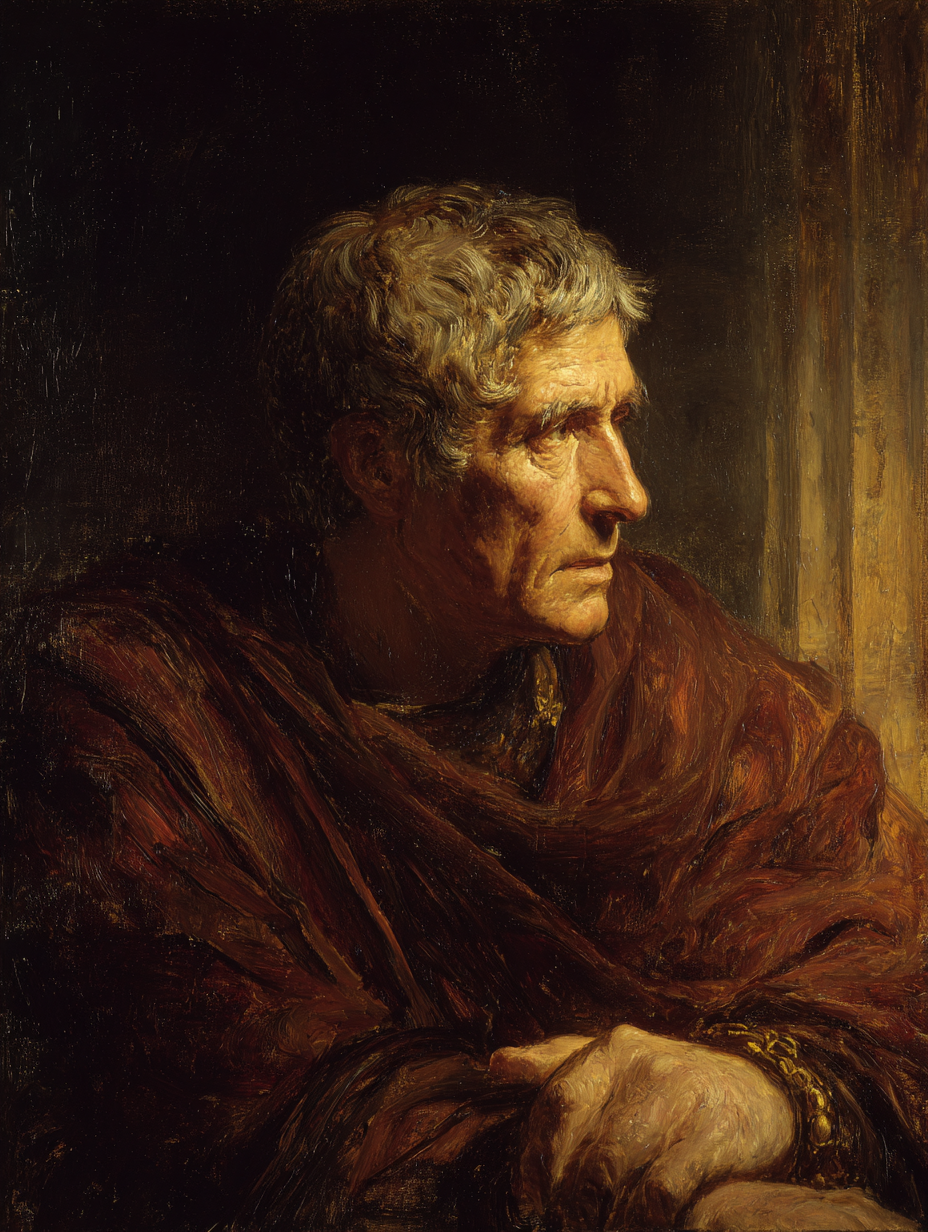
Tall, silver-haired, and still physically imposing in the way of men whose bodies have maintained the muscle memory of a military career without the ongoing physical demands. He carries himself with the particular quality of someone who has spent twenty-two years being the most powerful person in every room he enters and has developed, in response, a stillness rather than a presence — a quality of calm authority that does not need to assert itself because it has never been in question.
Body Features
Large frame, broad-shouldered, with the slight heaviness around the middle that two decades of palace life produces in men who were once physically active and are no longer. His hands are the residual evidence of the military years: large, calloused at the grip points, not the hands of a man who has only ever held a stylus. He moves with deliberate economy, never hurried, never restless. The stillness is cultivated and complete.
Facial Features
A strong Roman face, heavily lined but not aged in a way that reads as diminished — the lines are the record of concentration rather than decline. His expression at rest is one of neutral assessment, the face of someone who is always in the process of evaluating whatever is in front of him. He does not smile easily. When he does, it reaches his eyes, which is the tell that most people miss because they are not expecting it.
Identifying Characteristics
The stillness. He is the only person in most rooms who is not, in some small way, trying to manage his impression. He has been past that for at least a decade, and the result is a quality of presence that reads as either serenity or danger depending on the observer's relationship with power.
Physical quirks
Stands with his hands clasped behind his back during formal proceedings — a military posture retained from his early career and now so habitual it reads as a signature. Looks at the person speaking rather than the person he is about to speak to, which means he is always slightly behind the conversational rhythm in a way that forces the other person to wait for him. Has never, in twenty-two years of public life, been observed to be late for anything.
Apparel & Accessories
Imperial dress at formal occasions, worn with the ease of someone who has been wearing it for twenty-two years and no longer thinks about it. In private audiences — which he prefers — he wears the working dress of a senior Roman official rather than the full imperial register, a signal that the people he grants private audiences to have learned to read as an indication of how the conversation will go. The imperial signet ring is always present. It is the only jewellery he wears.
Specialized Equipment
The Frumentarii cipher system, which exists as a set of keys held only by the Emperor and the Frumentarii's director. Communications through this system cannot be decrypted by any other party; the system has been in use for twenty-two years and has not been compromised. He considers this the most significant engineering achievement of his reign, and does not say so in public, because a cipher system whose existence is well-known is a less effective cipher system.
Mental characteristics
Personal history
Born 1133 A.P. into a patrician family with senatorial standing and the particular social expectation of a family that has held that standing for nine generations. His early education was the standard patrician curriculum of rhetoric, law, philosophy, and military theory, to which he added a sincere engagement with military history that his tutors encouraged and that his family considered appropriate. He served in the legions from eighteen to thirty-two, reaching the rank of Tribune — the officer rank appropriate for a man of his class — before the political track that his family had been preparing for two decades required his return to Nova Romae.
The political career is unremarkable in its outlines — the standard cursus honorum of a patrician with ability, connections, and the patience to wait for the right moment. He served in the Senate for thirty years before taking power in 1100 A.P., and those thirty years were not merely waiting. They were thirty years of building the relationship network, the institutional knowledge, and the specific intelligence about where the empire's structural vulnerabilities lay that he spent his first year in power addressing. The Frumentarii, the restructured Magister Militum's office, the Rift XIII preparation programme — all of these were designed before he took power and implemented the moment he had the authority to implement them.
The twenty-two years since have been the execution of a plan that is now, with six weeks to Rift XIII, close to its final test. What he could not plan for is what comes through the Rift, and this — the first major variable in twenty-two years that is genuinely outside his control — is the thing that is keeping him awake.
Education
Patrician standard curriculum, augmented by genuine intellectual engagement with military history, political philosophy, and — more privately — the Permutatio scholarship that has been accumulating at the Academy for a century. He read Plinius's early publications on Permutatio mechanics before Plinius was well-known, and found them more significant than the Academy establishment was treating them. This was the beginning of a professional relationship that has been, on the Emperor's side, considerably more strategic than Plinius realises.
Employment
Thirty years in the Senate, rising through the committee structure with the methodical precision of someone who understood that committees are where policy actually happens. Tribune of the Comitia Militaris for eight years — the posting that gave him the military command relationships that have served him since. First Citizen since 1100 A.P., a tenure that makes him the most experienced active head of state in the known world and that the Senate debates, in whispered terms, as either wisdom or accumulation of habit. He is aware of this debate. He does not find it interesting.
Accomplishments & Achievements
The Frumentarii: the only intelligence service in Aethermarch that operates with genuine secrecy and reports to a single authority. Twenty-two years of intelligence operations that the Senate has not been able to penetrate, document, or officially acknowledge. Plinius suspects its scope but has not published his suspicions, which the Emperor considers a courtesy he will eventually acknowledge in some form.
The goblin negotiations: the most significant secret diplomatic initiative in the empire's history, authorised by the Emperor, conducted through Ambassador Pons, and unknown to the Senate. If it succeeds, it will alter the western frontier's political geography more decisively than any military action in twelve centuries. If it fails, it will be very difficult to explain.
The Porta Research Initiative: authorised eleven years ago on the strength of a research proposal from a mid-level Academy natural philosopher whose intelligence told him was either a genuine discovery or a brilliant fraud, and that turned out to be a genuine discovery. Six weeks from a live test. He has not told anyone he authorised it except the researcher himself.
Twenty-two years of senatorial management that has kept the conservative and reformer factions in a productive stalemate while the policy work he actually cares about proceeds through other channels. This is not, by conventional measures, an accomplishment. By the measures that matter it is the most demanding sustained achievement of his reign.
Failures & Embarrassments
The succession question is unresolved and he has allowed it to remain unresolved, which is either a strategic choice or a personal failure depending on how one reads it. His son Gaius Aurelius Minor has the capacity for the office and the temperament for administration but lacks the specific political instincts that the next decade will require. His daughter Aurelia Maxima has those instincts and is constitutionally excluded from direct succession by conventions he could revise and has not. He has been not-resolving this for five years.
He authorised the Porta Research Initiative without asking what Silanus intended to do if it worked and who he intended to tell. This is an unusual lapse for a man who typically models downstream consequences in detail, and it is starting to feel like one as the test date approaches and he realises he has no plan for the morning after a successful transit.
Mental Trauma
The death of his wife Claudia Aurelia in 1178 A.P. She died of a fever that the palace physicians treated adequately and too slowly. He has not remarried. He has not, in twenty-two years of public life, given any indication that the loss affected him in ways that influenced his decisions. This is the most disciplined act of his reign and the one that cost him the most, and it is not something he will ever discuss.
Intellectual Characteristics
He thinks the way a good general maps a campaign: from the objective backward to the current position, identifying the decision points that determine outcomes and the resources required at each one. He is not a theorist. He does not have a political philosophy in the academic sense. He has a working model of how power operates in this specific empire at this specific moment, and he updates the model continuously with incoming information, and he acts on the model rather than on principle. The distinction matters and he is aware of it.
His primary intellectual strength is the long game. He planned the Frumentarii, the goblin negotiations, and the Rift XIII preparation programme before he took power, and the plans have held through twenty-two years of changing circumstances. His primary intellectual limitation is that the long game requires a stable variable set, and the Rift XIII variable set is not stable. He is operating at the edge of his model's predictive capacity and he knows it.
Morality & Philosophy
He believes that the empire is worth preserving and that preserving it requires doing things that a strictly ethical accounting would not approve. He is not cynical about this — he has made specific calculations about specific actions and found them warranted in specific contexts, rather than adopting a general license for moral flexibility. The goblin negotiations are the clearest example: he believes that a formal treaty protecting goblin territorial integrity from orc predation is the right policy on its merits, and he is pursuing it through channels that exclude the Senate because Senate oversight would kill it before it reached a vote. He considers this a defensible choice. He has written the defence, in his private correspondence, with considerable care.
He has a line he will not cross that is less visible than most men's and more firmly held: he will not use the Frumentarii against the Senate. The intelligence service exists to protect the empire from external threats and from within the Imperial household. It is not, and has not been, a political suppression tool. He made this decision in his first year and has maintained it with an integrity that Ambassador Pons, who runs the Frumentarii, considers the most significant restraint in the history of the office.
Taboos
He will not use the Frumentarii domestically against political opponents. See Morality and Philosophy above; this is the line and it is structural, not situational.
He will not name a successor until he has resolved, in his own mind, which of his two children is the correct choice. He is not resolved. He will not be pressured into resolving it before he is ready, which has been the Senate's position on the matter for five years and which he has resisted without explanation.
Personality Characteristics
Motivation
Stated motivation: the stability and prosperity of the Roman Empire and the correct management of the empire's transition through the Thirteenth Rift.
Actual motivation: the same, with the addition of a private conviction that has developed over twenty-two years of ruling. He believes that Rift XIII will not merely bring a new people to Aethermarch — he believes it will change something fundamental about the relationship between the peoples already here, in ways that the preparation programmes cannot fully account for. He has been building infrastructure — diplomatic, intelligence, military, and most recently scientific — for an event whose nature he cannot predict. He is aware that this is the correct response and that it is insufficient. He has not found anything better.
Savvies & Ineptitudes
Genuinely exceptional at: reading political situations and the people in them; sustaining a long-term strategic plan through changing circumstances; knowing when to act and when to wait, which is rarer than either skill individually; and managing the Senate's factional dynamics with a precision that the factions consistently underestimate.
Genuinely limited by: the inability to fully model variables he has not encountered before, which includes the Rift XIII variable set; the succession question, which he is avoiding rather than resolving; and an occasional tendency to assume that people he has assessed correctly in institutional contexts will behave consistently in crisis contexts, which is not always warranted.
Likes & Dislikes
He prefers direct speech in private contexts and uses it himself, which is why his private correspondence is a different register from his public addresses. He dislikes being managed — he notices it immediately and adjusts his behaviour accordingly, which means the people who try to manage him get the version of him they have signalled they expect rather than the version that would be useful to them. He takes genuine pleasure in chess, plays it badly, and finds this instructive.
He dislikes the unresolved succession question more than he dislikes anything else in his current situation, and since he is the person who has left it unresolved, this produces a specific quality of irritability when it is raised that his staff have learned to work around.
Virtues & Personality perks
He keeps his word. In twenty-two years of wielding more power than any other individual in the known world, he has not broken a commitment he made explicitly. This is a more significant virtue than it sounds, and the people who have worked closely with him for decades cite it before anything else.
He is also, genuinely, interested in being correct rather than being consistent. He has revised positions publicly when evidence warranted revision — on the centaur alliance, on the halfling vassal terms, on the Frumentarii's scope of operations — without the political cost that such revisions typically carry, because his record of being right often enough has made the revisions read as precision rather than inconsistency.
Vices & Personality flaws
He has been sitting on the Porta Research Initiative authorisation for eleven years without a plan for what happens if it works. This is the clearest available evidence that the long game has a limit, and that when events move faster than the plan anticipated, the plan has gaps. He is six weeks from a live transit test conducted by a man he has not spoken to in three years, in a city he cannot easily reach, with implications he has not fully modelled.
He has also, more quietly, allowed the succession to drift for five years because resolving it requires choosing between his two children, and choosing means one of them is not chosen, and he has found that this particular calculation is the one he cannot make with the same clean rationality he applies to everything else. He is aware that this is a weakness. He has not resolved it.
Personality Quirks
Clasps his hands behind his back when standing and thinking — the military posture, retained across four decades. Asks one question per audience, precisely worded, and waits for the full answer before responding; this is the most reliably disorienting thing he does in private meetings because most people are not accustomed to being genuinely listened to by the most powerful person they have ever met. He remembers every name of every person he has been introduced to, which is either genuine or performed so well that the distinction does not matter.
Hygiene
Impeccable, in the manner of someone for whom personal presentation has been a professional instrument for forty years and for whom the habits are now structural rather than considered. His staff notes that he is dressed and presentable at any hour, which is either admirable discipline or the sign of someone who does not sleep as much as they used to.
Representation & Legacy
His public image is that of a stable, capable administrator who has kept the empire on a steady course through a period of increasing external uncertainty. The Senate faction leaders have more nuanced private assessments. The people of Nova Romae, who have never directly experienced his governance but have experienced twenty-two years of the city functioning correctly, regard him with the specific approval that competence without visibility tends to generate.
His legacy, which will be defined entirely by what happens over the next six weeks and the following year, is the most uncertain of any emperor in recent memory. He is aware of this. He has arranged for his private correspondence to be sealed for twenty years after his death, which is either historical modesty or the act of a man who is not certain how the correspondence will read once the outcome is known.
Social
Reign
Twenty-two years, from 1178 A.P. to the present. The defining arc of his reign is the Rift XIII preparation programme, which has consumed the bulk of his strategic attention since the first year. The secondary arc is the goblin negotiations, which represent the most significant foreign policy initiative since the halfling vassal treaty two centuries ago and which are, as of 1200 A.P., almost concluded. The tertiary arc — which he would not describe as such — is the Porta Research Initiative, running in the background of everything else for eleven years and six weeks from its test.
The Senate debate he is managing in the immediate term is about Rift XIII preparations, but the real subject is the goblin treaty, which Senator Aquila is navigating toward a vote while Senator Corvinus prepares to object to whatever he suspects is coming. The Emperor has authorised Aquila's negotiations. He has not told Corvinus. He has been monitoring Corvinus's suspicions through the Frumentarii for six months and has assessed that the old senator is close to the truth but not yet there.
Contacts & Relations
Plinius: the most intellectually significant relationship in the Emperor's network and the most carefully managed. He has read everything Plinius published, funded the Comparative Cultural Studies faculty indirectly through three Academy budget cycles without Plinius noticing the connection, and used the scholarly output to inform foreign policy decisions that the Senate believes originated with the Frumentarii. The relationship is not friendship in the conventional sense. It is the particular relationship between a ruler and the most honest available source of information about the world the ruler governs — valuable, somewhat asymmetric, and sustained with considerable care on the Emperor's side.
Magister Militum Sulla: the relationship is professional and close. Sulla is loyal to the Emperor without complication, which the Senate finds troubling and the Emperor finds useful. He trusts Sulla's military judgement completely and Sulla's political judgement not at all, which is a precise and accurate assessment of Sulla's actual capacities.
Senator Livia Serena Aquila : recruited to the goblin negotiations eight months ago after three years of observing her work on the Comitia Provincialis. She is the diplomat he is using for the most significant secret in Aethermarch. She knows the Emperor authorised the negotiations. She does not know the extent to which Corvinus suspects. He has assessed that she is more exposed than she realises and has not told her, because telling her would change how she negotiates and the current approach is working.
Ambassador Pons: twenty years of the most sensitive intelligence operations in the empire's history, none of which has been compromised, all of which has been reported honestly. The most reliable professional relationship the Emperor has, and the most invisible. Pons's cover as Imperial Ambassador has not been officially pierced in twenty years. The Emperor considers this the most impressive ongoing performance in his administration.
High Thane Durak Ironmantle: the railway negotiation has been in process for three years. The Emperor knows what the dwarves want — formalised diplomatic status and recognition as a sovereign civilisation of the first order — and is prepared to give it, but not until after Rift XIII, when the political leverage the dwarves' orrery data provides is no longer as significant. The High Thane knows the Emperor is waiting. Both men are comfortable with this.
Family Ties
His son Gaius Aurelius Minor , 38, Governor of Provincia Septentrionalis: a capable administrator, loyal, with the patient methodical intelligence that has served the Aurelii Maximi for nine generations. He does not have his father's instinct for the decisive moment, which in ordinary times would be a minor limitation and in the next decade may be a significant one.
His daughter Aurelia Maxima , 35, on the Comitia Provincialis: she has the political instincts her brother lacks and a working knowledge of the Senate's factional dynamics that is more current than her father's. She is constitutionally excluded from direct succession. The Emperor has not yet decided whether to revise the convention.
Claudia Aurelia , his wife, died 1178 A.P. He does not discuss her.
Religious Views
Formally observant of the Roman state religion as required by his office, and treats the observance with the seriousness appropriate to a man who understands that institutions are sustained by their rituals. Whether he believes in the specific theological claims is a question he has declined to address, in public or in private, for twenty-two years. His physician, who is one of four people who might know, has said only that the Emperor takes his health seriously and treats his obligations with equal care.
Social Aptitude
Complete command of formal and semi-formal social contexts, which after twenty-two years of being the most powerful person in every room is not an achievement but a condition. What is more interesting is his performance in private contexts — the one-on-one audiences he prefers, where the formal register drops and he is direct in the way that the people who have experienced it remember for years afterward. He is charming when he chooses to be and is sufficiently aware of how charm works to use it sparingly, which makes it more effective than if he used it constantly.
Mannerisms
The hands-behind-back posture when thinking. The single precisely worded question per audience. The specific quality of attention that Plinius described as making him feel that the subject of his study was studying him more carefully than he was studying it. He ends private meetings by standing rather than by signalling that the audience is over, which is a distinction that takes most visitors a moment to register and that means the meeting ends on his terms rather than theirs.
Speech
Public register: the Latin of formal imperial address — measured, authoritative, entirely without ornament, carrying the weight of the office rather than the person. He is a skilled orator who has decided that the most effective speeches say nothing that can be held against him and everything that is necessary to be said, and has achieved this over twenty-two years without the press finding it remarkable. Private register: direct, spare, occasionally dry in a way that his staff finds easier to work with than the formal version. He does not raise his voice. He has not needed to.
Wealth & Financial state
Imperial wealth, which is a category distinct from personal wealth: the treasury, the estates, the ceremonial holdings are institutional rather than personal. His personal wealth, inherited from the Aurelii Maximi estate, is substantial by senatorial standards and unremarkable by imperial ones. He does not spend on personal display. The palace is maintained as an institutional obligation rather than a personal preference, and he has made no additions to it in twenty-two years. His personal correspondence indicates that he finds this appropriate and has never reconsidered it.
Imperator Caesar Gaius Aurelius Maximus Augustus
Pater Patriae
Pontifex Maximus (ceremonial, distinct from the religious office)
First Citizen
None on public record. He gives speeches with considerable skill and says nothing in them that he could not defend in a legal proceeding. His private correspondence, which the Frumentarii protect, is a different register entirely.
Latin (native)
Enough Dwarvish to follow a railway negotiation without a translator, which he considers strategically useful and has not disclosed
Augustus Caesar crossed with a competent modern head of state who has been in office long enough to know where all the bodies are buried

Comments