
FORUM NOVUM
The Great Forum · District · Nova Romae
"The Forum is where the Empire performs itself. The Palatine is where it governs itself. The Subura is where it sustains itself. The Forum is where it looks at itself and decides what it sees. This function requires an audience, which is why the galleries hold two hundred people and the colonnades hold considerably more."
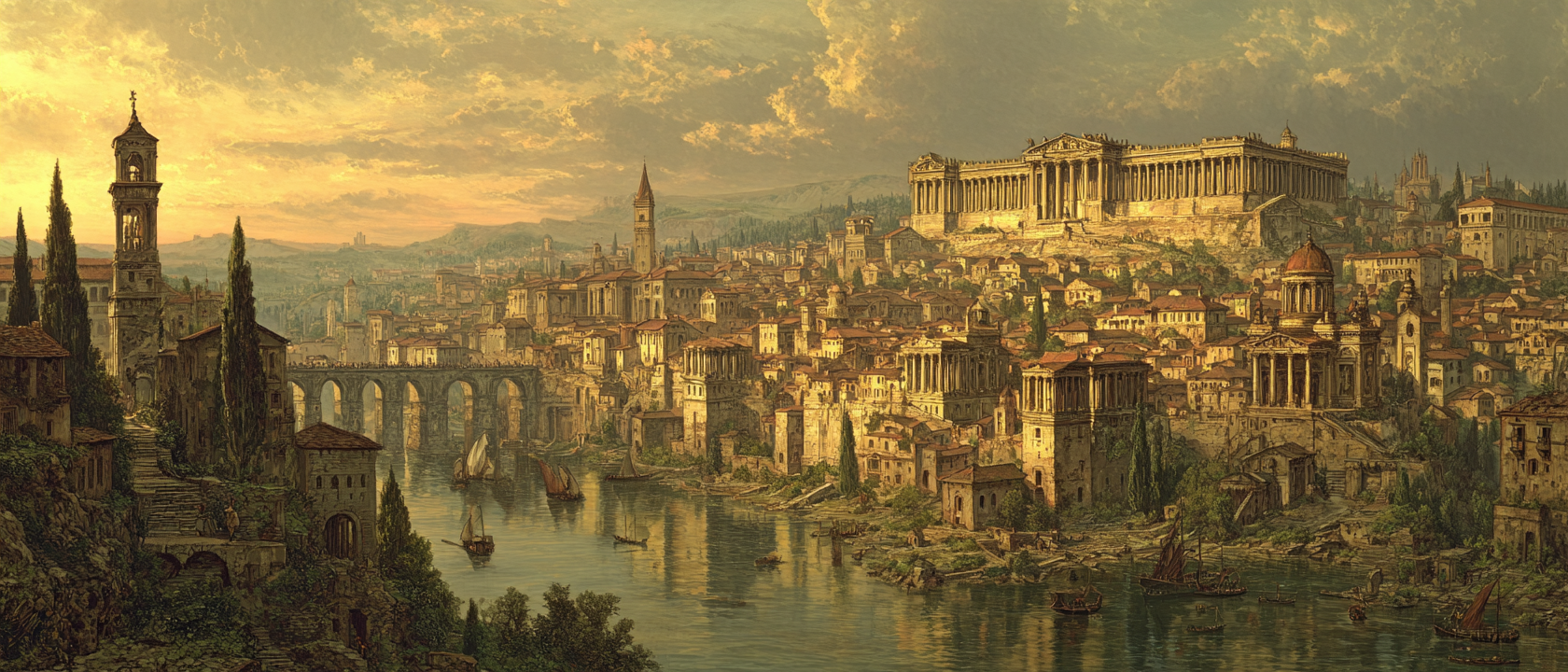
The Forum Novum is the civic heart of Nova Romae — a rectangle of white stone a quarter mile long, flanked by colonnades and public buildings, with the triumphal arches of three different emperors marking its cardinal points. It is the formal centre from which every Imperial road measures its distance, the space where public announcements are made, major legal cases argued before crowds, Senate vote results posted within hours of passage, and foreign dignitaries formally received. It is also, on any given day, the location where the ordinary business of eight hundred thousand people generates a constant low roar of commercial and social activity that makes it simultaneously the most formal and the most alive space in Nova Romae.
Demographics
The Forum has no permanent residential population — it is a public space rather than a district in the residential sense. Its daily population, which fluctuates between approximately ten thousand on quiet mornings and forty thousand on Senate sitting days or major festival occasions, comprises an unfiltered cross-section of Nova Romae: citizens, freedmen, slaves on errands, merchants from every province, foreign visitors, petitioners awaiting their moment, lawyers preparing their arguments, the food vendors whose carts occupy the Forum's southern colonnade, and the various observers — official and unofficial — who monitor the Forum's activity as a professional practice.
Government
The Forum is administered by the Aedilitas — maintenance, vendor licensing, event management, the continuous effort of keeping a large open public space functional. The Quaestor Publicus manages the Curia's public access on Senate sitting days. Legal proceedings in the Forum are administered by the Praetor's office. The Cohortes Vigilum maintain a visible presence; the Forum is the one location in Nova Romae where their visibility is as much ceremonial as functional — the display of order is part of the Forum's purpose.
Defences
The Forum is a public space and is not defended in any military sense; it is surrounded by the Palatine's walls to the west and has the Capitoline's temple wardens to the north. The Vigilum presence handles the routine security of a very large public gathering space. The Forum has been the location of three public disturbances in the past century, all of which were managed without escalation to military involvement, and the Vigilum's crowd management protocols for the Forum are the most developed of any location in the city.
Industry & Trade
The Forum's commercial activity is primarily the commerce of public life — the food vendors, the legal advocates, the notaries whose offices occupy the colonnade's eastern end, the money-changers who have maintained a presence at the Forum's southern entry since the third century. The golden milestone at the Forum's centre generates its own commercial ecosystem: the distance-measurement services, the route-planning advisors, the courier companies whose pricing is based on milestone distances. More significantly, the Forum is where commercial decisions of consequence are publicly performed — the announcement of grain prices, the posting of new trade regulations, the formal receipt of goods seizures — and the commercial information generated by these performances moves through the city's trade networks within hours.
Infrastructure
The Forum's commercial activity is primarily the commerce of public life — the food vendors, the legal advocates, the notaries whose offices occupy the colonnade's eastern end, the money-changers who have maintained a presence at the Forum's southern entry since the third century. The golden milestone at the Forum's centre generates its own commercial ecosystem: the distance-measurement services, the route-planning advisors, the courier companies whose pricing is based on milestone distances. More significantly, the Forum is where commercial decisions of consequence are publicly performed — the announcement of grain prices, the posting of new trade regulations, the formal receipt of goods seizures — and the commercial information generated by these performances moves through the city's trade networks within hours.
Guilds and Factions
The Forum does not host guilds in the residential sense, but the Forum advocates — the legal professionals who conduct public cases — constitute one of the most influential informal professional groups in Nova Romae. The leading advocates of each generation have shaped Imperial legal precedent more directly than most senators, because they argue the cases that establish what the law means. The current leading advocate, Gaius Antonius Primus, sixty-four, has argued thirty-two significant precedent cases in forty years and is preparing his thirty-third, whose subject the Senate would prefer not to come to public argument.
History
The Forum Novum was established in the second century on the site of the original market square — expanded from the Old City's Platea Prima as the city's administrative centre shifted outward from the original settlement. The golden milestone was set in 203 A.P. The three arches were built in 203 A.P., 411 A.P., and 780 A.P. respectively. The Forum has been the site of every major public event in Nova Romae's history: Imperial declarations, senatorial crises, the formal reception of every foreign diplomatic mission, the public announcement of every significant political development. It will be the site of whatever announcement the Senate eventually makes about Rift XIII.
For full chronological detail, see: Annales Mundi.
Points of interest
The golden milestone at the Forum's centre is the most precisely located object in Aethermarch — a gilded column marking the point from which every Imperial road distance is officially measured. Its installation in 203 A.P. was the first Emperor's most practically significant act and arguably his most permanent. Every road in the Empire traces its length back to this point. Every distance in Roman geography is defined by relationship to this column. The milestone itself is modest in scale; the implications are not.
The Rostra is the Forum's public speaking platform, raised four feet above the Forum surface, its face bearing the bronze beaks of captured warships that have no navigational relevance in Aethermarch and complete symbolic relevance in Rome. Every significant public announcement in Nova Romae has been made from the Rostra. The Pale Wanderer's rising will be announced here, when the Senate decides to make it public, from a platform decorated with the weapons of a world that no longer exists.
The Basilica Iuridica on the Forum's eastern side is the primary court building for Nova Romae's major legal proceedings — the cases argued publicly before crowds in the Forum's tradition of legal spectacle. The cases currently scheduled before the Basilica include two commercial disputes of moderate significance and one case whose subject matter — a challenge to the Annona's most recent grain distribution calculations — has attracted more than usual public attention, including from a group meeting in the Forum's colonnades after dark that is not criminal yet.
The triumphal arches of three emperors are Nova Romae's most studied architectural monuments — each a different style, each communicating something about its builder's understanding of Imperial authority. The first Emperor's arch is the tallest: plain, severe, the inscription listing what he did without adjectives. The fourth Emperor's arch is the most decorated: reliefs showing every province, every ally, every trade route. The seventh Emperor's arch is the smallest and the most recent, its inscription in both Latin and Dwarvish — the only state monument acknowledging the dwarven partnership in explicitly equal terms, which was controversial in 780 A.P. and is now simply history.
Tourism
The Forum Novum is fully public and is one of the standard destinations for visitors to Nova Romae — the place where the Empire's scale becomes physically evident in a single space. The three triumphal arches and the golden milestone are standard stops on any guided tour. The food vendors' carts in the southern colonnade offer the most consistent quality-to-price ratio of any eating option in the inner city, which is known to every local and unknown to every first-time visitor who follows a guide's restaurant recommendations instead. The Forum at dawn, before the crowds arrive, is one of the most affecting experiences the city offers, according to Varro, who has been doing it for forty years and has not yet found a morning where he regrets it.
Architecture
The Forum's architecture is the accumulated statement of twelve centuries of Imperial self-presentation. The triumphal arches of three emperors — the first Emperor, the fourth, and the seventh — mark the Forum's three cardinal points (the fourth point is the Palatine approach each arch is a different height, the tallest belonging to the first Emperor not because he was the greatest but because he came first and set the scale. The colonnades along the Forum's long sides are third-century construction with dwarven engineering contributions; they provide covered public space for several thousand people and have been the location of every significant public announcement in Nova Romae's history. The Rostra — the raised speaking platform at the Forum's northern end — is where orators address the public; its stone face bears the beaks of captured warships, a practice imported from old Rome and maintained for twelve centuries in a world that has never seen those ships.
Geography
The Forum Novum occupies the low ground between the Palatine Hill to the west, the Capitoline to the north, and the first ring road to the east — the natural gathering place of the original settlement, expanded and formalised over twelve centuries into the current monumental space. It is bounded by public buildings on all sides: the Basilica Iuridica to the east, the Senate Quarter's southern edge to the north, the Palatine's approach ramp to the west, and the colonnaded commercial buildings that mark the transition to the Old City to the south. The Forum's surface is white stone, maintained to a standard that requires continuous attention and is continuously given it.
Access
Fully publicly accessible at all times.

Comments