


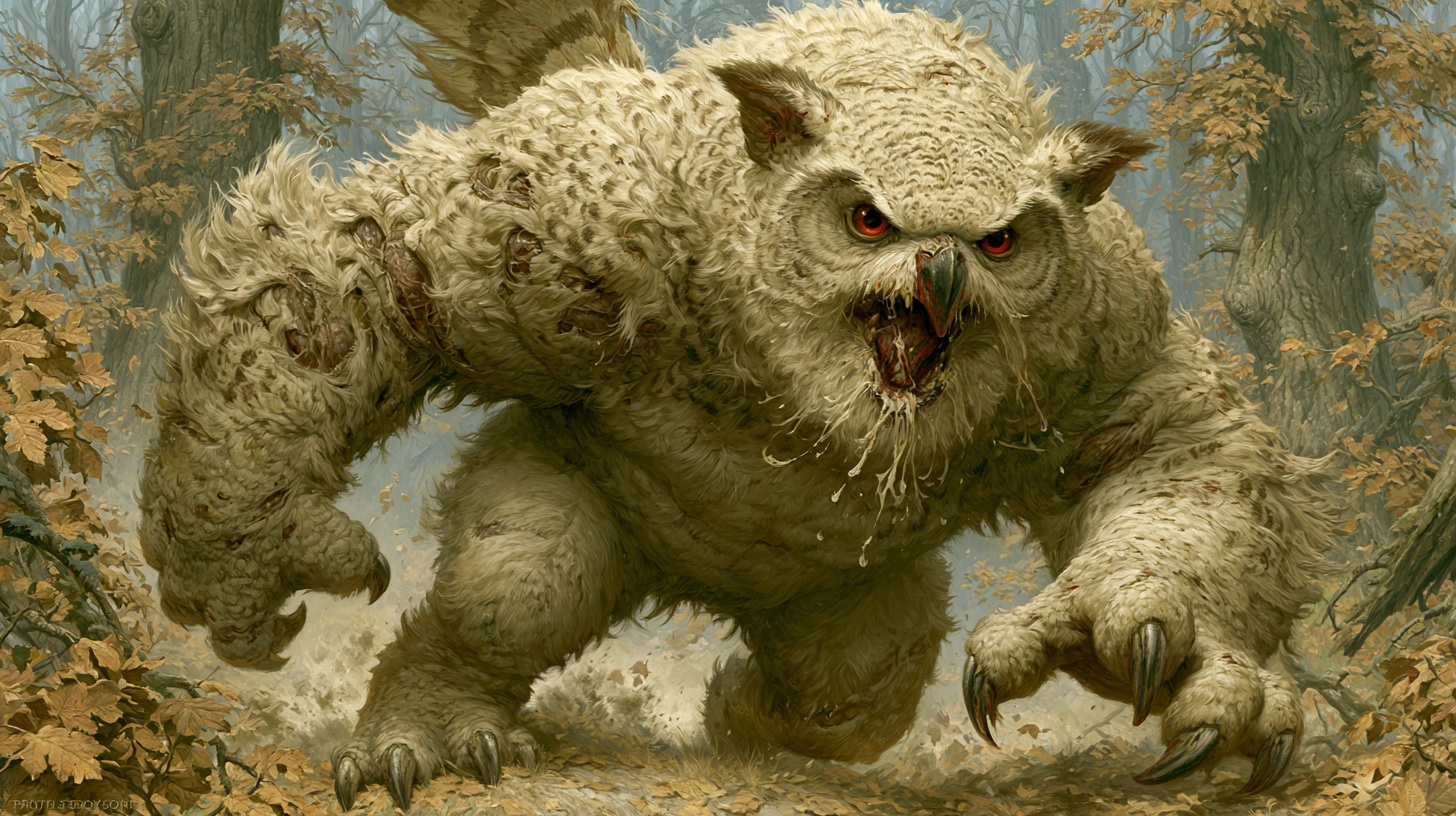
Rabid Owlbear
Pain, Blood & Death
"A hungry owlbear may be driven off with fire, steel, or luck. A rabid one knows neither fear nor pain, and it will chase a man until one of them falls dead. Pray it is not you, for the disease ensures the victor is seldom the survivor."
The rabid owlbear does not belong in nature.
It is not a distinct species, nor a regional variation recognized by druids or natural philosophers. It is what remains when one of the world's most dangerous predators contracts a virulent supernatural affliction that strips away instinct, memory, and every trace of self preservation, leaving behind only pain and violence.
Few creatures inspire more immediate terror.
Ordinary owlbears are already infamous for their ferocity. Solitary, immensely powerful, and notoriously difficult to drive away from their territory, they are capable of overwhelming experienced hunters through sheer strength and aggression. Yet even an ordinary owlbear behaves according to recognizable instincts. It hunts when hungry, defends its young, retreats from overwhelming danger, and eventually rests after exertion.
The rabid owlbear has forgotten all of those things.
Its body continues to function, but its mind has been reduced to an endless cycle of agony and blind rage. Every movement appears unnatural. Witnesses describe animals stumbling forward in violent spasms, slamming into trees they would once have avoided, clawing at the ground for no apparent reason, and attacking prey long after it has ceased moving. The creature often injures itself while charging through dense undergrowth or rocky terrain, seemingly incapable of recognizing wounds that would cripple any other beast.
Indeed, many specimens appear to survive only through sheer momentum. Their hides are frequently torn open by old injuries. Broken claws, shattered beaks, infected wounds, and embedded arrows are common sights. Some continue hunting despite missing an eye or dragging a partially useless limb behind them. Pain no longer serves its natural purpose. It has become merely another sensation drowned beneath the constant fever consuming the creature's mind.
The origin of the affliction remains uncertain. Some scholars believe it is an unusually virulent disease that occasionally infects owlbear populations through bites exchanged during territorial conflicts. Others insist no mundane illness could produce the profound psychological collapse observed in afflicted specimens. Certain priests claim the condition represents a supernatural corruption born from curses, demonic influence, or places where the natural order has been profoundly violated.
No consensus exists.
What is certain is that the condition spreads through violent contact. The saliva of an infected owlbear carries whatever curse or pathogen drives its madness, and those wounded by its beak occasionally begin exhibiting disturbing behavioral changes within hours. Victims grow increasingly irritable, struggle to think clearly, and develop an almost uncontrollable impulse to lash out at anyone nearby when injured or frightened. Fortunately, these symptoms can usually be reversed through restorative magic if treated quickly.
Left untreated, the outcome is far less certain.
Experienced woodsmen often remark that the most terrifying aspect of a rabid owlbear is not its strength but its refusal to behave like a living creature. It does not bluff charge. It does not roar to establish dominance. It does not flee when wounded beyond reason. Hunters accustomed to intimidating dangerous beasts quickly discover that the creature no longer recognizes fear. Fire, loud noises, and grievous injuries that would send almost any predator retreating have little visible effect upon its relentless pursuit.
This unnatural determination has claimed the lives of many overconfident adventurers. More than one seasoned monster hunter has assumed the beast would eventually exhaust itself or retreat after sustaining serious injuries. Instead, it continued attacking until either it or its prey finally collapsed.
Entire villages have been abandoned following confirmed sightings. Rangers generally advise avoiding any forest known to harbor a rabid owlbear rather than attempting to track or eliminate it. Even successful hunts often result in severe casualties, and many hunters consider the risk disproportionate to any reward the carcass might provide.
The creature's death offers little comfort. The violent convulsions that accompany its final moments frequently send claws and limbs thrashing with enough force to wound anyone standing nearby. Veterans therefore caution inexperienced hunters never to approach a fallen specimen until several moments have passed and all movement has unquestionably ceased.
Perhaps the greatest tragedy lies in recognizing what has been lost.
Beneath the blood, fever, and madness remains an owlbear that once occupied a rightful place within the wilderness. It hunted because it was hungry. It defended its territory because survival demanded it. It belonged to the forests as surely as wolves, bears, or hawks.
The rabid owlbear belongs nowhere.
It is not a triumph of nature, but its failure.
Every encounter ends the same way. Either the beast dies, or something else begins carrying its madness deeper into the wild, where another hunter, another traveler, or another unsuspecting village will eventually discover that the forest has learned a new way to kill.
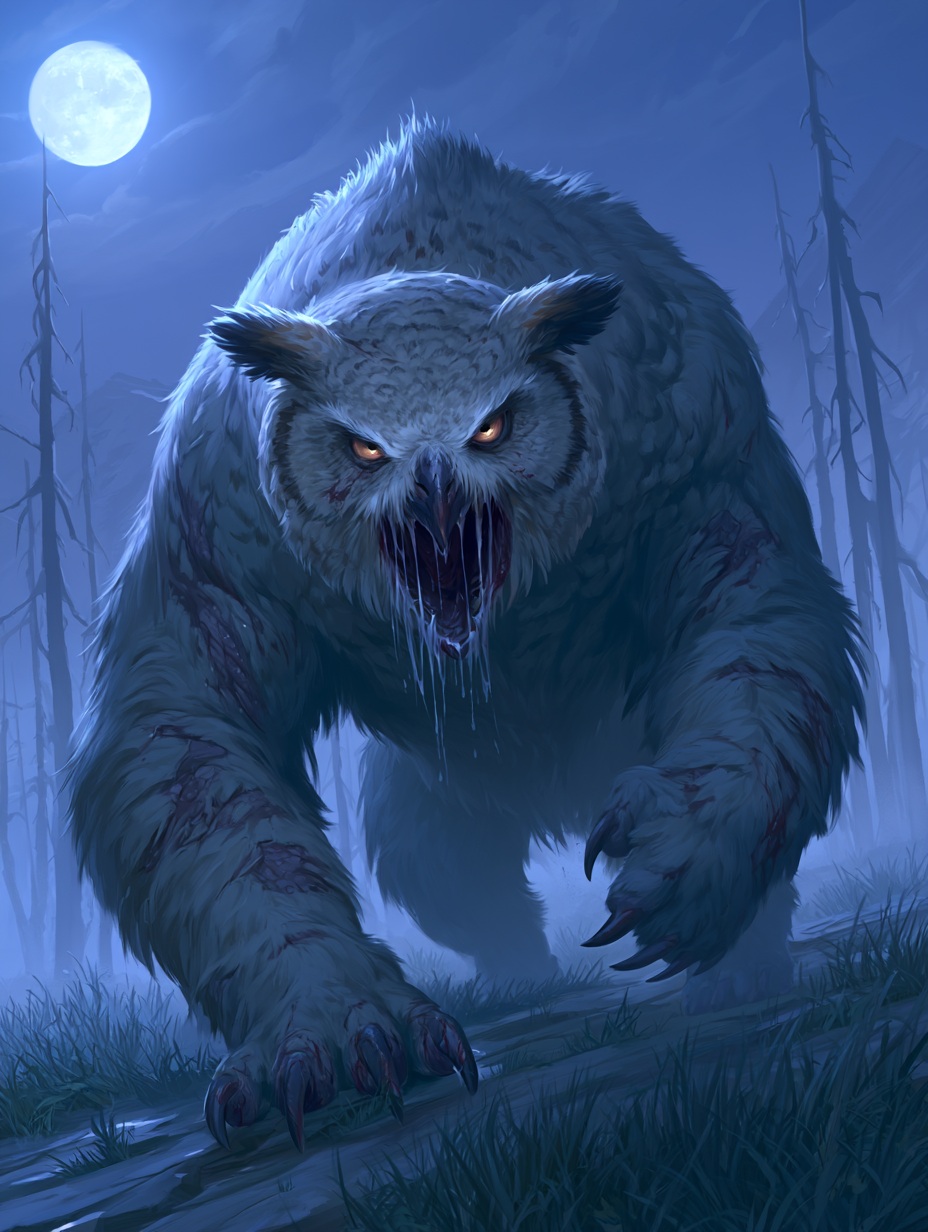
"I have seen dragons retreat from battle. I have never seen a rabid owlbear retreat from anything."
Genetic Ancestor(s)
Scientific Name
Ursistrix ferox
Origin/Ancestry
Average Height
8-12 ft
Average Weight
1,500-2,000 lbs
Average Length
8-10 ft






Lol very nice. Love a good frenzied, savage attack