


Coelleca
Hunger From The Abyss
“Ships vanish in the Illusion Sea the way sparks vanish in a storm. Sometimes it's weather. Sometimes it's rocks. And sometimes it's something large enough that the sea itself seems to move aside for it.”
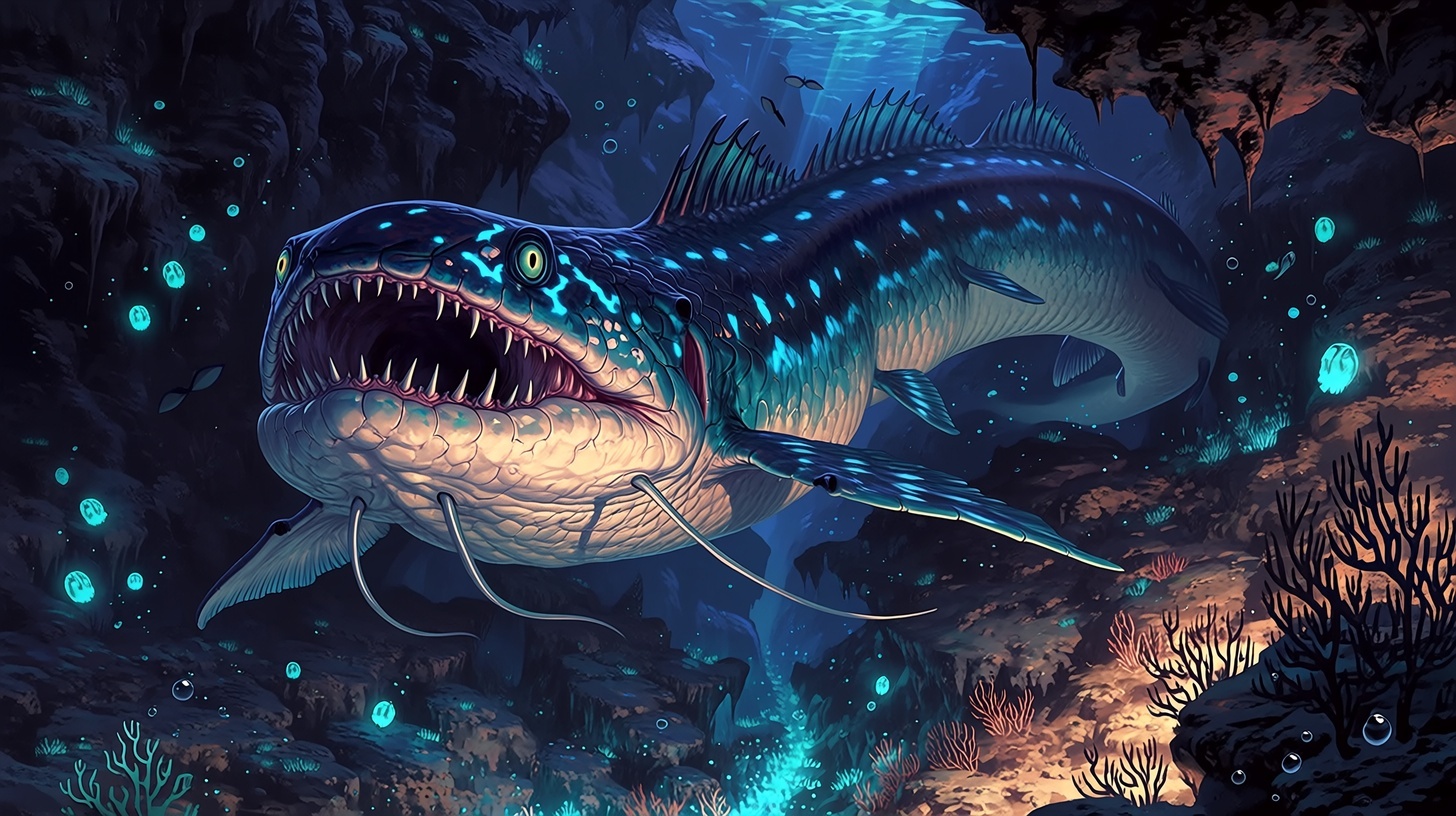
The Coelleca is a massive abyssal predator that inhabits the deep tropical regions of the Illusion Sea. Rarely seen and poorly understood, it is regarded by sailors as one of the ocean’s true leviathans. Most encounters occur far from shore where the sea drops into vast dark basins that few vessels ever explore. In these depths the creature lives largely unseen, rising only when prey movements or seasonal migrations bring opportunity closer to the upper layers of the sea.
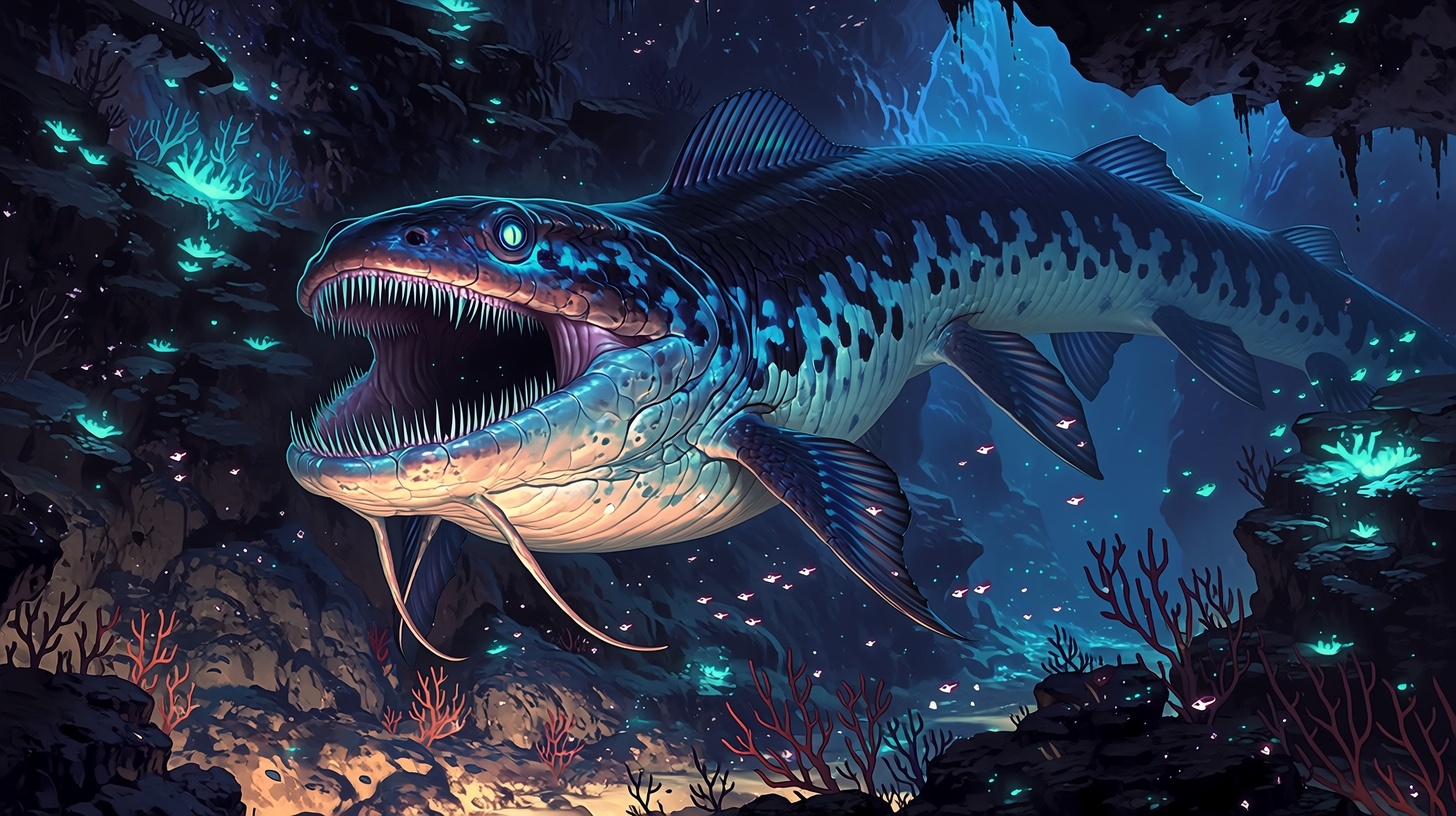
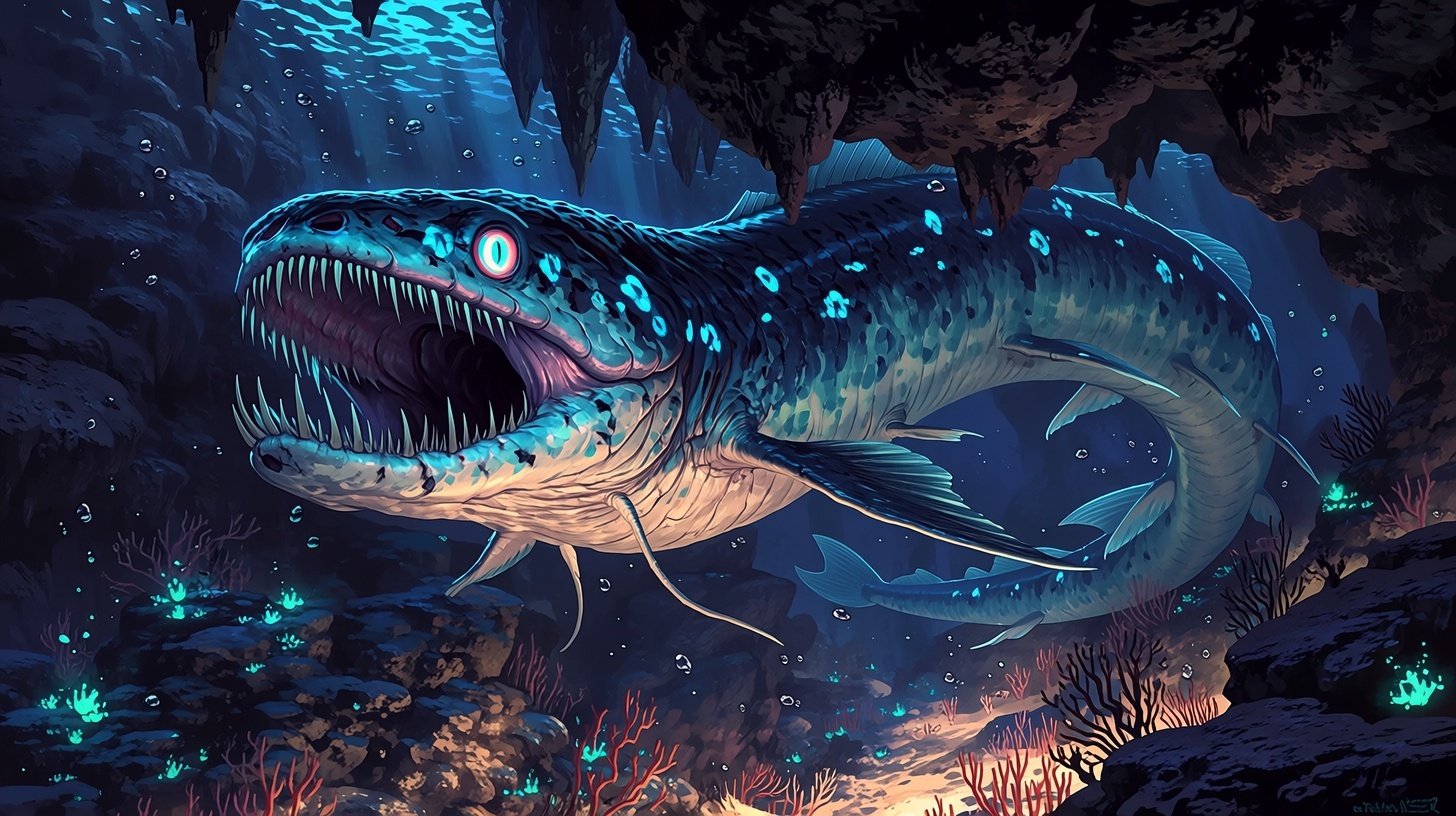
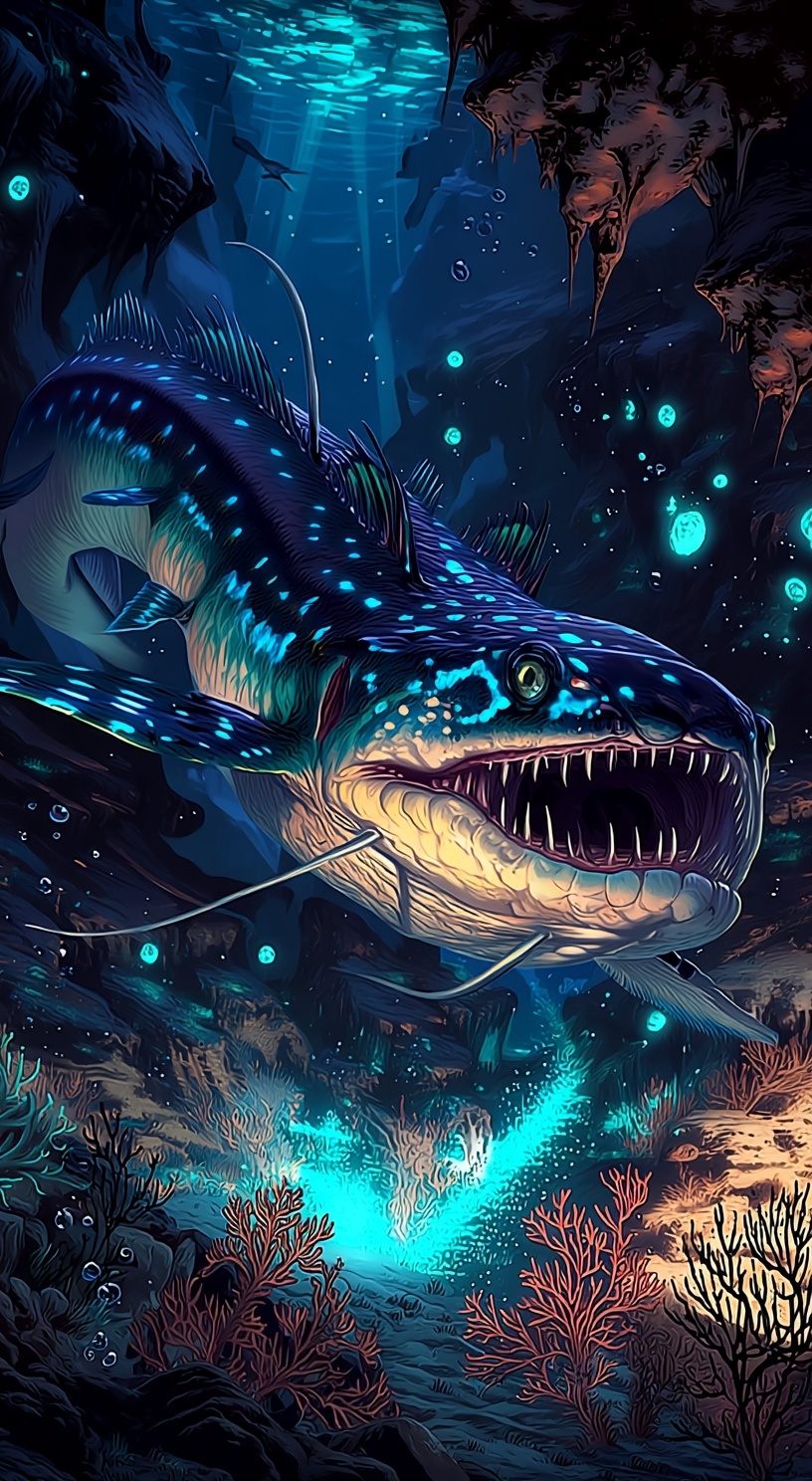
Physically the Coelleca combines features that remind observers of several very different marine animals. Its heavy forward body resembles that of a sperm whale, while its elongated trunk and powerful tail carry the fluid motion of a giant eel. Long sensory barbels extend from its jaw like those of a catfish, constantly testing the surrounding water for signs of life. Along its sides faint bioluminescent markings glow in the darkness, forming dim patterns that drift beneath the waves when the creature moves through deeper waters.
The species is best known for its method of hunting. Unlike many large predators that rely on endurance or pursuit, the Coelleca is an ambush specialist. It drifts quietly through the dark water or settles along underwater ridges until prey approaches. When the moment arrives the creature launches forward with astonishing speed, accelerating in a violent torpedo like strike that overwhelms its target before escape becomes possible.
Despite its immense size the Coelleca spends much of its life in slow patient inactivity. The deep ocean environment rewards conservation of energy rather than constant movement. Long periods may pass between successful hunts, during which the creature drifts in near silence through the abyss. These quiet intervals help explain why confirmed sightings remain extremely rare even in regions where sailors insist the animals are present.
Naturalists believe the species lives for centuries and maintains vast solitary territories across the deeper basins of the Illusion Sea. Encounters between individuals are thought to be uncommon, possibly occurring only during rare breeding cycles. This combination of immense territory and low population density contributes to the creature’s almost mythical reputation among surface dwellers.
To most people the Coelleca exists somewhere between documented species and maritime legend. Scholars studying deep sea ecosystems acknowledge its place among the ocean’s largest predators, yet few have ever observed one directly. For sailors crossing the open waters of the Illusion Sea, the creature represents something older and far larger than the ships that pass above it. A silent hunter moving patiently through a world of darkness beneath the waves.
Basic Information
Anatomy
“Whatever that thing was, it was built for the deep the way a shark is built for the open sea. Every part of it had a purpose and none of those purposes were good for us.”
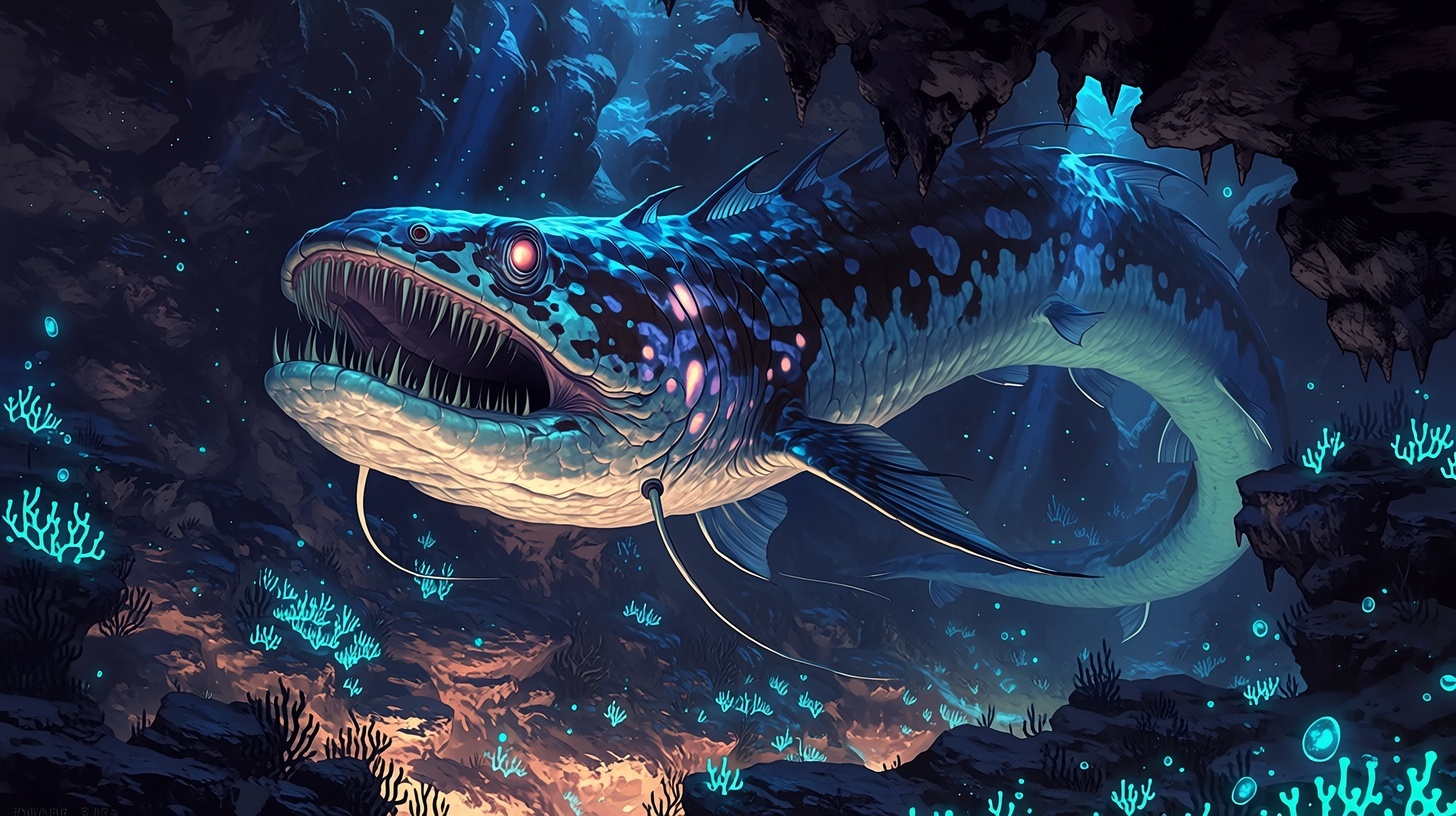
The Coelleca possesses a massive elongated body built for movement through the high pressure depths of the Illusion Sea. At full maturity individuals are believed to reach lengths comparable to the largest ocean leviathans, with a body shape that combines the forward bulk of a sperm whale with the flexible length of a deep sea eel. This structure allows the creature to generate enormous propulsion while maintaining the ability to maneuver through narrow trenches and underwater ridges.
The head is broad and heavily muscled, forming a blunt forward mass that houses the animal’s primary feeding structures. Its skull is reinforced with dense bone and cartilage designed to withstand the violent impacts that occur during high speed ambush strikes. This structure allows the Coelleca to collide with prey while remaining largely unharmed by the force of the impact.
Extending from the front of the jaw are several thick sensory barbels that resemble those of large catfish. These flexible appendages contain dense sensory tissues used to detect chemical signals, electrical impulses, and subtle disturbances in the water. They move constantly when the creature is alert, drifting through the surrounding currents as the animal searches for information about nearby life.
The mouth itself is enormous and capable of opening far wider than its resting shape suggests. Long recurved teeth line the interior of the jaws, angled inward to prevent prey from escaping once captured. These teeth are not built for chewing but for gripping and guiding prey deeper into the throat where powerful muscular contractions complete the swallowing process.
The creature’s body transitions gradually from the broad head into a long muscular trunk. The musculature along the spine is dense and layered, forming a powerful engine capable of generating sudden bursts of speed. These muscles operate in coordinated waves along the body, allowing the Coelleca to propel itself forward with explosive force during hunting strikes.
Running along the length of the body is a thick dorsal ridge that stabilizes the creature during rapid acceleration. Rather than large protruding fins the Coelleca relies on low profile stabilizing structures that minimize drag while maintaining control. This design allows it to move efficiently through the dense waters of the deep sea without sacrificing maneuverability.
The tail section tapers gradually into a powerful propulsion structure that functions similarly to that of large eels and deep sea predators. When the creature launches forward the tail delivers the majority of the thrust, snapping in a powerful motion that sends the animal surging through the water like a launched projectile.
Distributed along the sides of the body are clusters of bioluminescent organs embedded beneath the skin. These lights glow faintly in patterns that can pulse or dim depending on the creature’s activity. In the darkness of the deep sea these organs serve both as communication signals and as a possible lure that attracts curious prey animals.
The skin of the Coelleca is thick and rubbery, designed to withstand the crushing pressures of abyssal depths. Its surface is typically dark in coloration, ranging from deep blue to near black, allowing it to blend almost perfectly into the surrounding water. The skin also carries a thin layer of mucus that reduces friction as the animal moves through the ocean.
Taken together these anatomical features produce a creature perfectly adapted for the role it occupies within the Illusion Sea. The Coelleca is not merely large. It is engineered by evolution for stealth, sudden violence, and survival in one of the most hostile environments on the planet. Every aspect of its body reflects the demands of life in the deep ocean where strength, patience, and sensory awareness determine whether a predator survives.
Biological Traits
The biological traits of a species define variations between life span, life expectancy, height, weight averages and other traits that manifest to a groups or subgroups of the species like gender or role.
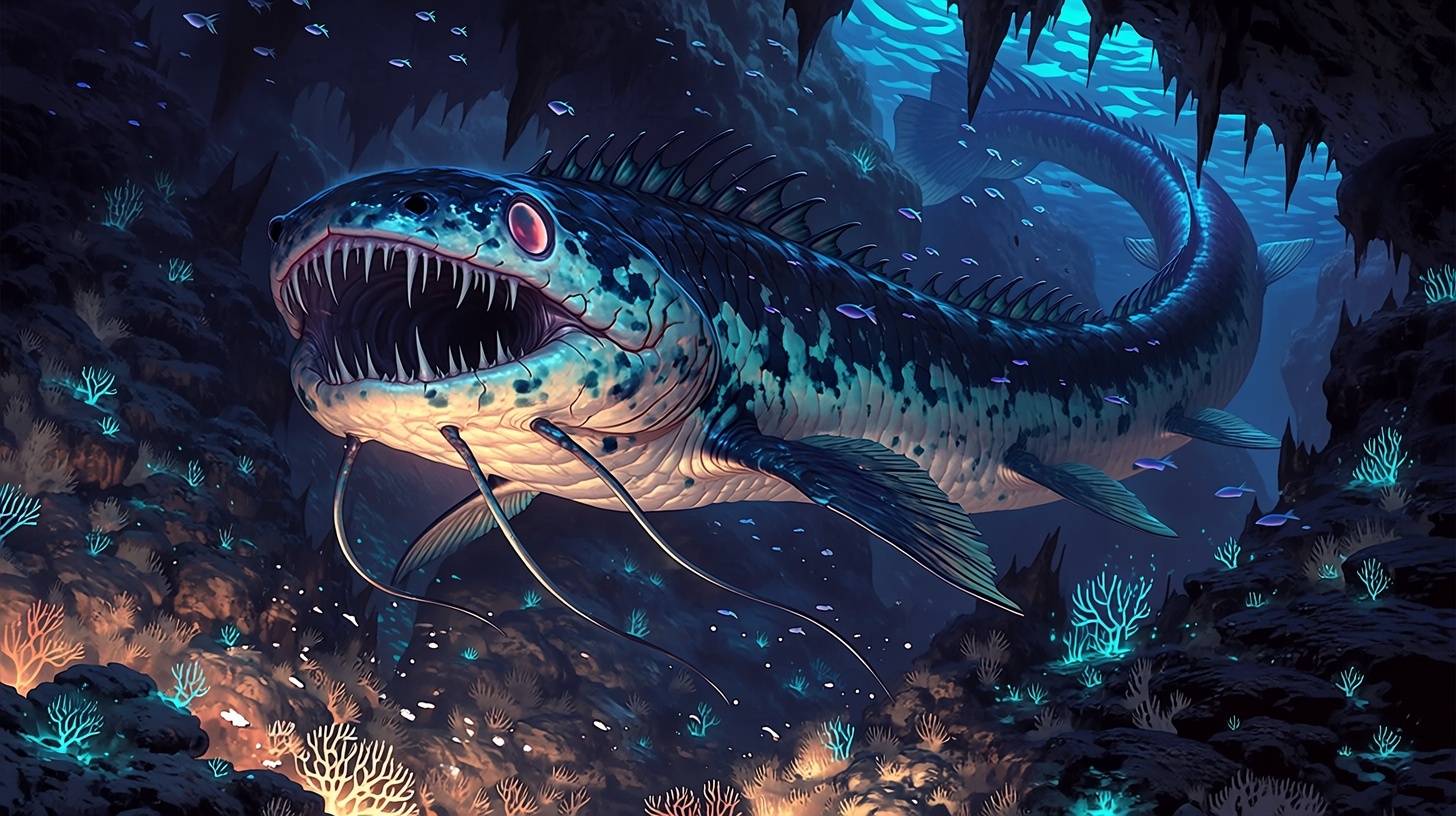
The Coelleca is among the largest predatory species known to inhabit the Illusion Sea. Mature individuals are believed to reach lengths between sixty and ninety feet, though some sailors insist the oldest specimens may grow even larger. Because most encounters occur in darkness or deep water, exact measurements remain uncertain. Even conservative estimates place the species firmly among the great leviathans of Aerith’s oceans.
Weight varies significantly depending on age and feeding conditions, but adult Coelleca are thought to exceed one hundred tons in mass. Much of this weight comes from dense musculature required for the creature’s explosive hunting strikes. The majority of that muscle mass is concentrated along the spinal column and tail, where it generates the powerful bursts of speed that define the animal’s ambush behavior.
The life span of the species is believed to be extremely long. Many naturalists suspect that a healthy Coelleca may live for several centuries, similar to certain deep sea whales and other abyssal leviathans. Evidence supporting this theory comes from scar patterns and growth ridges observed on rare carcasses or skeletal remains recovered from the deep sea floor.
Growth in the species appears to be slow and gradual. Juveniles likely spend many years in deeper and safer waters where they avoid competition with mature predators. During this stage they feed on smaller fish, squid, and other mid sized marine life while slowly developing the massive musculature that defines adult specimens.
Sexual dimorphism within the species is not well documented due to the rarity of confirmed observations. However some scholars believe that females may grow slightly larger than males, a trait common among many deep sea predators. This size advantage could allow females to produce and carry larger clutches of offspring during breeding cycles.
The species likely produces relatively few offspring during each reproductive cycle. Deep sea animals often rely on low birth rates combined with extremely long life spans. This strategy allows populations to remain stable even when encounters between adults are rare across the vast territories they occupy.
Individual Coelleca display subtle physical variations depending on their region of the Illusion Sea. Specimens believed to inhabit deeper basins often exhibit darker skin coloration and more pronounced bioluminescent markings. These adaptations may help them blend more effectively into darker waters while communicating with others of their species.
Other variations appear in the length and sensitivity of the sensory barbels along the jaw. Some individuals develop longer and more elaborate whiskers, possibly reflecting differences in hunting environments where vibration detection becomes more important than sight.
The physical condition of a Coelleca also reflects its feeding success over time. Well fed individuals develop thick muscle layers and a broad forward body mass, while older or injured specimens may appear leaner and slower. Scar patterns from territorial encounters or failed hunts often remain visible across the creature’s thick skin.
Despite these variations the overall biological structure of the species remains remarkably consistent. The Coelleca is built for the same purpose across its entire range. Massive size, extreme longevity, and explosive hunting power define its role as one of the dominant predators of the deep tropical waters of the Illusion Sea.
Ecology and Habitats
“The Illusion Sea looks empty if you stare at the surface long enough. That is the trick of deep water. Everything important is happening somewhere you cannot see.”
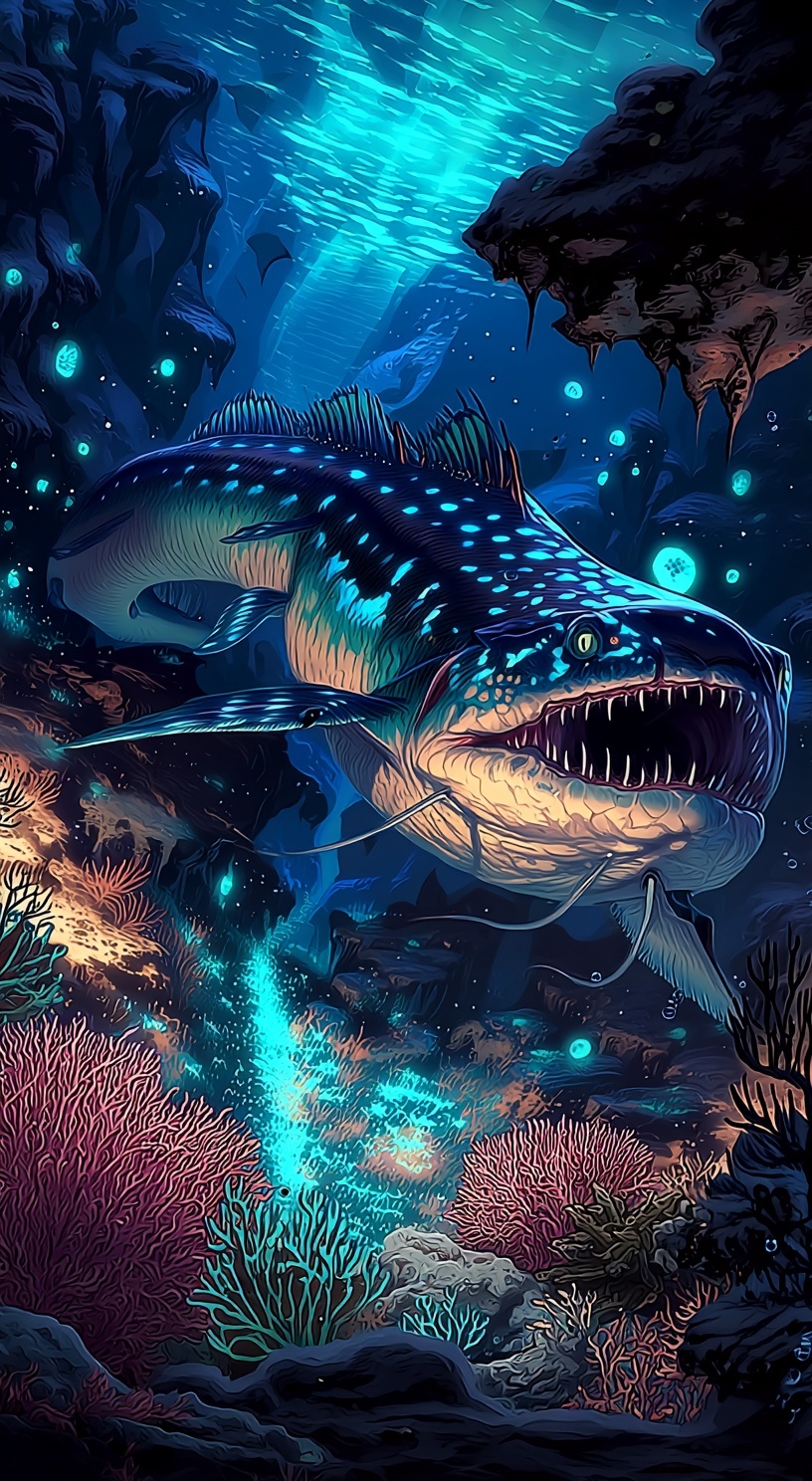
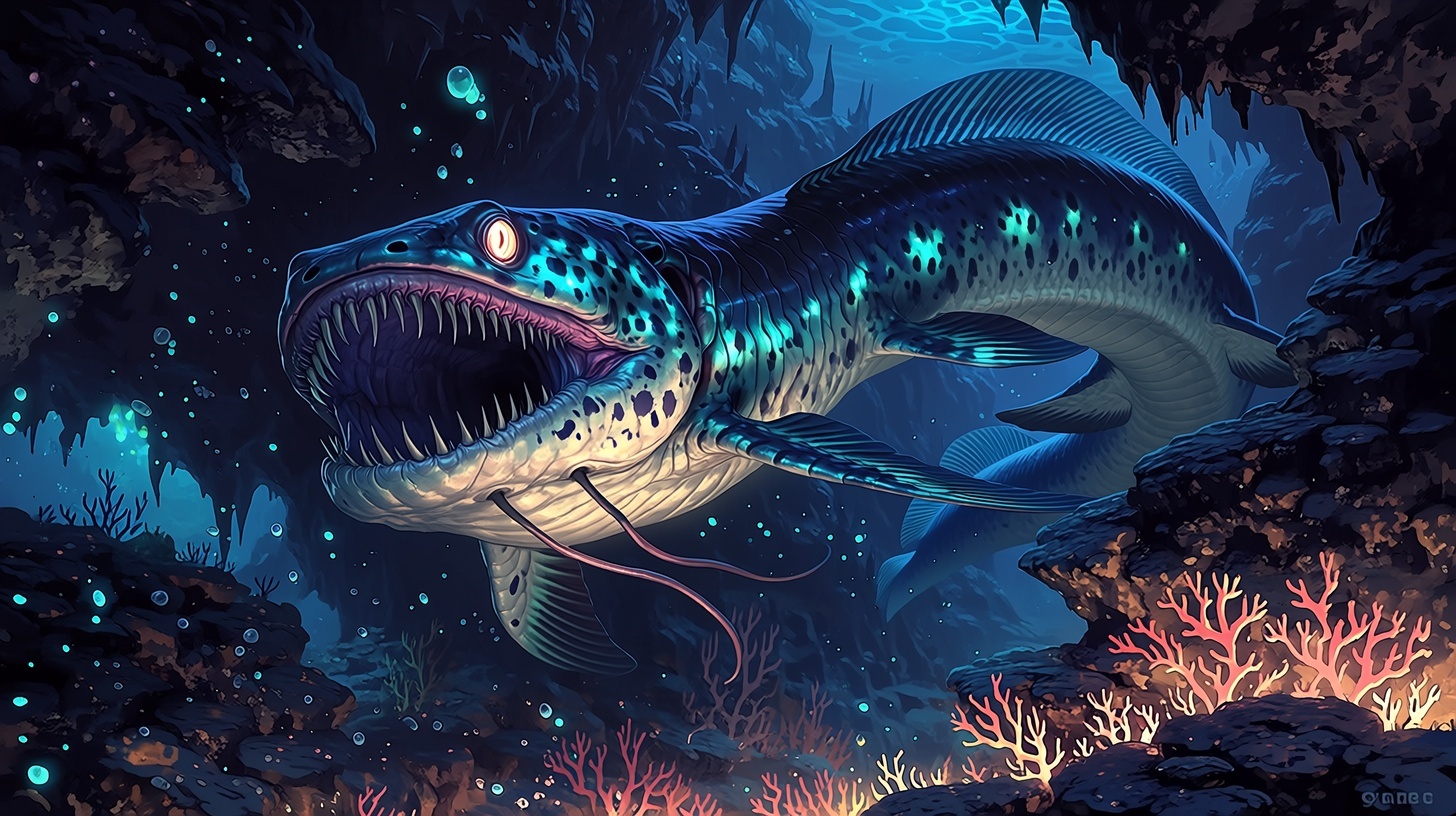
The Coelleca inhabits the deep tropical regions of the Illusion Sea, favoring abyssal basins where the seafloor drops sharply beyond the reach of ordinary sunlight. These regions form a vast and largely unseen ecosystem where temperature, pressure, and darkness shape the behavior of nearly every living thing. The Coelleca exists near the top of this environment’s food chain, occupying a role similar to that of the largest predators in other oceans.
Most individuals spend the majority of their time far below the sunlit layers of the sea. In these depths the water grows colder and quieter, and large predators rely more on vibration and electrical signals than sight. The Coelleca’s whiskered sensory structures allow it to navigate this darkness effectively, detecting subtle movements in the water and locating prey across surprising distances.
The creature’s preferred hunting grounds tend to form along the steep continental slopes and underwater ridges that break the otherwise open seafloor. These geological formations concentrate marine life as currents push nutrients upward from deeper layers. Schools of fish, migrating squid, and large filter feeding animals gather in these zones, creating ideal feeding opportunities for a patient ambush predator.
Although the Coelleca is primarily associated with the abyssal depths, it occasionally moves into higher waters during feeding periods. These ascents are often linked to seasonal migrations of prey species that travel through the Illusion Sea’s warmer tropical currents. When such movements occur the predator follows them upward, sometimes bringing it close enough to the surface that sailors report strange disturbances in the water below their vessels.
The bioluminescent organs along the creature’s body play an important ecological role in these deeper environments. In a world where sunlight disappears quickly, faint light signals become a common form of communication and deception. The Coelleca’s slow drifting glow may attract smaller animals or confuse prey that mistake the lights for harmless organisms moving through the darkness.
Despite its enormous size, the Coelleca does not appear to be especially numerous. Most naturalists believe the population of these leviathans is extremely small, with each individual occupying a vast hunting territory within the deeper regions of the sea. The scarcity of sightings supports this theory, as decades may pass between reliable encounters.
The presence of a Coelleca can influence the behavior of other marine species across large areas of ocean. Large fish schools have been observed shifting migration routes after one of these predators appears in a region. Even powerful sea creatures known to inhabit the Illusion Sea are believed to avoid waters where a Coelleca is actively hunting.
For this reason sailors sometimes describe the Coelleca not merely as a predator but as a force that quietly reshapes the ecology of the deep sea around it. Wherever one chooses to hunt, the balance of the surrounding waters adjusts in response. Prey species scatter, migratory paths bend, and the vast dark ecosystems of the Illusion Sea shift subtly around the presence of one enormous hunter.
Dietary Needs and Habits
“You do not see it eat. Never. The sea simply erupts once, the way a storm erupts, and afterward there is less life in the water than there was a moment before.”
The Coelleca feeds as a deep sea apex predator, relying on sudden violence rather than prolonged pursuit. Its diet consists primarily of large marine life that inhabits the deeper tropical regions of the Illusion Sea. Massive squid, migrating schools of pelagic fish, deep water sharks, and even smaller sea leviathans are believed to form the bulk of its prey. Creatures that occupy the same abyssal hunting layers often disappear entirely from an area after a Coelleca begins feeding there.
The animal’s hunting method reflects the environment it inhabits. Rather than roaming constantly in search of food, the Coelleca drifts slowly through the water column or settles in darkness along underwater ridges and trenches where marine life naturally gathers. In these locations it waits with extraordinary patience, conserving energy while its sensory organs monitor the movements of nearby animals.
Once prey enters range the creature’s behavior changes instantly. The Coelleca launches forward with explosive speed, accelerating through the water with a violent torpedo like burst. This attack is designed to intercept prey rather than chase it. By striking from below or from the side it cuts off escape routes and forces its target into a direct collision with its jaws.
The mouth of the Coelleca is built for engulfing prey whole. Its long teeth are designed to grip and guide rather than tear, preventing struggling animals from escaping once the attack connects. Large prey animals are swallowed in a single violent motion, while smaller creatures are drawn inward by the rush of water created during the strike.
Bioluminescent organs along the creature’s body may also contribute to its feeding strategy. Some naturalists believe the faint drifting lights serve as a lure in the darkness of the deep sea. Curious fish and squid drawn toward the gentle glow can unknowingly drift within the predator’s striking range before realizing the danger.
The Coelleca does not feed frequently. The immense size of its prey means that a successful hunt can sustain the animal for extended periods. After a major feeding event the creature often descends back into deeper waters where it drifts slowly and conserves energy while digesting.
There is no evidence that the Coelleca stores food or returns to carcasses once a feeding strike is complete. Its strategy relies entirely on ambush and overwhelming force rather than resource protection. The creature consumes what it captures immediately and then vanishes back into the depths where it resumes its patient watch over the dark water.
For the ecosystems of the Illusion Sea this feeding behavior creates sudden disruptions in the balance of marine life. Entire schools of fish may scatter or migrate after one of these predators begins hunting nearby. Even large sea creatures alter their routes to avoid the territories where a Coelleca is known to feed, leaving stretches of water strangely quiet long after the predator has passed through.
Biological Cycle
“Out there the sea has seasons the surface never sees. Things rise, things sink, and once in a great while something ancient comes up with them.”
The biological cycle of the Coelleca is shaped almost entirely by the deep ocean environment it inhabits. Unlike coastal creatures that experience dramatic seasonal changes in temperature and light, the abyssal waters of the Illusion Sea remain comparatively stable throughout the year. As a result the Coelleca does not rely on strict seasonal migrations in the same way many surface dwelling marine animals do. Instead its biological rhythms are tied more closely to the movements of prey and the shifting currents that carry nutrients through the deep sea.
For much of the year the creature remains in the lower water columns of the tropical basins where pressure is immense and light is nonexistent. During these long periods its activity is relatively subdued. The Coelleca drifts slowly through the depths or settles along deep trench systems where it can conserve energy while waiting for favorable hunting opportunities. This behavior functions almost like a state of extended dormancy rather than true hibernation.
At certain times of the year massive migrations of fish, squid, and other marine animals move through the deeper regions of the Illusion Sea. These migrations are driven by seasonal currents and shifts in nutrient distribution across the ocean. The Coelleca appears to respond strongly to these events, gradually rising through the water column to intercept the concentrations of prey that form during these cycles.
These ascents bring the creature closer to the upper layers of the sea than it would normally travel. Sailors who report strange disturbances in the water or dim drifting lights beneath their vessels may be witnessing one of these seasonal hunting periods. Although the animal rarely reaches the surface, its presence can be detected by the sudden disappearance of fish schools and the unusual agitation of marine life.
Reproductive behavior among Coelleca remains poorly documented due to the rarity of encounters. Most scholars believe that breeding occurs deep within the abyssal regions where the species normally resides. Encounters between adults are thought to be infrequent, suggesting that reproduction may occur only after long intervals when individuals cross paths within overlapping territories.
Some theories propose that the faint bioluminescent patterns along the creature’s body may play a role during these reproductive periods. Changes in the intensity or rhythm of these lights could serve as signals used to identify other members of the species in the vast darkness of the deep ocean. If true, these displays would be among the few moments when Coelleca actively seek out one another rather than avoiding contact.
Young Coelleca, if they survive their earliest stages of life, likely spend their first years in deeper and safer waters where competition with adult predators is limited. In these environments they can grow gradually while feeding on smaller marine life before reaching the massive size associated with mature individuals.
Over the course of its life the Coelleca follows a cycle defined less by seasons than by opportunity. Periods of deep water dormancy are broken by bursts of activity when prey migrations bring life within reach. Between these events the creature returns to the silent depths of the Illusion Sea where time passes slowly and the rhythms of the abyss continue largely unseen by the world above.
Behaviour
“Nothing that big should move that fast. One moment the water was calm. The next moment the sea came straight at us like a thrown spear.”
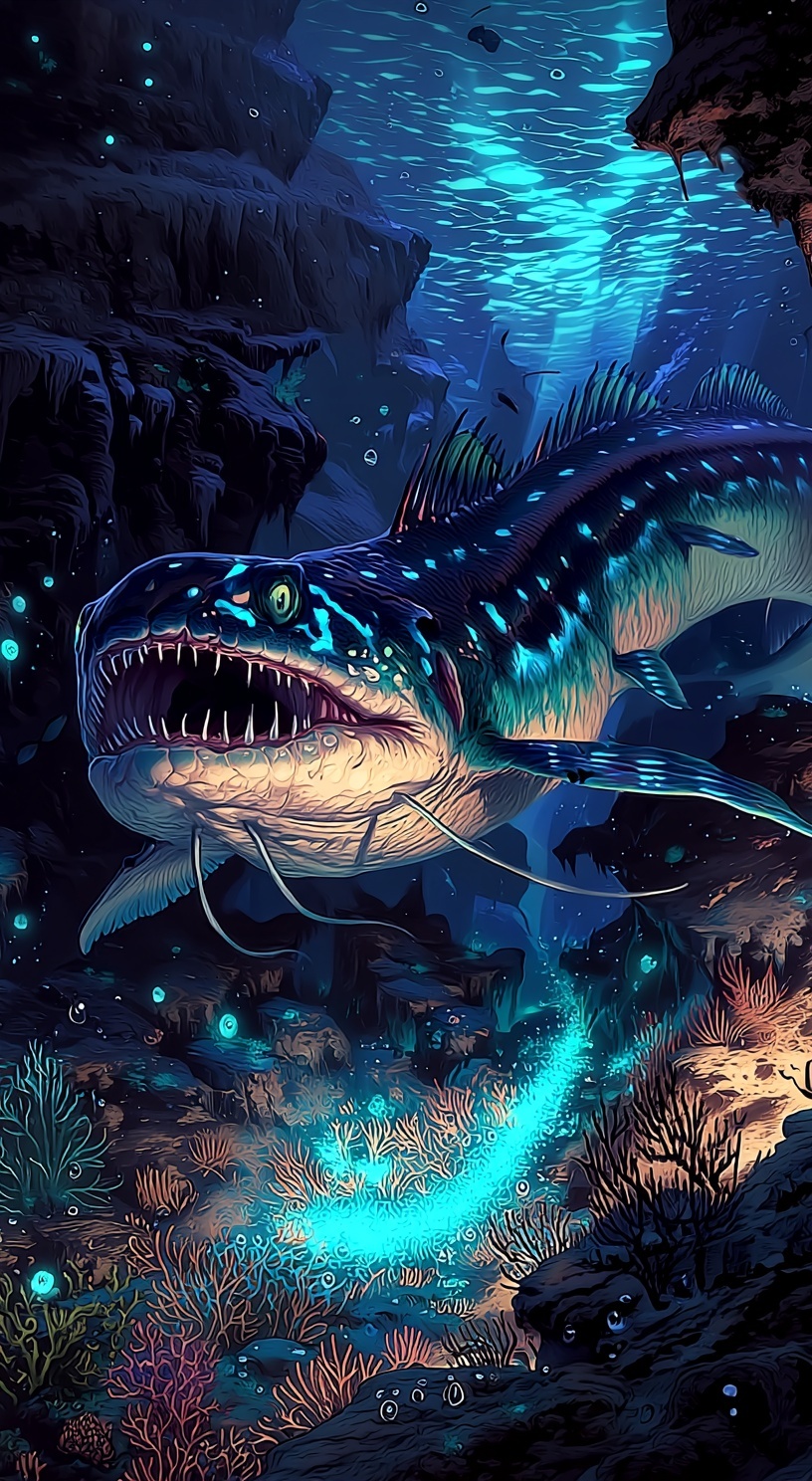
The Coelleca spends most of its life in the deep tropical basins of the Illusion Sea where light rarely penetrates and movement is governed more by pressure and current than by sight. In this environment patience is more valuable than speed. The creature drifts slowly through the water column or settles into deep trenches where it can remain nearly motionless for long periods. Its immense mass and dark coloration allow it to blend with the surrounding black water so effectively that other marine life often passes nearby without recognizing the danger.
Despite its size the Coelleca is not a constant roving hunter. It behaves as a calculated ambush predator that conserves energy between feeding opportunities. Long stretches of inactivity are common. During these periods it relies on a network of sensory organs and whiskered barbels along the jaw to detect vibrations, electrical impulses, and subtle shifts in current created by passing animals. These senses allow it to track prey even in total darkness.
When suitable prey approaches the creature’s demeanor changes instantly. What appears to be a sluggish leviathan becomes a sudden projectile of muscle and momentum. The Coelleca is capable of explosive acceleration that contrasts sharply with its otherwise slow movements. Its body straightens and the powerful tail drives forward with a force similar to a massive barracuda or predatory eel. In these moments the creature behaves less like a drifting giant and more like a torpedo launched from the depths.
This burst of speed is usually brief but devastatingly effective. The Coelleca closes the distance before prey can react, striking with a forward ramming motion that intercepts rather than chases its target. Large fish, squid, or marine mammals caught in the path of this charge are overwhelmed by the sheer mass of the creature and drawn directly toward its jaws. The attack is designed to end quickly rather than develop into a prolonged pursuit.
Because of the energy required for these explosive attacks, the Coelleca rarely attempts them without a clear advantage. It prefers to strike from below or from behind where prey animals are least likely to detect its approach. The creature’s bioluminescent organs may also play a role in this strategy. Some scholars believe the faint drifting lights attract curious animals closer to the predator’s waiting position before the attack begins.
The psychological behavior of the Coelleca reflects a creature adapted to isolation rather than social interaction. There is no evidence that they hunt cooperatively or form long term groups. Most sightings suggest solitary individuals occupying large territories within the deep sea. Encounters between two adults are believed to be rare and may only occur during breeding cycles that remain poorly understood.
For sailors and naturalists alike the Coelleca represents the kind of predator that defines the upper limits of deep ocean life. It is neither reckless nor aggressive without reason. Instead it embodies a cold efficiency shaped by an environment where energy is precious and mistakes can mean starvation. The creature waits, senses the right moment, and then strikes with terrifying speed before vanishing once more into the silent depths.
Additional Information
Perception and Sensory Capabilities
“They say the deep sea is blind. That's not true. It simply watches in ways we don't understand.” — Tanya Dor, Captain of the Star Runner
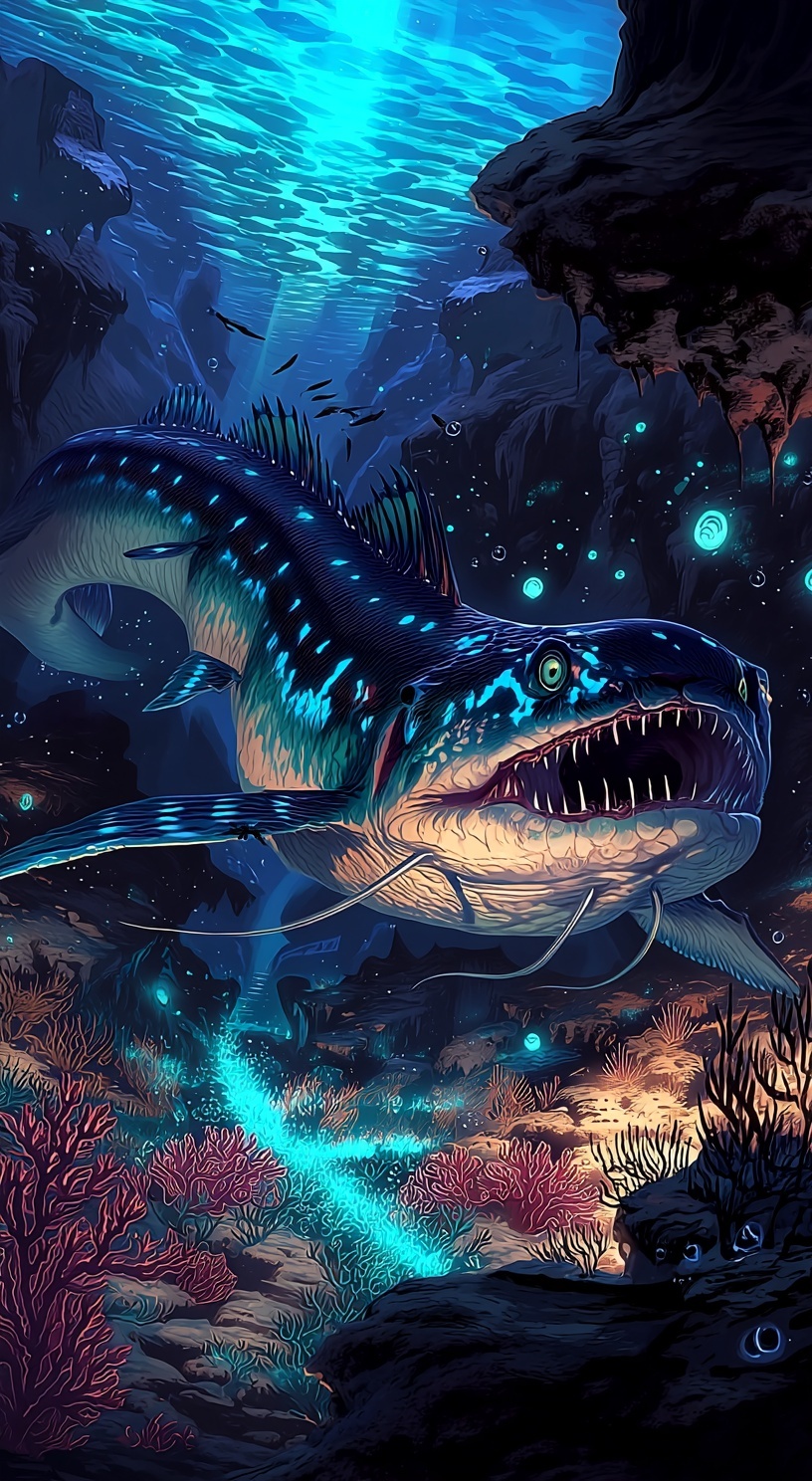
The Coelleca survives in an environment where ordinary vision is of limited use. In the abyssal depths of the Illusion Sea sunlight fades long before reaching the seafloor, leaving most of the water column in near total darkness. As a result the creature’s sensory system is adapted less for sight and more for detecting subtle disturbances in its surroundings. Movement, vibration, and electrical signals in the water provide far more reliable information than light.
The long whiskered barbels that extend from the creature’s jaw serve as one of its primary sensory tools. These structures function similarly to those of deep water catfish, containing dense networks of receptors capable of detecting chemical traces and minute water movement. Even small disturbances created by swimming prey can be identified at surprising distances through these sensitive organs.
In addition to these barbels the Coelleca appears to possess a highly developed lateral sensory system running along the length of its body. This structure allows it to detect pressure waves and shifts in current produced by nearby animals. In deep water where sound and vibration travel efficiently, this sense allows the predator to track prey without needing direct line of sight.
Hearing also plays an important role in the creature’s perception of its environment. The dense tissues of the Coelleca’s skull are believed to conduct low frequency vibrations exceptionally well. These vibrations may allow the animal to detect distant movements such as migrating schools of fish or the struggles of wounded prey far beyond visual range.
Although its eyes are relatively small compared to the rest of its body, they are adapted for the limited light that does exist in the deeper ocean layers. The eyes are capable of detecting faint glimmers of bioluminescence produced by other deep sea creatures. This allows the Coelleca to notice the presence of prey animals that rely on glowing organs for communication or camouflage.
The creature’s own bioluminescent markings may also function as part of its sensory system. By producing controlled pulses of light it may be able to observe how nearby organisms react, revealing the position of animals that would otherwise remain hidden in darkness. Such interactions between light and behavior can provide valuable information in environments where visibility is extremely limited.
Some sailors and deep sea explorers claim that the presence of a Coelleca creates an unsettling awareness in the surrounding waters, as though the animal senses movement before it becomes visible. While there is no confirmed evidence of supernatural perception, the extraordinary sensitivity of its biological sensors can easily give the impression that the creature anticipates actions before they occur.
Taken together these sensory adaptations make the Coelleca extremely effective within the dark ecosystems of the Illusion Sea. It does not rely on a single dominant sense but instead combines vibration detection, chemical sensing, low frequency hearing, and limited visual awareness to form a detailed understanding of its surroundings. In the darkness of the deep ocean this network of perception allows the creature to hunt with deadly precision even when no light remains at all.
“Most sailors fear storms, reefs, or pirates. The wise ones fear the quiet water that suddenly isn’t quiet anymore.”





God, I love a giant fish.
There's always a bigger fish ;)