


Dusk Stalker
Sunset Bloodlust
"I never saw the creature. Just the eyes. Every time I looked away, they were somewhere else, a little closer than before. By dawn I was standing in the middle of the road with my back to a tree, because I'd become afraid to blink."
Few monsters inspire as much disagreement as the Dusk Stalker.
Ask a dozen travelers about the creature, and several will dismiss it as little more than a campfire tale invented to frighten children away from wandering after sunset. Others will insist they have seen its unmistakable crimson eyes watching from the edge of the trees, only for the creature to vanish the instant they looked directly at it. Rangers argue over whether it is a beast, a fey predator, or something stranger still, while natural philosophers quietly admit that almost everything known about the Dusk Stalker comes from people who survived encounters with it.
That, perhaps, is the creature's defining characteristic.
Most witnesses survive.
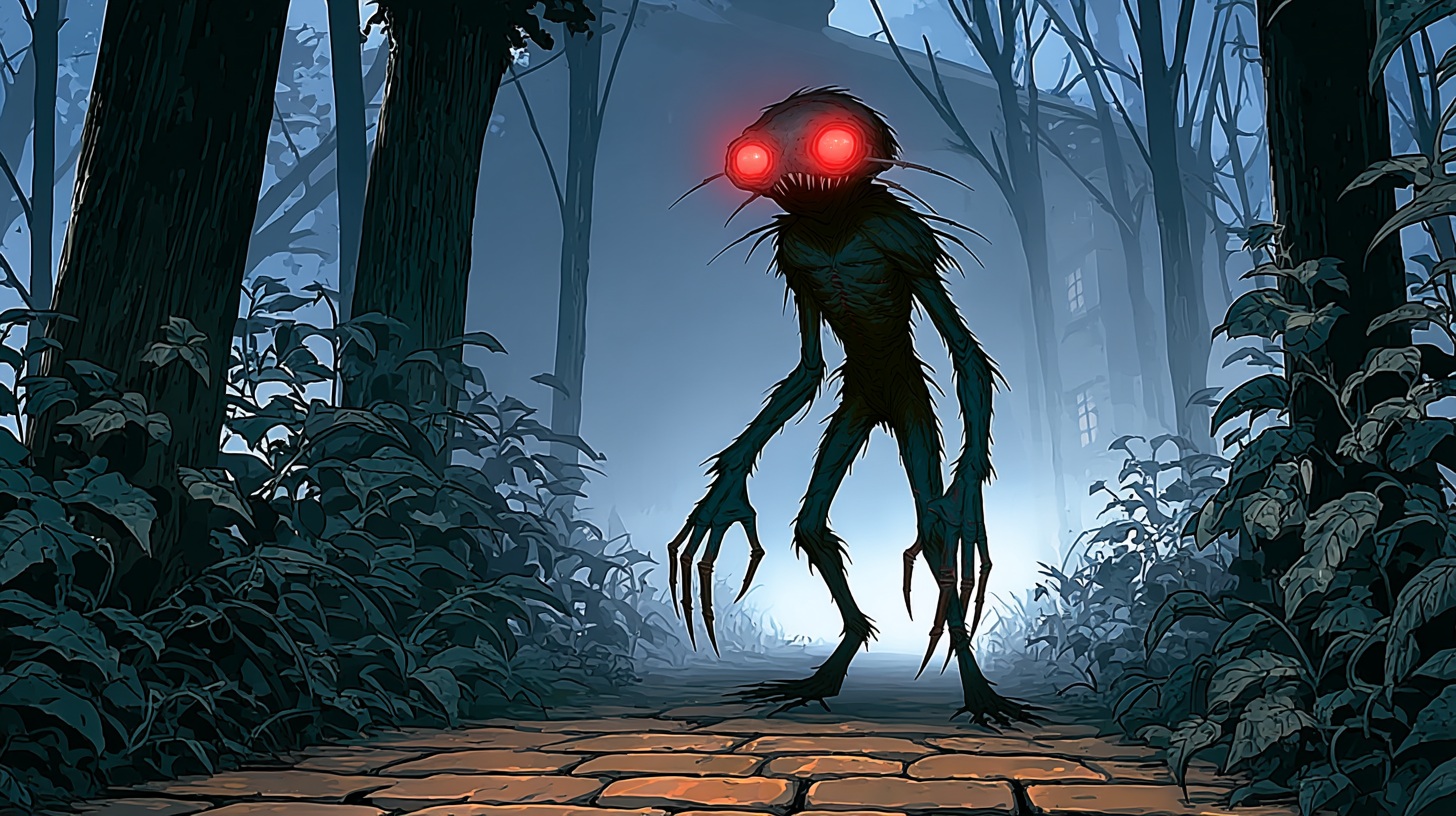
The Dusk Stalker is not driven by hunger alone. It is a patient predator that appears to derive as much satisfaction from stalking prey as from killing it. It rarely charges from concealment or launches sudden ambushes. Instead, it allows its victims to notice it. A pair of enormous crimson eyes watches from beneath distant branches. When someone points them out, they disappear. Minutes later they return from another direction. Hours may pass with nothing more than fleeting glimpses, each one convincing the travelers that they are being observed by something intelligent enough to remain unseen.
The uncertainty is deliberate.
Victims begin questioning one another. Did anyone else see the eyes? Were they higher in the trees than before? Could anything have moved that quickly? By the time the creature finally strikes, exhaustion and apprehension have already done much of its work.
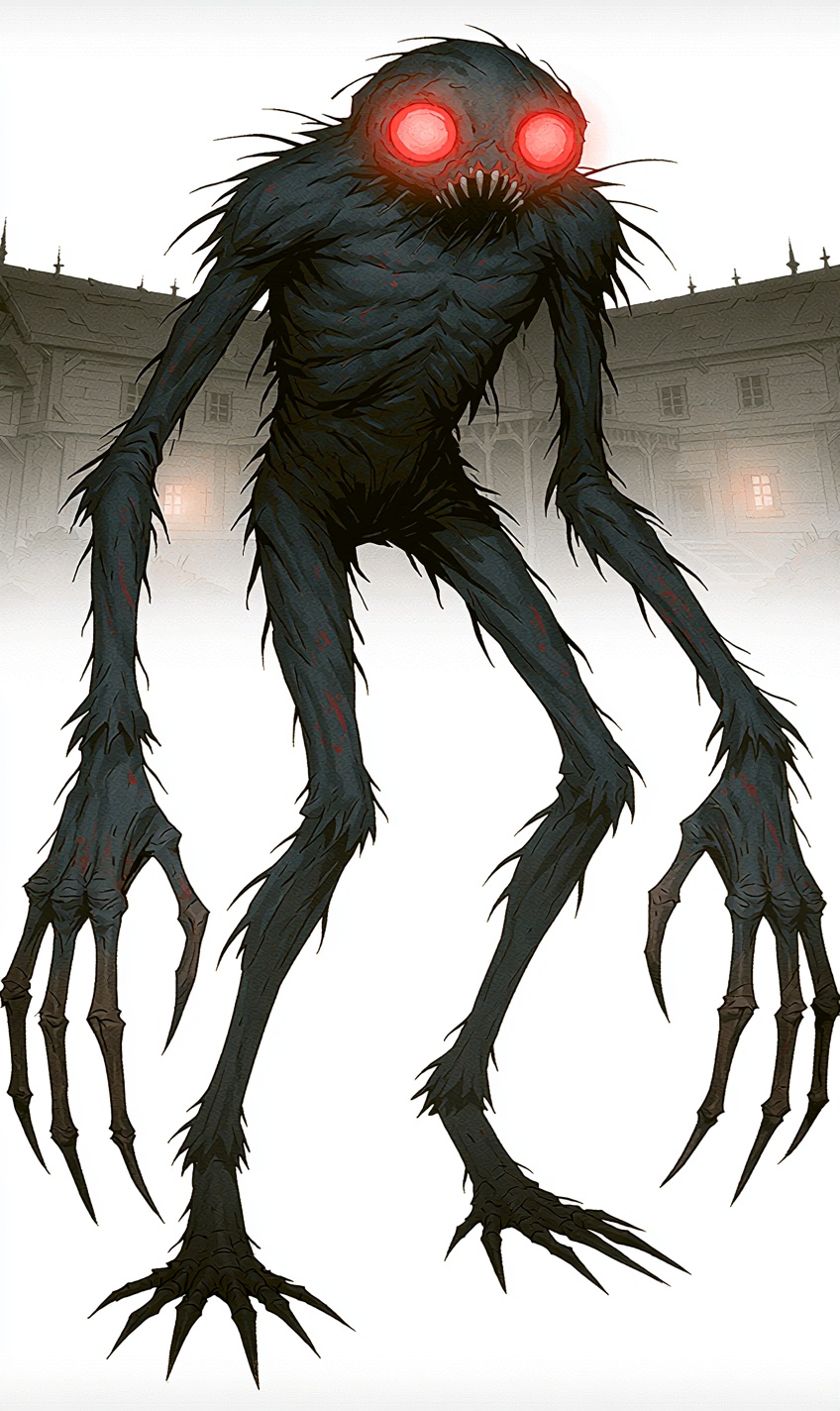
The Dusk Stalker's appearance only deepens this unease. Standing taller than most people, it possesses a painfully thin frame covered in sparse black fur that hangs in uneven patches from elongated limbs. Its hands end in needle-like claws capable of reaching prey farther away than their length should permit. Yet few observers remember those details clearly. Almost every account begins with the same description.
The eyes.
They dominate the creature's face so completely that everything else seems secondary. Enormous, luminous, and an unnaturally vivid crimson, they seem almost detached from the body surrounding them. Travelers often report noticing the eyes long before realizing there is anything behind them at all. Some even claim the eyes appear brighter when viewed indirectly, fading slightly whenever looked at directly, though no reliable explanation has ever been offered.
These unsettling features have given rise to numerous superstitions. Some villages insist that making eye contact with the creature ensures it will follow you home. Others teach children never to point toward mysterious lights in the woods after sunset, believing the gesture attracts the Stalker's attention. A few frontier communities deliberately avoid discussing the creature aloud after dark, fearing that speaking of it somehow invites its presence.
Whether any of these customs possess genuine protective value remains unknown.
Unlike many predators, the Dusk Stalker appears strongly associated with places where civilization gradually gives way to wilderness. Forgotten roads, abandoned orchards, neglected graveyards, overgrown estates, and forest paths that receive fewer travelers each passing year are all favored hunting grounds. It seldom ventures into thriving settlements or untouched wilderness, instead haunting the uncertain boundary between the two. Scholars have suggested that this preference reflects something deeper than simple habitat selection, though no theory has gained widespread acceptance.
Equally mysterious is the creature's origin. Despite generations of searching, no hunter has ever produced convincing evidence of nests, eggs, juveniles, or family groups. Every confirmed sighting involves a solitary individual. Some naturalists have reluctantly proposed that Dusk Stalkers do not reproduce in any conventional sense, instead manifesting wherever neglected places remain undisturbed for long enough. Others dismiss this as superstition born from frustration, yet they can offer no better explanation for the complete absence of younger specimens.
Those fortunate enough to observe the creature at length have noted another peculiar behavior. The Dusk Stalker almost never commits fully to a fight unless escape becomes impossible. It withdraws readily when discovered too early, abandoning otherwise favorable attacks without hesitation. Days or even weeks later, however, the same crimson eyes may reappear many miles away, patiently resuming the hunt as though no interruption had occurred. This persistence has convinced experienced rangers that once a Dusk Stalker chooses its quarry, distance alone offers little protection.
For this reason, seasoned woodsmen advise responding to the creature differently than most monsters. Chasing it into the trees is rarely successful. Ignoring repeated sightings is equally dangerous. The safest course is often to reach well-lit ground, remain together, and deny the creature the uncertainty upon which it seems to thrive.
Whether that caution truly discourages the Dusk Stalker, or merely convinces people they have escaped, is impossible to know.
After all, nearly every account ends the same way.
The witnesses eventually leave the forest.
The crimson eyes do not follow.
At least... not where anyone can see them.
"If you ask ten villages about the Dusk Stalker, nine will laugh and tell you no such creature exists. The tenth will grow quiet and say only this: 'If you see its eyes... don't look away.'"
Genetic Ancestor(s)
Scientific Name
Noctomimus rubrifacies
Lifespan
Unknown (estimated 30–50 years)
Average Height
7 - 8 ft.
Average Weight
200-300 lb.
Geographic Distribution



I love that they stalk the boundary. This is true to the way we really often encounter creatures. I also loved the way its behavior was different than what was expected. There being a lack of clarity is what gives the creature it's most power though. Brilliant.