
The Chained
The Chained of Orichalcum — The Settled Ruins
Hell does not force anyone to stay. It does not force anyone to leave either. The ones who came to Orichalcum came because Hell's pressure was the thing they could no longer bear, and mortal entropy, for all its bleakness, does not test.The Ruins of Orichalcum are largely empty; few who visit, even among demons, would dare to stay. Hell's natives found them too sad. There is in Orichalcum the remnants — beings caught in the city when Stambhana froze, suspended in partial dissolution. They are slowly returning toward simpler states without the peace that once made the return bearable; the Mortal Realm entropy that continued, lawfully and without comfort, doing what it always does.
Then the chained came, bearing wrongweight, and Orichalcum acquired, for the first time in its existence, something that could be called inhabitants.
Why Here
The choice is not obvious from the outside. Orichalcum is the saddest place at Hell's border — dissolution without acceptance, entropy without grace. It is the ruins of a synthesis that asked whether mortality could learn to rest and received, in place of an answer, a frozen silence. Hell's natives have always found it unbearable. The chained chose it anyway, and their reasoning, reconstructed from what few accounts exist, runs something like this:
Hell's testing-substrate is constant and total. It applies pressure to everything within it continuously, demanding that what is present either hold or fail honestly. For a being carrying the cold chain-scarring that represents someone else's untested failures, Hell's pressure tests them against a burden they did not generate and cannot honestly claim.
Mortal entropy does not test. It simply, patiently, gradually undoes. It does not demand that anything hold. It does not apply pressure in Hell's sense at all. For someone exhausted by being tested against the wrong weight, the slow, cold, graceless dissolution of Orichalcum is not comfortable. But, it is a different kind of uncomfortable, one that does not actively compound the condition. The pressure drops. The chains do not add links as quickly. The cold scarring settles rather than spreads.
It is not peace. Stambhana is frozen and the peace it offered is gone. But it is the closest thing to rest that Hell's geography currently offers someone who has chosen the chains over the Lake, and the chained found it before anyone thought to recommend it to them.
The Community
What they have built is not a city. They are not attempting to succeed where Orichalcum failed; the irony of the chained trying to found a new synthesis-settlement in a place that failed to hold one is not lost on them. What exists instead is a loose, self-organizing settlement — structures repaired against mortal entropy as needed, maintained by consensus and necessity rather than by elders or formal governance, organized around the shared knowledge of what the condition requires and what it prohibits.
The Remnants
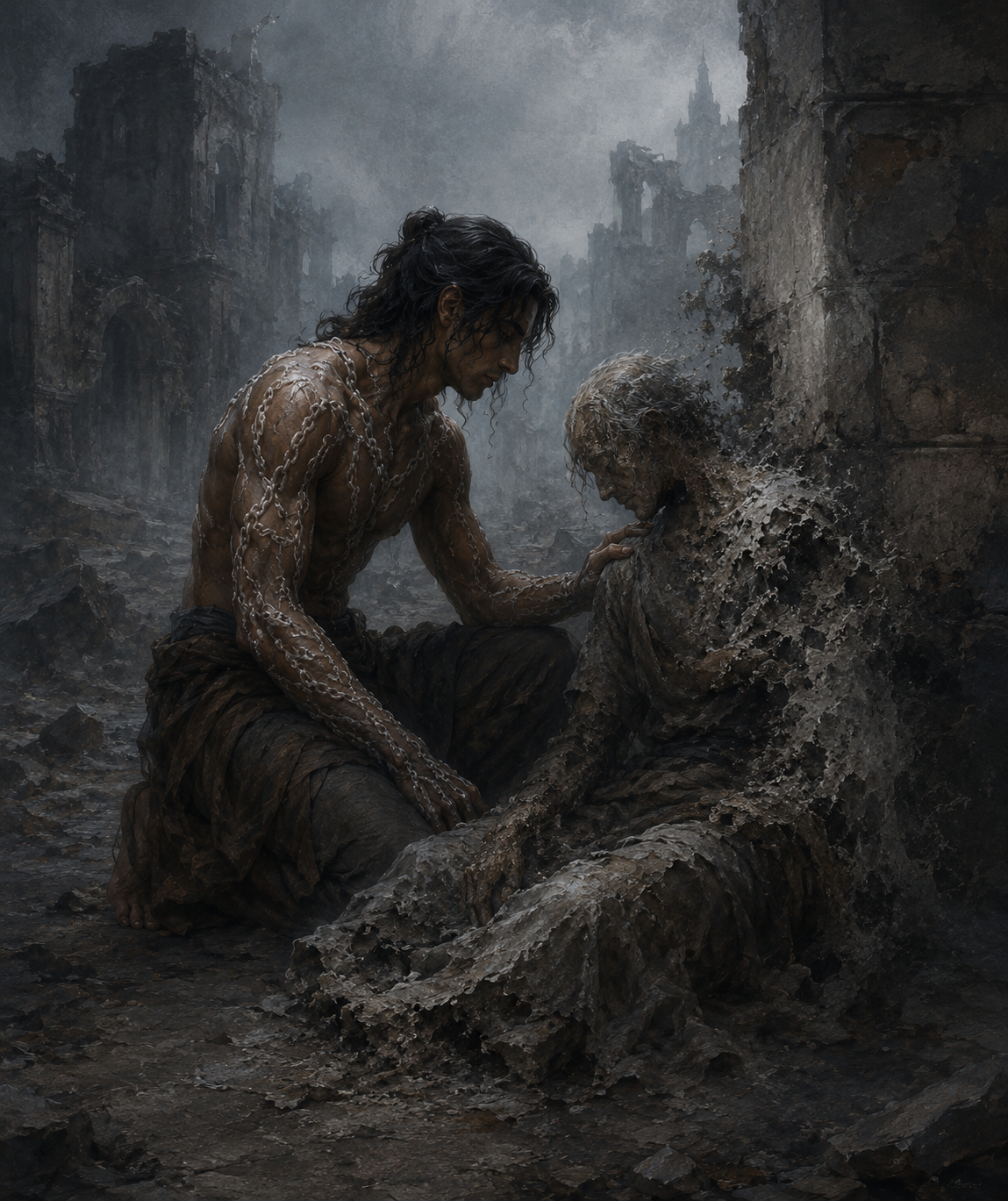
The community shares Orichalcum with the remnants — the beings suspended in partial dissolution since Stambhana froze, neither complete nor gone, slowly returning toward simpler states without the peace that once gave the process grace. They do not move. They do not speak. They are simply present, distributed through the ruins, in various stages of becoming less.
The chained have developed, over time, a relationship with the remnants that is difficult to describe to anyone who hasn't witnessed it. They do not treat them as furniture or ignore them as background. They tend to them; a carrier sitting beside a remnant for an hour. A hand placed briefly on a half-dissolved shoulder. Nothing that risks transmission; the remnants generate no active dross, they are too far into dissolution for that. Simply the acknowledgment that something is here, and that being here with it is a choice someone is making.
The Aging Question
The mortal entropy that defines Orichalcum does not exempt its inhabitants from its operation. Carriers who settle here age. Perhaps not at the mortal pace, which would dissolve most of them within a century, but visibly, across the long centuries of their residence, they age. The community's oldest residents show it plainly: the slow weathering of features that Hell proper preserves, the particular quality of a face that has been subject to mortal entropy long enough for it to matter.
Some residents regard it as the final proof that their choice was right; that they have traded Hell's testing for something gentler, and that is simply what their choice means over time. Others find it harder, particularly those who have been here long enough to see the aging clearly in each other and in themselves. The question of whether to stay, knowing what staying eventually does, is one the community revisits individually and never answers collectively, because it is not a question that has a collective answer.
Further Reading
For the condition that defines the community, see Wrongweight. For the Ruins and their history, see Ruins of the Two. For the treatment the community has chosen not to pursue, see Lake of Fire. For the Realm whose frozen contribution defines Orichalcum's character, see Stambhana. For the testing-substrate whose pressure the community trades for mortal entropy, see Hell.
They came because the pressure was wrong for what they were carrying. They stayed because the alternative was worse. Hell keeps no monument to this. It simply notes that they are there, and that the chains grow more slowly, and that they tend the remnants in the mornings.

I love your hellish city too!
Your freind,
The Graiffe